
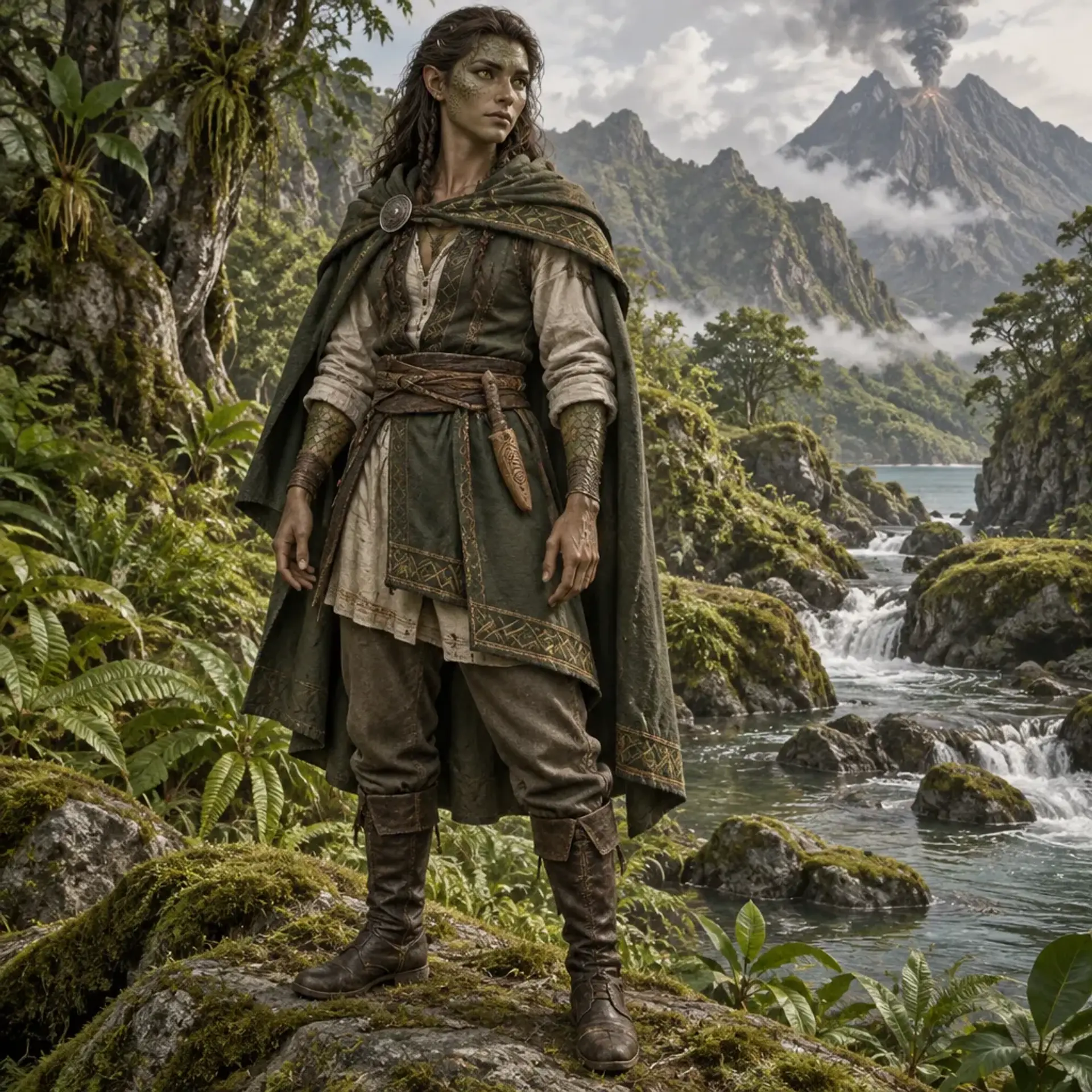
Halflingus virid sanguinis
Shipwrecked halflings found refuge on an island that seemed almost made for them, until ash, dragons, and a desperate bargain changed their blood.
At a glance
Darkvision 60 ft.
Languages Common, Halfling
Resistances Poison
Height Low-Blood: 3 to 4 ft.; High-Blood: 4 to 6 ft., with considerable variation
Weight Low-Blood: 35 to 55 lb.; High-Blood: 70 to 180 lb., varying with stature and build
Lifespan 70 to 90 years
At the table
You have resistance to poison damage. Your people have endured tainted waters, strange island growths, and the lingering effects of draconic blood, though this resistance does not make every poison harmless.
You can see in dim light within 60 feet of yourself as if it were bright light, and in darkness as if it were dim light. You discern colors in darkness only as shades of gray.
When you take the Attack action on your turn, you can replace one attack with a short exhalation of draconic energy. Choose poison or acid damage when you gain this species. Each creature in a 15-foot cone makes a Dexterity saving throw, with a DC equal to 8 plus your Constitution modifier and proficiency bonus. A creature takes damage of the chosen type on a failed save, or half as much on a success. The damage increases to at character level 5, at level 11, and at level 17. You can use this trait a number of times equal to your proficiency bonus, regaining all expended uses when you finish a long rest.
You can communicate simple ideas through gestures, whistles, and brief phrases with Small or Tiny beasts. This trait does not grant them understanding of complex plans, and the DM determines their response.
Common, Halfling
Poison
These people often prize endurance, perception, and quick hands, but their families differ widely. Choose ability score increases according to your table's 2024 rules; no ability score is fixed by this ancestry.
Usually halfling-sized, with subtle green-gold eyes or faint scales; their communities tend to preserve older family customs.
The first descendants of the blood rite. Low-Blood people generally keep the stature and many traits of their halfling ancestors, though some bear small signs of their draconic inheritance. They are not untouched by the changes: their children may experience painful growth and fierce tempers, and many families fear what the next generation will become.
Shipwrecked halflings found refuge on an island that seemed almost made for them, until ash, dragons, and a desperate bargain changed their blood. Three generations later, the Verdant-blooded are divided between elders who remember the old ways and a taller, sharper-edged youth shaped by draconic inheritance. They are trying to make a home while deciding whether their strange gifts are a safeguard, a curse, or the beginning of someone else's design.
The Verdant-blooded descend from halfling families who survived a shipwreck and a terrible trek through draconic wildlands.
Their ancestors accepted a secret blood-giving rite from a wounded green dragon in the hope of protecting their small community. The first descendants, now called Low-Blood, generally retain halfling stature and familiar features, though green-gold eyes, faint scales, or an unusual tolerance for poisonous fumes may mark them. High-Blood descendants are often much taller and leaner, with scaled patches, slit pupils, narrow teeth, ridged brows, or, in rare cases, vestigial wings and tails. Some High-Blood traits emerge only during painful adolescence. Their bodies are not uniform: a few develop unusual digestive needs, such as Eber Waldner's inability to chew. Both lineages are recognizably kin, though the younger generation increasingly resembles the strange golden humanoids once seen on the island.
A remote, volcanic archipelago of deep forests, hot springs, clear streams, fertile groves, dangerous shorelines, and draconic wildlands
Small children are closely watched, especially near cliffs, springs, and the dangerous forest margins. Some High-Blood children show unusual appetites or painful early changes.
Adolescence can bring feverish growth, volatile tempers, and striking physical changes among High-Blood families. The community's rites of adulthood are still being rewritten.
Most reach adulthood in their late teens. Adults may be Low-Blood or High-Blood, though the distinction is increasingly a matter of inheritance and politics as much as appearance.
Those who survive the harsh frontier and its upheavals may remain active into their seventies or eighties. Elders are valued as witnesses to the crossing and the first years on the islands.
The settlement began with survivors who had fled a massacre and a deliberately wrecked ship.
Their first years were marked by hunger, dangerous wilderness, and the deaths of many who had survived the voyage. A sheltered island offered fishing, fruit, fertile soil, mineral deposits, and fresh springs, and the halfling families set to work rebuilding. Later volcanic ash ruined crops and fouled water, while strange beasts and dragons made the shore unsafe. In that crisis, a boy found a wounded green dragon hidden beneath an untouched grove. He cared for her; in time, trust and love grew between them. When the community feared it could not survive the island, she offered an ancient blood ritual taught secretly by her parents. The resulting Low-Blood generation remained mostly halfling in appearance. Their children, increasingly called High-Blood, often grew taller and more visibly draconic, with difficult adolescent changes and more common magic. The shift has brought upheaval. Younger people are often described as aloof, calculating, and ambitious, though these are stereotypes as much as truths. Some have adopted increasingly rigid expectations based on sex, a troubling departure from the older community's practical flexibility. Hunting traditions, craft knowledge, and family feasts persist, but each has become a battleground over who gets to define the future.
There is no single temple or settled doctrine.
Families honor remembered dead, keep small household shrines, and leave offerings at clean springs or old groves. Some treat the green dragon as a benefactor whose blood saved the settlement; others regard the rite as a dangerous bargain. The island's mysteries have encouraged new forms of reverence, while elders preserve fragments of the faiths they carried from their lost homeland. Individuals can be found across the full range of alignments, though communal care remains an enduring ideal even as the High-Blood youth test it.
The Verdant-blooded remain a small people, wary of outsiders who arrive with ships, armies, or promises of protection.
They remember being hunted and discarded by dragons, and fear the gold-scaled island folk whose magic once made their children ill with terror. Encounters between High-Blood hunting parties and those golden strangers have sharpened the danger. Within the community, Low-Blood elders and High-Blood youths increasingly disagree about authority, inheritance, and how much of halfling tradition should survive. Some blame the green dragon for the changes; others suspect a family member or a hidden influence. Despite such divisions, kinship remains powerful, and many will risk themselves to prevent a neighbor from being left behind.
Their first island settlement grew from emergency shelters into timber-and-stone hamlets, with steep roofs, covered walkways, smokehouses, root cellars, and communal kitchens.
Homes favor defensible positions and concealed paths, a legacy of dragon attacks and hazardous wilderness. Fields and orchards cluster near fresh springs; sturdy workshops and modest mine workings reflect the Stout families' eye for ore. Clothing increasingly resembles practical Germanic island dress, including wool tunics, fitted vests, braided belts, embroidered caps, and weatherproof cloaks, while older halfling garments and customs persist in family ceremonies.
No images yet.
A high-res, share-ready sheet you can post or print.