
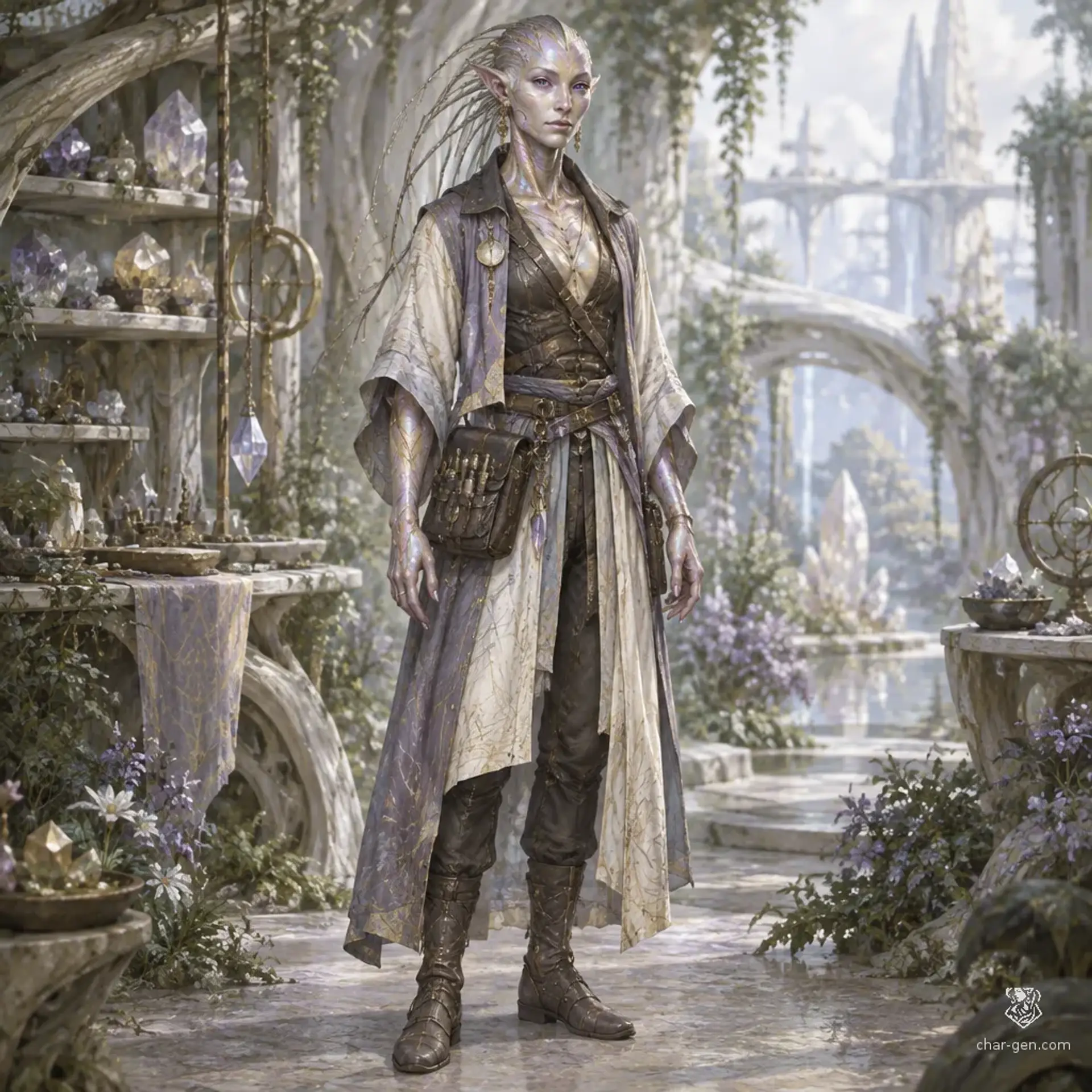
Xel'vani nacriformis
Xel'vani are survivors of a lost world, living forges whose bodies can turn suitable minerals into small, finished components.
At a glance
Languages Common, Xel'vani
Height 5 to 7 feet
Weight 120 to 240 pounds, varying with frame and mineral density
Lifespan 500 to 700 years
At the table
Your walking speed is 30 feet.
You gain proficiency with smith's tools. You can use these tools to represent the careful work through which your people preserve and improve their craft.
When you finish a Long Rest, you can produce one Tiny, nonmagical metal or mineral object with a market value of 5 GP or less, provided you have suitable raw material. The object must be a simple component or tool, not a weapon, armor, poison, or other item intended to deal damage or grant a combat advantage. The object lasts until the end of your next Long Rest, then crumbles into inert flakes. The DM determines whether a proposed object fits these limits.
You have Advantage on Intelligence (Investigation) checks you make to understand the construction or purpose of a nonmagical mechanical device you can touch. This trait does not reveal a device's command words, hidden magic, or every danger it contains.
Common, Xel'vani
Xel'vani often cultivate Constitution and Intelligence through resilient forge-bodies and technical intuition, but these are tendencies of training and culture, not biological requirements. Assign ability score increases according to your table's character creation rules.
Their forge glands favor fine control and elaborate, delicate work.
Sigilwrights were traditionally entrusted with precision instruments, seals, and intricate mechanisms. Many preserve their people's knowledge through meticulous records and coded designs.
Xel'vani are survivors of a lost world, living forges whose bodies can turn suitable minerals into small, finished components. They approach craft as both science and memory, carrying knowledge in their hands and histories in the objects they make. To meet a Xel'vani is to meet someone whose people were nearly erased, but whose art of making has endured.
Xel'vani are humanoids whose skin carries a naturally nacreous sheen, often shifting through pearl, pale gold, and faint violet as the light changes.
Their eyes may have little visible distinction between iris and sclera, and many bear fine metallic filaments where other humanoids grow hair. Beneath the skin, specialized glands and symbiotic nanite colonies process trace minerals and help maintain the body. Individuals vary widely in build, facial features, and ornamentation; the species' renowned symmetry is a cultural ideal, not a rule of biology.
Once native to the industrial gardens and crystalline foundries of Xel'vaan, Xel'vani now live wherever they can find privacy, raw materials, and a measure of safety.
Their enclaves are scattered across ports, frontier settlements, and hidden refuges.
A young Xel'vani learns to regulate their forge glands and nanite colonies under close guidance. They may look like a young adult of another humanoid species.
Most Xel'vani spend centuries refining a craft, discipline, or philosophy. Their appearance changes little through this long adulthood.
Elder Xel'vani may show subtle shifts in their pearlescent skin and filament-hair as their internal colonies slow. Their knowledge is often prized, though some choose solitude.
Before the destruction of Xel'vaan, Xel'vani were renowned across distant sectors as master makers and living interfaces between biology and technology.
Their bodies can metabolize certain raw minerals and metals, then shape the processed material into useful components. This ability is not limitless: it demands suitable feedstock, time, and careful control. In exile, craft has become a means of preserving history as much as meeting practical needs. A family design, a tool passed between generations, or a repaired object may carry more weight than a written archive.
Xel'vani traditions vary, from reverence for the forces that shaped matter to devotion to ancestors whose craft outlived them.
Some regard making as a sacred responsibility; others see it as a practical skill with no divine meaning. The loss of Xel'vaan has left many questioning old certainties. No alignment is typical, though a strong concern for autonomy is common among those who have faced enslavement or conquest.
Xel'vani are often met with awe, suspicion, or the dangerous interest of those who would exploit their unusual biology.
Many keep their capabilities private until trust is earned. They value relationships built on consent and mutual respect, and are especially wary of anyone who treats a person as a source of materials or knowledge. Among themselves, survivors maintain long-distance ties through exchanged designs, recipes, and carefully guarded names.
The lost world of Xel'vaan was famed for structures grown and shaped through a partnership of living matter and engineered minerals.
Its halls combined graceful curves with precisely fitted metal and stone, designed to be repaired by touch rather than replaced. Exile communities adapt this approach to local materials, often building compact workshops that can be dismantled quickly or concealed within existing settlements.
No images yet.
A high-res, share-ready sheet you can post or print.