
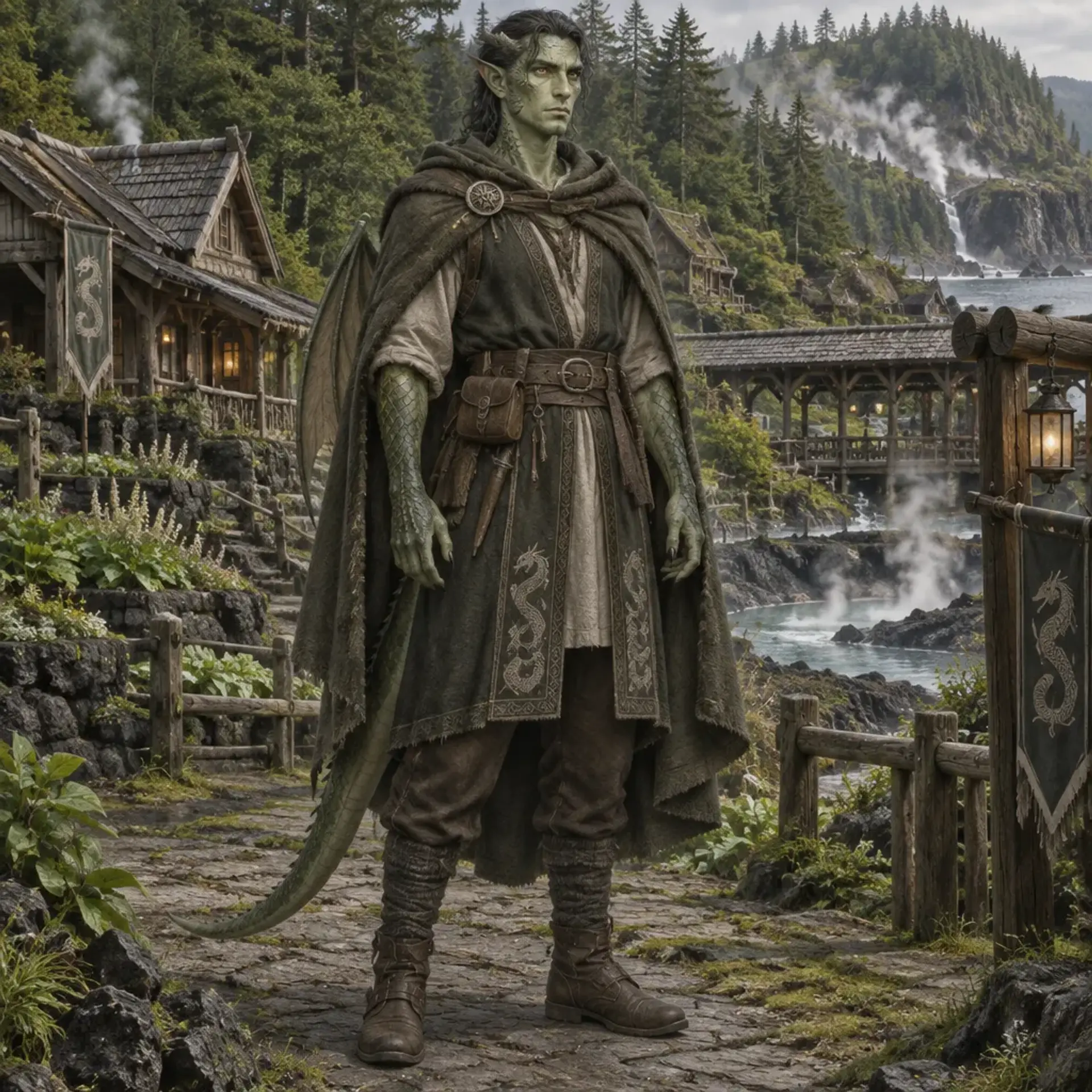
Homo draconis viridans
Shipwrecked halfling families survived a dragon-haunted archipelago through grit, fishing, and a forbidden gift of green-dragon blood.
At a glance
Darkvision 60 ft.
Languages Common, Halfling
Resistances Poison
Height Low-Blood: 3 to 4 ft.; High-Blood: 5 to 6 ft., with rare individuals taller.
Weight Low-Blood: 35 to 55 lb.; High-Blood: 110 to 190 lb.
Lifespan 80 to 110 years
At the table
Your creature type is Humanoid. Your size is Small if you are Low-Blood or Medium if you are High-Blood. Your walking speed is 30 feet.
You have Darkvision with a range of 60 feet. In darkness, you see shades of gray rather than color.
You have resistance to poison damage.
You can exhale a poisonous mist in a 15-foot cone. Each creature in the area makes a Dexterity saving throw, with a DC equal to 8 + your Constitution modifier + your proficiency bonus. On a failed save, a creature takes poison damage, or half as much on a successful save. The damage increases to at character level 5, at level 11, and at level 17. You can use this trait a number of times equal to your proficiency bonus, regaining all expended uses when you finish a long rest.
Choose Nature, Stealth, or Survival. You gain proficiency in the chosen skill, reflecting your family's habits of cultivation, concealment, or wilderness travel.
Common, Halfling
Poison
These people often cultivate Constitution and Wisdom through hard survival, or Dexterity and Intelligence through craft and study. Choose ability score increases according to the 2024 rules; no ability score is fixed by this ancestry.
Shorter stature and visible continuity with the family's halfling ancestry. Low-Blood characters are Small.
The older lineage, born before or soon after the dragon's blood became part of the community. Low-Blood people preserve the greatest variety of halfling features and usually remain devoted to familiar family customs. Some still show faint scales or green eyes.
Shipwrecked halfling families survived a dragon-haunted archipelago through grit, fishing, and a forbidden gift of green-dragon blood. Three generations later, their sheltered settlement is divided between halfling-rooted elders and a taller, increasingly draconic youth, while ash, strange magic, and an unseen dragon's designs threaten their fragile home.
Verdant-Blooded descend from halfling refugees changed by a secret ritual involving the blood of a crippled green dragon.
Low-Blood people retain much of their family's halfling appearance, including the varied builds and features associated with their old Lightfoot, Hairfoot, and Stout kin. Some have faint green eyes, small patches of scale, or a trace of unusual resilience. High-Blood people are generally taller and leaner, with pale green-tinted skin, sharp eyes, clawed hands, and green scales that may darken toward black. Some grow tails or vestigial wings. A few develop severe, painful changes, including altered digestion. The transformation is not uniform, and neither lineage can be judged by appearance alone.
A remote archipelago of deep woods, rich fishing grounds, hot springs, mineral seams, ash-prone fields, and draconic wilderness.
The principal settlement occupies a fertile island among more dangerous shores.
Small-bodied and often mistaken for ordinary halflings, Low-Blood children tend to show only mild scale growth or unusual eye color.
Adolescence may bring painful growth, temperamental changes, and the first unmistakable signs of dragon ancestry. High-Blood youths often outgrow their parents rapidly.
Adults form the working heart of the community, though arguments over custom, dragon worship, and the meaning of their ancestry divide generations.
Most elders retain halfling stature and habits. Their authority is increasingly challenged by the larger, more numerous High-Blood generation.
Their society is in upheaval.
Halfling customs of shared labor, family meals, and mutual aid remain strongest among the elders, while many High-Blood youths prize hunting, personal prowess, secrecy, and calculated ambition. Some have begun enforcing rigid expectations based on sex, a development that older residents regard with alarm. The settlement numbers about 447 people and is growing, but its traditions are being reshaped faster than its leaders can agree on. A few families still speak of the dragon and the first ritual with gratitude; others suspect the gift carried a price. Their former halfling kinship traditions are not gone, but are increasingly contested.
Beliefs are unsettled.
Some families honor ancestors, household spirits, or the land that sheltered them; others increasingly venerate dragons, and the influence of Tiamat is growing. The green dragon who gave the original gift is remembered by some as a savior and by others as the source of their troubles. No single alignment or faith defines the people, though fear, ambition, and communal duty are frequent themes.
Most island peoples are strangers to them, and the community's early terror of dragonlike golden inhabitants has become wary avoidance.
Their old halfling hospitality persists, but isolation and repeated disaster have made trust conditional. Low-Blood elders often see High-Blood youths as dangerously detached; many youths see elder customs as tools for a life that no longer exists. Outsiders may find a welcoming household beside a settlement that watches them from behind shutters.
Their first homes were hurried shelters built after a shipwreck, then low timber cottages, root cellars, communal barns, and stout stone workshops.
Germanic-inspired dress now mixes wool, linen, leather, embroidered hems, and practical hoods with older halfling patterns. Ash-resistant roofs and covered paths are increasingly common. Homes are built for concealment as much as comfort, a habit born of fear of dragons.
No images yet.
A high-res, share-ready sheet you can post or print.