
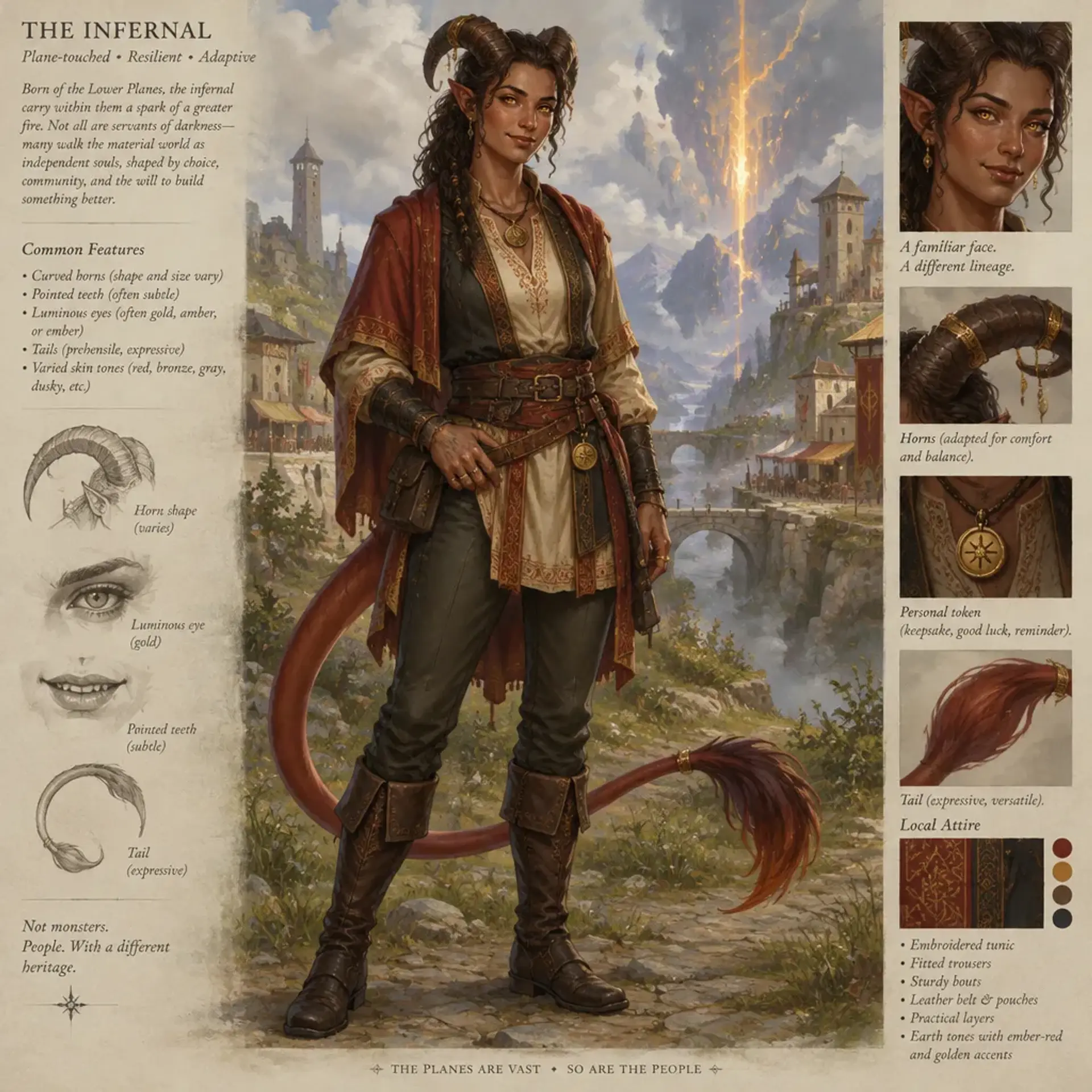
Homo infernalis
Your ancestry carries a trace of a fiendish plane, but it does not dictate your loyalties.
At a glance
Darkvision Darkvision
Languages Common, Abyssal, Infernal
Height 5 to 6 1/2 feet
Weight 100 to 250 pounds
Lifespan Usually similar to that of humans, though family histories vary
At the table
A Tiefling character is a humanoid with the infernal and humanoid traits. This ancestry is uncommon; access may depend on the campaign and setting.
You have the darkvision sense, allowing you to see in darkness and dim light as described by Pathfinder 2E rules.
Your planar inheritance can take many forms. Choose one heritage at character creation to represent its strongest expression; this choice describes a lineage, not a moral disposition.
Common, Abyssal, Infernal
A lineage marked by infernal or other fiendish influence often cultivates force of personality, quick judgment, and stubborn resilience. As a Pathfinder 2E ancestry, a character gains a Charisma boost and one free ability boost, with no ability flaw.
A heritage touched by chaotic fiendish realms, often associated with volatile transformation and forceful emotion.
Abyss-touched Tieflings carry signs of a chaotic and mutable planar influence. Horns, teeth, eyes, or other features may be asymmetrical or change subtly over time. Their ancestry does not make them chaotic, though outsiders may expect them to be unpredictable.
Your ancestry carries a trace of a fiendish plane, but it does not dictate your loyalties. That trace may come from generations spent near a planar rift, birth in an otherworldly realm, or a fiend who slowly became part of mortal life. People may feel uneasy before they know why, yet your insight, presence, and hard-won resolve can make you a persuasive negotiator or an inspiring leader. The question is not what your blood demands, but what you choose to do with its legacy.
Tieflings are humanoids whose ancestry or prolonged exposure has been shaped by a fiendish plane.
Some appear indistinguishable from their neighbors, while many bear visible signs of that history. Common features include horns of varied shape, a tail that may be prehensile or not, pointed teeth, and eyes that are wholly black, red, white, silver, or gold. Cloven feet, an unusual scent, or a subtle aura of unease occur less often. No single feature reliably reveals a person's origin or character, and appearances vary even within families.
Otherworldly, especially near fiend-touched planes, planar rifts, and settlements shaped by long exposure to such places; also found throughout ordinary mortal lands.
A young child whose unusual features may be faint or not yet visible. Family and community strongly shape their first understanding of their heritage.
An adolescent or young adult, generally physically mature around the same time as neighboring humanoid peoples. Fiendish traits may become more pronounced during this period.
A seasoned adult with a lifespan broadly comparable to that of humans. Individual longevity varies, especially among those with strong planar exposure.
Most Tieflings belong to the cultures in which they were raised, rather than to a single people-wide society.
Their customs, languages, and sense of home are usually local. In settlements where discrimination is common, families may cluster in neglected districts or establish mutual-aid networks and independent communities where their features need not be hidden. Some pursue money or public office as protection; others challenge the conditions that made such protection necessary. Kinship is often defined by care and shared experience as much as by blood.
Ancestry does not determine faith or morality.
Infernals may honor any deity, follow a philosophical tradition, or keep religion at a distance. Some are drawn to powers associated with their ancestral plane, whether through genuine devotion, fear, curiosity, or a wish to understand their origins. Their choices span every alignment and cannot be inferred from their appearance.
Many Tieflings grow up navigating prejudice that begins before they speak.
Some conceal their features, while others answer suspicion with wealth, influence, or unapologetic visibility. Others find belonging in families and neighborhoods formed across ancestry lines, including communities of other marginalized people. Trust can take time, but Tieflings are not inherently deceptive or cruel; their reputation for cunning often reflects the social skill required to read a room that has already judged them.
There is no single homeland or architectural tradition shared by all infernals.
Those born in mortal settlements build and live according to local customs, though exclusion often pushes families into crowded, neglected districts where they make practical use of overlooked spaces. In communities formed by shared ancestry, public halls and homes may be designed around the varied needs of horned, tailed, winged, or otherwise unusually built residents. Settlements near planar scars favor sturdy construction, clear escape routes, and materials chosen to withstand the local distortions.
No images yet.
A high-res, share-ready sheet you can post or print.