
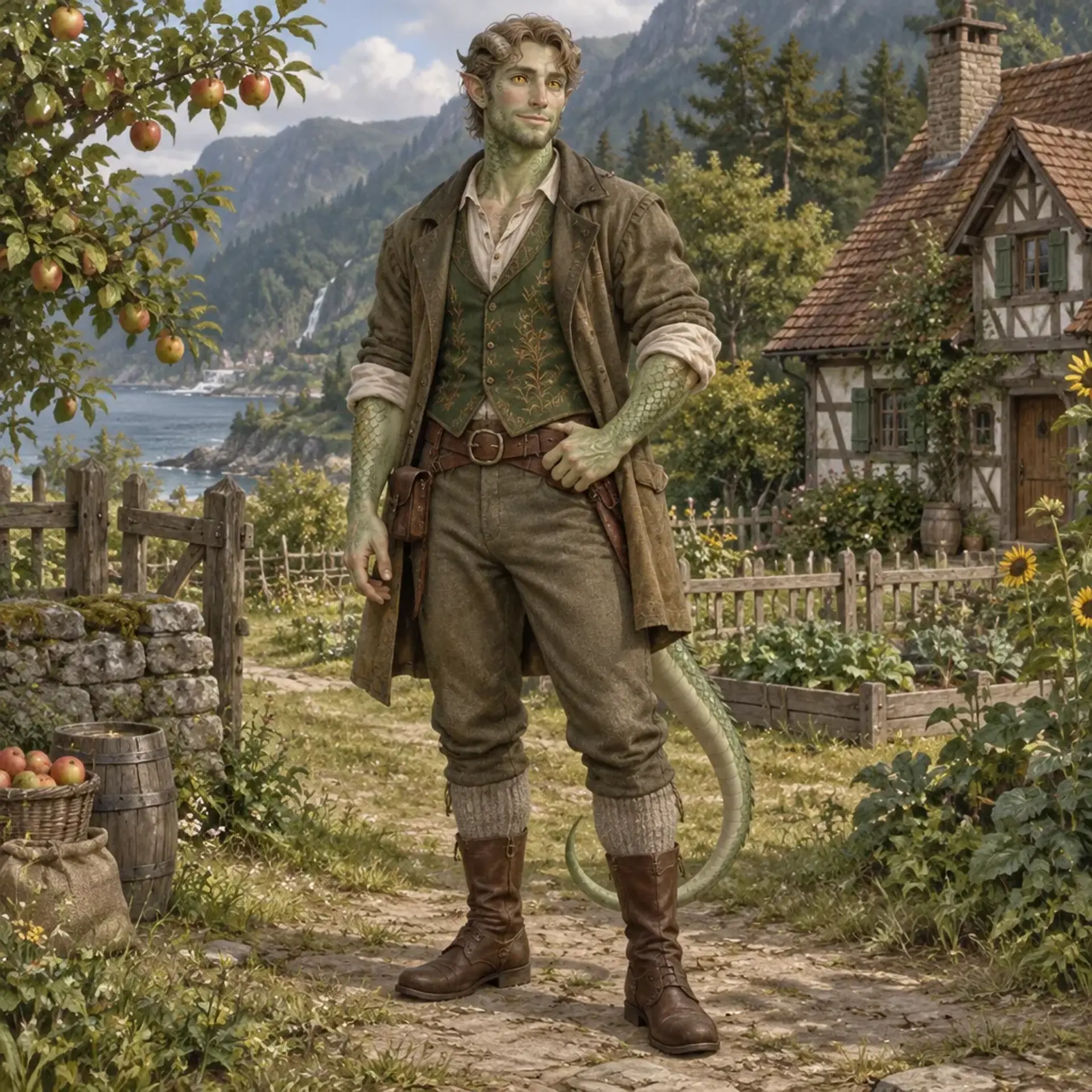
Homo draconis viridans
Born into halfling households but changed by the legacy of a scarred green dragon, the Grünblut grow into a heritage their elders never expected.
At a glance
Languages Halfling, Draconic
Resistances Poison
Height Low-blood adults are commonly 3 ft. 6 in. to 4 ft. 6 in.; High-blood adults range from 4 ft. 8 in. to 6 ft., with some men reaching six feet.
Weight 100 to 220 lb., varying greatly with height, build, and the extent of draconic growth.
Lifespan They mature at roughly the same pace as halflings and commonly live about 100 years, though the more pronounced draconic inheritance can make individuals' aging differ
At the table
Your walking speed is 30 feet.
Your draconic ancestry grants resistance to poison damage.
You know the language of dragons and can speak, read, and write Draconic.
You gain proficiency in one of the following skills of your choice: Animal Handling, Nature, or Survival.
As an action, you exhale a cloud of caustic green vapor in a 15-foot cone. Each creature in the area must make a Constitution saving throw, with a DC equal to 8 + your proficiency bonus + your Constitution modifier. On a failed save, a creature takes poison damage, or half as much on a successful save. The damage increases to at 6th level, at 11th level, and at 16th level. Once you use this trait, you cannot use it again until you finish a short or long rest.
Halfling, Draconic
Poison
Their long years of cultivation, close-knit households, and wary woodland instincts tend toward Constitution and Wisdom, though players assign ability score increases according to the 2014 rules they use.
The inheritance is unmistakable, and may include a tail, or wings.
The more common lineage, High-blood Grünblut tend to grow taller and more visibly draconic as they mature. Their pale, green-tinted scales and unusual stature may appear gradually or be evident from birth. Some develop horns, tails, or wings, changes that can bring pride, anxiety, or both to a family.
Born into halfling households but changed by the legacy of a scarred green dragon, the Grünblut grow into a heritage their elders never expected. Some remain small and faintly scaled; others become towering, horned, or winged, carrying their village's old ways into an uncertain future. They tend orchards, honor dragon spirits, and are learning that a cautious eye and a hunter's patience can serve as well in the forest as in the fields.
Grünblut are descendants of halfling families transformed by an old green-dragon inheritance.
Infants often look like ordinary halflings, but their differences emerge with age: pale skin may acquire a green cast, fine scales appear along the neck or forearms, eyes may become gold or narrow-pupilled, and teeth can grow sharper. High-blood adults are often tall and powerfully built, with a sinuous, predatory poise. Some develop horns, tails, or vestigial or functional wings; these traits may be present at birth or emerge during growth. Such changes can frighten outsiders and trouble families who remember a less visibly draconic past. Low-blood people retain more familiar halfling features, though they are generally taller than their halfling forebears and may bear faint scales. Clothing is practical, with elegant flourishes. Men commonly favor traditional halfling and German-inspired breeches, shirts, waistcoats, and sturdy coats; women often wear layered skirts, blouses, aprons, and fitted bodices. These customs are common, not compulsory, and individual practice varies.
A secluded archipelago of farms, orchard valleys, forested slopes, and dragon-ruled islands.
Born with a largely familiar halfling appearance, though some show faint scales or unusual eyes from infancy.
A gradual change begins. Scales, altered teeth, a slit to the pupil, or a stronger appetite may appear, unsettling relatives who expected a more ordinary childhood.
Most reach physical adulthood around twenty. Their inheritance continues to declare itself unevenly through adolescence and early adulthood.
They commonly live about a century. In later life, scales often thicken and old injuries or ailments become more troublesome.
Most Grünblut remain agricultural, organizing life around family farms, shared labor, seasonal festivals, and generous meals.
Work is often divided by sex according to old halfling and Germanic customs, particularly among elders, but these patterns are changing and are not universal. The community is in flux: those who remember being ordinary halflings watch younger relatives grow more cunning, aggressive, or self-interested. At the same time, green-dragon instincts have made some unusually capable hunters, and a new hunting culture is taking shape alongside farming. High-blood people are the majority; Low-blood families are fewer, though they remain part of the same communities. The seven founding children married into halfling households, so many families have complicated and overlapping claims to the inheritance.
Their faith is a domestic spiritism centered on dragons as powerful presences in the living world.
The green dragon who began their lineage is revered as an ancestor and teacher, not a flawless deity; her kindness is understood alongside her injuries, frailty, and grief. Older halfling tales and household gods remain woven into the practice, sometimes retold as companions or lesser spirits of the dragon. Many value loyalty and care for kin, but no single alignment defines them. The changing inheritance has made some more calculating, aloof, or acquisitive, while others work deliberately to preserve the generosity of their elders.
They are a small and largely insular people, accustomed to being regarded first as halflings and then, once their scales or stature are noticed, as something unfamiliar.
Their hospitality remains strong, though younger generations are often more guarded and ambitious than their elders. Relations with the dragons that rule the archipelago range from reverence to wary pragmatism. Outside their islands, some are welcomed as curious kin and others feared as the emissaries or descendants of dragons.
Their settlements cluster around family farms and sheltered harbors.
Timber-framed houses, steep roofs, tiled or thatched cottages, communal ovens, and carefully tended gardens reflect German rural traditions adapted to island weather. Older homes are built for halfling-sized residents; newer ones often have taller doors and sturdy rafters to accommodate High-blood growth, horns, or wings. Dragon shrines tend to be small and domestic, placed beside wells, hearths, or old boundary stones rather than raised as grand temples.
No images yet.
A high-res, share-ready sheet you can post or print.