
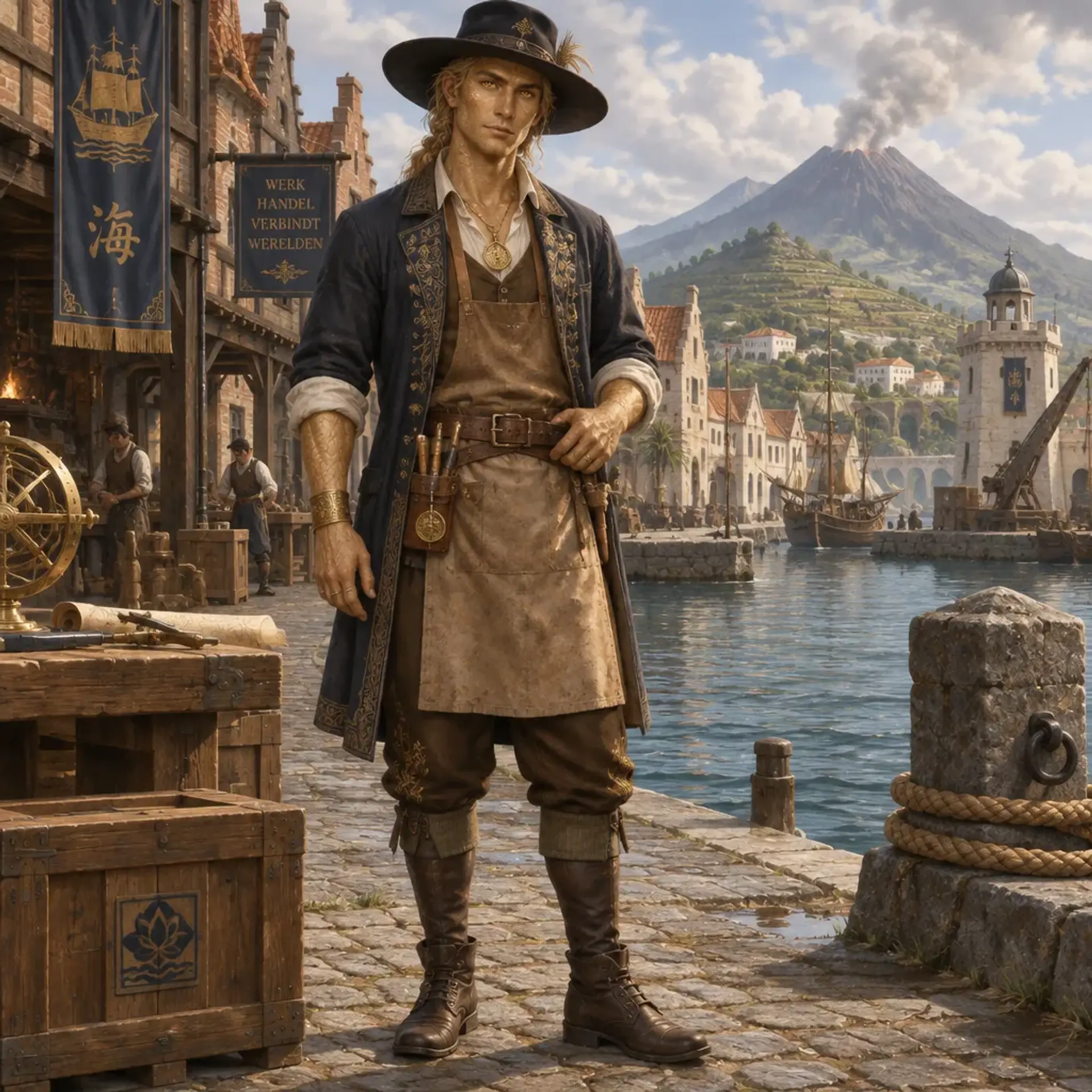
Gnomus draconis aureus
At a glance
Darkvision 60 ft.
Languages Draconic, Common
Height 5 ft. 8 in. to 6 ft. 6 in.; high-blooded men averaging about 6 ft. 4 in.
Weight 150 to 230 lb., with substantial variation by build and bloodline.
Lifespan 250 to 350 years
At the table
Your walking speed is 30 feet.
You have advantage on Intelligence, Wisdom, and Charisma saving throws against magic. This reflects the resilient and uncanny minds inherited from your gnomish forebears and altered by the rite.
You can communicate simple ideas to Small or smaller beasts through sounds and gestures. You have advantage on Wisdom (Animal Handling) checks made to influence them.
Once per long rest, you can exhale a concentrated burst of golden energy in a 15-foot cone. Each creature in the area must make a Dexterity saving throw, with a DC equal to 8 + your proficiency bonus + your Constitution modifier. On a failed save, a creature takes radiant damage, or half as much on a successful save. The damage increases to at 6th level, at 11th level, and at 16th level.
Draconic, Common
Their long gnomish tradition favors nimble minds and inventive hands, while the dragon rite has made many bodies taller, stronger, and more enduring. Characters often tend toward Intelligence and Constitution, or Wisdom among spirit-guides, but players assign ability score increases as they wish.
Greater likelihood of golden scales, jewel-bright eyes, metallic teeth, claws, and late-emerging draconic features; horns, tails, and wings remain uncommon and are viewed with unease.
High-blooded Aurethians carry a stronger trace of the old dragon rite and are the majority of the population. They tend toward lean, muscular frames and more visibly draconic features, along with pronounced confidence, territorial instincts, and occasional greed or arrogance. Such impulses are treated as personal tendencies to master, not inevitable virtues. Families carefully consider marriage because visible changes can affect social standing and inheritance.
Aurethians are gnomes remade by an ancient golden dragon's blood, now a tall, inventive island people balancing reverence for their rescuer against the unsettling truth of how their transformation was wrought. They are careful engineers, disputatious scholars, and proud artisans whose bodies may still change in adolescence. A traveler may find a society of precise manners and practical hats, then discover that every family keeps a different account of the oath that saved them.
The Aurethians began as gnomes, but generations after a deliberate ritual of golden-dragon blood have made them among the tallest peoples of their archipelago.
Their adults commonly stand well above six feet, with high-blooded men averaging about six feet four inches. Low-blooded adults are still strikingly tall compared with ordinary gnomes. Skin ranges from pale ivory-gold to deeper muted gold, with some families retaining natural gnome hues. High-blooded people often have lean, muscular frames that suggest a dragon's poised strength; low-blooded builds vary more widely and retain clearer gnomish features. Scales may lie almost invisibly along the cheekbones, shoulders, or forearms, blending into golden skin. Hair is often gold or paler than the complexion, and eyes may be amber, bright gold, purple, or jewel-toned. Some develop strong teeth or retractile-looking claws, which can complicate ordinary work. Horns, tails, and wings are rare and socially uncomfortable, especially among high-blooded families who fear such traits will be read as bestial. Children look like gnomes until puberty, when a painful and conspicuous second growth can alter height, proportions, voice, and temperament.
The Archipelagoes Draconis, especially the forged island of Aureth's Reach and its volcanic farms, harbors, workshops, and wind-battered towns.
Born with the stature and features of ordinary gnome children, they grow much as their forebears did. Families teach practical craft, household history, and the first careful customs around dragons.
Puberty brings a dramatic second transformation: rapid growth, deep aches, volatile moods, and sometimes the first scales, metallic teeth, claws, or unusual eyes. Community healers regard the process as expected, though outsiders may find it alarming.
Most settle into their adult form by the late teens or early twenties. Adults are expected to contribute a craft, study, trade, or public service, and many begin courtship and inheritance negotiations.
They commonly live between 250 and 350 years, with venerable individuals sometimes living longer. Age is measured in accumulated skill and witnessed events as much as in years.
Aurethian culture is prudently Dutch and gnomish in its habits: frugal, industrious, fond of ledgers, careful contracts, public argument, and reliable engineering.
It is also a society of experimenters. Scholars test theories in workshops, alchemists keep meticulous records, and artificers treat a failed device as information rather than disgrace. Jewelry, mechanical instruments, fine metalwork, and decorative arts are sources of civic pride. Broad hats and practical work clothes are characteristic; formal dress is becoming more elaborate, with Chinese-inspired motifs and fashions particularly visible among scholars, court officials, and social climbers responding to the new dragon lord. Silk has become a fashionable fascination, and plans to cultivate it locally are under discussion. The people are unexpectedly patriarchal for a gnome-descended society: men are generally favored as inheritors, a custom defended as a safeguard against sudden changes in family holdings. Women are not considered inherently lesser, and the rule is openly debated in unusually detailed records. Practical labor clothes are respected for all genders, while richer and more ornamental styles are increasingly popular. High-blooded Aurethians form the majority and their draconic presence can dominate public ideals of beauty, prestige, and authority. Low-blooded Aurethians are understood as a distinct branch, not an inferior one, though everyday power does not always match that principle. The founding transformation is taught as a sacred rescue, but a harsh, long-concealed truth persists in fragments: the rite may have been profane magic born of desperation, when ordinary gnomes could not survive the archipelago's harsh conditions. This tension helps explain why dragon spirits and magic are admired while overtly beastlike physical traits are often rejected.
Their spiritual life blends reverence for dragons with animal-centered shamanism, ancestor practice, and practical petitions for wisdom, prosperity, and safe passage.
The old golden dragon lord is remembered as an ancestor spirit and savior; the new lord is a living authority whose arrival has brought unfamiliar court customs and Chinese scholarly influences. Sorcery associated with metallic dragon heritage is often celebrated as a blessing. Public teachings praise restraint, learning, and useful service, though private histories preserve sharper doubts about the founding ritual. Aurethians have no universal alignment; dutiful households often value order, while inventors and reformers may prize freedom of inquiry.
Aurethians honor metallic dragons and people with metallic draconic ancestry, often treating them as potential teachers or living signs of a sacred history.
Their feelings toward chromatic dragons are marked by fear, old caution, and sometimes open hostility. Dragonborn are generally regarded as an unsettling, artificial-looking mockery of the blood that defines Aurethian identity, a prejudice that can be challenged by personal acquaintance. Kobolds are commonly employed in dangerous and poorly paid labor and are not treated as social equals, a practice increasingly questioned by reformers and some low-blooded guilds. Within Aurethian society, low-blooded people are not formally despised, but they live among a majority of high-blooded families and can be overshadowed in prestige, inheritance, and public attention. Claims of half-dragon ancestry evoke old poems and disputed artworks; such claimants may be honored, doubted, or quietly feared if they show overtly draconic behavior.
Their homeland is an island shaped from the sea by the old golden dragon lord, whose act remains the central event of public memory.
Settlements favor compact brick and timber houses, steep roofs, canals, seawalls, workshops, and broad storehouses. Harbors and dikes reflect careful Dutch-inspired engineering, while newer elite buildings incorporate restrained Chinese-inspired courtyards, screens, roof ornaments, and garden plans. The original sandy, salt-poor ground made farming difficult. Recent volcanic activity has pushed fertile material across parts of the shore, prompting experiments with drainage, compost, terracing, and unfamiliar livestock practices. Foraging customs remain embedded in food culture, and agricultural knowledge is still developing.
No images yet.
A high-res, share-ready sheet you can post or print.