
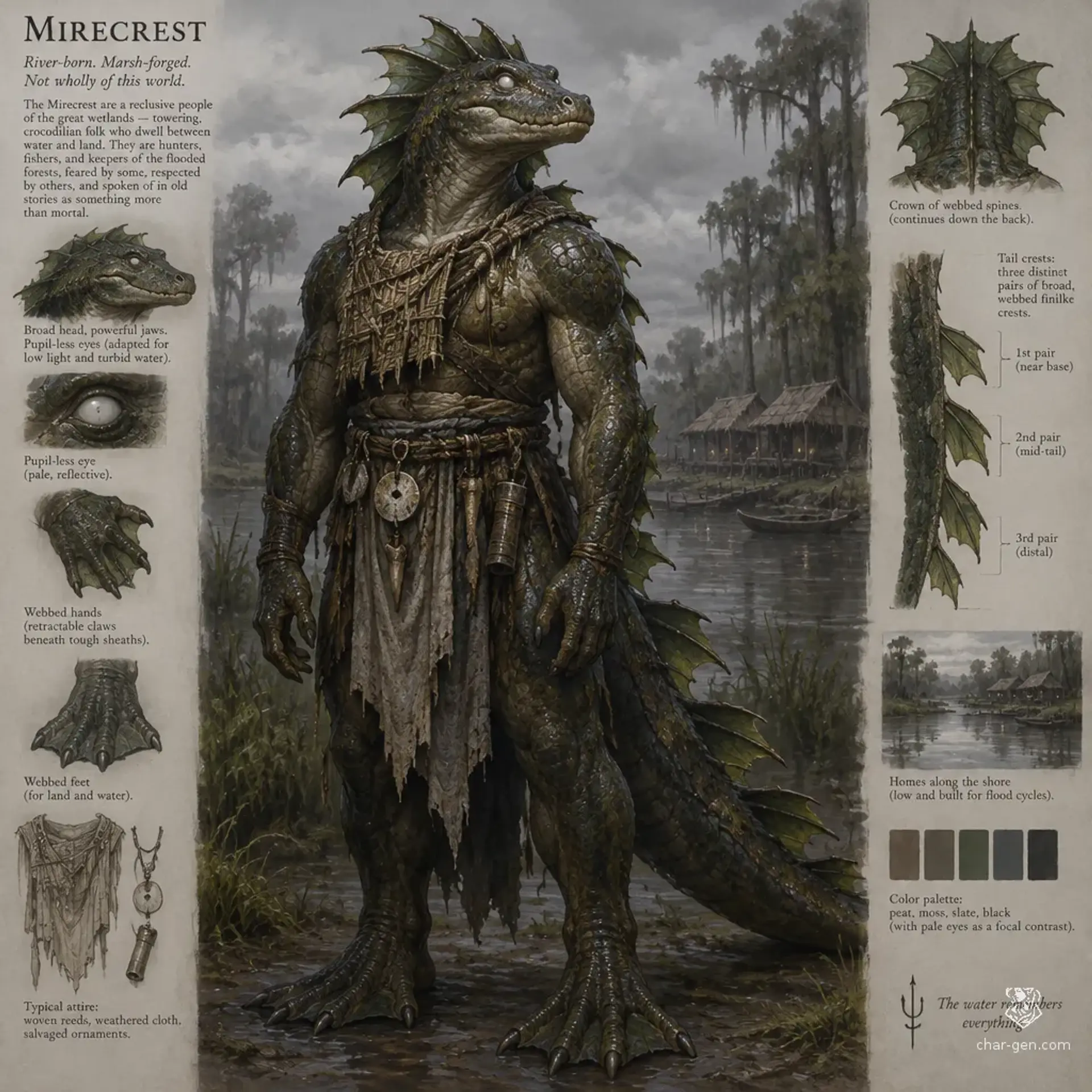
Paludisaurus reticulocrista
A Mirecrest is a patient hunter and formidable marsh guardian, adapted to dark, foul water where other folk see only mud.
At a glance
Darkvision Darkvision 60 ft.
Languages Common, Marshcant
Height 7 to 10 feet tall for fully grown adults; uncommon apex elders reach 11 to 16 feet.
Weight 450 to 900 pounds for typical adults; apex elders may exceed 1,500 pounds.
Lifespan 90 to 120 years, adult at 18
At the table
Your creature type is Humanoid. You are Medium, and your walking speed is 30 feet.
You have a swimming speed of 30 feet, and you can breathe air and water.
You have darkvision with a range of 60 feet. In darkness, you perceive shades of gray rather than color.
You have advantage on ability checks made to avoid or escape a grapple while you are underwater. Your webbed hands and feet help you maneuver through submerged reeds and silt.
As a Magic action, you can extend or sheath your retractable claws. While extended, they are natural weapons that deal slashing damage on a hit, using Strength for the attack and damage rolls. You can use your claws to manipulate objects while extended, though delicate tasks may be awkward.
You can hold your breath for up to 1 hour while out of water. You also have advantage on saving throws against disease caused by contaminated water, though this does not protect you from poisons or other harmful effects.
Common, Marshcant
These powerful swamp-dwellers tend toward Constitution and Wisdom, reflecting endurance and a hunter's patience; players assign any ability score increases as they wish.
Broad, dark webbing and a flattened tail built for sudden bursts through dense reeds.
Reedrunners are quick, agile hunters of shallow marshes and tangled waterways. Their families often serve as scouts and messengers between settlements.
A Mirecrest is a patient hunter and formidable marsh guardian, adapted to dark, foul water where other folk see only mud. Their pale, pupil-less gaze and crown of webbed spines make them look like a warning risen from the lake, but their communities are careful stewards of the waters that sustain them. They may join an adventuring company to defend a threatened wetland, repay a debt, or discover what is poisoning the pools they call home.
Mirecrests are towering amphibious beast-folk with dense scales, long muscular tails, and broad, crocodilian heads.
Their large, pale white eyes have no visible pupils, yet they track motion with unsettling accuracy in murky water. Thin, inward-pointing teeth grip slippery fish rather than tear heavy prey. Their fingers and toes are webbed, as are the tall spines that rise from the crown, run down the back, and continue in three distinct finlike sets along the tail. Retractable claws fold beneath tough sheaths when not in use. Their coloration ranges from peat-brown and algae-green to slate and black, often mottled like the lakebed.
Swamps and polluted or silty lakes; they rarely settle anywhere without permanent access to still or slow-moving water.
Newly hatched, these young can swim almost immediately and cling to their kin with hooked little claws.
Growing rapidly, juveniles learn current-reading, fishing, and the rules governing shared waters.
At full size, most adults stand 7 to 10 feet tall and assume responsibilities as hunters, guardians, or keepers of local knowledge.
Elders may become immense apex forms, reaching 11 to 16 feet tall. This is an uncommon growth stage, not a separate people, and often follows decades of survival in especially rich waters.
Mirecrest communities are organized around shared waters and seasonal fishing grounds.
Elders settle disputes by hearing each side in turn, while skilled fishers teach the young to read ripples, scent, and changes in water color. Their diet consists mainly of fish, supplemented by shellfish, amphibians, and marsh plants. They value restraint in hunting and regard pollution as a breach of communal trust. Apex elders are rare, respected figures whose great size is associated with longevity and exceptional survival, not automatic authority.
Many honor the Wetland Witness, a tradition of reverence for the life carried by mud, rain, and still water, rather than a single universal deity.
Some maintain small shrines to local spirits or river gods, while others are secular. Their communal customs often favor balance and reciprocity, though individuals range across every alignment.
Mirecrests are wary of outsiders who drain wetlands, foul lakes, or take more fish than they need.
They often judge people by how they treat shared water, but can form deep loyalties with neighbors who respect local boundaries. Their intimidating appearance and habit of watching in silence lead some communities to mistake caution for hostility.
Their settlements occupy reed-choked shores, flooded groves, and islands of firmer ground.
Homes are low, sturdy structures of woven reeds, mudbrick, salvaged timber, and stone, with submerged entrances and dry platforms above the waterline. Shared pools serve as nurseries, meeting halls, and reserves during drought. They avoid clear, fast rivers and open coasts, where their familiar muddy cover is absent.
No images yet.
A high-res, share-ready sheet you can post or print.