
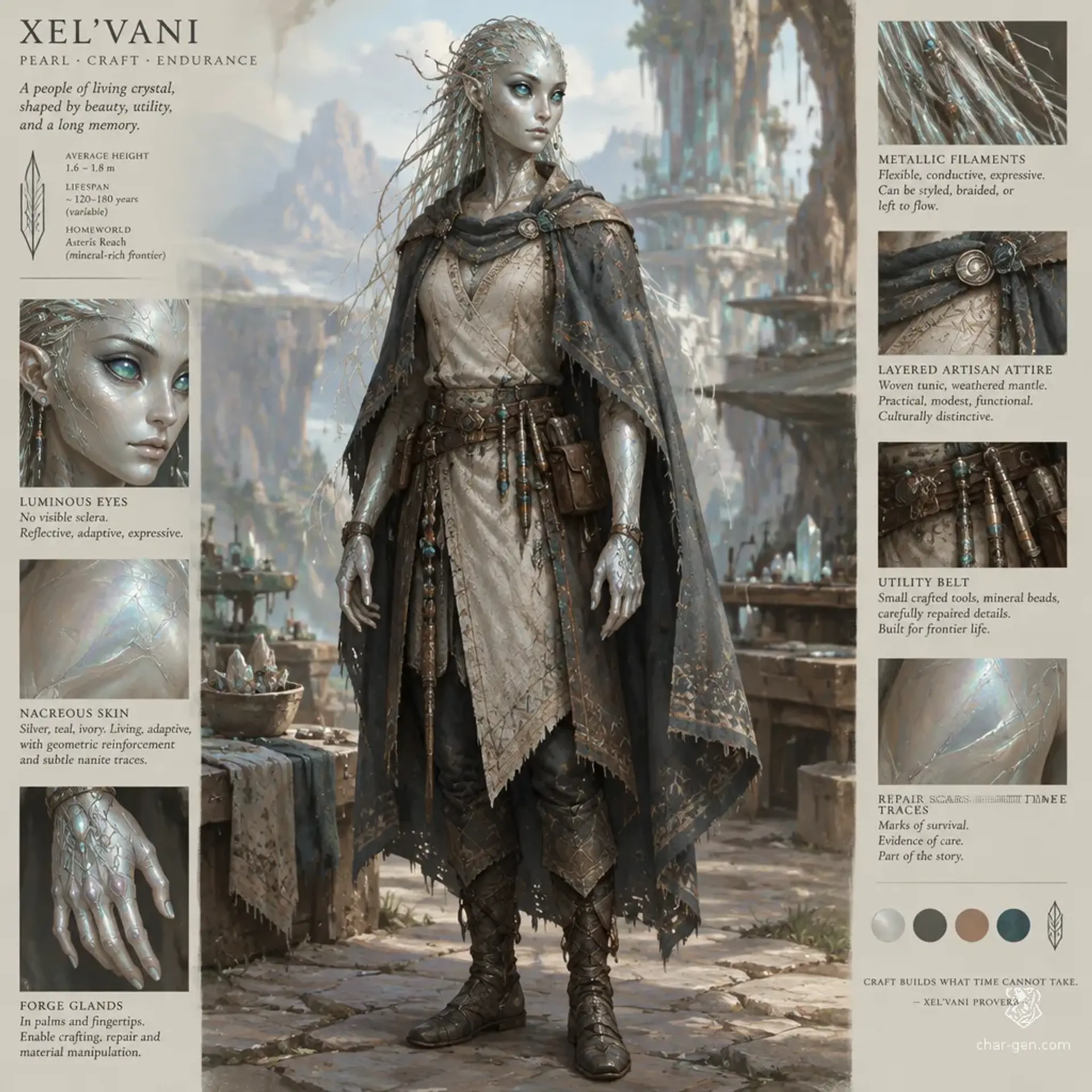
Xelvani artificialis
The Xel'vani are a nearly vanished people whose bodies are living workshops, able to sense, shape, and repair technology through touch.
At a glance
Darkvision Low-light vision; Xel'vani eyes perceive fine detail in dim conditions, but not total darkness.
Languages Common, Xel'vaani
Height 5 ft. 5 in. to 6 ft. 5 in.
Weight 140 to 240 lb., varying with body density and incorporated materials.
Lifespan Xel'vani can remain biologically stable for several centuries
At the table
Your body interfaces unusually well with crafted devices. You gain the trained proficiency rank in Crafting. If you would automatically become trained in Crafting from another source, you instead become trained in a skill of your choice.
You can use your body to shape small quantities of suitable mineral or metallic material into simple components during downtime, provided you have the materials, tools, and a safe place to work. This is a form of crafting, not instantaneous equipment creation, and the GM determines what materials and time are appropriate. Complex devices, weapons, and armor still require the normal rules for crafting them.
Xel'vani nanites respond to injury, but they do not grant rapid regeneration. You can safely identify whether a small sample of your blood contains active nanites, and you can use Crafting to assist with mundane repairs when appropriate. Nanites cannot disassemble creatures or objects at a glance, and their use does not bypass item, hazard, or crafting rules.
You gain low-light vision. Your reflective eyes and metallic filaments can reveal your presence in some lighting or concealment conditions, at the GM's discretion.
Common, Xel'vaani
Xel'vani often cultivate Constitution and Intelligence through resilient forge-bodies and technical intuition, but Pathfinder 2E ability boosts and flaws are determined by the ancestry rules and character creation choices, not fixed here.
Their nanites readily form protective layers, and their skin commonly bears geometric traces of repeated reinforcement.
Descended from guardians and armor-makers, Aegis-Born favor protection, repair, and defensive craft. They often serve as wardens of refugees or keepers of endangered workshops.
The Xel'vani are a nearly vanished people whose bodies are living workshops, able to sense, shape, and repair technology through touch. Once renowned across distant sectors, they were hunted for their rare biology and scattered when their homeworld fell. A Xel'vani adventurer may be a refugee, a maker guarding forbidden knowledge, or a survivor determined to ensure no people are ever harvested as resources again.
Xel'vani are humanoids whose bodies incorporate living nanite colonies and specialized forge-glands.
Their skin often has a nacreous sheen, with colors that shift subtly as light moves across it. Eyes may lack a visible sclera, their irises luminous and reflective. Hair can consist of metallic symbiotic filaments, though its appearance and capabilities vary by individual. Fine glandular structures in the palms and fingertips process prepared mineral and metallic matter into small components. Their bodies are biologically active, not machines wearing a skin, and they need rest, nourishment, and care. Repairs and adaptations leave distinctive patterns rather than erasing every scar.
Originally the engineered cities and mineral-rich settlements of Xel'vaan; now found, rarely, among diaspora communities, frontier ports, and hidden refuges across the stars.
Forge-glands and nanite colonies establish their mature patterns; young Xel'vani are closely guarded while learning to regulate their bodies.
The body reaches adult stability, and its owner begins refining a personal forge-pattern and choosing a vocation.
Experience deepens technical intuition, while accumulated repairs and adaptations make the body increasingly individual.
A rare late stage in which the nanite colonies may slow, fragment, or enter a deliberate dormancy. Some elders preserve their memories in crafted objects.
Before their diaspora, Xel'vani culture valued technical knowledge as a shared inheritance and treated bodily craft as both art and responsibility.
Apprentices learned to identify materials, regulate their forge-glands, and understand the consequences of every component they made. Some trained in secretive martial orders that designed tools for specific opponents, while others built homes, medical devices, or instruments. The loss of Xel'vaan fractured these customs. Modern Xel'vani often preserve culture through oral instruction, personal objects, and the careful teaching of practical skills.
Xel'vani traditions honor makers, ancestors, and the responsibility that accompanies creation.
Their scattered descendants may follow any faith or none. No alignment is inherent to their ancestry; their history includes caretakers, explorers, soldiers, and assassins alike.
Xel'vani are so uncommon that many people know them only through rumor or scavenged artifacts.
Some societies revere their craft, while others see their bodies as valuable resources. Trust is earned through conduct, not ancestry. Xel'vani communities often protect refugees and conceal the locations of surviving relics. Their history makes them especially wary of powers that collect minds, bodies, or technologies into a single system.
Xel'vaani settlements were grown as much as built.
Their living-forge inhabitants shaped mineral frameworks, responsive alloys, and nanite-worked surfaces into structures that could mend themselves. The destruction of Xel'vaan scattered its people and left only fragments of this architecture, often mistaken for inert ruins until a Xel'vani touches them.
No images yet.
A high-res, share-ready sheet you can post or print.