
Aureognomus draconis
At a glance
Darkvision You can see in dim light within 60 feet of yourself as if it were bright light, and in darkness as if it were dim light. You discern colors in darkness only as shades of gray.
Languages Common, Draconic, Gnomish
Resistances Fire
Height High-blood adults commonly stand around 6 ft. 4 in.; Low-blood adults are also strikingly tall, often near 6 ft. Men and women are comparably tall.
Weight 140 to 220 lb., varying with build; High-blood people tend toward lean, dense musculature.
Lifespan 200 to 300 years
At the table
Your base walking speed is 30 feet.
Accustomed to dark workshops, deep holds, and moonless volcanic paths, you have darkvision with a range of 60 feet.
The golden dragon blood in your lineage grants you resistance to fire damage.
You can speak, read, and write Common, Draconic, and Gnomish. Your community's Draconic includes regional variants shaped by long isolation.
Choose one kind of artisan's tools. You gain proficiency with those tools, reflecting the importance of making and maintaining things in Goldblood communities.
You have advantage on Intelligence, Wisdom, and Charisma saving throws against magic. This reflects the stubborn mental discipline inherited from your gnome ancestors and adapted through the old rite.
Common, Draconic, Gnomish
Fire
Their transformation favors sturdy constitutions, keen judgment, and a scholar's curiosity, but these are tendencies rather than fixed gifts. Use the ability score increases of your chosen D&D 5E (2014) rules option, or assign increases as your table permits.
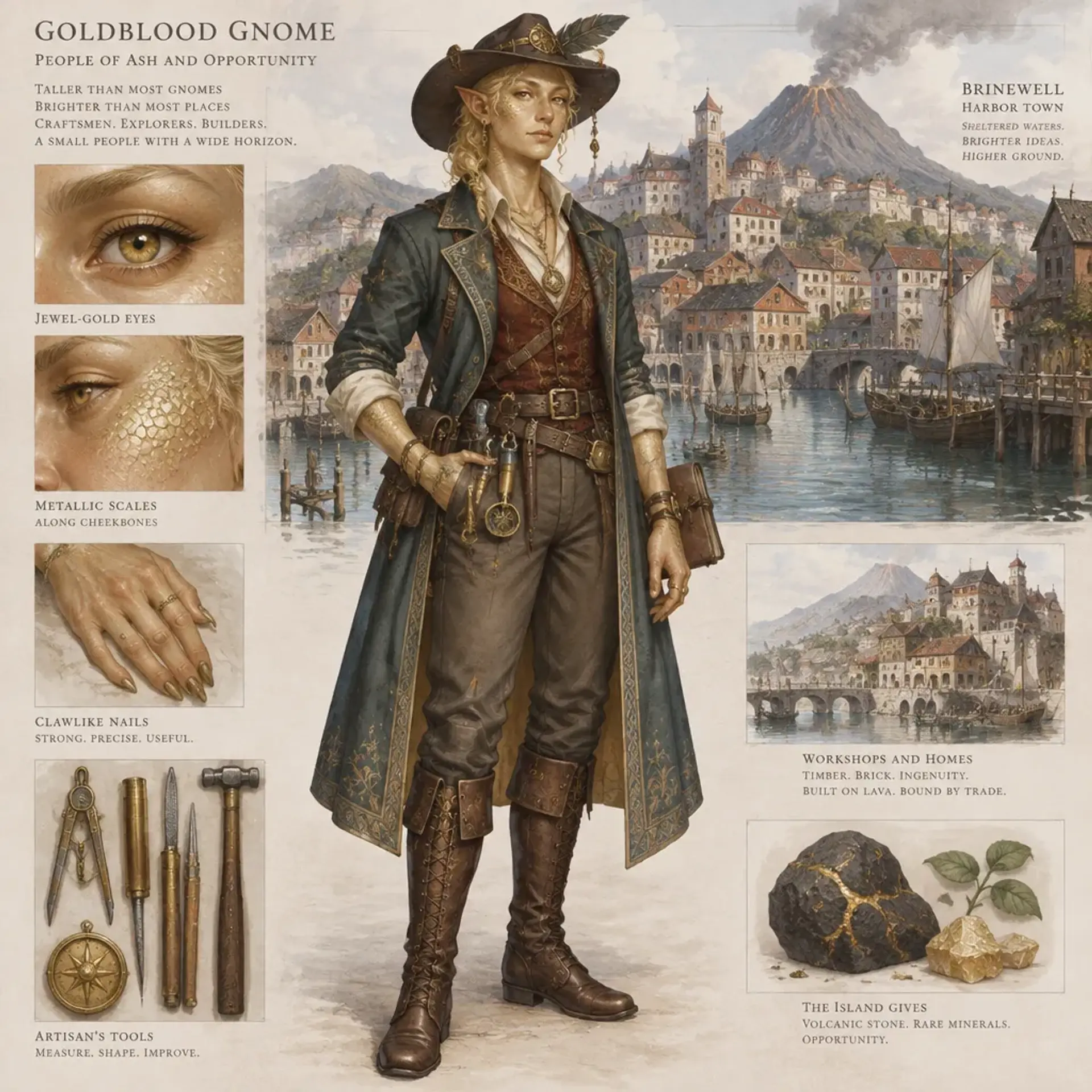
A more concentrated expression of the old rite, often visible in metallic scales, gold-toned eyes, a lean and powerful build, or claw-like nails. They are more prone than Low-blood people to rare horns, tails, or wings.
High-blood people form the majority and tend to show the most visibly draconic physical influence while remaining recognizably part of their island community. Their families may be especially attentive to inheritance and marriage, sometimes treating bodily changes as a matter of household reputation. They are not a separate mechanical ancestry.
On a volcanic island forged for them by a golden dragon, the Goldblood Gnomes honor a rescuer as ancestor spirit while debating whether their people's transformation was blessing, necessity, or a terrible bargain. They are tall, ingenious, and meticulous, with a talent for mechanical craft and a culture that prizes records, good workmanship, and well-argued opinions. Their golden heritage is a source of pride and unease in equal measure: a people who venerate dragons, fear the cost of their own blood, and must decide what kind of legacy deserves to survive.
They began as gnomes, but an old rite bound their people to the blood of a golden dragon.
The change is most obvious in their stature: even Low-blood adults are tall by the standards of neighboring peoples, while High-blood men commonly regard 6 ft. 4 in. as an unremarkable height. Their skin ranges from pale white-gold and warm pale gold to the natural tones associated with their gnome ancestry. High-blood individuals often have a lean, predator-like musculature, fine golden scales that merge with their skin, metallic teeth, and strong nails that may resemble claws. Their eyes can be gold, purple, or another jewel-like hue, and their hair is often gold or lighter than their skin. Low-blood people tend to retain more familiar gnome proportions and features, though their height and other signs of the transformation remain pronounced. Most are born looking like ordinary gnome children and change during adolescence, sometimes with years of growing pains and dramatic moods. Horns, tails, and wings are rare; the society generally considers them beastly or unsightly, despite admiring other signs of draconic power. A person's features can continue to change after adulthood.
The forged island of the Archipelagoes Draconis, especially its harbors, volcanic uplands, cultivated terraces, and sheltered workshop towns.
Born much like ordinary gnome children, they grow at a familiar pace through early childhood. Families watch for signs of unusual development without assuming every difference is an omen.
The onset of their draconic growth can bring sudden height, aching bones, volatile moods, and changing features. This period may last several years, and communities treat its trials as ordinary, though outsiders often find them alarming.
Most reach adult height and social standing in their late teens or early twenties. Their bodies may continue to settle afterward, and rare draconic changes can appear even in adulthood.
They often live for two to three centuries. Elders are valued as record keepers and practical authorities, though old age does not make them immune to the volatile effects of their inherited blood.
Their culture combines gnome inventiveness and a prudent, mercantile Dutch character with newer Chinese influences, particularly visible among scholars, court circles, and social climbers.
A recent, reluctant golden dragon lord brought new customs and styles to an island still shaped by its former ruler. Their people are highly literate in practical matters and unusually fond of archives, experiments, disputation, alchemy, and magic. They make jewelry, machines, fine tools, and decorative objects with equal seriousness. Silk has become a fashionable fascination, and plans to raise silkworms are a subject of both commercial speculation and scholarly argument. Clothing is adapted to work, with practical coats, sturdy skirts and trousers, layered garments, and conspicuous hats. Chinese-influenced fabrics and details are increasingly fashionable, especially in formal dress. Men and women are expected to take pride in useful work, though elaborate clothing and jewelry are growing more common. Their society is notably patriarchal: men are commonly named as heirs to avoid abrupt shifts in family inheritance, a custom defended as prudent and criticized in the same meticulous records. Women are not considered inherently lesser, and the tradition has no single founding justification; outside influences and family politics have strengthened it over time. High-blood people, shaped more strongly by the old rite, tend toward draconic confidence, pride, territoriality, and occasional greed. Low-blood people are not formally denigrated, but the majority status of High-blood families can make their lives feel overmanaged. Rare people who develop horns, tails, or wings may be socially avoided, judged risky marriage partners, or denied a place in public life. They are not normally hunted or physically harmed, and exile is uncommon, though ostracism can be severe. Their famously detailed records preserve arguments about these customs, including arguments against them.
The old golden dragon lord is revered as ancestor spirit, rescuer, and a source of counsel.
Prayer may take the form of offerings, quiet contemplation, or consultation with animalistic shamans and spirit-workers who interpret signs in weather, beasts, and flame. Dragons are associated with wisdom and wealth, though devotion is not the same as unquestioning obedience. Metallic draconic sorcery is often treated as a blessing. Their historical account presents the transformation as sacred rescue; a harsher truth, known to more than one bloodline, is that it was a desperate work of profane magic undertaken to survive a hostile archipelago. Scholarly debate about that history is lively but rarely free of grief. Their traditions favor prudence and ordered debate, but individuals vary widely in alignment.
They are courteous toward metallic dragons and people with metallic draconic heritage, regarding them as possible kin or embodiments of valued wisdom.
They are wary of chromatic dragons and can be distant or cruel toward people associated with chromatic blood, a prejudice that some challenge and others consider prudent. They regard dragonborn as a troubling imitation of their own inherited transformation, a belief that can make diplomacy strained. Kobolds are often employed as laborers and are not generally treated as social equals, a hierarchy that some Goldblood reformers contest. Among themselves, High-blood people form the majority and may set expectations that leave Low-blood families feeling crowded out. The distinction is regarded as difference rather than an official caste, though status, marriage prospects, and access to influence can still follow it.
Their homeland is a separate island said to have been raised and shaped by the old golden dragon lord, whom many call the ancestor spirit.
Sandy ocean floor once made cultivation difficult; recent volcanic activity has brought mineral-rich ground within reach and prompted an earnest, sometimes comic agricultural revolution. Farming traditions remain experimental, drawing on foraging knowledge and gnome ingenuity. Towns gather around protected harbors and workshops, with brick and timber houses, steep roofs, covered walkways, windbreaks, and orderly canals where the terrain allows. Public halls contain libraries, debating rooms, shrines, and guild benches. Workshops are celebrated civic spaces, and even modest homes often display carefully maintained tools or a family's best metalwork.
No images yet.
A high-res, share-ready sheet you can post or print.