
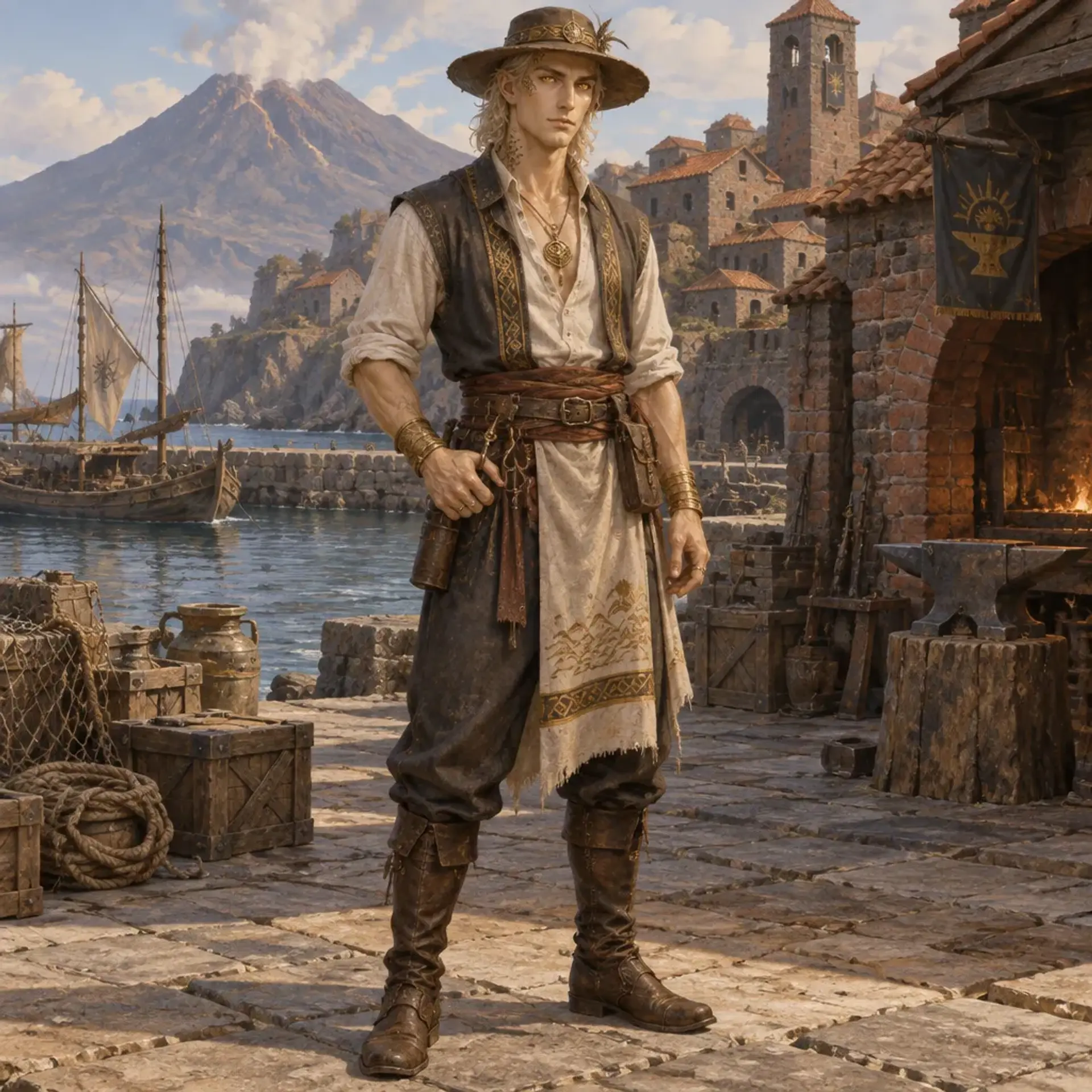
Dracognomus insularis
At a glance
Darkvision You can see in dim light within 60 feet of yourself as if it were bright light, and in darkness as if it were dim light. You cannot discern color in darkness, only shades of gray.
Languages Common, Draconic
Resistances Fire
Height High-blood adults commonly stand 6 ft. 4 in. tall, with many taller. Low-blood adults are also strikingly tall by gnomish standards, often exceeding 6 ft.
Weight 170 to 250 lb., with high-blood individuals tending toward lean, powerful builds and low-blood individuals showing a wider range.
Lifespan They mature at approximately the same rate as gnomes, becoming adults in their late teens or early twenties
At the table
Your size is Medium, and your walking speed is 30 feet.
You have resistance to fire damage, a vestige of the golden dragon's blood bound into your ancestry.
You can breathe a burst of flame in a 15-foot cone. Each creature in the area must make a Dexterity saving throw, with a DC equal to 8 + your proficiency bonus + your Constitution modifier. A creature takes fire damage on a failed save, or half as much damage on a successful one. The damage increases to at 5th level, at 11th level, and at 17th level. After you use this trait, you cannot use it again until you finish a short or long rest.
Accustomed to darkness in workshops, storehouses, and island caverns, you can see in dim light within 60 feet of yourself as if it were bright light, and in darkness as if it were dim light. You cannot discern color in darkness, only shades of gray.
You can speak, read, and write Common and Draconic. Generations of isolation have given local Draconic distinctive expressions and variants, but these are generally understood by speakers of the language.
Choose one kind of artisan's tool with which you are proficient, such as alchemist's supplies, jeweler's tools, smith's tools, or tinker's tools. The patient experimental habits of your people are expressed through the craft you have studied.
Common, Draconic
Fire
Their inherited gnomish curiosity and the rite's physical changes often foster Constitution, Intelligence, or Wisdom, but these are tendencies rather than rules. Assign ability increases according to the character's own history and choices.
A stronger concentration of the rite's draconic inheritance, commonly expressed through golden complexions, fine scales, jewel-bright eyes, and lean, muscular builds. They are more likely than low-blooded relatives to develop claws or other conspicuous features.
High-blooded Shoreforged are the majority and often occupy prominent places in civic, scholarly, and mercantile life. Their height and draconic appearance are admired when they remain within accepted ideals of beauty, but visible horns, tails, or wings can bring shame and fear. Their intensity is not a measure of character, though families sometimes explain possessiveness, pride, or territorial disputes as inherited dragon nature.
Raised on an island forged from the sea by a golden dragon they call ancestor, the Shoreforged are gnomes transformed by a blood rite into a people of towering stature, bright eyes, and carefully guarded histories. They honor dragon wisdom, test every claim in their workshops, and debate inheritance as fiercely as they experiment with magic. Their proud traditions conceal a hard question: did their revered rescue require a blessing, or a profane act of desperation?
The Shoreforged began as gnomes, but an old rite involving a golden dragon's blood altered their descendants over generations.
The change is not present at birth. Infants look much like ordinary gnome children, and the first years of life may reveal little beyond a family's ancestry. During adolescence, many undergo a striking growth spurt accompanied by aches, new appetites, and unsettled moods. The resulting adults are among the tallest people of the Archipelagoes Draconis. High-blooded men commonly stand about 6 ft. 4 in.; women high-blooded are also often well over 6 ft. Low-blooded Shoreforged are shorter on average than high-blooded relatives but remain unusually tall compared with gnomes. High-blooded people tend toward lean, muscular frames, alert expressions, and a forward, predator-like carriage. Their pale skin may carry a warm gold cast, sometimes threaded with fine scales that blend into the skin. Hair is often gold or lighter than the complexion. Eyes range from muted amber to bright gold, with occasional violet or jewel-like hues and narrow, draconic pupils. Low-blooded families vary more widely: some retain gnomish complexions and features, while others show pale gold skin or a taller, stronger frame. Both groups may have sharp teeth or small claws. Horns, tails, and wings are rare and generally considered distressing or unsightly, despite being more likely among people with high proportions of dragon blood. Their prevalence can rise after adulthood, particularly in families with strong draconic inheritance. A physical change is not always a magical one, and families disagree over whether either should be celebrated or concealed. They favor sturdy, well-made clothing suitable for workshops and ships. Distinctive hats, crafted jewelry, and embroidered or layered garments are common markers of household pride. Chinese-influenced silk, cuts, and decorative styles are increasingly fashionable among scholars and social climbers, while many working families prefer durable local cloth.
The Archipelagoes Draconis, especially the forged island raised by the old golden dragon lord.
Communities cluster around harbors, workshops, volcanic slopes, and newly exposed farmland.
Born with an ordinary gnomish appearance, children grow at much the same pace as their ancestors. Their families often record early habits and health carefully, looking for the first signs of change.
As their bodies begin to express the rite, rapid growth, painful joints, shifting appetites, and volatile moods are common. Communities treat this difficult passage as familiar, though its severity varies.
Most have settled into their adult form by their late teens or early twenties. A later emergence of scales, claws, or other draconic features remains possible, especially among high-blood families.
They commonly live for about 300 years, with some reaching considerably older ages. Long life encourages meticulous records, patient craft, and family disputes that can outlast several human generations.
Shoreforged society combines gnomish curiosity and craftsmanship with an orderly, mercantile island tradition reminiscent of Dutch civic life.
Families prize workshops, trade, public records, and careful argument. They are notably experimental in scholarship, alchemy, and magic, even while guarding customs that have endured since the island's founding. Artisans make fine jewelry, mechanical devices, tools, and precise instruments. Silk is a growing fascination, and several wealthy households are exploring whether local production is possible. Practical work clothes are respected for every gender, but clothing styles differ by convention; elaborate fashions are becoming more common among prosperous households and ambitious young people. Men are traditionally favored in inheritance, ostensibly to keep family holdings stable, not because women are deemed incapable. This custom has been contested in records and debate for generations, and outside influences have sometimes strengthened it. The community's scholarly habits make its arguments unusually visible. Most Shoreforged are high-blooded, and their prominence can leave low-blooded people feeling crowded out of authority and attention. The categories describe the extent of draconic inheritance, not a measure of worth. High-blooded people are more likely to develop scales, claws, or other noticeable features, a source of both pride and anxiety. The most accepted signs of dragon heritage are height, strength, handsome scales, unusual eyes, and sorcerous talent; wings, tails, and horns are more often judged beastly. Children begin life looking gnomish, then endure a celebrated but physically difficult transformation in adolescence. Older relatives treat the aches and mood swings as ordinary, though an outsider may find the experience alarming. Their gnomish ancestors relied heavily on foraging and had little livestock. New farmland, exposed by volcanic activity, is promising but unfamiliar, so communities are adapting with mixed success.
Their spiritual life joins ancestor veneration, dragon lore, and animalistic shamanism.
People pray to dragons for guidance, prosperity, or protection, and offer thanks to the old golden lord as the ancestor spirit who made their island possible. Many consider sorcery a blessing when it shows metallic dragon heritage. Public reverence rarely erases private uncertainty: a long-suppressed account holds that the rite was profane magic born from desperation, used because the gnomes could not survive the archipelago without draconic blood. This truth is not confined to one bloodline, though families differ on how much to disclose. Their philosophies span lawful tradition, scholarly skepticism, and personal independence; no alignment is typical.
Shoreforged are generally courteous toward metallic dragons and people with metallic draconic ancestry, whom many regard as possible bearers of wisdom or fortunate influence.
Their relationship with chromatic dragons is marked by fear, and some extend that distrust unjustly to people with chromatic ancestry. They regard Dragonborn as a troubling imitation of a lineage they consider sacred, a judgment that can sour encounters before either side has spoken. Kobolds are often employed as laborers and have historically been denied equal standing, a practice increasingly challenged by reformers and by kobold workers themselves. Low-blooded Shoreforged are not formally treated as lesser, but high-blooded families form the majority and can dominate inheritance, scholarship, and public life. Their culture records disputes carefully, including those over gender. Men are traditionally favored as inheritors to limit abrupt changes in family holdings, but women are not regarded as inherently inferior, and the custom is openly debated. Half-dragons appear in old poems and heroic portraits, but many Shoreforged take them for mythic exaggerations. Those believed to have such parentage may be asked for proof. Any conspicuously beastlike feature can provoke fearful whispers, even among people who publicly celebrate dragon blood.
Their principal island was raised and shaped by the old golden dragon lord, whose intervention turned a hostile stretch of sea and sand into a place where their ancestors could endure.
Settlements use stout brick, timber, tile, seawalls, and carefully engineered canals, with workshops and storerooms placed close to harbors. Their houses favor practical rooms, orderly courtyards, and conspicuous rooflines. Trade and scholarship have recently brought Chinese-influenced screens, textiles, garden layouts, and court furnishings into the homes of scholars and ambitious families. The island's sandy soil long made farming difficult. Recent volcanic activity has raised mineral-rich ground from the ocean floor, prompting experiments with unfamiliar crops, irrigation, and the small livestock inherited from gnomish ancestors. Foraging traditions still shape how many families gather food and share knowledge of local plants.
No images yet.
A high-res, share-ready sheet you can post or print.