
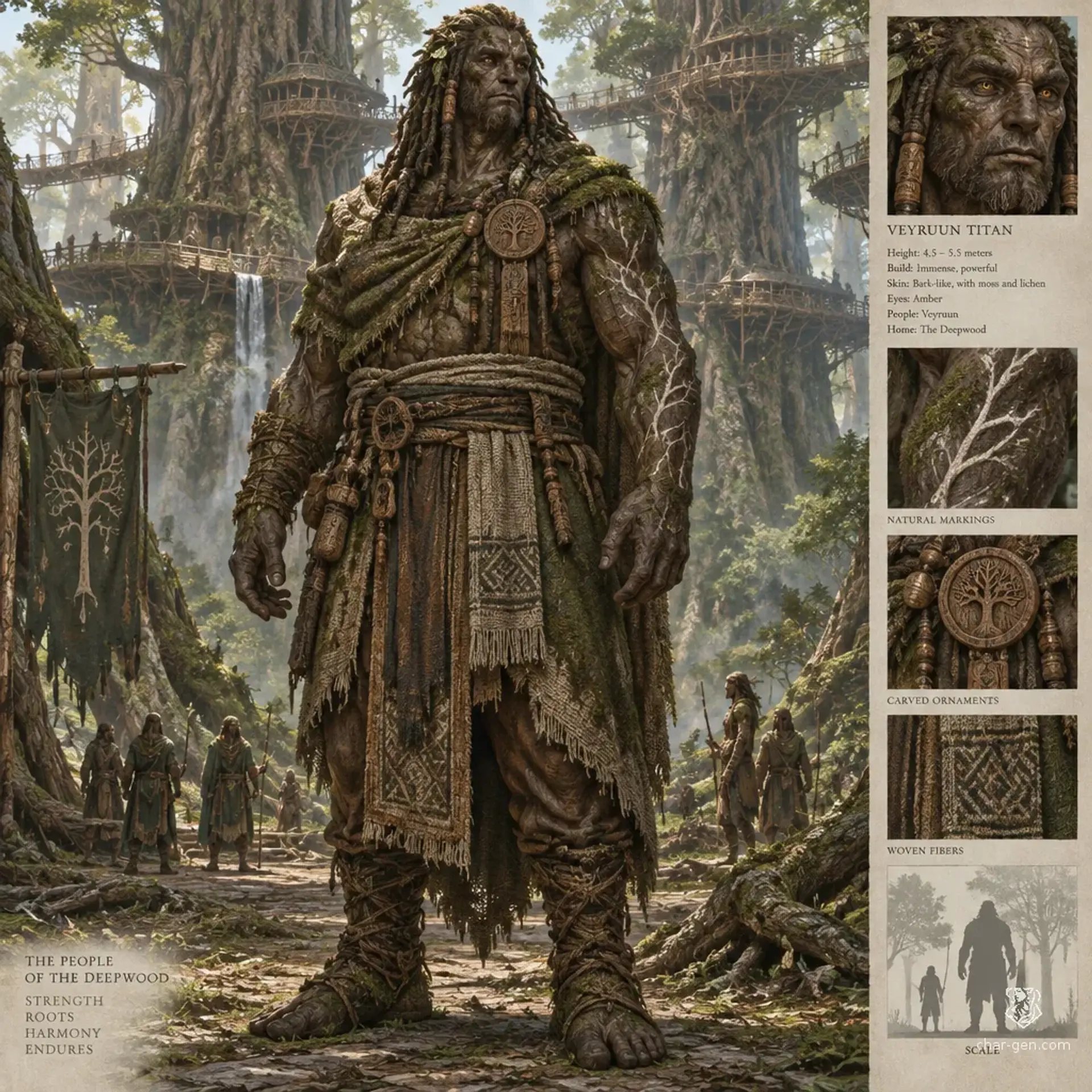
Arborath magnus
On the island of Veyruun, immense trees swallow the horizon and ancient titans walk beneath their canopy.
At a glance
Languages Common, Giant, Veyruun Cant
Height Variable: typically 18 to 45 feet in full stature; a transformed guise is usually 7 to 10 feet tall.
Weight Variable, often 4 to 30 tons in full stature; transformed weight remains substantial, around 400 to 1,200 pounds.
Lifespan 250 to 400 years
At the table
You have a walking speed of 30 feet. You can choose to have a climbing speed of 20 feet, reflecting a life among immense trees; discuss this choice with your DM if the campaign rarely features climbing.
You can squeeze through a space suitable for a creature one size smaller than your full stature, though you move slowly and cannot use this trait to pass through a solid barrier. Your actual size remains unchanged for rules that depend on size.
You can speak, read, and write Common, Giant, and Veyruun Cant. Veyruun Cant is a language of spoken phrases, hand signs, and deliberate gestures adapted for communication across great distances.
Once per Long Rest, when you or a creature you can see within 10 feet takes damage, you can use your Reaction to reduce that damage by an amount equal to your Proficiency Bonus plus your Constitution modifier, to a minimum of 1. This represents a practiced movement that shields a smaller ally or braces your own body.
As a Bonus Action, you can shift between your full stature and a compact guise. In the compact guise, your height is 7 to 10 feet, but you remain Large, retain your weight, and use the same game statistics. Your clothing and carried equipment change size with you. You can remain in either form indefinitely, and this feature does not grant disguise, invisibility, or a change of creature type.
Choose one of the following gifts at character creation: stone, wind, root, or pulse. Once per Long Rest, you can invoke your gift as an Action to produce one effect: stone grants you temporary hit points equal to your character level plus your Constitution modifier; wind lets you move up to your Speed without provoking Opportunity Attacks; root creates a 10-foot-radius area of difficult terrain centered on a point on the ground you can see within 30 feet until the start of your next turn; pulse lets you force one creature within 30 feet that can hear you to make a Strength saving throw, with a DC equal to 8 plus your Proficiency Bonus plus your Constitution modifier, or be pushed up to 10 feet away. Your gift’s appearance reflects your character. These are modest expressions of a legendary lineage, not the full battlefield-scale powers attributed to the Nine.
Common, Giant, Veyruun Cant
Titan-born characters often favor Constitution and Strength, while the more deliberate among them lean toward Wisdom; assign ability score increases as you wish, such as +2/+1 under your table’s rules.
A habit of listening before speaking, with pale, branching marks along the arms or throat.
Rootward titans are closely tied to the island’s oldest groves. They tend toward patience and caretaking, and their gifts often manifest through roots, bark, or the renewal of damaged growth.
On the island of Veyruun, immense trees swallow the horizon and ancient titans walk beneath their canopy. Most keep to the forest, but nine gifted individuals have been bound to an empire as living instruments of conquest. Each bears a singular power, and each must decide whether that power serves a throne, a people, or a future no one has yet imagined.
Veyruun Titans are towering, broad-bodied giants with skin that may resemble dark bark, weathered stone, or earth veined with moss.
Their hair often grows in coarse cords threaded with leaves, seedpods, or beads of polished wood. Eyes catch light like amber beneath a canopy. Each titan bears a distinct bodily sign of their gift: a ridge of mineral plates, a crown of thornlike growths, a voice that stirs leaves, or limbs marked by pale branching lines. Many can assume a shorter, more human-proportioned form, though even then they remain exceptionally tall and heavy. This guise changes scale, not identity, and does not make them easy to conceal.
Ancient forests, especially the immense, densely canopied woodlands of the island of Veyruun; some live in imperial barracks or remote garrisons.
Newly grown titans are already imposing, but their powers are erratic and their judgment untested. They are often raised communally beneath the canopy.
Mature titans develop a signature gift and may take a shorter, human-proportioned guise. Many are pressed into imperial service or choose a life among their own people.
Elders carry long memories, weathered bodies, and authority earned through deeds. Their transformations may be difficult to sustain, but their command of their gift is formidable.
A handful of titans survive for many centuries, becoming landmarks in local memory. Their names may be known across the empire, whether as patrons, weapons, or disasters.
The titan population is broad and diverse, but the Nine are a rare circle of uniquely gifted adults whose powers can reshape the course of a war.
Their gifts are individual rather than hereditary, and no single title or power is identical across generations. The empire claims authority over the Nine through oath, hostage-taking, and inherited treaties, then deploys them to enslave laborers, break resistance, and destroy cities. Some comply, some resist in quiet ways, and some have deserted. Among titans, great size carries responsibility: a careless gesture can kill, so restraint is taught alongside strength. Their most severe social taboo is keeping a human or other small person captive as a toy, pet, or possession. The practice has occurred, often excused as fondness, but is condemned by many titan communities as a profound breach of personhood.
Veyruun traditions honor the old growth as a community of living ancestors, with rites of thanks for fallen trees and solemn observances at the first rains.
Individual titans may follow other faiths. Their moral outlook varies widely, but the island’s customary law emphasizes consent, reciprocal obligation, and care for those placed in one’s keeping. The empire’s commands often test those principles.
The empire presents the Nine as honored guardians, while occupied peoples know them as weapons that can raze a city.
Many titans resent being treated as property, though some accept imperial service for protection, privilege, or fear of reprisal against their kin. Outside the empire, a titan’s scale invites awe and suspicion in equal measure. Some have formed close bonds with humans and other small folk, but Veyruun tradition condemns keeping people as pets or playthings, even when a captor calls it affection. Such captivity is a serious taboo, not a harmless custom.
Veyruun’s trees rise like towers, with broad limbs supporting woven halls, rope bridges, and platforms carved from living wood.
Titan homes are built around roots and clearings rather than within the trees themselves. Imperial outposts use open courtyards, reinforced causeways, and warning bells, since enclosed buildings cannot safely contain a titan.
No images yet.
A high-res, share-ready sheet you can post or print.