
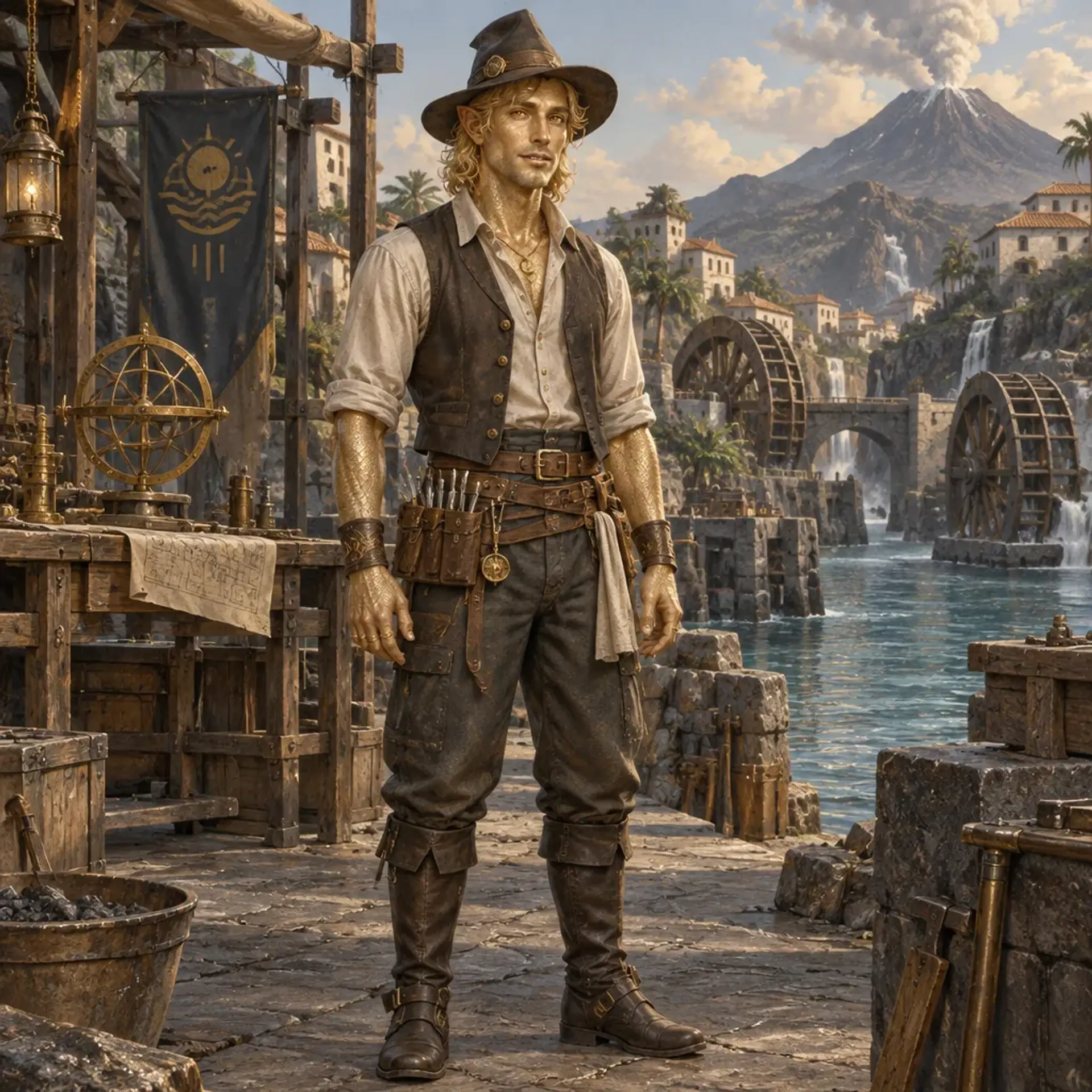
Gnomus draconis auratus
At a glance
Languages Draconic, Gnomish
Height Low-blood adults commonly stand 5 ft. 8 in. to 6 ft. 2 in.; high-blood adults commonly stand 6 ft. 2 in. to 6 ft. 8 in. High-blood men around 6 ft. 4 in. are considered unremarkable.
Weight About 150–230 lb., varying considerably with stature and the lean, muscular build common among high-bloods.
Lifespan 300 to 500 years
At the table
Your size is Medium, and your walking speed is 30 feet.
You have advantage on saving throws you make to avoid or end the poisoned condition, and you have resistance to poison damage. Your altered constitution and practiced care with alchemical materials make many ordinary toxins less effective against you.
You gain proficiency with one artisan's tool of your choice. Their communities value practical skill, and many grow up around workshops, mechanisms, or craft apprenticeships.
You can speak, read, and write Common, Gnomish, and Draconic. In isolated settlements, a local Draconic dialect may differ notably from the speech used elsewhere in the archipelago.
Draconic, Gnomish
Their transformed bodies tend toward Constitution and Intelligence, reflecting hardiness and a culture of craft and experiment, while individual talents vary widely. In this 2014 rules presentation, ability scores are not assigned by ancestry; use the character-creation rules at your table.
Tall, lean, muscular frames; gold or pale-gold skin; fine scales, metallic teeth, jewel-bright eyes, and more frequent claws. Rare horns, tails, or wings occur more often in these lineages and may bring unwanted scrutiny.
High-blooded Auric Gnomes express the old rite strongly and make up the majority of the population. Their appearance is more overtly draconic, and they are often expected to represent their families in trade, scholarship, and public life. Their increased likelihood of visible draconic traits creates a painful tension: the society admires their height, strength, scales, and magical promise, yet may stigmatize the same heritage when it forms horns, tails, or wings.
Born from gnome stock and remade by a golden dragon's blood, the Auric Gnomes are island craftsmen, scholars, and experimenters whose towering bodies bear the visible legacy of a desperate old pact. They honor the dragon who raised their homeland as an ancestor spirit, yet the truth behind that transformation is darker than the public hymns admit. A high-blooded jeweler with golden scales and a low-blooded field scholar may share a family name, a workshop, and a careful silence about the wings, horns, or tails that can turn a marriage prospect into a whispered scandal.
The Auric Gnomes descend from gnomes transformed through a ritual involving a golden dragon's blood.
Their great height is the most obvious change: even low-blooded adults are often taller than the humanoid peoples around them, while high-blood men averaging roughly 6 ft. 4 in. are common. Low-bloods tend to retain more of their gnome ancestors' compact proportions, though they remain tall by comparison. High-bloods are lean, muscular, and predator-like, their silhouettes recalling a golden dragon more than a gnome. Skin ranges from pale white-gold to darker pale gold, with some families retaining more recognizably gnome-colored complexions. High-bloods often have fine golden scales that merge almost seamlessly with the skin, metallic teeth, and sometimes retractable or visible claws. Their hair is commonly gold or lighter than their skin, while their eyes may be amber, bright gold, purple, or another jewel-like hue. Low-bloods show these features more subtly and inconsistently. Horns, tails, and wings are rare, but more likely in families with a high concentration of dragon blood; such traits are often treated as unsightly or beastly, despite the community's reverence for dragons. The change commonly begins after childhood: a period of painful growth and dramatic mood swings can turn a familiar gnome child into a towering adult over a relatively short span.
A single inhabited island in the Archipelagoes Draconis, surrounded by volcanic shoals, reefs, and dragon-claimed waters.
Born with the familiar proportions and features of their gnome forebears, children grow much like ordinary gnome children. Families watch closely for signs of the coming transformation.
The onset of draconic growth brings rapid height, pain, appetite, and volatile moods. The community considers this difficult passage expected, though outsiders may mistake it for illness.
Most have settled into their adult build and social station. Apprenticeship, marriage negotiations, and inheritance expectations become especially prominent.
They can live for several centuries. Elders are valued as witnesses to changing custom, though long life does not prevent family rivalries or stubborn disputes.
Auric Gnome society blends conservative Dutch-inspired civic and mercantile customs with gnome craft traditions.
Chinese influences have recently become more visible in scholarly circles and among social climbers, following the arrival of a new, reluctant golden dragon lord after the death of the old one. The change is debated and closely recorded rather than simply embraced. They are inventive craftsmen, alchemists, mechanics, and magical researchers, often testing ideas that other societies would leave as theory. Their island's isolation has made them tradition-minded, but not intellectually timid. They prize practical clothes for work in women and men, while elaborate dress, jewelry, and distinctive hats are increasingly fashionable. Their metalwork and ornamental arts are admired abroad, and local scholars are considering how to establish silk production of their own. Their society is notably patriarchal: men are usually treated as the default inheritors, a convention intended to prevent abrupt shifts in family estates. Women are not considered inherently lesser, and the origins and consequences of the custom are frequently debated in the archives. High-blood and low-blood are social and physical descriptions of how strongly the old rite expresses itself, not separate peoples or fixed ranks. High-bloods show more draconic stature and features and hold the demographic majority; low-bloods retain more visible gnome traits. The old transformation was not natural, nor simply a freely bestowed blessing. A guarded historical truth holds that desperate founders used profane magic because they could not survive the archipelago without draconic blood. The account is known within more than one lineage, but its implications are often softened in public. Earlier heroes appear in paintings and poems as half-dragons, though most scholars consider this symbolic rather than literal.
Dragons hold spiritual as well as political importance.
Many pray to the former golden dragon lord, called the ancestor spirit, for guidance, prosperity, and protection, while animalistic shamanic practices treat dreams, weather, and encounters with creatures as possible counsel from the unseen. The new golden dragon lord is respected, but also regarded with uncertainty after the death of the previous ruler. Metallic-dragon sorcery is commonly celebrated as a blessing; other visible or magical changes may be judged more cautiously. Their scholarly traditions encourage debate over doctrine, and no single alignment defines them, though family duty, measured prosperity, and social order are often prized.
They are warm toward metallic dragons and peoples with metallic-dragon ancestry, whom they regard as kin or worthy allies.
Their stance toward chromatic dragons and chromatic-blooded peoples ranges from wary distance to cruelty, shaped by fear and the dangers of a dragon-dominated archipelago. They regard dragonborn as a troubling, often perverse imitation of the bloodline they received through the founding rite. Kobolds commonly perform labor in their settlements but are not generally treated as social equals, a hierarchy some Auric Gnomes defend and others question. High-bloods form the majority and can dominate public life; low-bloods are not formally despised, but may feel overshadowed. Visible wings, tails, or horns can lead to avoidance and reduced marriage prospects. A person with such traits is not ordinarily attacked, yet families may quietly treat the condition as a social and political risk.
Their homeland is a forged island raised by the former golden dragon lord, revered as the ancestor spirit.
Its earliest ground was sandy and poor, but recent volcanic upheaval has lifted dark, mineral-rich earth from the sea. Settlements combine compact gnome workshops, steep-roofed Dutch-inspired houses, canals, wind and tide machinery, and newer courtly pavilions influenced by the incoming lord's Chinese traditions. Workshops and archives occupy the best-protected streets; family warehouses and gardens crowd the canals. Farming remains an experiment rather than an ancient expertise. Their livestock descend from gnome stock, while foraging knowledge and careful seed trials still supplement the harvest.
No images yet.
A high-res, share-ready sheet you can post or print.