
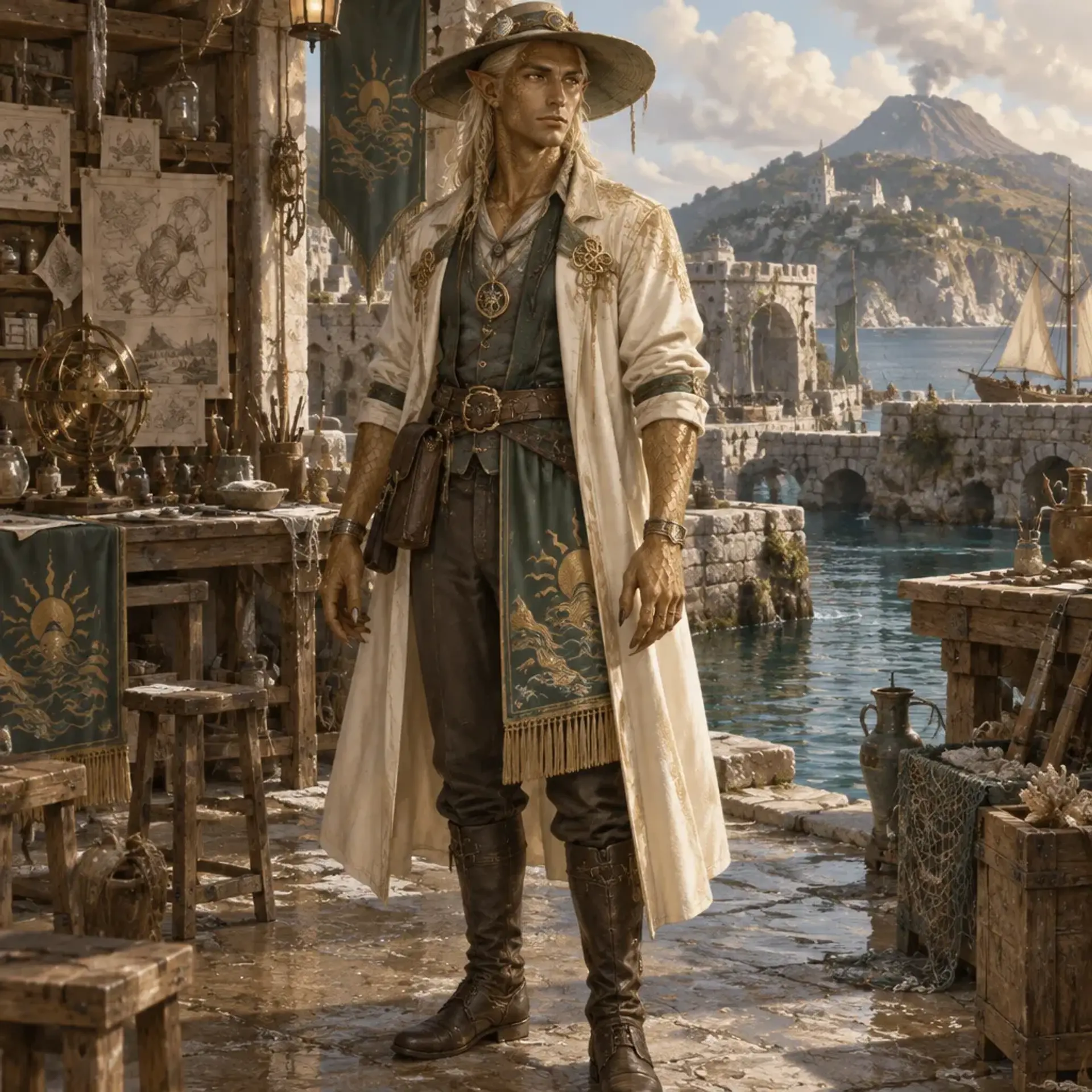
Aureognomus draconis
The Aurelkin are tall, scholarly islanders whose gold-dragon heritage is both their salvation and their most guarded secret.
At a glance
Darkvision 60 ft.
Languages Common, Draconic
Resistances Fire
Height High-blooded adult males average about 6 ft. 4 in.; most adult Aurelkin stand between 5 ft. 10 in. and 6 ft. 8 in. Low-blooded adults are also strikingly tall, commonly around 5 ft. 8 in. to 6 ft. 4 in.
Weight About 150 to 230 lb., with substantial variation by build and lineage.
Lifespan 300 to 450 years
At the table
Your base walking speed is 30 feet.
Accustomed to dim workshops, deep cellars, and night watches along the sea walls, you can see in dim light within 60 feet as though it were bright light, and in darkness as though it were dim light. You cannot discern color in darkness, only shades of gray.
Your altered blood lends you resistance to fire damage.
You gain proficiency in Arcana. Your people combine patient observation with bold experimentation, and you have learned to recognize the signs of magical processes even when their purpose is unclear.
You can speak, read, and write Common and Draconic. The Draconic used in the archipelago has developed local expressions and pronunciations through generations of isolation.
Common, Draconic
Arcana
Fire
Aurelkin often tend toward Constitution and Intelligence, reflecting their altered endurance and experimental scholarship, while others favor Dexterity, Wisdom, or the force of personality needed to navigate their closely watched society. For D&D 5E (2014), assign ability score increases using your table's preferred method rather than tying them to ancestry.
More common and more visibly draconic, High-blooded Aurelkin often show gold scales, jewel-bright eyes, fine claws, and a lean, powerful build. Rare horns, tails, or wings occur more frequently in these families and may be met with both fascination and social discomfort.
High-blooded Aurelkin are the majority and the most prominent lineage in civic life. Their stronger visible inheritance is associated with metallic-dragon sorcery and a heightened sense of pride, possession, and ancestral obligation. These tendencies are cultural and personal as much as physical; no High-blooded individual is destined to be arrogant or greedy.
The Aurelkin are tall, scholarly islanders whose gold-dragon heritage is both their salvation and their most guarded secret. They make precise machines, beautiful jewelry, and bold experiments in magic, yet their ordered houses and dragon reverence conceal a difficult history: their celebrated transformation began as a desperate act, not a pure blessing. Whether an Aurelkin is a meticulous Low-blooded investigator or a proud High-blooded artisan, they carry the same question into the wider world: what does a people owe the power that saved them?
Aurelkin descend from gnome families altered by a desperate ritual involving the blood of an ancient gold dragon.
The transformation is not an ordinary inheritance and does not occur fully at birth. Aurelkin infants resemble their gnome ancestors, and their early childhood is much like that of other gnome-kin. At puberty, the body begins a painful, uneven reworking: limbs lengthen, the frame broadens, and the face and voice may change over several years. The aches and mood swings are notorious, and local households keep familiar remedies and patient relatives close at hand. Most Aurelkin are among the tallest people of the archipelago. High-blooded adults are generally lean and muscular, with a bearing compared by outsiders to a hunting animal. Their skin ranges from pale white to warm gold, sometimes with fine scales that blend almost seamlessly into the skin. Hair is often gold or lighter than the complexion. Eyes may be amber, bright gold, purple, or another jewel tone, with a distinctly draconic sheen. Their teeth can be sharper and more metallic in appearance than those of their gnome ancestors, and some have claws that make delicate work awkward until they learn control. Low-blooded Aurelkin tend to retain more of their gnome-derived facial features, skin tones, and proportions, though they too are unusually tall by gnome standards. Low-blooded families are a small but established part of the population. The terms High-blood and Low-blood describe the perceived degree of draconic influence, not moral worth, and neither category guarantees a particular temperament or appearance. Horns, tails, and wings are rare. Their appearance is often treated as troubling or beastly, especially in a society that admires draconic strength but fears uncontrolled bodily change. Such traits are more likely among High-blooded families, and marriage arrangements may become unusually cautious when a family history includes them. Some Aurelkin develop additional scales, claws, or other visible features in young adulthood, particularly when exposed to powerful magic.
The inhabited island called the Forged Isle, within the Archipelagoes Draconis, as well as ports and scholarly enclaves throughout the surrounding islands.
Born with the familiar proportions and features of their gnome ancestors, children are raised among extended family and learn craft, debate, and practical household skills.
Puberty brings the most dramatic bodily changes. Growth spurts, aching joints, changing voices, volatile moods, and sudden shifts in appetite are common enough to have their own songs and remedies.
After the transformation settles, most Aurelkin live as adults for several centuries. Their society recognizes adulthood by competence, chosen vocation, and family obligations rather than a single ceremony.
Old age may bring a renewed affinity for solitude, teaching, and the interpretation of ancestral records. Some elders develop stronger golden scales or a more imposing presence, though this is not universal.
Aurelkin culture is orderly, industrious, and deeply conscious of household reputation.
Its older customs grew from gnome practices reshaped by island hardship and a prudent, mercantile sensibility: accounts are kept, tools are maintained, promises are witnessed, and public decisions are argued at length. Craftsmanship is a respected vocation, from jewelry and mechanical devices to alchemy and magical research. Experiment is admired when it is recorded carefully and its risks are understood, although elders may distrust innovations that unsettle family holdings. The population is mostly High-blooded, and their greater height and visible gold-dragon traits often set the tone for public ideals. Low-blooded families are recognized as Aurelkin, not treated as an inferior caste, yet they can find the High-blooded majority overbearing. Their difference may be praised as steadiness or criticized as a lack of grandeur, depending on the speaker and the occasion. The ancestry's most uncomfortable secret is that the transformation was neither natural nor simply a blessing. The old dragon's blood and a profane, desperate rite changed the people because their original bodies could not endure the archipelago's harsh conditions. Many Aurelkin know only a softened version of this history. A small circle of archivists and family custodians preserve accounts that suggest a more painful truth. The society is notably patriarchal in inheritance. Men are commonly designated as primary heirs, a practice defended as a way to prevent sudden shifts in family property and alliances. Women are not considered inherently lesser, and the culture's gnome foundations never established a strict doctrine of female inferiority. The resulting contradiction is openly debated, especially by scholars and ambitious social climbers influenced by the current dragon lord's court. Chinese-inspired fashions and intellectual customs have recently become more visible in elite and academic circles, though they are not universal throughout the population. Practical clothes are respected for all genders, particularly in workshops and fields. Formal dress increasingly includes silk, embroidered panels, polished metal ornaments, and ornate hats. Silk is a new fascination, and proposals to cultivate local silkworms have become the subject of both serious study and heated dinner conversation. Farming remains experimental. Aurelkin families traditionally relied heavily on foraging, and volcanic deposits have only recently made wider cultivation practical. Their livestock descends from gnome-era stock and is limited in variety, prompting inventive methods that sometimes work and sometimes become cautionary entries in agricultural journals.
The ancient gold dragon who raised the Forged Isle is honored as the Ancestor Spirit, a source of rescue, wisdom, and continuing responsibility.
Aurelkin may pray to dragons for guidance or good fortune, but the practice is often closer to reverent counsel than worship of a distant deity. Spiritual traditions mix animal symbolism, shamanic interpretation, household rites, and scholarly commentary. Sorcery believed to descend from metallic dragons is often celebrated as a blessing. The hidden account of the transformation complicates this reverence: some elders know the rite involved profane magic born of desperation, while others regard that claim as an attack on their people's founding story. Aurelkin can be of any alignment, though communal duty and formal debate often encourage lawful habits.
Aurelkin are hospitable to visitors who respect their craft, household customs, and careful manners, though their curiosity can feel like interrogation.
Metallic dragons and peoples with metallic draconic heritage are treated with warmth or guarded reverence. Chromatic dragons are feared, and chromatic-blooded peoples may encounter distance, suspicion, or deliberate cruelty rooted in old island dangers. Aurelkin commonly regard dragonborn as a troubling imitation of the draconic inheritance that shaped them, a prejudice some are beginning to challenge. Kobolds are frequently employed as laborers and are not generally treated as social equals, despite the irony of Aurelkin themselves having been rescued by a dragon. Low-blooded Aurelkin are not formally degraded, but the High-blooded majority can dominate public life, marriage negotiations, and civic prestige. The community's prolific records and debates preserve dissent as well as custom, giving reformers unusually strong evidence to argue from.
The Aurelkin homeland is an island raised and shaped by the ancient gold dragon they call the Ancestor Spirit.
Its old foundations are said to be dragon-wrought, though modern buildings combine stone quays, brick gables, steep roofs, canal-side workshops, and sturdy sea walls. Much of the island once had sandy, poor soil. Recent volcanic activity has lifted and enriched parts of the seafloor, giving farmers new ground to test. Homes and work halls are compact, orderly, and built to withstand salt wind; wealthy houses add courtyards, carved screens, silk hangings, and imported scholarly fashions. Broad hats are both practical protection and a conspicuous marker of local style.
No images yet.
A high-res, share-ready sheet you can post or print.