
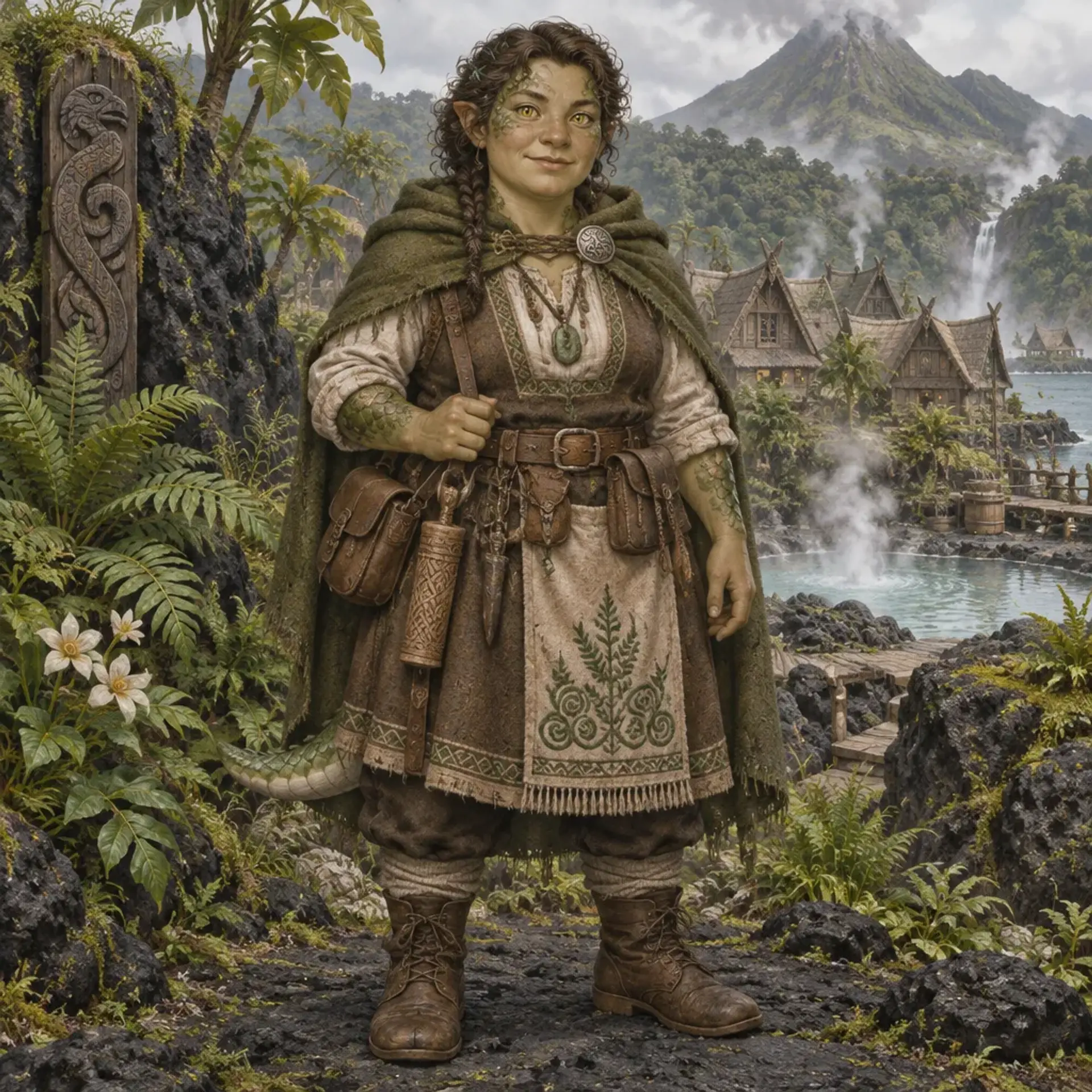
Homo draconis insularis
Three generations ago, halfling refugees crossed a dragon-haunted wilderness and found a green island that seemed made to shelter them.
At a glance
Darkvision 60 ft.
Languages Common, Halfling
Resistances Poison
Height Low-Blood: 3 to 4 ft.; High-Blood: 4 to 6 ft.
Weight Low-Blood: 35 to 55 lb.; High-Blood: 70 to 180 lb.
Lifespan Low-Blood members commonly live about a century
At the table
Your creature type is Humanoid. You are Small or Medium, chosen when you select this species. Your walking speed is 30 feet.
You have Darkvision with a range of 60 feet. Your eyes are adapted to forests and volcanic nights, though sudden bright light can still startle you.
You have Resistance to Poison damage. Your draconic inheritance also helps you withstand toxins, though it does not make you immune to their effects.
Choose Nature or Deception. You gain proficiency in the chosen skill, reflecting either your knowledge of the island’s living hazards or the discretion learned by a people who have had to hide.
Choose one of the following inheritances. The choice reflects your family’s expression of the dragon’s gift, not a separate people.
Common, Halfling
Poison
The Low-Blood often tend toward Constitution and Wisdom, while the High-Blood often favor Dexterity and Charisma. These are cultural and biological tendencies only; assign ability score increases as you wish.
Usually Small, with mostly halfling proportions and only subtle draconic features.
The older and less visibly transformed line preserves more of the refugees’ halfling appearance and communal traditions. When you or a creature you can see within 30 feet makes a saving throw to avoid or end the Frightened condition, you can use your Reaction to give that creature Advantage on the save. You can use this benefit a number of times equal to your Proficiency Bonus, and regain all expended uses when you finish a Long Rest.
Three generations ago, halfling refugees crossed a dragon-haunted wilderness and found a green island that seemed made to shelter them. A wounded dragon gave them her blood to help them survive; now her descendants are changing, and the village is split between those who remember a small, communal refuge and those who see a future shaped by draconic power. Mossblood Islanders carry that argument in their bodies.
Mossblood Islanders descend from halfling refugees transformed by a secret ritual using the blood of a wounded green dragon.
Low-Blood members remain recognizably halfling: compact, broad-footed, and often round-faced, with faintly green undertones to their skin, small patches of scales, or unusually bright eyes. High-Blood members are generally taller and leaner, with more extensive green scales, slit pupils, small horns, tails, or, rarely, vestigial wings. The inheritance is unpredictable, even within one family. Many children undergo painful adolescence as their bodies change, and some develop features that require special care, such as difficulty chewing or swallowing.
A volcanic archipelago of dense forest, mineral-rich hills, hot springs, fertile clearings, and dangerous draconic wilderness.
Small and quick to learn, children are raised among extended family and taught practical skills early. High-Blood children may experience painful growth spurts that worry their elders.
Most reach physical maturity in their late teens. Adulthood is marked by taking on a household duty, craft, or obligation to the village.
Low-Blood members commonly live around 100 years. High-Blood members have uncertain lifespans, with some showing signs of draconic vigor and others suffering from their unstable inheritance.
Their society is undergoing upheaval.
Low-Blood families preserve halfling customs of shared meals, mutual aid, and collective responsibility, adapted to a harsh island where every harvest matters. The younger, mostly High-Blood generation is more aloof and competitive, and some take pride in hunting dangerous creatures. Germanic-inspired clothing, craft guilds, seasonal feasts, and village councils have become prominent, while old halfling traditions are being reshaped or abandoned. Increasingly rigid expectations based on sex have appeared among some High-Blood groups, though many elders and young people resist them. Magic is more common than it was among the first settlers, and the source of this change remains contested.
Older families favor household rites, seasonal observances, and remembrance of the dead, often leaving offerings at springs or family hearths.
Younger High-Blood members are more likely to adopt formal vows, status customs, or private devotional practices influenced by draconic ideas of strength and order. The community has no single alignment: its traditions of mutual care contend with growing ambition, secrecy, and hierarchy.
Mossblood Islanders remain wary of dragons after the devastation that drove their ancestors from home.
Their history with the wounded green dragon is intimate but disputed: some remember her as a rescuer, others as the source of their present troubles. Relations between Low-Blood elders and High-Blood youth are strained by differences in stature, temperament, and custom. The golden, serpentine beings seen on the islands inspire fear and curiosity in equal measure. Outsiders may be welcomed as useful allies, but trust is earned through reliable actions rather than grand promises.
Their first settlement began as a refuge of low, timber-framed homes with steep roofs, covered walkways, and root cellars built to withstand storms and ashfall.
Germanic-inspired dress and craft traditions have grown more prominent over three generations: wool tunics, embroidered aprons, sturdy boots, carved beams, and communal halls. Older homes cluster around gardens and shared ovens; newer High-Blood houses are often taller, more private, and built with balconies or broad roofs suited to unusual bodies.
No images yet.
A high-res, share-ready sheet you can post or print.