
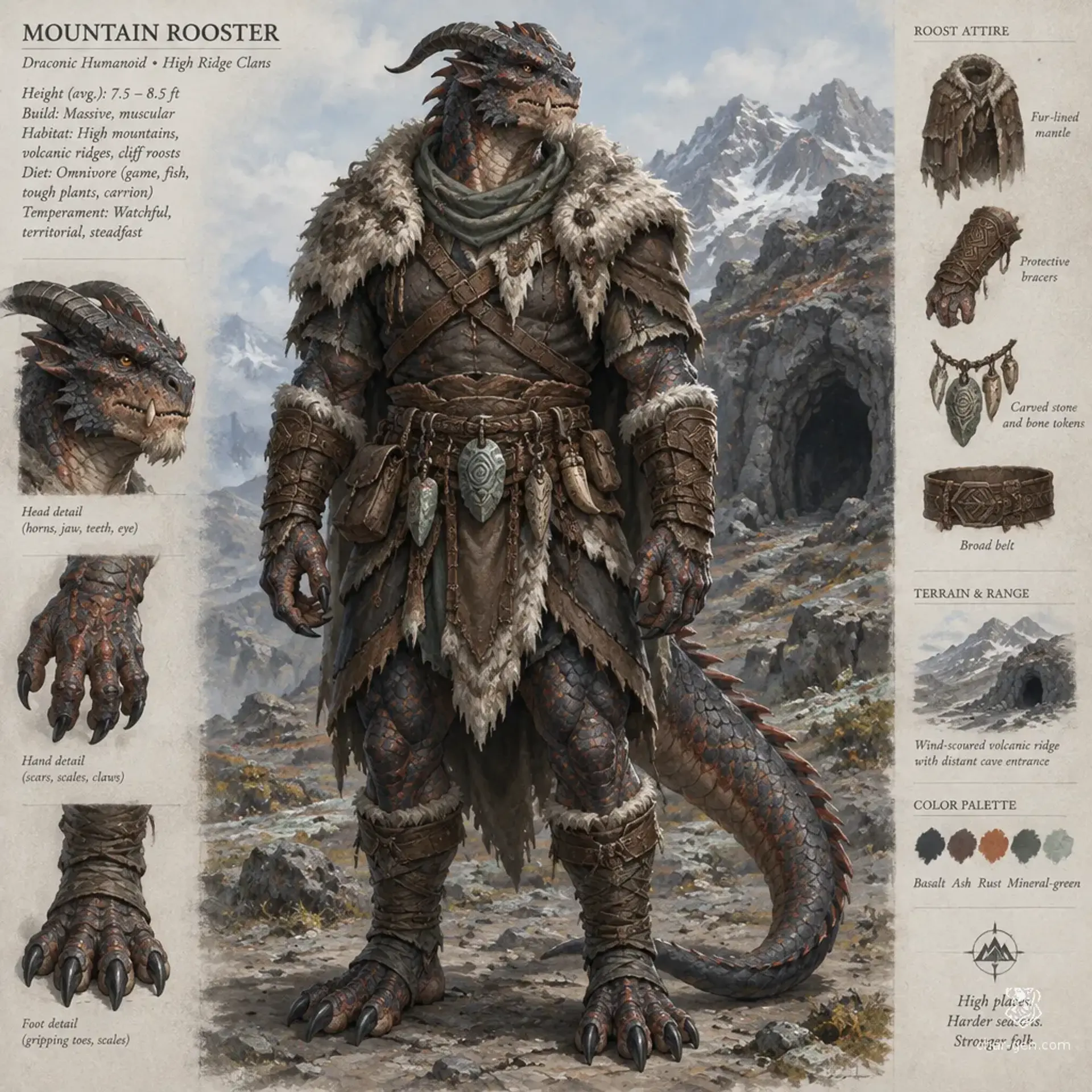
Dracanthropus montivagus
Ridgeborn are immense, hard-scaled descendants of dragonkind whose bodies carry far more draconic force than those of ordinary dragonborn.
At a glance
Darkvision 60 ft.
Languages Common, Draconic
Height 6 ft. 4 in. to 7 ft. 4 in.
Weight 260 to 390 lb.
Lifespan 90 to 120 years, adult at 18
At the table
You are a Beast-folk, and you are Medium.
Your walking speed is 30 feet. Your powerful claws and gripping toes give you a climbing speed of 20 feet on natural stone and other rough surfaces.
Choose a draconic aspect when you select this species: acid, cold, fire, lightning, or poison. Once per turn, when you hit a creature with an unarmed strike, you can deal extra damage of that aspect's type equal to your proficiency bonus. You can use this benefit a number of times equal to your proficiency bonus, and you regain all expended uses when you finish a Long Rest.
You can exhale destructive energy in a 15-foot cone or a 30-foot-long, 5-foot-wide line. Each creature in the area makes a Dexterity saving throw, with a DC equal to 8 + your Constitution modifier + your proficiency bonus. On a failed save, a creature takes damage of your chosen draconic aspect's type; on a successful save, it takes half as much damage. The damage increases by when you reach character levels 5, 11, and 17. You can use this breath a number of times equal to your proficiency bonus, and you regain all expended uses when you finish a Long Rest.
You have advantage on Wisdom (Perception) checks that rely on hearing or smell. Your heightened senses are suited to detecting movement and unfamiliar scents in the thin, echoing air of the high mountains.
Common, Draconic
Their massive frames and keen sense for danger tend toward Constitution and Wisdom; players assign +2/+1 as they wish, or use another ability-score method allowed by the table.
Their breath and scales carry the chill of high-altitude ice.
Frostcrests favor snowbound roosts and are patient trackers. Their scales are often pale gray, blue-white, or the color of weathered ice. Choose cold as your draconic aspect.
Ridgeborn are immense, hard-scaled descendants of dragonkind whose bodies carry far more draconic force than those of ordinary dragonborn. They descend from isolated mountain clutches that prize strength, vigilance, and a fierce claim to their ancestral heights. Most regard standard dragonborn as pale, weakened kin, a judgment that has earned them few friends beyond their own roosts. A ridgeborn adventurer may be a clan envoy, an exile, or simply someone who has discovered that the wider world is more complicated than the old stories say.
Ridgeborn are hulking draconic humanoids with dense frames, deep chests, heavy tails, and thickly scaled hides.
Their jaws are broad, their teeth prominent, and their brows often carry horns or bony ridges. Clawed hands and feet grip rough stone with ease. Their scales range from slate, rust, and basalt to muted greens and coppery browns; a few show brighter mineral flecks along the neck or spine. Their throats swell subtly when they gather the force for a breath, and their voices carry a rough, resonant rumble. Despite their monstrous appearance, they have expressive eyes and careful hands, traits that outsiders often overlook.
High mountains, volcanic ridges, wind-scoured plateaus, and cavern systems near old dragon lairs.
Hatches strong-limbed and alert, but remains dependent on its clutch for protection and instruction.
Learns clan law, climbing, and the controlled use of its breath. Young adults often undertake a solitary trial before earning a full name.
An adult is expected to defend the roost, contribute to its stores, and answer for its kin in disputes.
Older individuals often become scarred counselors and living repositories of clan grievances, though many remain formidable hunters.
A roost is both home and political body, usually organized around clutches and the elders who remember their obligations.
Status is earned through protection, useful skill, and controlled strength, not size alone. Public contests test endurance or judgment, and a challenge is expected to have clear terms and a peaceful conclusion. Ridgeborn distrust outsiders and often describe ordinary dragonborn as frail imitations of their draconic inheritance. This belief can make them arrogant, but it is also bound up with a history of defending isolated homes from raiders and hungry predators. Those who leave the mountains may find their assumptions tested by the people they once dismissed.
Many honor ancestral dragons as formidable forebears rather than distant gods, while some revere mountain spirits, elemental forces, or the remembered dead of their clutch.
Their traditions favor keeping one's word and defending kin, but neither practice dictates goodness: ridgeborn can be generous protectors, hard-edged traditionalists, or ambitious raiders. Their suspicion of outsiders is cultural, not innate, and individuals vary widely in how they interpret it.
Ridgeborn are wary of unfamiliar peoples and slow to trust promises made without witnesses.
Their contempt for standard dragonborn is a point of pride in many roosts, though individual ridgeborn may question that prejudice after meeting dragonborn who show courage, ingenuity, or loyalty. They respect demonstrated competence more readily than titles, and a shared hardship can earn trust faster than years of polite conversation. Their imposing appearance and blunt customs often provoke fear or offense before a relationship has a chance to form.
Their roosts occupy defensible ledges, deep caves, and old calderas.
Buildings are low, thick-walled, and anchored into rock, with broad ramps and reinforced thresholds sized for heavy bodies. Communal halls are often carved directly into the mountain, while narrow watch paths and exposed platforms test visitors before they reach the clan's inner chambers.
No images yet.
A high-res, share-ready sheet you can post or print.