
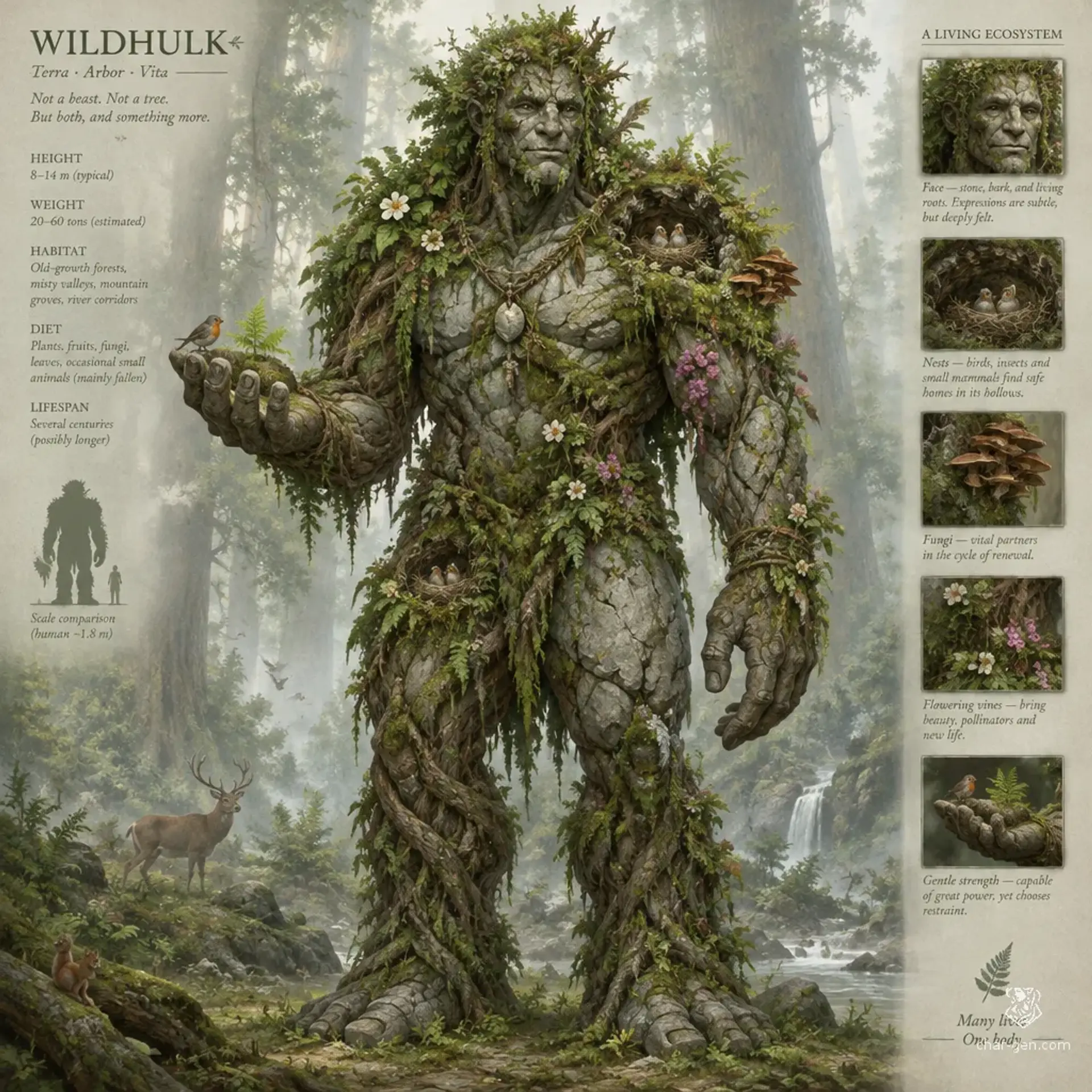
Magnogena silvestris
A Wildhulk is a walking landscape, immense enough to turn a path into a shadow and gentle enough to pause for a snail crossing its hand.
At a glance
Languages Common, Giant, One language associated with your homeland or the creatures among whom you were raised
Resistances Choose one damage type when you select your subspecies: bludgeoning, piercing, or slashing. You have resistance to that type, representing your body's predominant material.
Height 12 to 24 feet, though some bodies are broader than they are tall
Weight 3 to 20 tons, varying greatly with material and density
Lifespan 400 to 800 years
At the table
Your creature type is Giant, and your size is Large. You can move through the space of a Medium or smaller creature, though you cannot end your turn there. You can squeeze through an opening large enough for a Medium creature, treating it as difficult terrain.
Your base walking speed is 30 feet. Your body can absorb a punishing blow, but its resilience depends on its dominant material. Choose bludgeoning, piercing, or slashing damage when you select your subspecies; you have resistance to that damage type.
You have proficiency in one skill of your choice from Animal Handling, Athletics, Nature, or Survival. In addition, you can communicate simple ideas to Beasts and Plants through gestures, scent, and patient attention. This does not grant them the ability to understand speech, and it does not compel them to help you.
When you take the Search action, you can focus your senses on signs of nearby natural life. Until the end of your next turn, you know the direction of any Beasts or Plants within 60 feet that are not behind total cover. You learn their exact location only if you can see them.
These folk tend toward Constitution and Wisdom, reflecting immense endurance and a patient attentiveness to living things. Players assign any ability score increases according to the 2024 rules; no scores are fixed by ancestry.
A body chiefly composed of living wood, vines, leaves, and other plant matter.
Greenhearts are most at ease in forests and gardens, and often carry blossoms, nests, or seedlings in their limbs. Their chosen resistance is usually piercing damage, but it may reflect another material in their body.
A Wildhulk is a walking landscape, immense enough to turn a path into a shadow and gentle enough to pause for a snail crossing its hand. It loves growing things, quiet company, and the small marvels most folk overlook. But its home is sacred, and an invitation is a deliberate bond of trust. Harm what it protects or presume upon its welcome, and the patient giant may answer with a violence that reshapes the ground.
Wildhulks are immense living beings whose bodies form from materials found in nature.
One may be a mass of corded muscle and hide, another a walking tangle of wood and leaves, a pillar of layered stone, or a shifting shape of sand threaded with roots. Many combine several materials, incorporating moss, shells, soil, bone, or flowering growth. Their silhouettes are rarely symmetrical. Faces may be recognizable features in bark or rock, glimmers within a cloud of petals, or a quiet hollow in a mound of flesh. Small creatures often nest on or within them, and many take deliberate care not to disturb their passengers. A Wildhulk's body is not a suit or construct: it is alive, responsive, and often capable of slowly replacing damaged material from its surroundings.
Old forests, mountain ranges, river deltas, deserts, peatlands, and other places where natural materials gather and change over long spans of time.
Individuals may travel, but most feel a lasting pull toward a particular landscape.
Newly formed from a natural convergence, a youngling is small by its kin's standards and eager to handle everything it sees. It may take decades to settle into a stable body.
A settled adult has chosen a durable shape and can maintain a home, make treaties, and take responsibility for a stretch of wild country.
An elder's body may hold centuries of growth: ancient wood, strata of stone, or generations of plant life. Its memories can be patient, symbolic, and difficult to hurry.
Wildhulks are solitary by habit but not necessarily lonely.
They gather for migrations, seasonal exchanges, or to settle disputes over watersheds and old-growth places. Their customs prize measured speech and practical hospitality: a shared meal, a safe place to rest, or permission to cross a protected hollow can be meaningful offerings. Their homes are private sanctuaries. A guest is expected to follow the host's rules, avoid harming living features of the dwelling, and understand that the invitation can be withdrawn. Anger is uncommon but unmistakable; a Wildhulk may first warn a trespasser through shifting stones, closing roots, or a sudden silence among birds.
Wildhulks honor cycles of growth, decay, and renewal, often through local spirits, ancestral places, or seasonal rites rather than organized temples.
Their outlook tends toward neutrality, though individuals may be tender, stern, generous, or wrathful. Many consider a promise made under their roof to be as binding as an oath sworn before a ruler.
Wildhulks are curious about small folk and often enjoy their music, tools, gardens, and brief, bright lives.
Their size makes ordinary gestures dangerous, so trust is built through patience and clear boundaries. They are violent when provoked, especially when guests threaten their homes or the smaller creatures under their protection. An invitation to enter a Wildhulk's home is a rare sign of trust and may carry obligations of hospitality, discretion, and care. They may form deep bonds with communities, but rarely accept that affection grants anyone ownership over their land or labor.
Their homes are less built than cultivated.
A giant might hollow a living tree without harming it, arrange boulders into a windbreak, or shape a sheltered hollow in a dune. Entrances are scaled to their enormous bodies, while inner gardens and niches protect small animals and delicate plants. A formal invitation grants a guest the right to enter and share the host's shelter; arriving uninvited is often treated as trespass, and damaging a home is a grave offense.
No images yet.
A high-res, share-ready sheet you can post or print.