
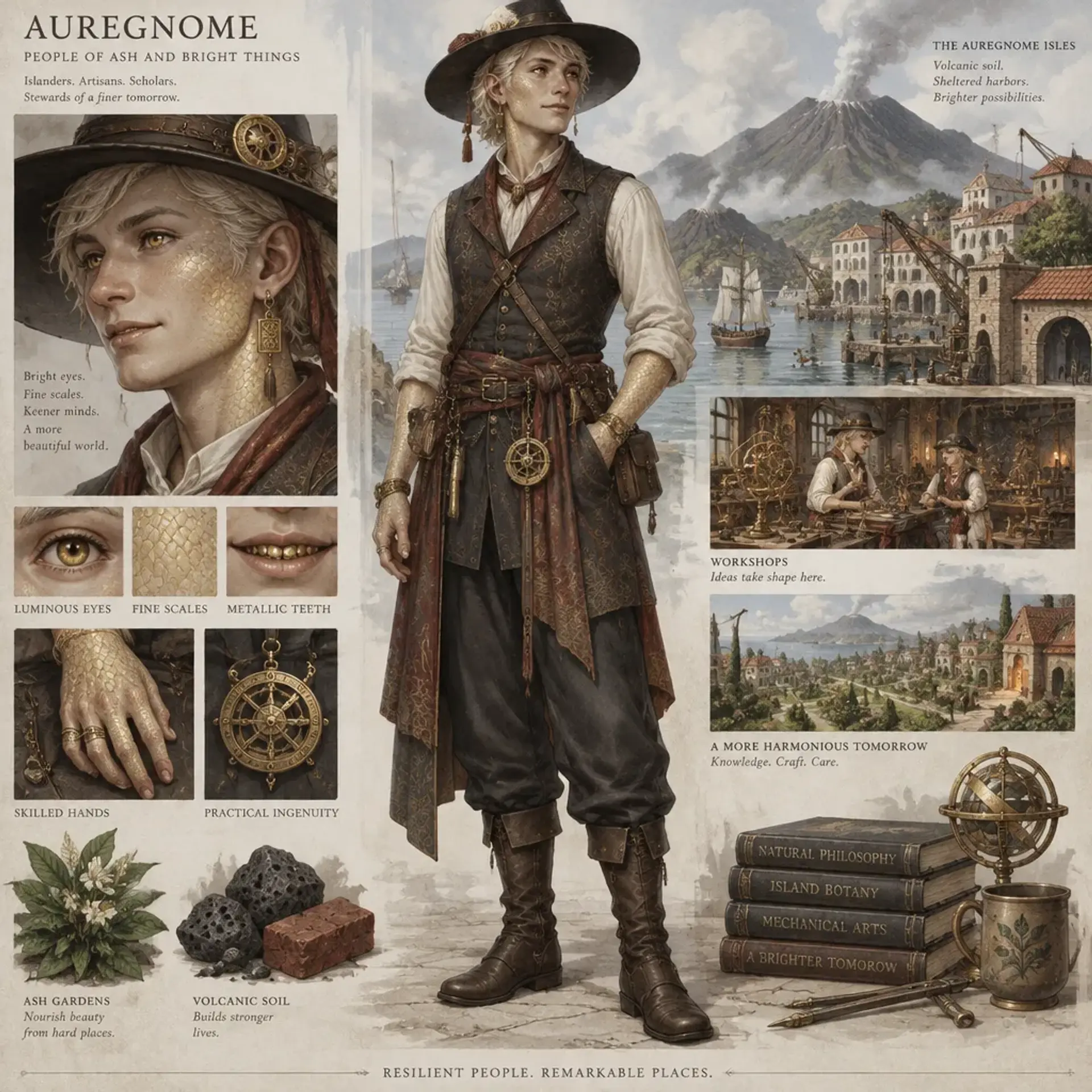
Aureognomus draconis
On a forged island raised from the sea by a golden dragon, gnome descendants carry a deliberate inheritance of dragon blood.
At a glance
Languages Draconic, Gnomish
Height About 5 ft. 8 in. to 6 ft. 6 in.; many exceed 6 ft., and even low-blood individuals are notably tall for their gnome ancestry.
Weight About 150 to 230 lb., with high-blooded individuals tending toward lean, muscular builds.
Lifespan 250 to 350 years
At the table
Your walking speed is 30 feet.
Your draconic inheritance grants resistance to one damage type: acid, cold, fire, lightning, or poison. Choose the type when you select this ancestry. This choice reflects a family's inherited expression of the old rite, not a guarantee that its members share the same temperament.
Choose one skill from Arcana, History, Investigation, Nature, or Sleight of Hand. You gain proficiency in that skill, reflecting a culture where inquiry and practical craftsmanship are widely taught.
You know the Draconic language. If your character already knows Draconic, work with the DM to choose another language spoken in the campaign. Local Draconic has developed distinct accents and expressions during the island's long isolation.
Once per long rest, when you fail an Intelligence, Wisdom, or Charisma saving throw, you can call on your inherited steadiness and add to the roll, potentially turning failure into success. You must decide to use this trait before the DM says whether the saving throw succeeds.
Draconic, Gnomish
These folk often cultivate Constitution through hard work and Wisdom through careful observation, though their experimental scholars may favor other talents. In D&D 5E (2014), assign ability score increases according to your table's character creation rules rather than receiving fixed increases from this ancestry.
More frequent scales, golden eyes, pale or gold hair, metallic teeth, and occasional claws; horns, tails, or wings are also more likely to appear.
High-blooded auregnomes carry a stronger expression of the old rite and make up most of the population. Their lean, muscular physiques and increasingly draconic features can inspire pride, but the same inheritance may bring territorial instincts, hoarding impulses, or a reputation for arrogance. Families may carefully manage marriages in hopes of avoiding traits they consider socially undesirable. A new physical change can be celebrated as proof of heritage or privately feared as a sign that instinct is overpowering judgment.
On a forged island raised from the sea by a golden dragon, gnome descendants carry a deliberate inheritance of dragon blood. These tall, inventive islanders make exquisite jewelry, alchemical marvels, and arguments as carefully as they make machines. Their old protector is dead, a new dragon lord rules uneasily, and every household must decide what its blood, traditions, and future are worth. 1000 words
The auregnomes descend from gnomes transformed by a deliberate rite involving the blood of a golden dragon.
They are often pale white-gold, cream, or muted gold in complexion; some have darker pale-gold tones, while others retain familiar gnome skin colors. Most are tall, often six feet or more, with long limbs and alert, expressive faces. High-blooded individuals are commonly lean and muscular, with gold scales that merge seamlessly into their skin, golden eyes, light hair, metallic teeth, and sometimes claws. Low-blooded families retain more recognizable gnome features, but are still unusually tall and may show a golden cast to the skin or eyes. Horns, tails, and wings are uncommon and considered animalistic or unbecoming by many households. Such traits occur more often among high-blooded descendants, making marriage choices a subject of anxious family discussion. Changes can appear late, especially in high-blooded young adults, and may be read as either a spiritual blessing or an alarming loss of restraint.
A volcanic, artificially forged island in the Archipelagoes Draconis, surrounded by shoals, reefs, and recently raised seabed.
Children are taught practical crafts, family histories, and the first forms of Draconic before they are trusted with dangerous alchemical work.
Young adults take on apprenticeships, public duties, and the difficult task of choosing a household or scholarly allegiance. High-blooded individuals may develop new draconic traits during this period.
Elders are valued as witnesses to custom and as interpreters of the old rite. Their advice is sought in disputes over inheritance, land, and the meaning of dragon omens.
Auregnome identity was made, not inherited unchanged from their gnome forebears: the transformation followed an old oath and rite through which the golden dragon lord rescued their ancestors and secured their survival amid dragon-dominated islands.
High-blooded people carry more pronounced draconic traits, while low-blooded families retain more gnome-like appearances. These are degrees of inheritance, not separate castes by law, though high-blooded households form the majority and can dominate public life. The culture is prudently Dutch in its habits of commerce, craft, recordkeeping, and civic debate, with older gnome experimentation beneath it. Chinese-inspired styles and scholarship have recently become fashionable among courtly circles, ambitious families, and learned societies under the new dragon lord, whose influence is welcomed by some and resented by others. The society is patriarchal in inheritance: male heirs are favored to limit disruptive changes in family holdings. Women are not regarded as inherently lesser, and the contrast between inherited custom and recorded principle is a frequent subject of public argument. Practical clothing is common for all genders, with distinct cuts and conventions; broad hats, fine jewelry, and detailed mechanical accessories are particularly admired. Farming was once marginal on the sandy island, and the people traditionally relied heavily on foraging. Volcanic activity has recently pushed up seabed and enriched new land, prompting experiments with crops and the small, unusual livestock inherited from gnome practice. Interest in silk is growing, along with plans to cultivate or produce it locally.
The old golden dragon lord is honored as an ancestor spirit, rescuer, and maker of the island.
Prayer often takes the form of asking dragons for counsel, prosperity, or protection, and spiritual practice can include animal symbolism, household offerings, and shamanic interpretation of unusual signs. Metallic-dragon sorcery is widely regarded as a blessing; other manifestations are debated rather than automatically condemned. Auregnomes tend toward principled, orderly conduct, but individual loyalties range from community-minded service to ambitious self-interest. Their scholarly tradition records disagreements rather than concealing them, including disputes over whether ancient heroes described in poetry were truly half-dragon.
Auregnomes usually treat metallic dragons and people with metallic-dragon ancestry with respect, though that respect can become deference or expectation.
Chromatic dragons inspire deep fear, and chromatic-blooded peoples may meet suspicion or, in some cases, deliberate cruelty. Dragonborn are often regarded as a troubling imitation of draconic inheritance, a prejudice that can make encounters tense. Kobolds are commonly employed as laborers and are not treated as social equals, a hierarchy defended by custom but challenged by some scholars. Low-blooded auregnomes are not formally beneath high-blooded families, yet the majority status and prestige of high-blood houses can make low-blood voices easy to overlook. Outsiders may find their measured manners welcoming until they discover how firmly these islanders guard property, lineage, and local custom.
Their island homeland was made habitable by the old golden dragon lord, whose feat remains both a creation story and a matter of recorded history.
Settlements cluster around sheltered harbors, freshwater cisterns, workshops, and fields newly enriched by volcanic ash. Houses combine gnome ingenuity with sturdy, orderly Dutch-inspired forms: steep roofs, brick or pale stone walls, windbreaks, canal-like drainage, and generous workshop windows. Temples and civic halls preserve old carved records beside newer scholarly ornament introduced under the current dragon lord. Farming remains difficult, but raised beds, carefully managed ash soil, and inherited foraging techniques are expanding the food supply.
No images yet.
A high-res, share-ready sheet you can post or print.