
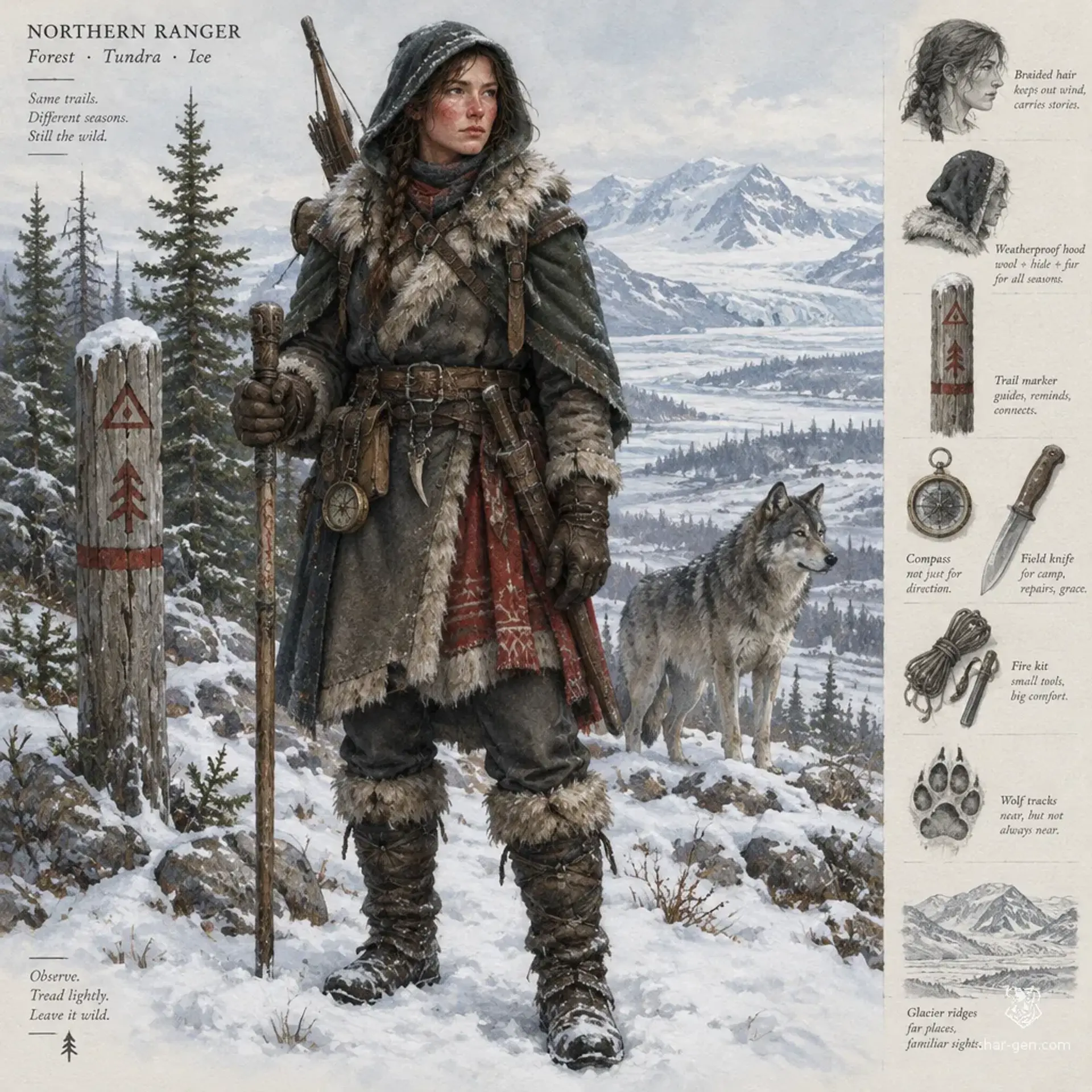
Homo borealis vestigator
At a glance
Languages Common, Rimecant
Height 5 ft. 2 in. to 6 ft. 5 in.
Weight 110 to 250 lb.
Lifespan 80 to 100 years
At the table
Your creature type is Humanoid. You are Medium, and your walking speed is 30 feet.
Choose Animal Handling, Perception, or Survival. You gain proficiency in the chosen skill, reflecting a ranger's early training in reading the wild.
Your inherited reflexes sharpen your response to danger. When you roll Initiative, you can add your Proficiency Bonus to the roll. Once you use this trait, you cannot use it again until you finish a Long Rest.
You can convey simple feelings and intentions to beasts through posture, tone, and practiced signals. This is not language and does not compel a beast to help you. Dire Wolves, Blood Hawks, and Sea Fangs are especially likely to recognize the customs behind these signals, though each remains an independent creature.
Common, Rimecant
Northern rangers often develop Constitution through hard travel and Wisdom through patient observation, but these are tendencies, not rules. Assign ability score increases as you wish, such as +2/+1 under your table's character creation rules.
Their long patrols among forest and tundra wolves favor silent coordination and patient pursuit.
Wolftrail rangers are most often encountered along inland routes, where they work with Dire Wolves as scouts, sentries, and hunting partners. Their bond is built through shared travel and mutual respect. They gain proficiency in the Stealth skill.
Northern rangers are trail-wise humans of the Rime Reach, descended in clan tradition from a nomadic people said to have received a divine blessing for surviving the first great winter. Their heritage is less a supernatural mark than a practiced inheritance of alertness, resilience, and kinship with the region's formidable beasts. Whether guiding travelers, hunting a threat, or carrying news between isolated settlements, they know that surviving the wild is a partnership, never a conquest.
Northern rangers are human in appearance, with the wide range of features found across humanity.
Generations in the Rime Reach have encouraged practical adaptations in dress and bearing rather than a single distinctive look: layered wool and hide, weather-darkened skin, wind-reddened cheeks, and hair kept braided or bound against ice and travel. Their eyes are often trained to pick out movement against snow, brush, and sea haze.
The Northern Rime Reach: tundra, boreal forest, glacier valleys, storm-battered coasts, and the sparse settlements along their seasonal routes.
Children learn trail signs, animal etiquette, and the basics of keeping warm before they travel beyond their home settlement.
A young ranger earns adult standing after completing a demanding journey or service to the community. This usually occurs in the late teens.
Experienced rangers often become route-keepers, teachers, or clan mediators. Their knowledge of old paths is treated as a communal resource.
Clans trace seasonal routes and share responsibility for maintaining shelters, food caches, and warning signs.
A ranger's bond with a Dire Wolf, Blood Hawk, or Sea Fang is regarded as a relationship earned through trust, not ownership. These animals remain independent, and a bond does not guarantee obedience. Young people learn to read tracks, weather, and animal behavior; experienced guides are expected to pass that knowledge on without hoarding it.
Many honor a collection of local gods associated with winter, travel, hearths, and wild places.
Clan stories remember a nomadic ancestor-band blessed by the gods, but beliefs differ on whether the blessing persists as divine favor or simply lives on through inherited customs. Rangers tend toward no single alignment; communal responsibility and respect for wild creatures are common values, not universal dictates.
Rangers are often valued as guides and scouts, though outsiders can mistake their caution for coldness.
They readily respect people who keep their word and show care toward working animals. The clans trade with neighboring peoples and welcome guests who follow local safety customs, but they are wary of anyone who treats the Rime Reach as empty land to be claimed.
Rime Reach settlements are built to endure wind and snow, with low timber halls, stone windbreaks, and hide-covered shelters that can be dismantled for travel.
Storehouses are raised above drift level, and communal hearths serve as meeting places as much as sources of heat. Rangers mark safe routes with carved poles, cairns, and strips of dyed cloth.
No images yet.
A high-res, share-ready sheet you can post or print.