
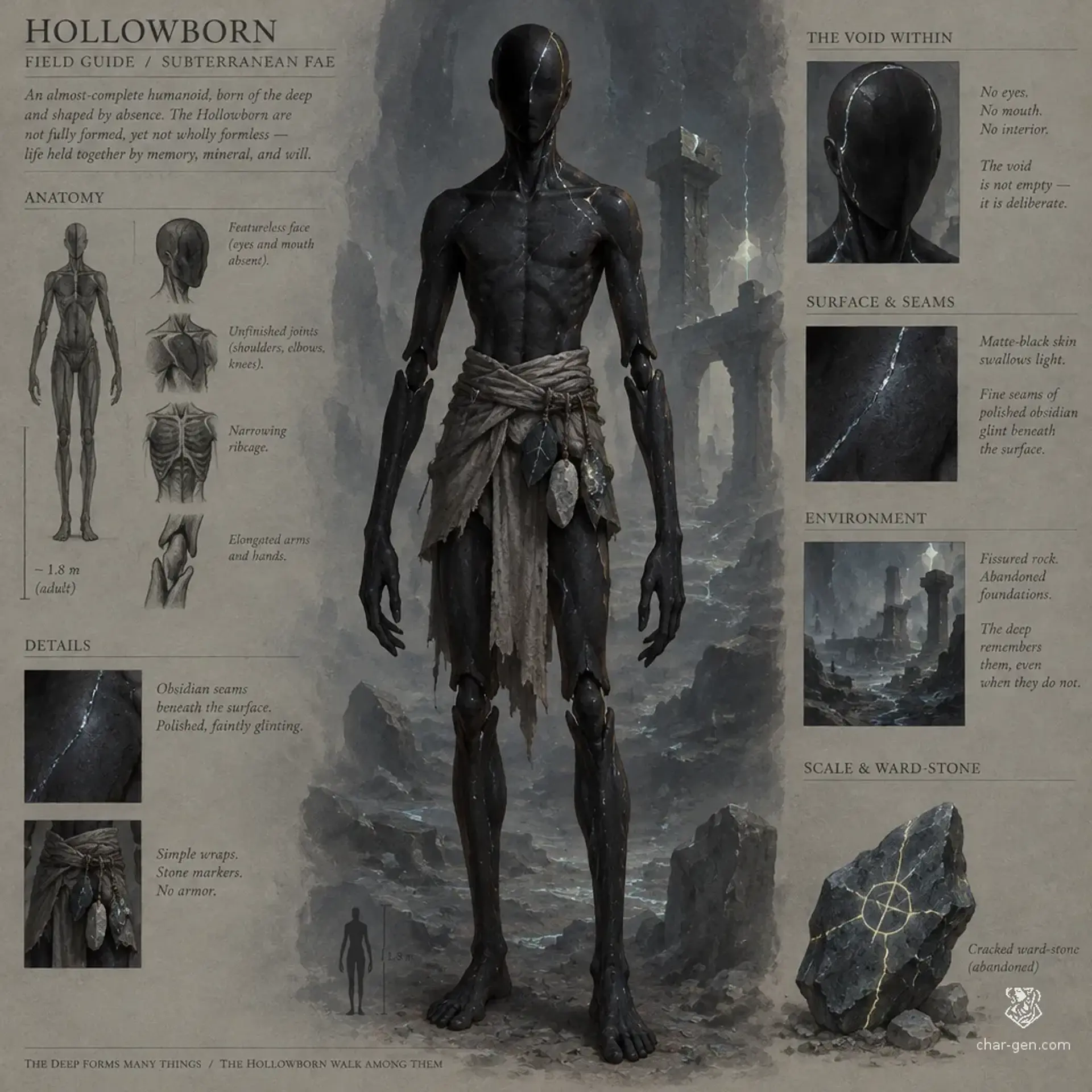
Inanivorus reliquus
When the oldest seals fail, the things buried beneath the world do not rise as an army.
At a glance
Darkvision 60 ft.; their sight reads heat, motion, and magical disturbance as pale contours
Languages Common, learned from surface contact, Riftcant, a sparse language of clicks, pauses, and pressure against stone
Resistances Necrotic harm, Magical effects that drain or alter vitality
Height Variable, from 4 to 9 feet when upright
Weight Variable; their apparent mass is unreliable, commonly 80 to 300 pounds
Lifespan They do not age in a mortal sense
At the table
Your body is unfinished and can compress through narrow natural gaps. You can squeeze through a space large enough for your head and shoulders, provided you are not wearing bulky equipment. This does not let you pass through solid stone or sealed barriers.
You can sense nearby active magic as a faint pressure or taste, though you do not learn its exact source or nature. Strong emotion also registers as a disturbance, but you cannot identify a person's feelings or thoughts from it.
When your black blood or marrow touches an ongoing magical effect, it can briefly dull or disrupt that effect. This requires close contact and a deliberate effort; it cannot erase permanent enchantments, consume an entire spell, or be used to command another creature.
No spell, ritual, or ordinary supernatural influence can force you to follow a command. Effects may still restrain, harm, deceive, or alter your perceptions, but a direct order cannot take control of your actions.
These creatures tend toward Constitution and Wisdom, shaped by the endurance of long hunger and a keen sense for weakness; in a game that assigns flexible bonuses, players choose where those bonuses go.
Their outlines are especially incomplete around the head and hands, and they can detect the use of magic across greater distances.
Far-Hollows serve as pack-scouts, following distant spellcraft through rock and ruin. Their heightened sensitivity makes them poor at ignoring magical bait.
When the oldest seals fail, the things buried beneath the world do not rise as an army. They seep through cracks in stone, gather around spellfire and the raw heat of fear, and hunt in silence. The Hollowborn are leftovers from creation, unwanted possibilities given a body of absence. They crave magic because it is the one thing they were denied, yet their obsidian blood can snuff it out. No hand can command them. At best, a seal can hold them; once released, only choice, hunger, or another fracture can turn them aside.
A Hollowborn is a lean, predatory figure whose proportions seem almost, but not quite, complete.
Some have too-long arms or a ribcage that narrows into nothing; others appear to have missing joints, as though the artist stopped drawing midway. Their skin absorbs light to a matte black, interrupted by voids where eyes, mouths, or other features ought to be. Those gaps are not wounds and reveal no interior. Beneath the surface, their blood and marrow are black obsidian: a touch can smother active enchantments, leaving charms dull and wards briefly mute. Their forms vary widely, and the same creature may look subtly different to each observer.
Subterranean vaults, fault lines, abandoned foundations, and the deep passages beneath failing seals
A raw, unstable body newly pressed through a fracture in the seals. It follows stronger packmates and responds to magic as if to scent.
A fully formed hunter capable of leading a pack through stone, tracking spellcraft, and choosing which prey to pursue.
An ancient survivor whose outline has grown more deliberate with time. Such elders remember fragments of the world's making, though their memories contradict one another.
Hollowborn gather in hunting packs, but their bonds are not based on blood or hierarchy alone.
A pack follows the creature best able to sense prey and read the shifting cracks in buried stone. They are not made to obey, even by the powers that imprisoned them, and resist attempts to reduce them to tools. Their hunger for magic is constant, though some learn to endure it without feeding. Strong emotion also attracts them: panic can draw a pack as surely as a beacon, while practiced calm may let travelers pass unnoticed. Among those who choose to remain together, shared silence and the marking of safe passages serve as a language of trust.
They have no shared faith and little sense of a creator as a benevolent parent.
Some regard the world's makers as jailers; others consider creation an accident with no author to blame. Their choices range from predatory to cautiously protective, and their origin does not dictate their ethics. Hollowborn who develop a moral code often prize release, restraint, and the right to exist without being assigned a purpose.
Most surface folk mistake them for purposeful monsters, and many are dangerous enough to justify the fear.
Hollowborn are drawn to active magic and intense emotions, but neither attraction guarantees an attack. Packs hunt strategically, often isolating spellcasters or emotionally volatile prey. A few learn restraint, trade warnings for access to abandoned magic, or protect people whose feelings quiet their hunger. They cannot be compelled through ordinary commands or domination; bargains may work, but only when freely chosen and grounded in needs the creature understands.
They have no ancestral homeland above ground.
Their oldest territories are the negative spaces around buried seals: fissures, collapsed chambers, and passages too narrow to seem traversable. When they make shelters, they wedge themselves into fractures and arrange loose stones as markers rather than walls. These marks indicate safe routes, hunting grounds, or places where magic has recently been consumed.
No images yet.
A high-res, share-ready sheet you can post or print.