
Terrafeyra quattuor
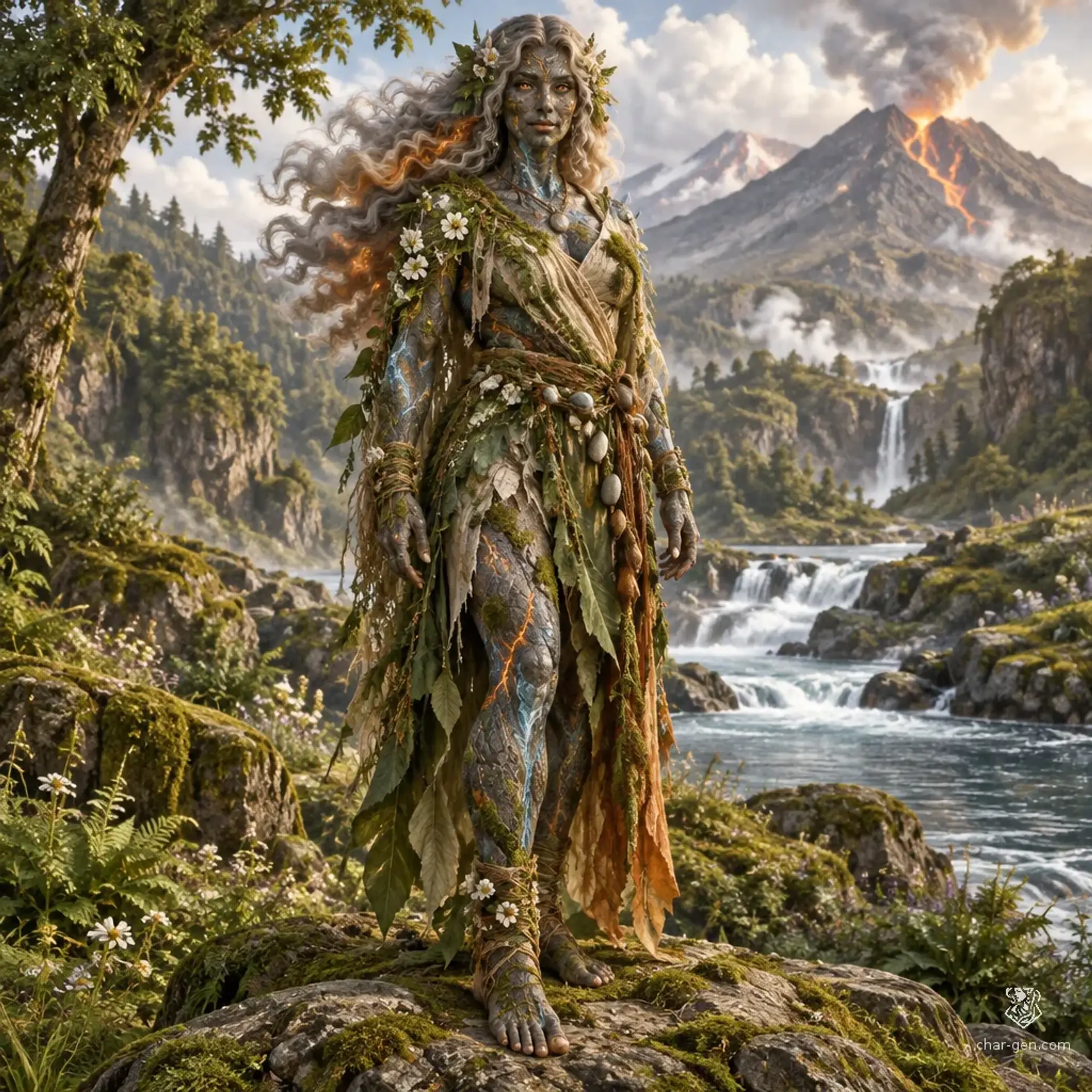
A Verdantel is a walking meeting of the world’s oldest forces: stone for a body, cloud for hair, water and lava beneath the skin, and fire in the gaze.
At a glance
Languages Common, Sylvan
Height Variable, usually 4 to 8 ft.
Weight Variable, usually 90 to 500 lb., depending on stature and mineral density.
Lifespan 180 to 250 years, adult at 20
At the table
Your size is Small, Medium, or Large, chosen when you select this species. Your chosen size does not change your Speed or other species traits.
Your walking Speed is 30 feet.
You know the Druidcraft cantrip. Wisdom is your spellcasting ability for it.
When you finish a Long Rest, choose one of the following damage types: acid, cold, fire, lightning, or thunder. You have Resistance to the chosen type until you finish your next Long Rest. The choice reflects which element is currently most prominent in your body.
Common, Sylvan
These people often cultivate the endurance of stone, the intuition of rivers, the force of flame, or the flexibility of wind. Players assign their ability score increases freely, such as +2 to one score and +1 to another, or +1 to three different scores.
Their skin tends toward dark basalt or iron-rich clay, while lava glows prominently beneath the surface.
Cinder-rooted Verdantels are shaped by volcanic slopes and fire-cleared forests. They often serve as smiths, soil tenders, or keepers of dangerous but fertile ground.
A Verdantel is a walking meeting of the world’s oldest forces: stone for a body, cloud for hair, water and lava beneath the skin, and fire in the gaze. Their vine-grown garments bear the seasons like a second history. They are not guardians by birthright, but many feel the pull of places where life is threatened or balance has been broken, and they carry the patience of mountains alongside the urgency of flame.
Verdantels are humanoids whose bodies visibly unite earth, air, water, and fire.
Their skin resembles soil, clay, slate, or layered stone, sometimes flecked with crystals or moss. Hair drifts like mist, curls into cloudlike masses, or streams in an unseen breeze. Beneath the skin, branching veins carry clear water, glowing magma, or both in slow, interwoven currents. Their eyes shine like banked coals or small, steady flames. They wear garments grown from vines, leaves, bark, and woven grasses, often living clothing that flowers or changes color with the seasons. Their builds and proportions vary widely.
Forests, volcanic slopes, river valleys, fertile plains, and other places where several elemental forces meet.
Newly shaped, with elemental features still settling into their first stable pattern.
Considered fully grown once they can keep all four elements in balance through a full turning of the seasons.
Their stone skin gathers mineral veining and their cloud-hair grows pale or storm-dark; elders are valued as living records of change.
Verdantel culture prizes reciprocity among the four elements and between a community and its home.
They mark time by seasonal turning, floods, eruptions, and migrations rather than by a single calendar. Decisions are often discussed in circles where each speaker represents a different concern: stability, movement, renewal, or growth. Their customs vary greatly, and no single element determines a person’s temperament or role. Young Verdantels are encouraged to travel, both to learn from other landscapes and to discover which forms of balance they can sustain.
They may honor land spirits, seasonal powers, ancestors, or deities of nature and creation.
Some regard the elements as sacred teachers rather than gods. Their communities value reciprocity and restraint, but individuals can be of any alignment; a Verdantel’s devotion to balance may express itself as compassion, fierce protection, or stubborn resistance to change.
Verdantels often form friendships through shared work: planting, building, cooking, or keeping watch through a difficult season.
They respect people who adapt without abandoning their responsibilities, though they may distrust those who treat land and living things as disposable. Their elemental appearance can inspire awe or fear, so many learn to meet strangers with humor and practical kindness.
Their settlements favor ecotones: hot springs beneath wooded ridges, river deltas beside volcanic soil, or wind-carved uplands with sheltered gardens.
Homes are shaped from living roots and fitted stone, with channels that carry rainwater and vents that let warm air escape. Construction is treated as a partnership with the land, and buildings are repaired or allowed to return to the soil as conditions change.
No images yet.
A high-res, share-ready sheet you can post or print.