
Lithovena memoria
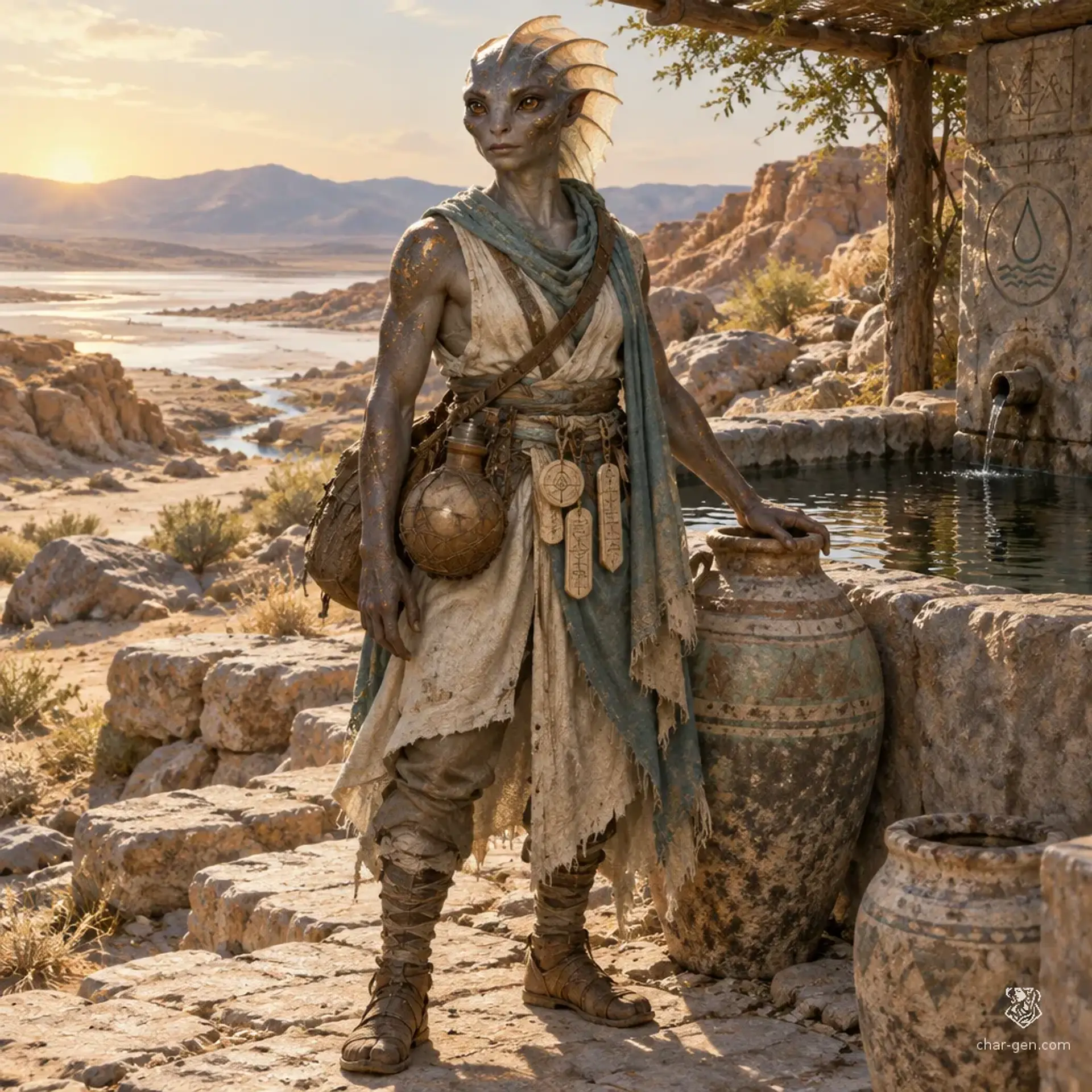
Vellari are long-lived keepers of wells, routes, and hard-won knowledge, their mineral-flecked skin recording age like stone records rain.
At a glance
Darkvision 60 ft.
Languages Common, Terran
Height 4 ft. 8 in. to 5 ft. 8 in.
Weight 110 to 190 lb.
Lifespan 120 to 150 years, adult at 18
At the table
Your hit point maximum increases by 1, and it increases by 1 again whenever you gain a level.
You have Darkvision with a range of 60 feet.
You have Advantage on saving throws you make to avoid or end the Frightened condition.
As a Magic action, you touch a quantity of water no larger than a barrel and learn whether it is safe to drink, saline, or contaminated by poison or disease. You can use this trait a number of times equal to your Proficiency Bonus, regaining all expended uses when you finish a Long Rest.
Common, Terran
These folk tend toward Constitution and Wisdom, shaped by lives of patient observation and endurance; assign ability score increases according to your character creation rules.
Their skin carries pale, branching lines, and their eyes glimmer faintly in darkness.
Raised in cavern settlements and ancient cisterns, Deepwell Vellari are practiced at navigating enclosed spaces and preserving water in difficult conditions.
Vellari are long-lived keepers of wells, routes, and hard-won knowledge, their mineral-flecked skin recording age like stone records rain. They build communities around water and treat every spring as a promise to the generations yet to come. A Vellari adventurer may be a patient guide, an exiled engineer, or the first person in centuries to question what their ancestors recorded.
Vellari are compact humanoids with smooth, cool-toned skin ranging from deep umber and charcoal to pale clay.
Fine mineral flecks mark their shoulders, temples, and forearms, often gathering into patterns that become more pronounced with age. Their eyes have broad, reflective irises suited to dim caverns, and a narrow ridge of translucent tissue runs from brow to nape. Despite old stories, they are not aquatic: they breathe air, prefer dry ground, and can become ill if kept constantly damp.
Dry uplands, salt basins, deep ravines, and the edges of seasonal rivers, especially where underground water can be reached.
Newborns are carried in woven slings and introduced to the community's waters, where elders observe their breathing and first response to light.
Young people learn to read currents, tend cisterns, and memorize the histories of nearby springs. They are considered adults after completing a solitary journey to a water source not known to their household.
Adults maintain homes, trade knowledge, and make seasonal journeys between settlements. Most remain vigorous for many decades.
Elders develop pale mineral patterns along their skin and are valued as living records of droughts, migrations, and restored waters.
Vellari culture centers on custodianship.
Families and chosen households maintain wells, cisterns, and water routes, with responsibilities recorded in public ledgers and marked stones. Their histories are recited at seasonal gatherings, where disagreement is welcome if it is supported by witness or evidence. Travelers are offered a measured portion of water without being asked to prove their worth, but repeated waste is remembered for a long time.
Vellari traditions honor springs, deep earth, and the memory held in places, though many follow the gods of neighboring peoples.
Their customs favor mutual obligation and measured judgment, but individuals range across every alignment. Some regard water as sacred; others see its careful management as a plain necessity.
Vellari often become valued guides and negotiators, particularly in arid lands.
Their careful stewardship can look possessive to outsiders, while their practice of asking practical questions before offering trust may be mistaken for suspicion. They tend to respect people who maintain shared spaces and distrust those who waste what cannot easily be replaced.
Their settlements cluster around wells, springs, and cisterns.
Homes are built from stone, packed earth, and glazed clay, with shaded courtyards and narrow channels that capture rare rainfall. Public waterworks are treated as both civic infrastructure and shared inheritance.
No images yet.
A high-res, share-ready sheet you can post or print.