
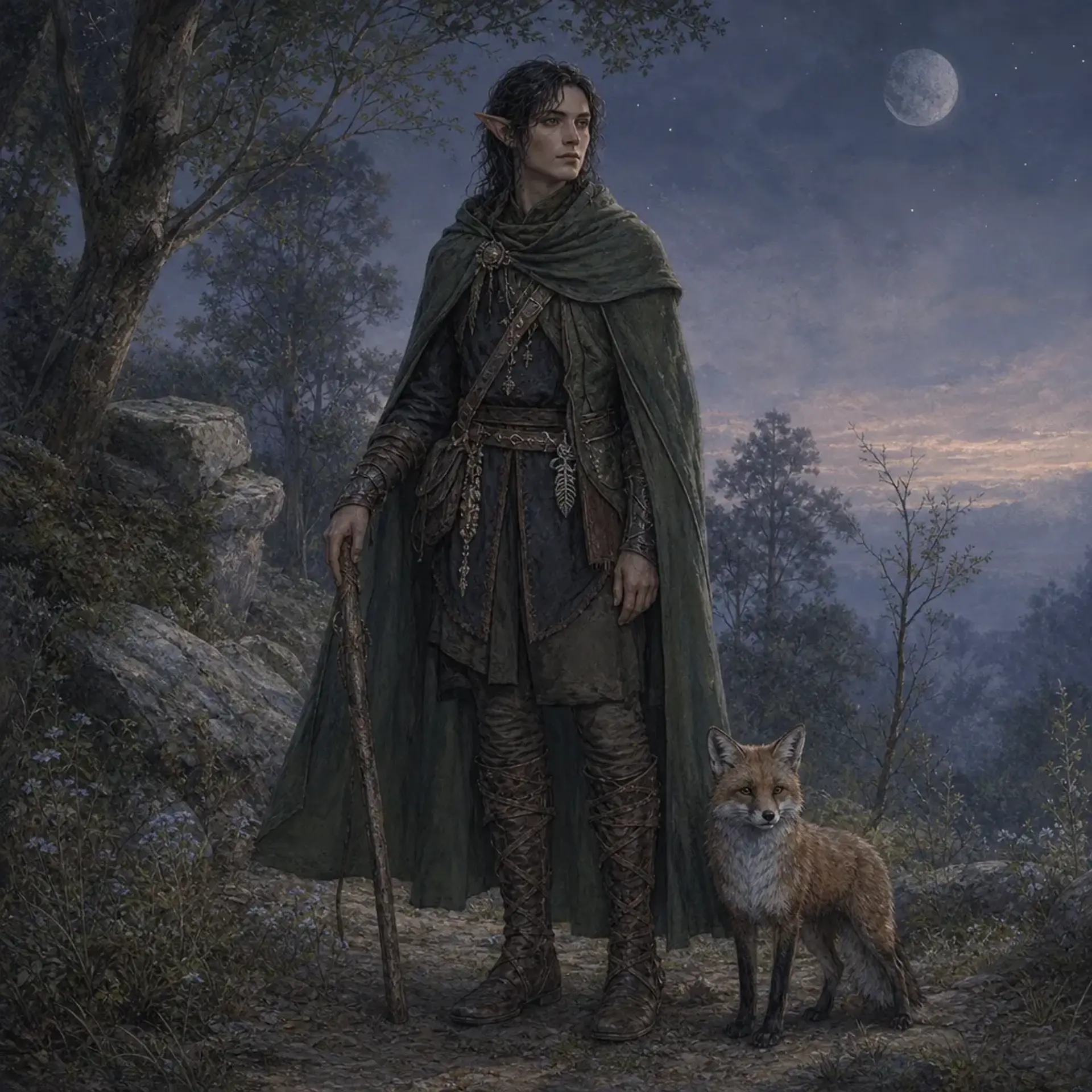
Noctiluma silvans
Vesperkin are night-wise elven folk who read a landscape by its quietest signs.
At a glance
Darkvision 60 ft.
Languages Common, Elvish
Height 5 ft. 3 in. to 6 ft. 2 in.
Weight 105 to 175 lb.
Lifespan 250 to 350 years
At the table
You have Darkvision with a range of 60 feet. In darkness, you see in shades of gray rather than color.
You have proficiency in the Perception skill or the Survival skill. Choose when you select this species.
You can finish a Long Rest in 4 hours if you spend those hours in a trancelike meditation, during which you remain conscious. You must still avoid strenuous activity to gain the benefits of the rest.
Once per Long Rest, when you fail a Wisdom (Perception) or Wisdom (Survival) check, you can reroll the check and use the new result. This represents a moment of heightened attention to subtle signs.
When a Vesperkin dies for the first time, their spirit may return as a beast and seek the last adventuring party they knew. This is a narrative afterlife feature, not a combat form or an additional player character. The beast cannot speak normally, is not under the player character’s control, and communicates through behavior, signs, dreams, or other means agreed upon with the DM. It can offer guidance through the spirit realm at the DM’s discretion, while respecting the beast’s safety, agency, and the needs of the campaign.
Common, Elvish
These folk often cultivate keen perception, patience, and physical composure, tending toward Wisdom and Dexterity. Choose any ability score increases allowed by your table’s character creation rules; no scores are fixed by this species.
Their tradition emphasizes small, nimble animals and close reading of tracks, scent, and ground-level signs.
Bramble communities dwell in tangled woodlands and overgrown borders. Their guides often return as foxes, hares, martens, or other quick-footed creatures, and their living members are practiced scouts.
Vesperkin are night-wise elven folk who read a landscape by its quietest signs. They live long lives in close attention to the changing world, knowing that their first death will not be an ending: they return as a beast, drawn back into contact with the spirit realm and able to guide the party they last traveled with. A Vesperkin adventurer may be seeking a life worth returning to, or learning how to trust a future that cannot be planned.
Vesperkin are slender, long-lived folk with the poised bearing and tapered ears commonly associated with elf-like peoples.
Their eyes are adapted to dim light, often appearing silver, amber, or deep green, with pupils that widen markedly at dusk. Skin and hair vary widely, though muted tones and dark hair are common in regions where camouflage matters. Their hearing is especially alert to faint movement, and many learn to walk with a softness that makes them difficult to notice in brush or shadow. Their returned dead take the form of ordinary nocturnal or crepuscular beasts, such as foxes, owls, hares, moths, or small wildcats, rather than visibly spectral creatures.
Old forests, hill-country, quiet coastal reaches, and settled lands where night skies remain visible.
Many communities make homes near wilderness corridors used by nocturnal animals.
A child learning the night’s sounds and the customs of quiet travel.
An adult who has completed the vigil of first moon and is recognized as responsible for their own path.
A seasoned person whose memory and judgment are sought in councils and spirit vigils.
A departed guide, returned in the shape of a beast and able to maintain contact with the living through spirit signs.
Vesperkin communities prize quiet competence, reliable memory, and care that does not demand recognition.
Night vigils serve as social gatherings, lessons, and occasions to share news. Elders teach children to identify animals by sound and to navigate without relying on a single landmark. The return after first death is treated as a sacred possibility, not a guaranteed reward or a duty owed to survivors. A returned guide generally seeks the party it last knew, maintaining contact through repeated visits, gestures, dreams, or other signs shaped by the story. The beast is a distinct living presence, not a controllable transformation, and its guidance should be coordinated with the game’s DM.
Vesperkin traditions honor thresholds: dusk and dawn, birth and death, the edge of the forest, and the moment before a traveler chooses a road.
Some revere gods of night, nature, travel, or the dead; others understand the spirit realm as a presence rather than a deity. Their customs favor compassionate, watchful conduct, but individuals may hold any alignment.
Vesperkin are valued as guides, watchkeepers, and patient mediators, though their long perspective can be mistaken for aloofness.
They often form strong traveling bonds across cultures and treat a party as a chosen circle of mutual care. Their belief in return as a beast is not universal among other peoples, and some find the practice comforting while others regard it with unease. Vesperkin generally ask that the returned guide be welcomed on its own terms, not treated as a familiar or possession.
Their settlements favor shaded courtyards, high windows, covered walks, and pale stone or timber that catches moonlight without reflecting glare.
Homes often include a roofed open-air room for night vigils and small, undisturbed patches of habitat for visiting animals. Traveling families use compact, quiet shelters that can be assembled without bright fires.
No images yet.
A high-res, share-ready sheet you can post or print.