
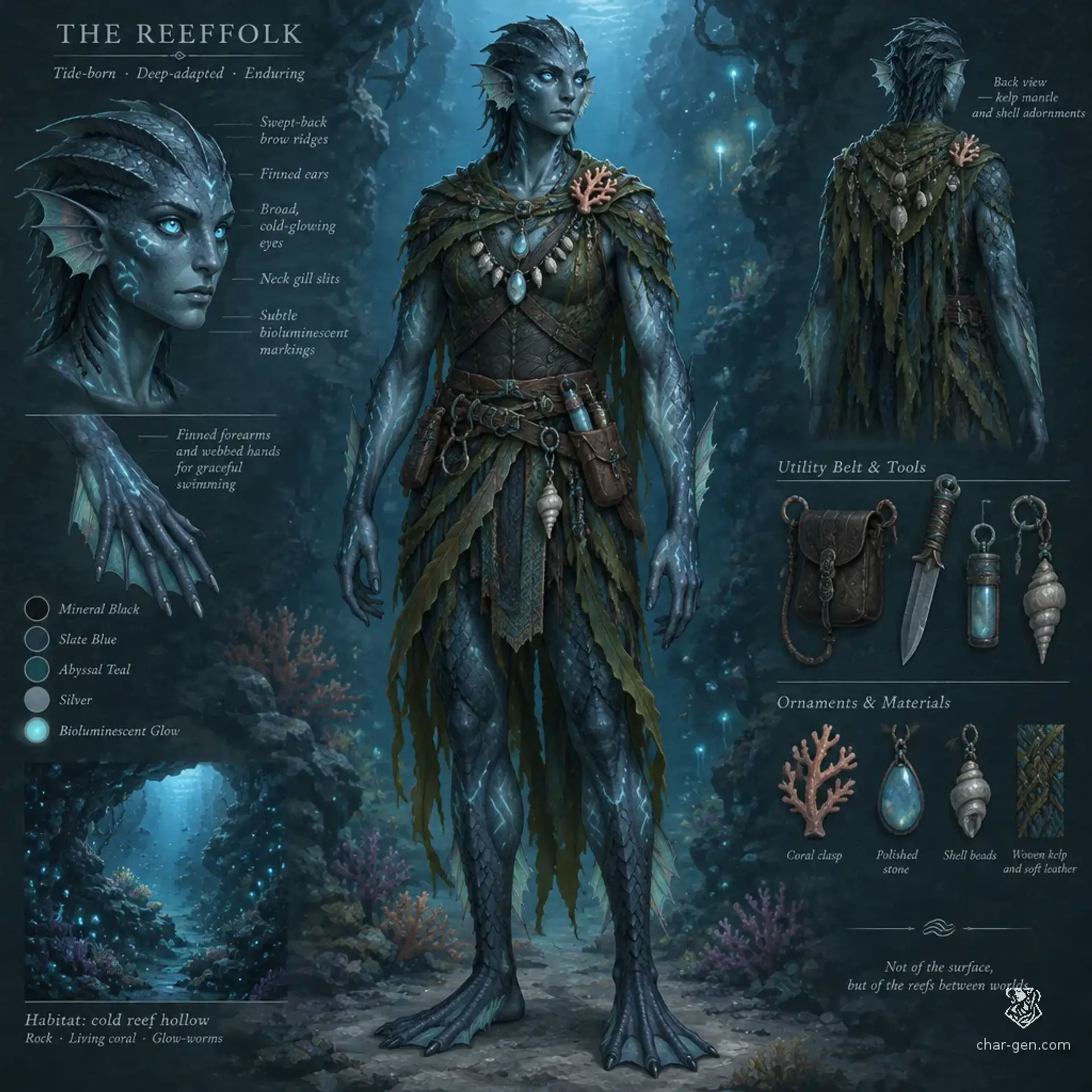
Dracothera profundis
Born of a pact with a dragon sleeping beneath the ocean floor, the Thalassari are a people of watchful patience.
At a glance
Darkvision 60 ft.
Languages Common, Aquan
Height 4 ft. 8 in. to 6 ft. 2 in.
Weight 110 to 230 lb.
Lifespan 180 to 240 years, adult at 20
At the table
You can breathe air and water, and you have a swimming speed of 30 feet.
Your darkvision extends 60 feet. In that range, you perceive dim light as bright light and darkness as dim light, discerning colors only as shades of gray.
You have proficiency in one skill of your choice from Animal Handling, Nature, Perception, or Survival. This reflects the watch-clutch’s practical training in reading living things and changing conditions.
As a Magic action, you can call on your ancestral ward to steady yourself and nearby allies. Choose yourself and up to a number of creatures equal to your proficiency bonus within 10 feet of you. Each chosen creature gains temporary hit points equal to your proficiency bonus. Once you use this trait, you cannot use it again until you finish a Long Rest.
Common, Aquan
These deep-ocean guardians tend toward Constitution and Wisdom, reflecting endurance and instinct, but players assign ability score increases as they wish.
Their markings glow more brightly, and their scales often carry pale silver or blue hues.
Lanternwake families dwell near reefs and undersea routes, serving as guides, couriers, and rescuers. Their communities prize hospitality and skilled navigation.
Born of a pact with a dragon sleeping beneath the ocean floor, the Thalassari are a people of watchful patience. Their ancient guardian lies dormant in the lightless trenches, its dreams stirring currents and its breath warming hidden vents. Thalassari communities keep the sea’s approaches safe and the dragon undisturbed, but a guardian’s vow can lead its children far from home when the balance of the waters is threatened.
Thalassari are humanoids with sleek, overlapping scales, webbed fingers, and finned ears or forearms.
Their broad eyes often shine with a dim, cold light, and narrow gill slits along the neck allow them to breathe underwater as well as air. Some bear swept-back horns, ridged brows, or faint luminous lines inherited from their draconic ancestor. Their features vary widely between families, though their scales commonly echo the dark blues, greens, and mineral blacks of the abyss.
Abyssal trenches, cold-water reefs, undersea caverns, and coastal settlements built around deep ocean vents.
Newly hatched, able to swim and recognize familiar voices, but reliant on kin and community.
Learns currents, oral histories, and the duties of tending the guardian’s outer shrines.
An adult recognized as capable of bearing a watch, negotiating beyond the reef, and making independent vows.
An elder whose memories span generations and who may hear the sleeping dragon’s dreams with unusual clarity.
Thalassari culture is organized around watch-clutches: extended households that share the care of hatchlings, shrine tending, and patrols of the surrounding waters.
They preserve history through chants whose repeated rhythms help divers keep time and remember routes. Duties rotate with the tides, and a person’s standing comes less from birth than from how reliably they keep a promise. Those who leave the deep are expected to learn the customs of other peoples without forgetting the quiet obligations of the watch.
Many honor the sleeping dragon as a sacred ancestor rather than a god, leaving offerings of song, polished stone, and carefully tended coral.
Others worship ocean deities or follow philosophies of balance and renewal. Their traditions favor protective and disciplined outlooks, but individuals range across every alignment.
Thalassari are wary of those who exploit the sea, but they readily aid sailors in peril and respect coastal peoples who live by the tides.
They often misunderstand surface urgency as recklessness, while land-dwellers may mistake their reserve for suspicion. Their guardianship is not ownership: they recognize that many peoples depend on the same waters, though they may disagree sharply about what protection requires.
Their settlements cluster around seamounts and sheltered reef hollows, with pressure-resistant halls carved into stone and coral.
Living coral buttresses, shell mosaics, and lines of glow-worm lamps mark safe routes. The innermost sanctuaries are left deliberately plain: no altar, statue, or tool is placed where it might disturb the sleeping dragon below.
No images yet.
A high-res, share-ready sheet you can post or print.