
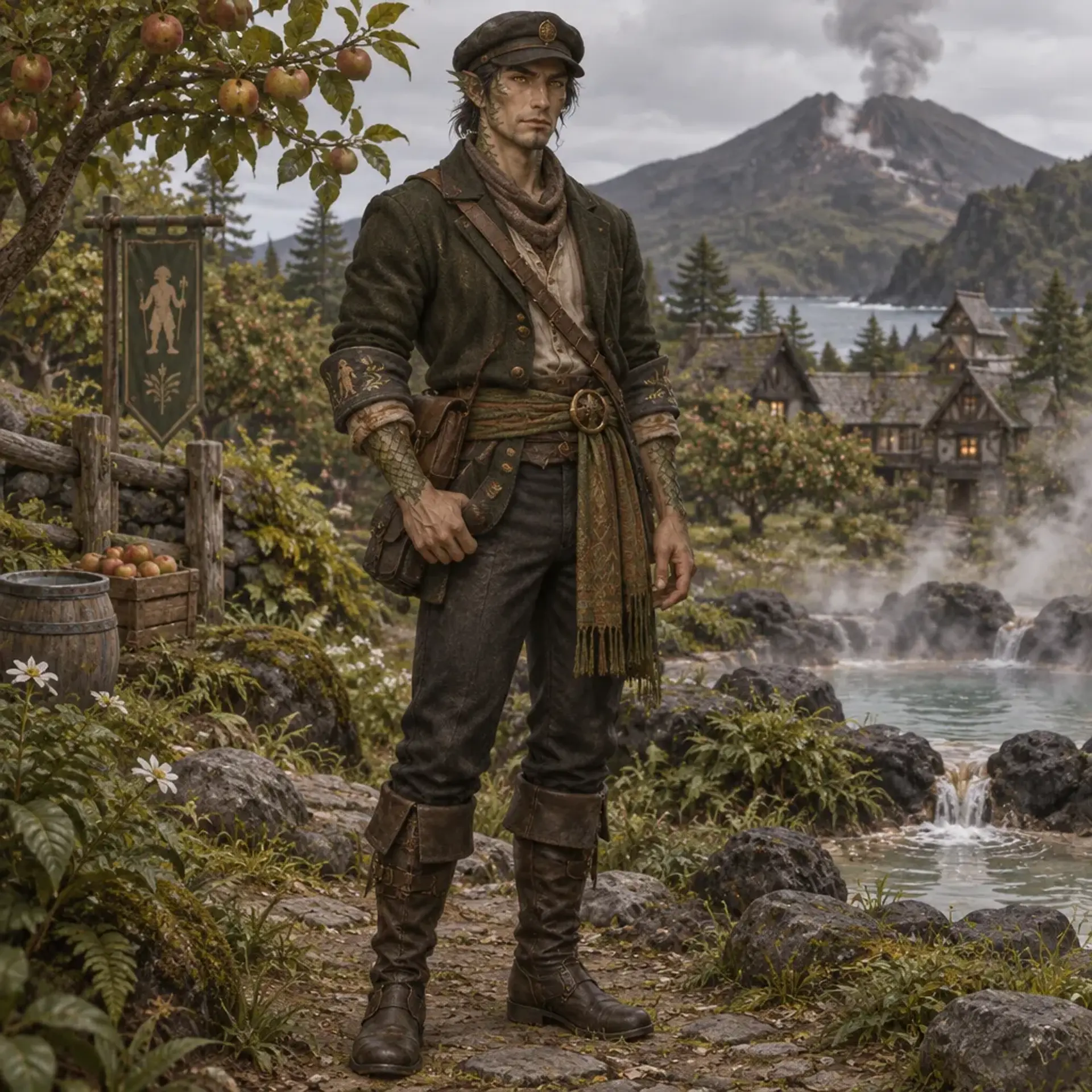
Homo draconicus insularis
Ashgrove Wyrmblood are island-born descendants of halfling refugees and a wounded green dragon, a people still learning whether their inheritance is a gift, a danger, or both.
At a glance
Darkvision 60 ft.
Languages Common, Halfling, Draconic
Resistances Poison
Height Low-blooded adults average 3 to 4 feet; High-blooded adults commonly stand 5 to 7 feet.
Weight Low-blooded adults typically weigh 40 to 70 pounds; High-blooded adults commonly weigh 100 to 220 pounds, with considerable variation.
Lifespan Low-blooded Ashgrove folk commonly live about 100 years
At the table
You have resistance to poison damage, an inheritance associated with the green dragon blood in your ancestry.
You can see in dim light within 60 feet of yourself as if it were bright light, and in darkness as if it were dim light. You discern colors in darkness only as shades of gray.
Choose Nature or Survival. You have proficiency in the chosen skill, reflecting lessons learned among the archipelago's woods, farms, and dangerous shores.
You can exhale toxic breath in a 15-foot cone. Each creature in that area makes a Constitution saving throw, with a DC equal to 8 plus your Constitution modifier and Proficiency Bonus. On a failed save, a creature takes poison damage; on a successful save, it takes half as much. The damage increases to at character level 5, at level 11, and at level 17. Once you use this trait, you cannot use it again until you finish a Long Rest.
Common, Halfling, Draconic
Poison
Many Ashgrove folk tend toward Constitution and Wisdom, while High-blooded individuals often prize Charisma or Intelligence; assign ability increases according to your table's character-creation rules.
Compact stature and a strong attachment to extended family and village traditions.
Low-blooded folk are closer in build and appearance to their halfling ancestors. They are usually Small and often serve as the keepers of family histories, gardens, and communal customs. They share the common species traits.
Ashgrove Wyrmblood are island-born descendants of halfling refugees and a wounded green dragon, a people still learning whether their inheritance is a gift, a danger, or both. Their elders cherish shared meals, hidden gardens, and the stubborn customs that carried their ancestors through shipwreck, wilderness, and ashfall. Their younger, often High-blooded generation is taller, more magically potent, and less certain that old obligations should bind them. Somewhere beyond their contested groves, a dragon with an ancient grievance is quietly encouraging that divide.
Ashgrove Wyrmblood are descendants of halfling refugees and a green dragon's bloodline, shaped by an island whose magic and history remain poorly understood.
Low-blooded folk retain a compact halfling build, rounded ears, and familiar faces, though many have faintly green or amber eyes, unusually keen senses of smell, or small patches of fine scales. High-blooded folk are taller and leaner, with more extensive scales, slit or ringed pupils, ridged brows, and occasional tails or vestigial wings. Their adolescence can bring painful growth spurts and volatile moods. The severity differs from person to person; no single appearance or temperament defines the bloodline.
A remote volcanic archipelago of temperate woods, fertile valleys, mineral-rich hills, hot springs, and treacherous dragon-haunted wilderness.
Children are raised among extended family and introduced early to gardening, fishing, and household craft. High-blooded children may undergo painful, unpredictable changes as they grow.
Ashgrove folk are generally considered adults around twenty. Coming-of-age customs emphasize a useful skill, a shared meal, and a promise to protect someone beyond oneself.
Low-blooded adults often live about a century. High-blooded adults vary widely, and no reliable record yet establishes whether their draconic inheritance lengthens their lives.
The first island families survived through shared labor, careful stores, and traditions carried from their old halfling communities.
They prize hospitality, craft, seasonal festivals, and the quiet competence of people who know how to make a little food last. German-inspired dress is common: woolen layers, aprons, fitted jackets, sturdy boots, embroidered cuffs, and weatherproof caps, adapted to island life. The High-blooded majority among the young has unsettled those customs. Many are more private, ambitious, and drawn to hunting or magic, though such tendencies are not universal. Some see independence as a necessary response to a dangerous world; others suspect an outside influence is turning natural differences into a political fracture.
Their customs honor household ancestors, the dead lost during the voyage, and the natural springs and groves that sustained the survivors.
Some leave bread or flowers at family shrines; others pray to local powers without agreeing on their names. A few fear the green dragon as a benefactor, while others see her blood as a dangerous bargain. Ashgrove folk lean toward community-minded alignments, but the pressures of exile and inherited power produce every sort of outlook.
Ashgrove folk are wary of dragons and of anyone who treats them as useful bodies, convenient pawns, or living curiosities.
They can be generous hosts once trust is earned, though the old refugee families remain suspicious of grand promises and distant authorities. Low-blooded elders often fear that High-blooded kin are being drawn away from communal life; many High-blooded people resent being judged for traits they did not choose. The divide is real, but neither group is uniform, and friendships, marriages, and shared work cross it every day.
Their island villages combine halfling practicality with German-inspired timber craft: steep-roofed homes, carved beams, painted shutters, tiled stoves, and communal kitchens.
Buildings are partly dug into slopes or screened by orchards to hide smoke and light from the sky. Cellars store root crops and supplies against ashfall, while meeting halls are built stoutly enough to shelter a whole hamlet during storms. High-blooded households increasingly favor taller, more isolated homes, a visible point of tension in older settlements.
No images yet.
A high-res, share-ready sheet you can post or print.