
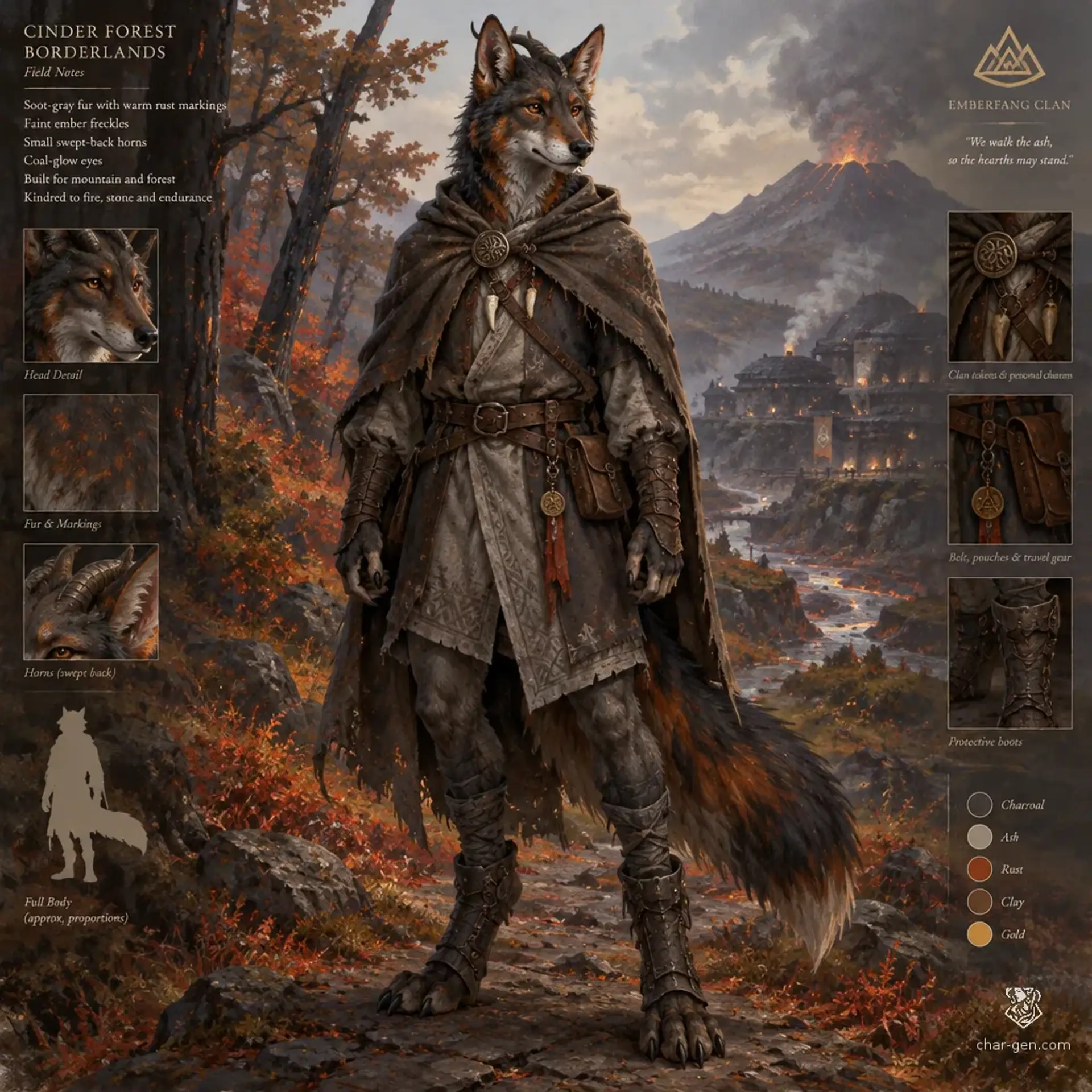
Canis cineris
Cinderhounds are canine-featured people born of old crossings between the mortal world and infernal realms.
At a glance
Darkvision 60 ft.
Languages Common, Infernal
Height 5 to 7 feet
Weight 120 to 260 pounds
Lifespan 80 to 110 years
At the table
Your walking speed is 30 feet.
You can see in dim light within 60 feet of yourself as if it were bright light, and in darkness as if it were dim light. You discern colors in darkness only as shades of gray.
Once per long rest, when a hostile creature you can see within 30 feet of you is reduced to 0 hit points, you can use your reaction to draw a fading ember of its vigor. You gain temporary hit points equal to your proficiency bonus. This ember lasts for 1 minute and cannot restore hit points, remove conditions, change ability scores, grant levels, or take anything from the creature beyond this brief reserve of temporary vitality.
Common, Infernal
Their endurance and keen awareness are often celebrated; players may assign +2 and +1 to any ability scores of their choice, or +1 to three different scores, following the 2024 rules.
Their breath carries a faint scent of smoke, and their voices often rumble like distant thunder.
Ashward cinderhounds descend from lineages that guarded crossings and hearths. They tend to value patience, public service, and careful records, though individuals vary as widely as in any other lineage.
Cinderhounds are canine-featured people born of old crossings between the mortal world and infernal realms. Their legends speak of taking strength from the defeated, but the truth is subtler: a cinderhound can draw a brief ember of resolve from a foe who falls in battle. Among their clans, that gift is treated as a solemn responsibility, not a right. A cinderhound adventurer might be a boundary scout, a pact-breaker's descendant, or simply someone determined to decide for themselves what their inherited power means.
Cinderhounds are upright, canine-featured people with powerful legs, long muzzles, expressive ears, and tails that communicate more than they intend.
Their coats range from rust and smoke-gray to midnight black or pale ash, sometimes marked with ember-like freckles that brighten with exertion or strong emotion. Small horns, blunt or swept back, are common but not universal. Their eyes may shine like banked coals in darkness. Though their appearance carries infernal associations, they are living people with ordinary needs, varied temperaments, and no inherent tie to evil.
Otherworldly realms, especially ash plains, cinder forests, volcanic borders, and settlements built near infernal crossings
Pups are born with closed eyes and faintly glowing gums. Families teach them restraint alongside the first games of pursuit.
Young adults undertake a road-vigil, traveling beyond their home enclave to learn which customs deserve keeping and which should be challenged.
Mature hellhounds often serve as witnesses, guides, or keepers of clan memory, though many choose lives far from their birth communities.
In old age, their fiery markings dim to a steady coal-glow. Elders are valued for judgment, but are not expected to surrender their independence.
Cinderhound culture is shaped by memory of old pacts and by the practical need to live near dangerous boundaries.
Many communities rely on witnesses for important promises, keep shared accounts of bargains, and teach children how to recognize coercion. Clan ties may be strong, but adoption and chosen kin are widely respected. The power to draw an echo from a fallen foe is surrounded by custom: some treat it as a last-resort defense, while others see it as a reminder that victory carries obligations.
Cinderhound beliefs are diverse.
Some honor hearth-spirits, ancestors, or gods of travel and refuge; others reject infernal tradition altogether. Their inherited power does not determine their ethics. Communities commonly teach that strength taken in battle is a temporary burden to be handled with care, while individuals may embrace, question, or refuse that teaching.
Many people mistake cinderhounds for fiends or assume their power is predatory.
Some cinderhounds answer such suspicion with patience; others resent being asked to prove their goodness. Their communities have longstanding ties with planar travelers, borderland guides, and anyone who respects a witnessed agreement. They judge outsiders less by ancestry than by how they treat the vulnerable and whether they keep their word.
Their oldest communities occupy borderlands between the mortal world and harsher planes.
Settlements are built around sheltered courtyards, communal hearths, and clear routes for runners and messengers. Black stone, fired clay, and scavenged metal are common, but styles vary widely: some enclaves are austere and defensive, while others are lively caravan towns where visitors are welcomed under explicit, carefully witnessed rules.
No images yet.
A high-res, share-ready sheet you can post or print.