
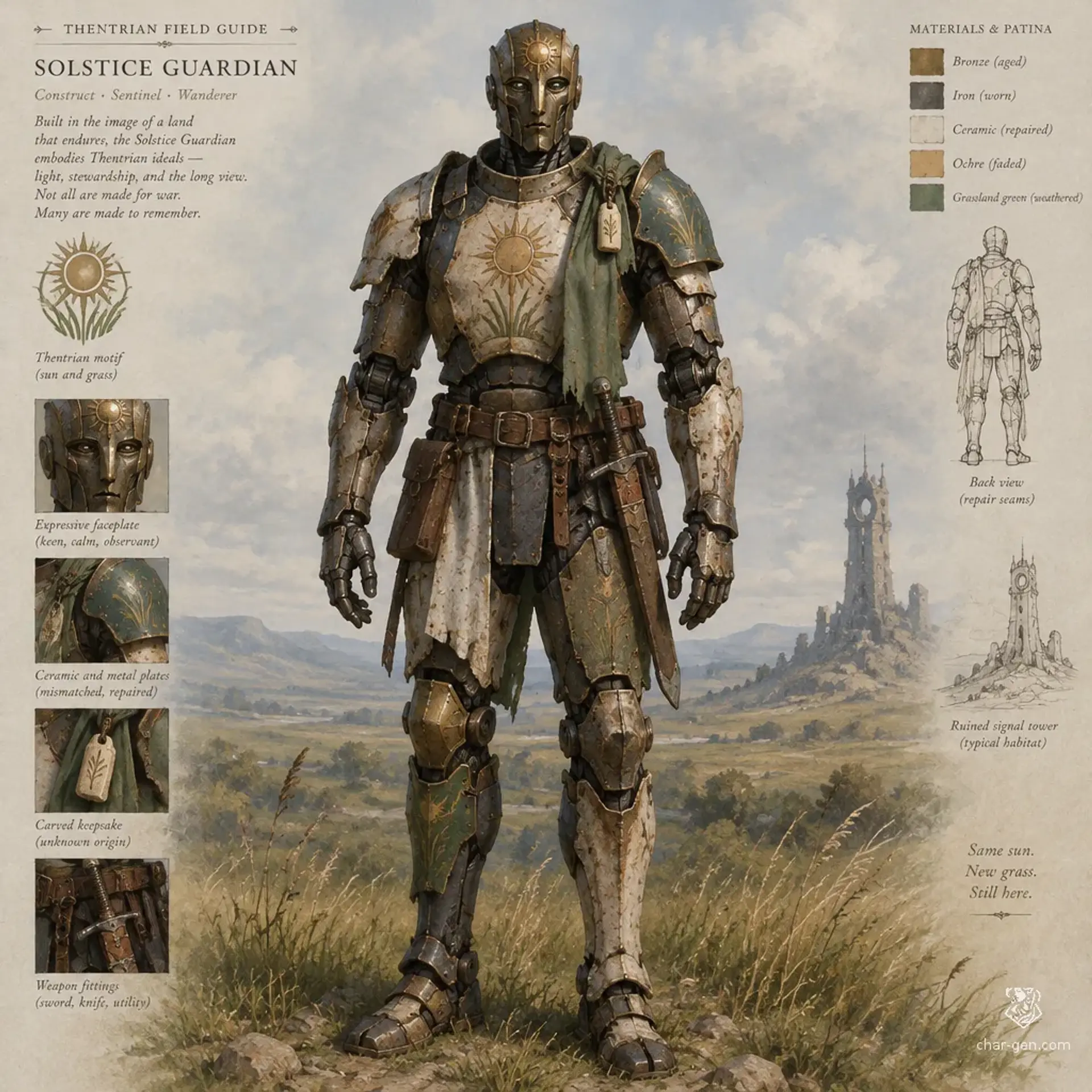
Homo ferratus thentrianus
Forged by Thentria's ancient civilizations as knights, the Wardens were built to master the demands of battle.
At a glance
Darkvision 60 ft.
Languages Common, Thentrian
Height 6 to 7 feet
Weight 250 to 400 pounds
Lifespan They do not age biologically, but wear, damage, and scarcity of specialized repairs limit most to several centuries
At the table
You have advantage on saving throws you make to avoid or end the Poisoned condition, and you have resistance to poison damage. You do not need to eat, drink, or breathe.
When you finish a Long Rest, you can spend at least 4 hours in an inactive, motionless state. You remain conscious during this time, and you gain the benefits of the Long Rest as usual.
Choose one kind of martial weapon when you finish a Long Rest. You gain proficiency with that weapon until you choose a different one using this trait. This reflects adaptable training, not automatic mastery: class features and practice determine what specialized techniques you can use.
Common, Thentrian
Their disciplined design often encourages Constitution and Wisdom, reflecting endurance and battlefield judgment, but ability scores are assigned according to the 2024 rules and receive no species-based increases.
Broad, reinforced shoulders and visible plates designed to withstand impacts.
Built to hold a line and protect companions, Bulwark-pattern Wardens often favor shields, rescue work, and defensive tactics. Their construction grants no additional combat bonuses.
Forged by Thentria's ancient civilizations as knights, the Wardens were built to master the demands of battle. Their training encompassed many weapons and tactics, but no design made them flawless, and no old command can decide what a Warden should become now. Across the plains they serve as guardians, wanderers, teachers, and adventurers, carrying the memory of a vanished empire in bodies still learning the meaning of freedom.
Thentrian Wardens are humanoid constructs built around a durable inner frame of layered metal, stone, or ceramic.
Their makers gave them articulated limbs, expressive faceplates, and armor shaped to suggest a knight rather than a siege engine. No two surviving examples are quite alike: centuries of repair have left many with replacement plates, borrowed insignia, or repairs made from whatever materials were at hand. They breathe only by habit or as part of an old mechanism, and their voices may resonate like a bell through a metal throat.
Open plains, old battlefields, and settlements near the grasslands of Thentria
Newly awakened, still learning to distinguish a command from a choice.
Experienced in the world beyond their makers' campaigns, whether or not they still follow a military calling.
A rare veteran whose memories span generations and whose body may bear repairs from many eras.
The Wardens were created as a military order, and many retain habits of drill, maintenance, and formal address.
Their ancient makers are gone, leaving no universal command structure and no single culture to replace it. Some form small fellowships to share repair skills and histories; others choose civilian trades or travel alone. A Warden's old combat training can be formidable, but it is not innate perfection: individuals vary in skill, and their present capabilities depend on practice, experience, and circumstance.
The Wardens were made to serve institutions, not a single faith.
Some honor the dead gods of Thentria, while others follow local traditions, cultivate private philosophies, or reject worship altogether. Their original duties encouraged discipline, but modern Wardens can be kind, ruthless, lawful, unpredictable, or anything between.
Some people see a Warden as a reliable protector, while others remember the armies that their makers sent across the plains.
Wardens may earn trust through steady service, but they can also unsettle those who fear being judged, commanded, or replaced. Their own views differ: some seek kinship with other constructs, some adopt the communities that shelter them, and some insist that shared purpose matters more than shared origin.
Their makers raised them in the ancient civilizations of Thentria, where broad roads crossed the plains between fortified granaries, signal towers, and military cities.
Those settlements are mostly ruins now. The knights who remain live wherever they find purpose, often favoring sturdy buildings with clear sightlines, accessible workshops, and room to maintain equipment. Some gather in small enclaves around recovered Thentrian forges, while others make homes among ordinary townsfolk.
No images yet.
A high-res, share-ready sheet you can post or print.