
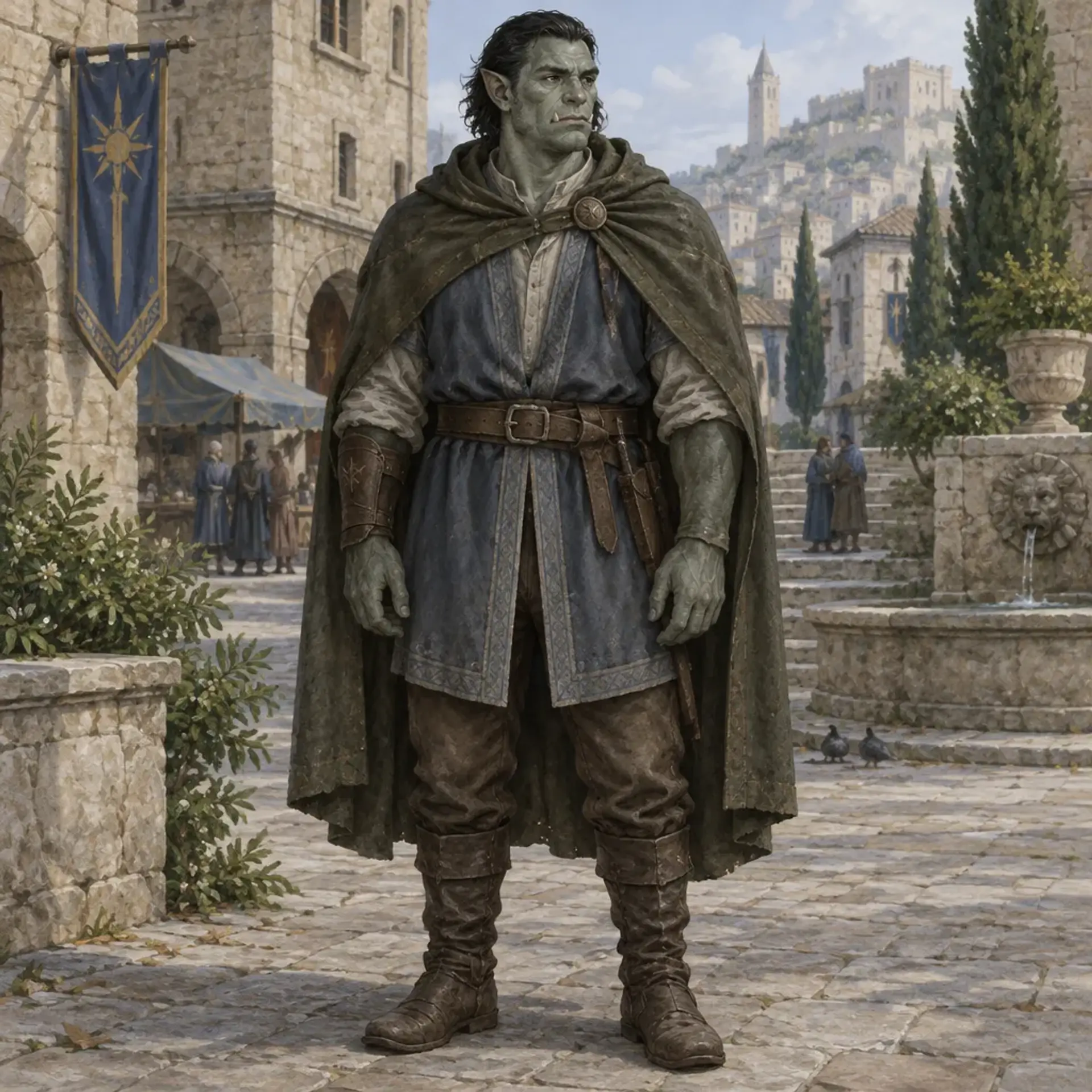
Homo bellator tethyrensis
Made in a wizard's laboratories to break Tethyr's enemies, the dromaar were once the main fighting force of Agares the Undefeated.
At a glance
Darkvision Dromaar have low-light vision, not darkvision. They can see in dim light as though it were bright light.
Languages Common, Orcish
Height 6 ft. 2 in. to 7 ft. 2 in.
Weight 200 to 330 lb.
Lifespan 70 to 90 years, adult at 16
At the table
Dromaar are humanoids. Their ancestry Hit Points are 8, and their Speed is 25 feet.
A dromaar can see in dim light as though it were bright light. This is low-light vision, not darkvision.
At character creation, choose a heritage representing a dromaar's appearance, upbringing, or developed talents. A heritage does not determine a character's personality or allegiance.
Common, Orcish
War-breed ancestry boosts suit their forceful physiques and adaptable instincts. In Pathfinder 2E, apply the ancestry boosts and any ancestry flaw according to the character creation rules; no particular ability score is required to define a dromaar.
A heavier brow, broad jaw, greenish or gray skin, and often visible lower tusks.
These dromaar visibly reflect the orcish features common in the first experimental cohorts. Many learn to manage other people's assumptions about their strength and temper.
Made in a wizard's laboratories to break Tethyr's enemies, the dromaar were once the main fighting force of Agares the Undefeated. Fifty years after his conquest, their service is no longer compulsory, but suspicion follows them into every street and hiring hall. They are not born to cruelty, nor are they content to remain weapons. In a kingdom that still argues over what they are, the dromaar are beginning to decide for themselves.
Dromaar vary greatly in appearance.
Some have greenish or gray skin, prominent lower tusks, heavy brows, and broad jaws; others appear almost entirely human, with their ancestry suggested only by a pronounced nose, jawline, or brow. Some descendants of human and orc parents have strongly human features. Nearly all are much taller and heavier than the average human, with dense musculature and a powerful build. Their hair is usually dark, most often black, but brown, gray, green, and deep red shades occur. Their ears are often slightly pointed.
Urban, especially the cities and garrison towns of Tethyr
A child raised amid the consequences of a war they did not choose. Many are taught practical skills early, though communities increasingly defend their right to an ordinary childhood.
Most reach physical maturity in their late teens. The first generation born through ordinary dromaar families is now reaching adulthood, shaping a culture distinct from military service.
Dromaar adults commonly live as mercenaries, laborers, craftspeople, or neighbors in Tethyr's cities. Their lives are still short enough that some remember the first days of the conquest.
Those who reach old age are living witnesses to the species' creation and the kingdom's changing rule. They may become valued mentors, though not all wish to be treated as relics.
The dromaar are a recent and rare ancestry, found primarily in Tethyr.
Mortum, the Overlord's wizard, created the first through experiments on orcs and humans as Agares's answer to Tethyr's Dragon-Born Phalanx. For years, their lives were ordered around units, drills, and service. Those who have left the Overlord's forces now work as mercenaries, guards, laborers, and craftspeople, often finding that neither orc nor human communities fully claim them. Dromaar is an Orcish word meaning war drummers, first used for the troops and now increasingly chosen as a name for the people themselves. Some still use half-orc, but others consider it dismissive. Dromaar can reproduce with one another and are raising a new generation in a society that has yet to decide whether it will make room for them.
Dromaar have no single faith or common alignment.
Some honor orc gods, some follow human traditions, and others reject the faiths associated with their creators and commanders. Many value freedom, loyalty, and protection of the vulnerable, but people shaped by war may express those values in very different ways. Their creation does not make them inherently evil.
Many people assume a dromaar is still loyal to Agares or fear that they are.
Tethyr's veterans may regard them as former enemies, while others remember them as the Overlord's soldiers and hold them responsible for the conquest. Orc communities may recognize shared features without seeing dromaar as kin; human neighbors may welcome individual families while remaining uneasy about the ancestry as a whole. The young generation is building friendships, households, and alliances that do not depend on either acceptance or inherited military ties.
The dromaar have no ancestral homeland apart from the Kingdom of Tethyr, where their first cohorts were housed in barracks, laboratories, and fortified compounds.
Those who have left service make homes in crowded city districts, adapting rented rooms, abandoned guardhouses, and workshops to family life. Their buildings are ordinary urban structures, though many favor broad stairways, reinforced doors, communal kitchens, and open courtyards where a whole street can gather.
No images yet.
A high-res, share-ready sheet you can post or print.