
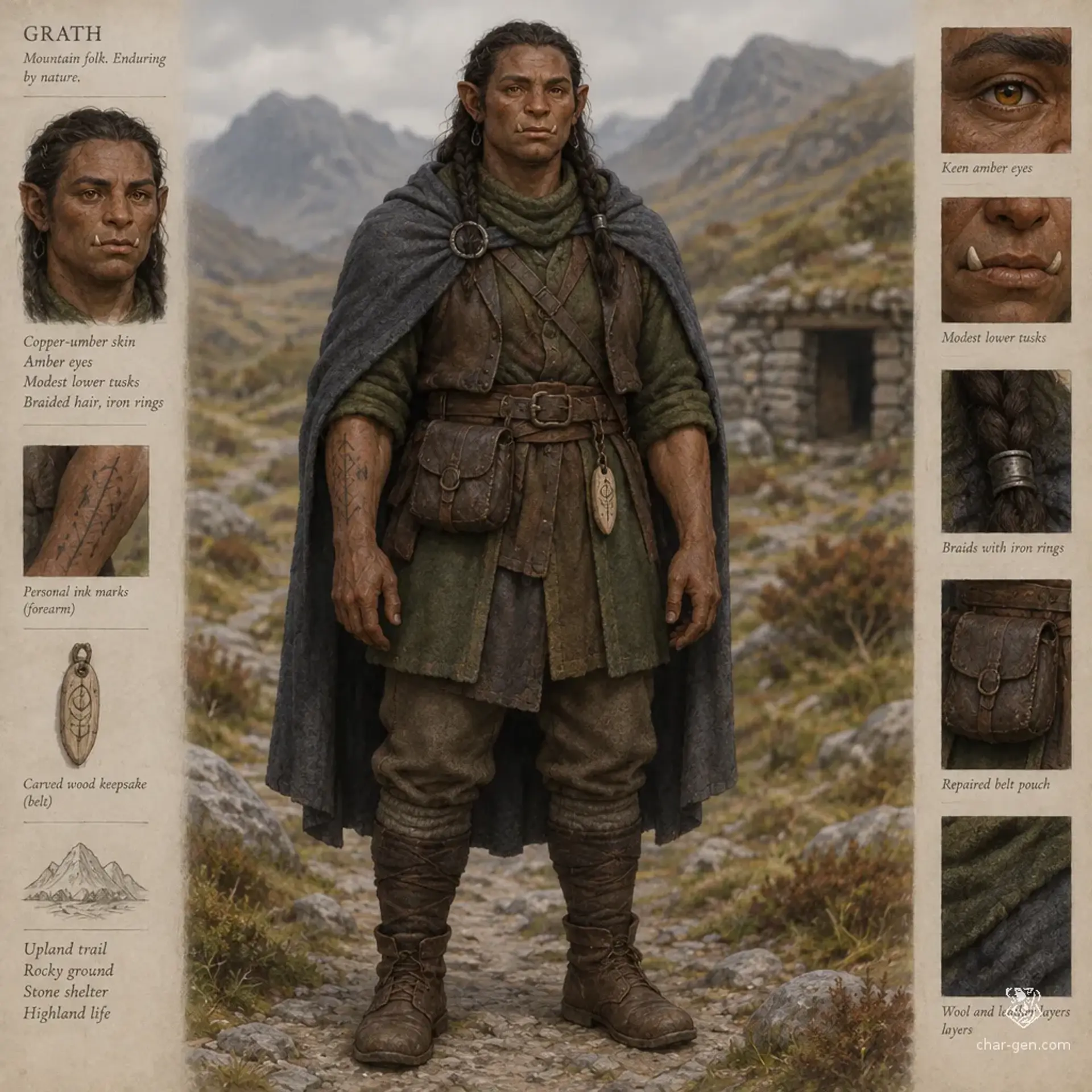
Grathus fortis
Grath are resilient, practical people whose idea of strength is not simply surviving hardship, but making sure the next person has an easier road.
At a glance
Darkvision You have Darkvision with a range of 60 feet.
Languages Common, Grath
Height 5 ft. 8 in. to 6 ft. 8 in.
Weight 170 to 300 lb.
Lifespan 75 to 95 years
At the table
You have Darkvision with a range of 60 feet. In dim light, you can see as if it were bright light, and in darkness as if it were dim light, but you perceive colors there only as shades of gray.
When you fail a saving throw to avoid or end the Frightened condition, you can choose to succeed instead. Once you use this trait, you cannot use it again until you finish a Long Rest.
As a Bonus Action, you can move up to 10 feet toward a creature you can see. This movement does not provoke Opportunity Attacks. You can use this trait a number of times equal to your Proficiency Bonus, and you regain all expended uses when you finish a Long Rest.
Your carrying capacity is calculated as though you were one size larger. You also have Advantage on ability checks made to avoid being shoved or knocked Prone.
Common, Grath
Grath tend toward Constitution and Strength, reflecting their endurance and physical culture, but ability scores are assigned according to your character’s background and choices. No ability score increases are fixed by this ancestry.
Their skin often carries cool gray or mossy undertones, and their communities prize quiet observation and memory for trails.
Raised among wet uplands and forested ridges, moor grath are practiced pathfinders and patient keepers of local lore. Their settlements tend to be dispersed, joined by well-maintained trails and seasonal gatherings.
Grath are resilient, practical people whose idea of strength is not simply surviving hardship, but making sure the next person has an easier road. Grobb might be a caravan guard, an apprentice mason, a clan envoy, or a young wanderer who left home to discover what kind of promise is truly their own.
Grath are broad-framed humanoids with dense muscle, sturdy joints, and skin in shades from warm umber and copper to olive, gray-brown, and deep charcoal.
Their lower canines commonly protrude into modest tusks, though their shape and prominence vary widely. Hair is often thick and worn in braids, cropped for convenience, or bound with rings that mark family milestones. Their keen eyes range from amber and brown to green or pale gray. Many bear decorative scarification or ink, but such marks are personal or regional rather than universal.
Hill country, upland forests, rocky coasts, broad grasslands, and the edges of settled lands.
Grath communities adapt readily to new climates when they can build strong shelters and maintain dependable stores.
Learns practical skills early and is usually expected to contribute to the household.
Considered ready to choose a craft, make public promises, and travel beyond the home community.
An adult in full standing, able to take on leadership, parenthood, or the keeping of a family vow.
Respected for accumulated judgment and stories, though age does not automatically grant authority.
Grath communities are organized around households, craft circles, and mutual obligations rather than a single hierarchy.
A person earns influence by being dependable, skilled, and willing to share the consequences of a decision. Competitive games and strength contests are popular, but so are cooking, oral history, and collaborative repairs. Many grath travel for a season or more before settling, returning with new techniques and stories to exchange.
Grath religious practice varies by community.
Some honor ancestors, local land spirits, or deities associated with hearths, craft, and protection; others keep no formal rites. Their traditions often treat vows as sacred, though a vow made without understanding its cost is considered foolish rather than virtuous. Grath have no innate alignment; their cultures value courage and loyalty, but also prize restraint, fair dealing, and the freedom to choose one’s own path.
Grath meet strangers with a frankness that can read as either refreshing or intimidating.
They often respect people who take responsibility for their mistakes and distrust those who use rank to avoid consequences. Old conflicts between communities exist, but most grath regard inherited hostility as a burden to examine rather than an order to obey. Friendships are commonly expressed through useful acts: sharing supplies, repairing gear, or standing watch without being asked.
Traditional homes are built around shared kitchens, workshops, and sheltered courtyards.
In highlands, grath shape low stone halls into slopes for warmth and wind protection; elsewhere they favor timber frames, raised floors, and broad roofs that collect rain. A family’s history is often recorded in practical objects: repaired tools, marked beams, and carved lintels.
No images yet.
A high-res, share-ready sheet you can post or print.