
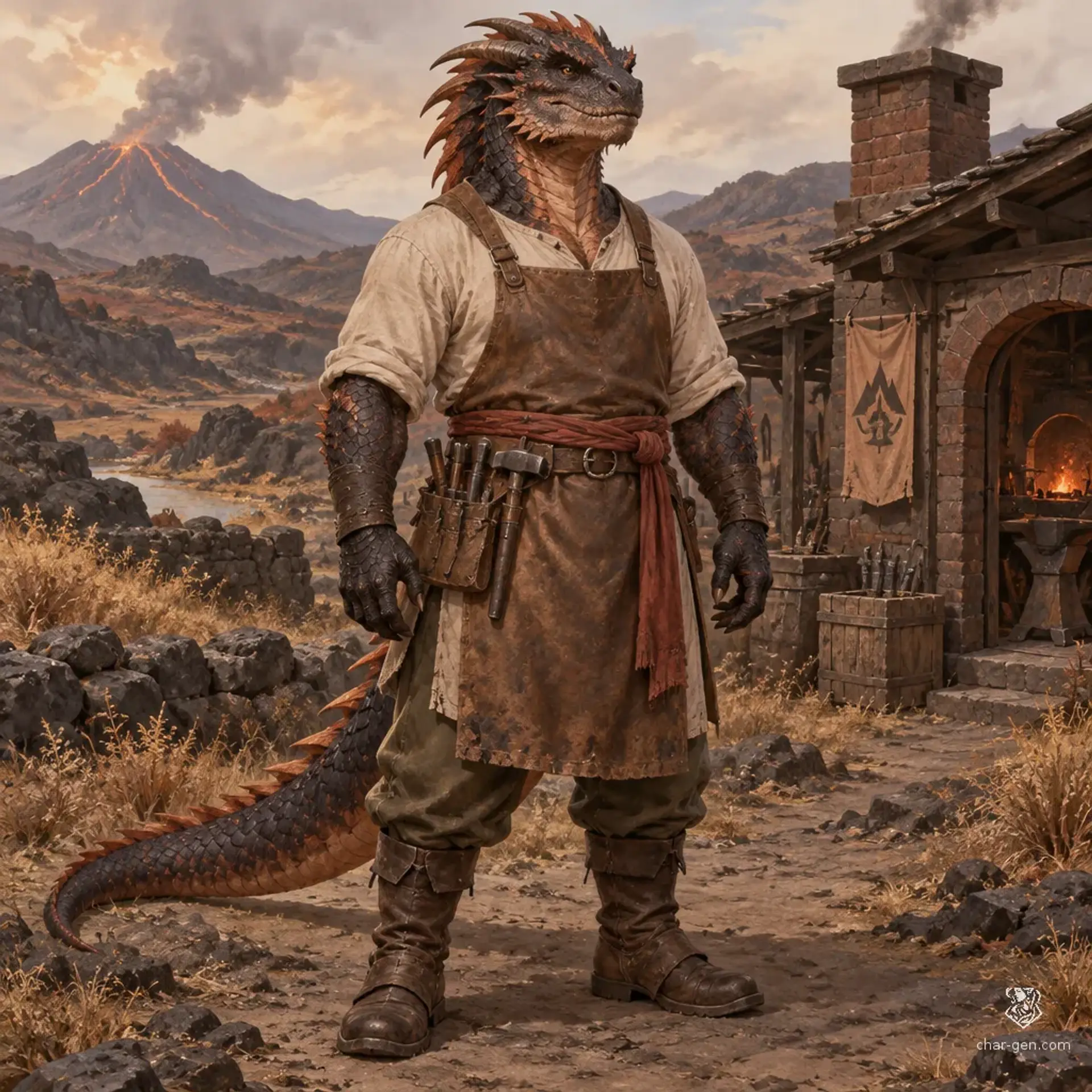
Draconis cinereus
Cindercrests are scale-clad descendants of ancient wyrms, but their lives are shaped less by draconic grandeur than by the work of keeping a community warm, fed, and safe.
At a glance
Darkvision 60 ft.
Languages Common, Draconic
Height 5 ft. 6 in. to 6 ft. 8 in.
Weight 150 to 300 lb.
Lifespan 90 to 110 years, adult at 16
At the table
Choose a lineage when you select this species. Your lineage determines the damage type of your exhalation and your resistance: cinder, cold, lightning, poison, or acid.
As an action, you exhale elemental force in either a 15-foot cone or a 30-foot-long, 5-foot-wide line. Each creature in the area makes a Dexterity saving throw, with a DC equal to 8 + your Constitution modifier + your proficiency bonus. On a failed save, a creature takes damage of the type associated with your Wyrmline; on a successful save, it takes half as much. The damage increases to at character level 5, at level 11, and at level 17. You can use this trait a number of times equal to your proficiency bonus, regaining all expended uses when you finish a long rest.
You have resistance to the damage type associated with your Wyrmline.
Starting at character level 5, you can unfurl spectral wings as a bonus action. The wings last for 10 minutes, or until you dismiss them as a bonus action or have the incapacitated condition. While they last, you have a flying speed equal to your walking speed. Once you use this trait, you cannot use it again until you finish a long rest.
Common, Draconic
Cindercrests tend toward Constitution and Charisma, reflecting hardy bodies and forceful presence; players assign ability score increases as they wish.
Their scales often show ember-red or blackened patterns, and they resist fire damage.
Cinderline Cindercrests are associated with volcanic slopes, kilns, and smithies. Their exhalation deals fire damage.
Cindercrests are scale-clad descendants of ancient wyrms, but their lives are shaped less by draconic grandeur than by the work of keeping a community warm, fed, and safe. They prize resilience, skilled hands, and the courage to speak plainly. A Cindercrest adventurer might be an exiled forge-keeper, a caravan guard who learned to trust strangers, or a determined wanderer seeking the truth behind a family legend. Granok fits naturally among them: a sturdy name with the sound of stone set firmly in place.
Cindercrests are upright, scaled folk with powerful torsos, long tails, and faces shaped by broad muzzles, pronounced brows, and small horns or ridges.
Their scales range from soot-black and iron-gray to copper, clay-red, and pale gold. Many bear a crest of spines or flexible frills along the head and neck, which lifts when they are excited or alarmed. Their hands are dexterous despite thick claws, and their voices often carry a low, resonant rasp.
Volcanic uplands, mountain valleys, dry grasslands, coastal cliffs, and settled cities with sturdy workshops.
Hatchlings are alert, sturdy, and closely watched by kin until they can manage their own scales and safely control their first sparks.
Young Cindercrests learn a craft, a household history, and the discipline to use their breath without endangering companions.
Most are considered adults after completing a community service or craft trial. Their scales and breath are fully developed.
Older Cindercrests often become keepers of family records, mediators, or teachers. Their scales may dull, but their voices carry great authority.
Cindercrest culture is organized around households, work circles, and promises witnessed by others.
Young people commonly apprentice in a trade or service before choosing their own path. A craft is valued not only for beauty but for what it makes possible: a sound roof, a safe oven, a dependable bridge. Family may mean blood relations, adoptive kin, or the companions who stood beside someone through a hard season. Their communal feasts are noisy, practical affairs, with stories traded as freely as food.
Cindercrests honor many faiths, especially those concerned with hearths, craft, ancestors, storms, and renewal after catastrophe.
Some tell stories of a first wyrm who taught their forebears to tend fire without serving it. Their culture has no required alignment: duty may lead one Cindercrest to preserve tradition, while another sees justice in breaking an unjust custom.
Cindercrests are often read as intimidating before they are known, so many learn to soften first impressions with humor, hospitality, or useful work.
They respect people who keep their word, regardless of ancestry, and tend to judge a community by how it treats its most vulnerable members. Their directness can unsettle more diplomatic folk, while their loyalty can feel overwhelming to those who value distance.
Cindercrest settlements favor stone, fired brick, and timber sealed against sparks.
Homes are built around communal courtyards, shared ovens, and broad stairs suited to heavy feet. In harsher regions, buildings are partly sunk into hillsides to hold warmth and resist wind. Their towns are less often fortresses than places where craftspeople can work safely and neighbors can gather quickly.
No images yet.
A high-res, share-ready sheet you can post or print.