
Titanis infernalis
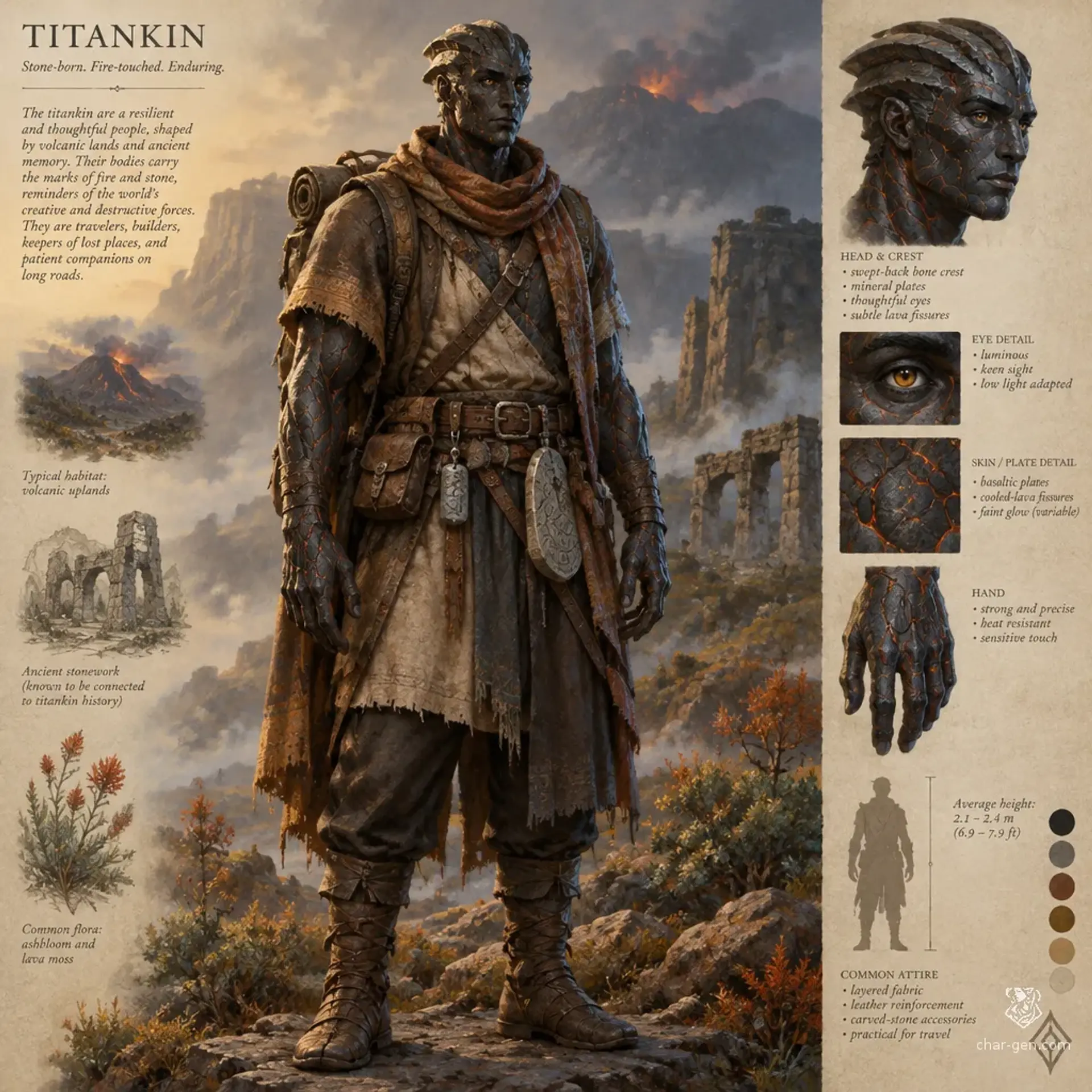
Titankin descend from colossal beings of a perilous otherworld, but they are people, not the remnants of a sleeping god.
At a glance
Darkvision 60 ft.
Languages Common, Titan Cant
Height 6 to 8 feet
Weight 250 to 500 pounds
Lifespan 180 to 240 years, adult at 20
At the table
Your creature type is Humanoid. You are Medium or Large, chosen when you select this species. Your choice does not change your reach or the equipment you can use.
Your walking Speed is 30 feet. You have Darkvision with a range of 60 feet.
You count as one size larger when determining your carrying capacity and the weight you can push, drag, or lift.
When you fail a Strength or Constitution saving throw, you can choose to succeed instead. Once you use this trait, you cannot use it again until you finish a Long Rest.
As a Bonus Action, you release a concussive bellow. Each creature of your choice within 10 feet of you must succeed on a Wisdom saving throw ( plus your Proficiency Bonus plus your Constitution modifier) or have the Frightened condition until the end of your next turn. Once you use this trait, you cannot use it again until you finish a Long Rest.
Common, Titan Cant
Titan-blooded folk tend toward Constitution and Charisma, reflecting immense vitality and a presence that can shake a room; assign ability score increases as you wish, such as +2/+1.
Their skin carries dark, glassy plates, and their voices often have a low, stone-deep resonance.
Cinderhearts are associated with volcanic caverns and the heat-scarred reaches of the otherworld. Many favor patient labor and protective roles, but their heritage does not make them immune to fire or grant them command over flame.
Titankin descend from colossal beings of a perilous otherworld, but they are people, not the remnants of a sleeping god. Their bodies carry a muted echo of immense scale: a voice that can rattle shutters, bones that weather blows, and a presence that makes legends feel uncomfortably close. Each must decide whether that inheritance is a burden, a birthright, or simply one fact among many.
Titankin are humanoid, but their proportions and surfaces hint at something older and less familiar.
Many stand well above human height, with broad frames, long limbs, or unusually heavy bones. Their skin may bear natural plates, ridges, faintly glowing seams, or patterns like cooled lava and cracked porcelain. Some have swept-back crests or blunt hornlike growths; others appear nearly ordinary until their eyes shine or their voices reverberate. These traits vary widely within families and do not reliably indicate temperament or power.
Most often found near volcanic uplands, deep caverns, ash plains, and other places where the boundary between worlds runs thin.
Communities also thrive in ordinary cities, often far from any trace of their ancestral homeland.
Growth comes in slow, unmistakable spurts. Young titankin are often kept close to trusted adults until they can control the force of their reflexes.
The first full pulse of inherited power commonly arrives during adolescence, accompanied by changes in voice, bone, or skin.
Most titankin leave home, take a chosen name, and make their own account of the legends attached to their blood.
Age brings a quieter, denser presence. Elders may develop mineral ridges or faintly luminous marks that resemble old sigils.
There is no single titankin nation or tradition.
Some families preserve genealogies in carved stone, while others deliberately leave ancestry out of their children’s upbringing. Communities often prize self-command, hospitality, and practical ways to prevent accidents, but these customs vary as much as titankin appearances. A common rite of adulthood is to choose a name independent of family history.
Titankin follow many faiths, including those that have no connection to their ancestry.
Some honor the dead colossi as forebears; others regard them as cautionary tales, natural forces, or simply distant relatives. Their immense bearing is no guide to alignment. Personal choice, family tradition, and the communities they protect matter more than inherited myth.
Many folk respond to titankin with awe, suspicion, or both, particularly in places where old stories warn of world-shaking monsters.
Titankin communities tend to reject the assumption that ancestry determines allegiance. They form friendships across cultures, though some find themselves treated as natural bodyguards or living symbols. A titankin who travels may be asked to speak for an entire lineage they barely understand.
Old settlements favor immense doorways, broad stairways, and stonework designed to endure tremors.
Modern titankin commonly live in adapted neighborhoods or ordinary homes, altering little beyond reinforced furniture and clear routes through crowded rooms. Their oldest sites are sometimes mistaken for the remains of impossibly large beings.
No images yet.
A high-res, share-ready sheet you can post or print.