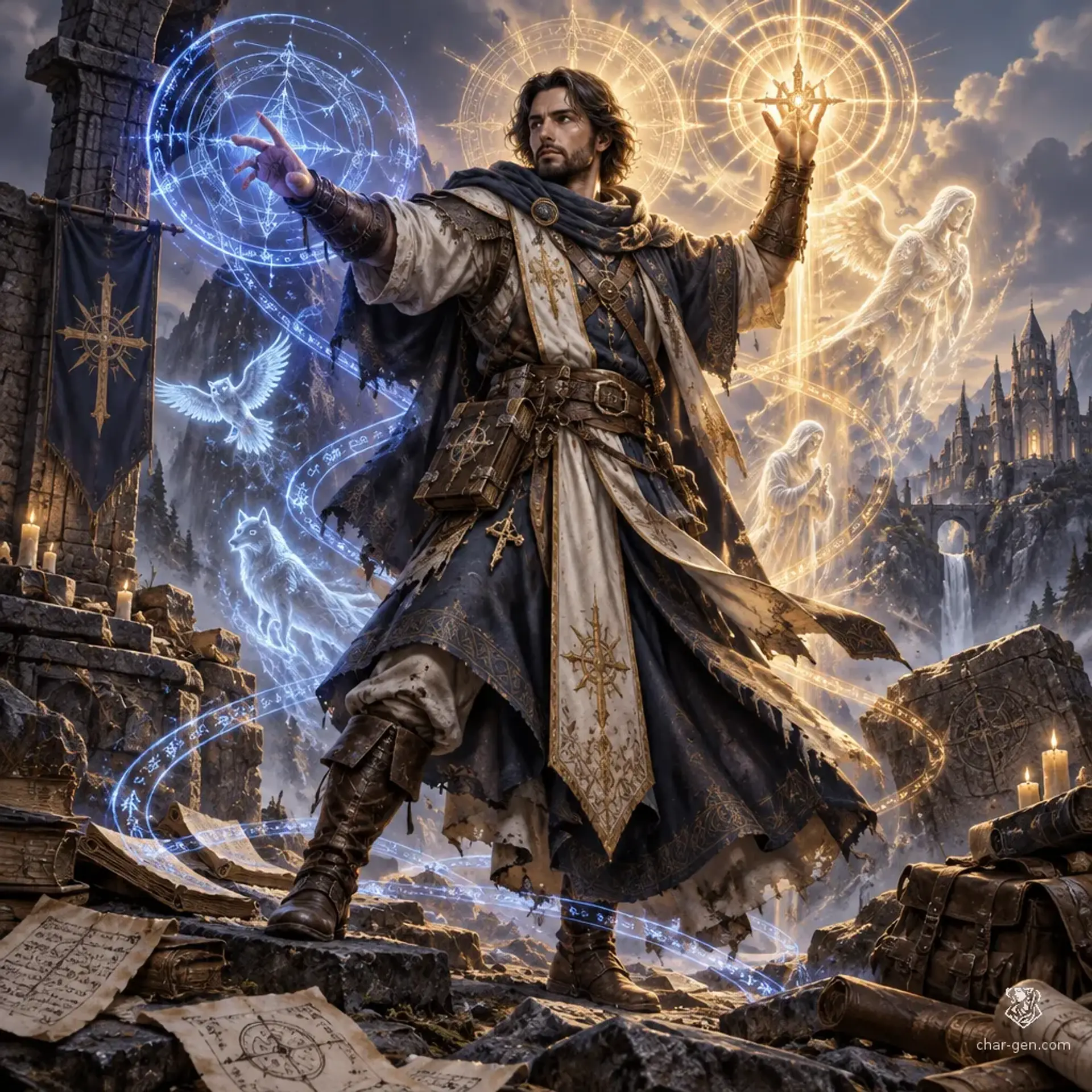
Concordants study the shared grammar beneath spellcraft and prayer. They combine arcane technique with divine purpose, making versatile full casters who can adapt their prepared magic to a party's needs and briefly reinforce spells with a measured reserve of concordance. Their strength is breadth and flexibility rather than unmatched damage, armor, or a single specialized spell list.
Where prayer meets proof, magic finds common ground.
Full caster; adaptable support, utility, and battlefield control.
CConcordant
At a glance
Level
1
Proficiency
+2
bonus at this level
Uses
Hit die d6
PrimaryIntelligence or Wisdom (choose one for spellcasting)Constitution
Features
20, levels 1 to 20
1Level 1, reached
Spellcasting
You learn to cast spells drawn from both arcane and divine traditions. You prepare spells from the concordant spell list after a long rest, using the full-caster spell-slot progression; choose Intelligence or Wisdom as your spellcasting ability, which you use for all your concordant spells.
2Level 2
Concordant Calling, Concordance
Choose a Concordant Calling, which grants features at 2nd, 6th, 10th, and 14th level. You also gain a reserve of concordance points equal to your proficiency bonus, regained when you finish a long rest; you can spend 1 point when you cast a concordant spell to add your proficiency bonus to one healing or damage roll of that spell.
3Level 3
Measured Reprieve
You can perform a rite of quiet focus during a short rest, recovering expended spell slots whose combined levels equal no more than half your concordant level (rounded up). No slot can be 6th level or higher, and you can use this feature once per long rest.
4Level 4
Ability Score Improvement
5Level 5
Living Repertoire
When you finish a long rest, you may replace one prepared concordant spell with another spell from the concordant spell list. You can do so a number of times equal to your proficiency bonus, regaining all uses after a long rest.
6Level 6
Calling Feature
Your Concordant Calling grants a feature. When you spend a concordance point, you can also choose one ally within 10 feet of you; that ally gains temporary hit points equal to your proficiency bonus.
7Level 7
Steadfast Attention
You can maintain concentration on a concordant spell while taking damage with greater discipline. You have advantage on Constitution saving throws you make to maintain concentration on a concordant spell.
8Level 8
Ability Score Improvement
9Level 9
Expanded Repertoire
You can prepare one additional concordant spell. In addition, when you finish a long rest, you can choose one prepared spell; it counts as prepared without counting against your normal number of prepared spells until your next long rest.
10Level 10
Calling Feature
Your Concordant Calling grants a feature. When you spend a concordance point, you may add your proficiency bonus to one saving throw you make before the start of your next turn.
11Level 11
Silent Synthesis
When you cast a concordant spell of 1st through 5th level, you can spend 2 concordance points to cast it without verbal or somatic components, unless those components are consumed or have a specified cost.
12Level 12
Ability Score Improvement
13Level 13
Held Synthesis
When you finish a long rest, you can designate one prepared concordant spell of 1st through 5th level. Once before your next long rest, you can cast it without expending a spell slot; you cannot do so again until you finish a long rest.
14Level 14
Calling Feature
Your Concordant Calling grants a feature. Your concordance reserve increases by 1 point.
15Level 15
Deep Repertoire
You can prepare two additional concordant spells. When you roll initiative and have no concordance points remaining, you regain 1 point.
16Level 16
Ability Score Improvement
17Level 17
Greater Reprieve
When you use Measured Reprieve, you can recover spell slots whose combined levels equal up to your concordant level (rounded up), rather than half your level. You still cannot recover slots of 6th level or higher.
18Level 18
Refined Concordance
When you cast a concordant spell that restores hit points or deals damage, you can spend 1 concordance point to reroll one of the spell's dice. You must use the new roll.
19Level 19
Ability Score Improvement
20Level 20
Perfect Accord
When you roll initiative, you regain 2 concordance points if you have fewer than 2 remaining. Once per long rest, when you fail a Constitution saving throw to maintain concentration on a concordant spell, you can choose to succeed instead.
Core traits
Hit die
d6
Primary
Intelligence or Wisdom (choose one for spellcasting)Constitution
Hit pointsHit Die: per concordant level; hit points at 1st level: 6 + your Constitution modifier; hit points at higher levels: (or 4) + your Constitution modifier per concordant level after 1st.
Saving throwsProficient in Intelligence and Wisdom saving throws. Light armor proficiency; no shield proficiency.
Armorlight armor.
Weaponssimple weapons.
Toolsone artisan's tool or one musical instrument of your choice.
Saving throwsIntelligence and Wisdom.
Skillschoose two from Arcana, History, Insight, Medicine, Nature, Persuasion, and Religion.
ResourceSpell slots (full-caster progression) and concordance points (proficiency bonus per long rest, increasing by 1 at 14th level).
MulticlassingPrerequisite: Intelligence 13 or Wisdom 13, matching the spellcasting ability you chose for this class. Proficiencies gained: light armor, one skill from the concordant skill list, and one tool of your choice. For multiclass spell slots, count all your concordant levels; they contribute as full caster levels under the multiclass spellcasting rules. You prepare concordant spells separately and cannot use another class's spellcasting ability for them.
Spells and options
How it casts
You are a full caster and use the cleric's 2014 spell-slot table.
You know four concordant cantrips at 1st level and learn additional cantrips at 4th, 10th, and 17th level. After each long rest, prepare a number of concordant spells equal to your concordant level + your chosen spellcasting ability modifier (minimum one); you may prepare spells of any level for which you have spell slots. Your class spell list draws on arcane and divine magic and includes the spells shown in Spell List, plus other spells the DM approves as fitting this class. You may use an arcane focus or a holy symbol as a spellcasting focus. Spell save DC = 8 + proficiency bonus + chosen spellcasting ability modifier; spell attack modifier = proficiency bonus + chosen spellcasting ability modifier.
Cantrips
1st-Level Spells
2nd-Level Spells
3rd-Level Spells
4th-Level Spells
5th-Level Spells
6th-Level Spells
7th-Level Spells
8th-Level Spells
9th-Level Spells
Subclasses
3
School of the Shared Flame
Turn precise spellcraft into a clear, protective force.
2nd: Choose one damage type among acid, cold, fire, lightning, or thunder; when you spend concordance on a spell that deals that type, add the bonus to one damage roll.
6th: Gain resistance to the chosen damage type while concentrating on a concordant spell.
10th and 14th: Improve spell shaping and protect allies from your area spells.
Vow of the Open Hand
Make practical care the highest form of magic.
2nd: Gain a modest healing or warding benefit when you spend concordance on a spell that restores hit points.
6th: Protect a nearby ally from a condition or magical affliction.
10th and 14th: Strengthen restorative magic and bring allies back from the brink.
Tradition of the Quiet Star
Find the pattern that joins fate, formula, and faith.
2nd: Learn to read lingering magical traces and gain a divination-oriented benefit.
6th: Share a brief warning with allies before danger strikes.
10th and 14th: Improve information-gathering magic and act on glimpsed possibilities.
Playing one
What it is
Concordants study the shared grammar beneath spellcraft and prayer.
They combine arcane technique with divine purpose, making versatile full casters who can adapt their prepared magic to a party's needs and briefly reinforce spells with a measured reserve of concordance. Their strength is breadth and flexibility rather than unmatched damage, armor, or a single specialized spell list.
How to play one
At the table, the concordant feels like a flexible full caster who prepares for the party's likely needs and changes course when plans shift.
Use concentration spells and support options to shape encounters, then spend concordance points on a pivotal heal, damage roll, or defensive moment. You have fewer signature tricks than a specialist, so choose spells that cover different situations.
Make one
Personality
I ask what a spell is meant to accomplish before I ask how it works.
Ideal
Reconciliation. Opposing traditions can teach each other without losing what makes them meaningful.
Bond
I owe my first teacher a debt that neither of us can agree how to repay.
Flaw
I keep trying to mediate conflicts that are not mine to resolve.
Quirk
Draws a small diagram in the air before casting.
Personality
I ask what a spell is meant to accomplish before I ask how it works.
I make room for disagreement, then take careful notes on both sides.
I treat old prayers and old formulae with equal respect.
I explain complicated ideas with small demonstrations and everyday objects.
Ideals
Reconciliation. Opposing traditions can teach each other without losing what makes them meaningful.
Service. Knowledge and miracles matter most when they ease another person's burden.
Inquiry. No doctrine or theory is beyond honest questioning.
Bonds
I owe my first teacher a debt that neither of us can agree how to repay.
A community I served trusts me to settle a dispute between its temple and its arcanists.
I carry a relic that responds to both prayer and careful study, and I intend to learn why.
Flaws
I keep trying to mediate conflicts that are not mine to resolve.
I distrust any magical answer that cannot be explained, even when time is short.
I sometimes overprepare for a problem and overlook the person standing in front of me.
Quirks
Draws a small diagram in the air before casting.
Uses both scholarly and devotional terms for the same magical idea.
Keeps separate notes for what a spell did and what it meant to its witnesses.
Pauses to listen for a moment before beginning a prayer or incantation.
In the world
Training
Most concordants begin as students of either a temple or a magical school, then encounter a teacher who recognizes that their questions cross traditional boundaries.
Training combines formal spell theory, religious history, practical service, and supervised study of spells from both traditions. Initiation is usually a public act of service rather than a secret rite: the student must use both disciplines to solve a problem neither could address alone.
How others see them
Ordinary people may see concordants as reassuring healers who understand both learned magic and faith.
Religious and arcane authorities are more divided: some value their mediation, while others suspect that blending traditions weakens both.
Famous practitioners
ConcordantIlyra VennA quiet mediator said to have ended a plague by pairing a carefully prepared ritual with a saint's blessing.
ConcordantOren HalewickA former court mage who founded a refuge where exiled priests and dismissed scholars study together.
ConcordantSister CaldusA wandering teacher whose annotated prayerbook is copied by students across three kingdoms.
Factions
The Open Accord
A traveling fellowship that settles disputes over magical practice and teaches practical spellcraft in remote communities.
The Scriptorium of Two Lamps
A secluded society of scribes and chaplains who compare sacred texts with arcane formulae, seeking their common structure.
The Kindly Measure
A mutual-aid network of healers and hedge mages that is welcomed by the poor and regarded warily by some temples.
Regions
The Crossroads Principalities
In cosmopolitan cities, concordants often work as mediators between temples, magical colleges, and civic authorities.
The Farward Marches
In isolated settlements, one concordant may serve as healer, tutor, and keeper of local rites.
The Ashen Borderlands
In regions suspicious of organized magic, concordants are sometimes valued as discreet counselors and sometimes driven underground.
Character hooks
You were raised in a temple library where a forbidden spellbook was hidden among the hymnals.
A village miracle you performed was later identified as arcane magic, and both a church and a college now want answers.
You are the last student of a teacher who vanished while trying to reconcile two rival magical traditions.
A divine vision gave you the formula for a spell no mortal school has ever recorded.
You served as a mediator between a temple and a wizard's tower until a magical disaster made both sides blame you.
You seek a cure for a loved one, convinced that neither prayer nor scholarship alone can provide it.
Media
0 images
No images yet.
Visual sheet
Turn Concordant into a sheet
A high-res, share-ready sheet you can post or print.

 Constitution