William Windon
William Windon
At the table
“You have combed it as though the hair were the problem.”
Voice
William's voice carries the breath and slight rasp of outdoor work, with a practical, local cadence rather than a polished scholarly manner. His breath catches when his chest hurts, and he sometimes pauses as if checking whether a word is his own. The reflection's voice is produced through William's mouth but has an older accent, deeper resonance and crisply finished consonants. It sounds as though it has learned modern speech from listening rather than living among its speakers.
William speaks in a plain Wiltshire English voice, with the measured phrasing of someone used to explaining what he has actually seen rather than what he thinks others want to hear. His work gives him a vocabulary of soil, roots, weather and careful observation. When nervous he becomes overly exact, describing where a sound came from or how long a pause lasted. The reflection uses his mouth but sounds older: its consonants are clipped and its phrasing formal, with a dry, almost conversational sarcasm. Its voice is not softer when angry; anger makes it more direct and less interested in wit.
Speech patterns
How to play them
Treat William as a frightened but observant young man, not as a cryptic oracle. He responds best to patience, direct questions and practical help. Do not mock his account or force him to perform the reflection's behavior. If Elizabeth or Adaline is present, he tries to keep the stranger from speaking for him. The reflection may interrupt through glass or, under pressure, without it. Offer William a choice: investigate the heart, search for Abraham, or seek protection for his family.
Goal
Find Abraham Gorff or recover the heart, learn what the reflection is, and stop it from taking control of his life or frightening the people he loves.
Motivation
To regain ownership of his body and ordinary life without dismissing the possibility that the presence is a person, or something that can suffer.
Appearance
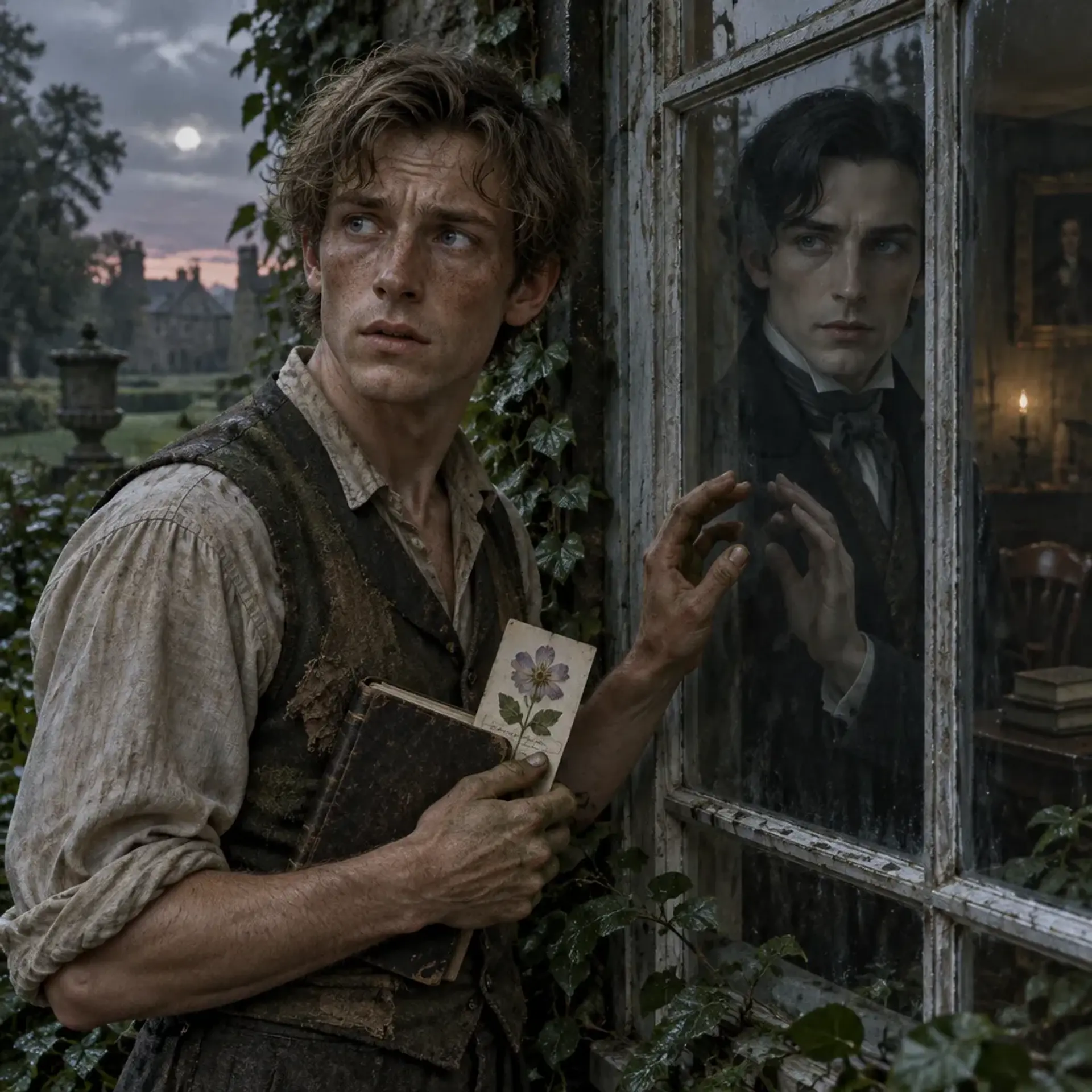
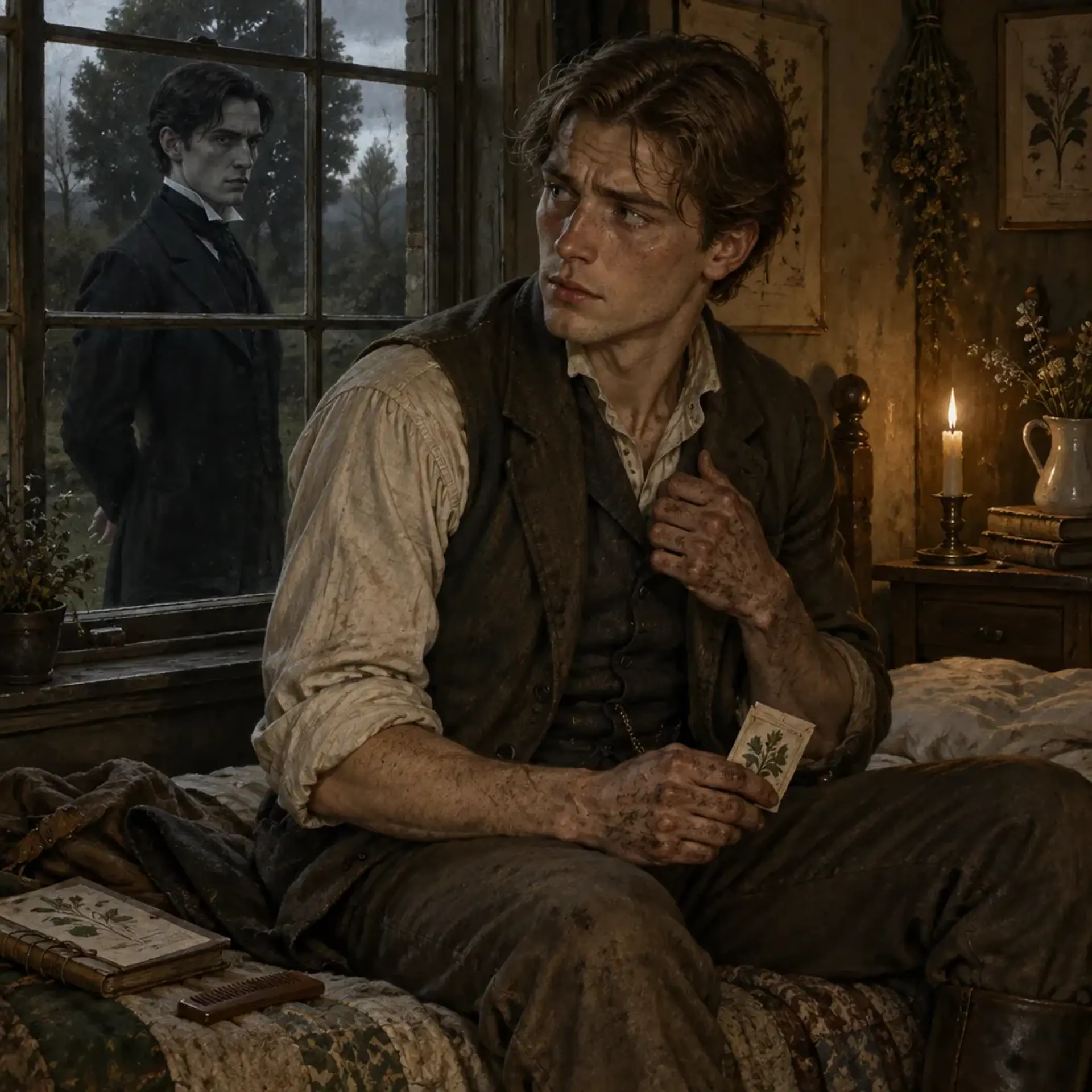
William is a tallish, narrow-shouldered young man with a long, weather-browned face and freckles scattered over his nose and cheeks like soil flecks. His dark-blond hair is usually flattened by a comb and then disrupted by wind or work. He stands with his weight on the balls of his feet, as if ready to cross a garden bed without disturbing a seedling. His hands are roughened by pruning, potting soil and estate work, with green stains that persist around the nails. His expression can seem open until he catches sight of his reflection: then his jaw sets and his eyes fix on the glass with the wary attention of someone facing a stranger at a gate. In reflective surfaces the stranger appears instead: long-faced, handsome by an old-fashioned English standard, with carefully combed black hair, moonlit blue eyes and a stern, composed expression. At first the stranger mimed William's movements; now he sometimes moves independently. The unexpected detail is William's habit of carrying a tiny, carefully folded paper packet of garden seeds in his waistcoat, even while on bed rest, and turning it over like a worry stone.
Clothing
Practical gardener's clothes: worn work trousers, waistcoat, shirts with sleeves rolled for labor, and boots that carry honest traces of soil. At home he favors a brushed jacket and a carefully combed part, trying to look respectable even when confined to bed. He keeps a seed packet tucked close.
Body language
William waits lightly forward, as if ready to rise, but illness has made him guard his chest with one hand when startled. He rubs thumb against forefinger as though feeling soil there. When the reflection speaks, his shoulders stiffen and his gaze slides toward the nearest pane. The stranger's reflected posture is more formal: chin level, shoulders held square, hands often clasped behind its back even when William's hands are occupied.
- Height
- Approximately 5 feet 11 inches
- Build
- Tallish and lean from outdoor work, with wiry strength rather than bulk; currently weakened by recovery from the heart stoppage.
- Eyes
- Blue; the stranger's reflected eyes are a colder, moonlit blue.
- Hair
- Dark blond
- Skin
- Fair, weather-browned from outdoor work, with freckles across the face
- Age
- Young adult, approximately 19
- Gender
- Male
- Size
- Human-sized
Distinguishing features
Personality
18 traits and drivesWilliam is practical but not incurious: he wants evidence before belief, yet cannot stop asking what a living heart might mean. He is proud of his work and easily stung by anyone who treats it as lesser. Around strangers he tries for good manners; with family he is more candid, though he often hides his worst fears to spare them. His kindness is real but not endlessly patient. He can be protective to the point of controlling, especially around Elizabeth and Adaline, and then feel guilty for assuming they need his protection. He wants to be brave, but often mistakes silence for courage. The reflection brings out contradictions he would rather keep private: William resents its arrogance, envies its ease with words, fears its interest in the people he loves, and sometimes laughs at its jokes before he remembers to be angry. His moods alter the way he handles the haunting. When calm, he records what the reflection says and tries to find patterns. When tired or in pain, he answers it aloud and risks an argument in front of others. When frightened, he becomes brisk and practical, asking for a glass to be covered or a room to be cleared. When ashamed, especially after the reflection has spoken cruelly through him, he withdraws rather than explaining. Around Adaline he tries to be ordinary, which makes his pauses more conspicuous. Around Elizabeth, he can be gently teasing until the reflection takes an interest; then he becomes vigilant and overbearing. The stranger's presence makes William question whether his own preferences are truly his. It criticizes his combing and clothes, and William sometimes changes them merely to prove he can. It interrupts his speech when it considers a remark improper, which infuriates him because the stranger has already shown itself capable of genuine impropriety. He is not certain whether this is a moral objection, a habit from another life, or a bid for control. He hates that he can find its dry wit funny. He hates even more that the reflection seems to know when he does. With Elizabeth, the reflection is watchful rather than openly hostile. It calls her “interesting” and studies the way she asks about boys, clothes and manners. It sometimes offers an answer in a polished, corrective tone, as though it considers itself a better guide to her than William. William sees danger in that attention and tells it to stop. Yet when Elizabeth is upset, the stranger has once fallen silent rather than mock her. William does not know whether this was compassion, curiosity, or simply a pause. He is protective of his sister but knows she dislikes being managed. Their arguments usually end with him apologizing awkwardly and her asking another question before he has finished. With Adaline, the reflection behaves as if a private contest has begun. It notices William's efforts to look presentable and comments on them. It calls her pleasing to the eye, asks whether she likes William's jacket, and sometimes offers a pointedly elegant compliment through his mouth. William experiences these moments as both humiliating and threatening. The stranger does not simply insult Adaline; it seems to want her attention and to test how much of William's relationship it can enter. William has not told Adaline everything, partly from fear of losing her and partly because he cannot bear the thought of her being studied by the presence. He wants to trust her with the truth but worries that the truth will make her see him as a danger. William's moral center is not a grand code. It is the small, repeated choice to keep faith with people, to tend what is growing, and to take responsibility when something goes wrong. The reflection's cruelty toward the neighbor's child wounded him because it used a voice he thought was his. He remains angry at the stranger, but understands that the responsibility cannot be neatly separated from him. He is trying to learn when to resist, when to listen, and how to tell the difference between a warning and a manipulation.
- Alignment
- Protective but self-interested; the reflection's idea of propriety is not the same as William's idea of kindness.
Quirks
Habits
Traits · 5
Flaws · 4
Fears · 4
Wants and needs · 5
Combat
HP 0William is not a trained fighter and avoids violence. He would get between danger and his family, use a door, chair or garden tool to make space, and flee if possible. The reflection is an unpredictable custom supernatural presence, not a combat-trained alternate character. No Secret Histories combat statistics are asserted here because no rules for that system were supplied.
William Windon
Services they sell
Equipment
- Garden seeds (personal item)Small folded packets of seeds, saved from his gardening work and handled for comfort.
- Pocket comb (personal item)A comb used in his habitual morning grooming; the reflection frequently comments on its use.
- Work hammer (tool)The hammer used against the heart. It failed to damage the object and is now a reminder of the pain it returned.
Possessions
Background
William Windon was born in Wiltshire into a family that had lived among its lanes and fields for generations. He grew up knowing the practical calendar of the countryside: when the ground would take a seed, which hedge would shelter a nest, and how quickly a good pair of boots could be ruined by a wet winter. His father, Hector, is a historian, fond of dates and records and sometimes too pleased with his own London education. William learned early to listen without pretending to agree. His mother, Clare, is the person he trusts to notice when something is wrong before he has found the words for it. His sister Elizabeth is younger, bright, inquisitive and never short of questions about clothes, manners, or the boy she likes. William can be protective of her and still find her questions exhausting; the two feelings arrive together, which embarrasses him more than either feeling alone. William works as a gardener on a local estate and hopes to train as a botanist. Plants make sense to him without being simple. A seed can remain dormant, a cutting can take root in the wrong place, and something beautiful can be poisonous. He likes the patient evidence of growth, and he has an eye for small changes that others overlook. He is proud of knowing his work, but still feels the old pinch when educated visitors treat a gardener as scenery. He has a girlfriend, Adaline, whose auburn hair and soft brown eyes he finds lovely; he also values that she speaks plainly to him. Their relationship is young, affectionate and not free of awkwardness. William wants to impress her and fears that wanting to impress her makes him foolish. The trouble began with a visitor to the Hush House. Bartholomew Golden, an amateur arcanist, tried to pay for entry with what he called a fossilized living heart, forged of heart and scale. It looked like a lump of Dover cliff chalk cut into the shape of a human heart, its surface crowded with barnacles and sea grass. The household rejected it, and the object was thrown into the sea. It came back to shore streaked with salt water and black ooze. Beneath its stony surface a red-pink light seemed to return, though no one could say whether it was light, blood, or an effect of wet stone. A young man named Abraham Gorff picked it up and carried it home to Wiltshire. He had come from London, and at first the object repulsed him as much as it fascinated him. He showed it to neighbors, whereupon it seemed to die in their presence. Weeks later, at a Hampshire shore, he placed it in water and saw its color revive. Abraham decided it was special and belonged to him. He also learned, in the unsettling way one learns the preference of a difficult houseguest, that the heart seemed not to like company. He kept it from visitors, not simply out of greed but because it appeared to become inert around them. Abraham's house grew strange. Voices spoke in empty rooms; doors moved; footsteps crossed halls and stairs. He came to understand that the heart beat, and that it wept salt water. The experience frightened him enough that he sold the thing to William, one of the people who had seen it during one of its apparent deaths. William was proud of his odd acquisition. He thought it a peculiar natural object, perhaps a curiosity he might someday explain through careful observation. Then he began to feel its beat inside his own chest. After a spell of tasting the sea in the back of his throat, William took a hammer to it. The blow did not break the stone. Pain struck his chest instead. He fell, groaning and spitting blood, and for a fraction of a moment saw muscle twitch beneath the rock. He woke with Clare's hands on his face. She told him his heart had stopped. William recovered, but the incident left him shaken and under medical orders to rest. He hid the object in a hollow log, hoping the separation would end the matter. Days later it was gone. The heart in the log had looked cold and pristine despite the hammer blow. The mirror became his next problem. While grooming, William began seeing a different young man in the glass: long of face, short black hair combed back, blue eyes, and a stern expression. The face was not William's. At first it only copied him, and William tried to ignore it. The reflection's movements then began to jerk away from his own, as if the stranger had somewhere else to be. During William's bedtime routine, it spoke using William's mouth: “Well, it's not often you use that one.” The voice sounded older than William's and carried an accent from a generation he could not place. The reflection has since become a companion, nuisance, and intruder. It comments on William's combing, clothes and manners; it sometimes prevents him from speaking when it thinks his words improper. It has made cutting remarks about Hector, including after Hector dismissed country people as silly. William was punished for a later incident in which the reflection directed a slur at a Welsh neighbor's child after the child accidentally bumped him with a toy wagon and apologized in tears. William had to muck out the neighbor's stables. He remains angry about the reflection's cruelty and ashamed that the words came out of his own face. The reflection talks about a father and siblings of its own, but speaks of them as though describing weather, tide or a sensation rather than living people. It calls Elizabeth “interesting.” When she chatters about a boy she likes or asks whether a thing looks nice, the reflection watches her with an attention that makes William uneasy. It does not seem to hate her. It studies her, sometimes answers her questions from the glass in William's voice, and has on occasion attempted to correct her manners. William intervenes whenever he can, telling it to leave her alone. The stranger's responses range from dry amusement to a startling, almost tender silence. William cannot tell which is worse. Adaline has become a special point of contention. The first time the reflection saw her, it assessed her auburn hair and soft brown eyes with immediate interest. It calls her “pleasing to the eye,” a phrase William finds both insulting and embarrassingly close to his own thoughts. It comments on how she dresses, how she looks at William, and whether he has made himself presentable before seeing her. It has tried to take over conversations by correcting William's phrasing or offering Adaline a dry, polished compliment in his mouth. Adaline has noticed that William sometimes pauses as if listening to someone she cannot see. William has not told her the whole truth, fearing she will think him ill or fear him. The reflection seems delighted by this silence and treats Adaline as a kind of contest. It has called her “interesting” too, but with a warmth that makes William's stomach tighten. When William's schoolmates Tommy DeHare, John Mollask and Ryan O'Leary visited during his bed rest, the reflection revealed that glass was no longer necessary. It reacted physically to them and spoke without a mirror. The friends saw enough to know William was not merely tired or feverish. William now wants the heart back, or Abraham Gorff, or any explanation that can tell him what is happening and how to stop it. He has learned that Abraham moved to Canada. The search is complicated by his recovery, his need to keep the family calm, his work and ambitions, and the uncomfortable fact that the reflection knows things William does not. A dream in which William stood on the other side of the glass has made the fear personal: perhaps the stranger is not trying to get out. Perhaps it is trying to show William where he belongs.
Role in the story
A grounded, sympathetic witness to an uncanny possession or contact, with a mystery that can become a personal investigation, a family threat, or a question about identity and consent.
“His father, Hector, is a historian, fond of dates and records and sometimes too pleased with his own London education.”
- Faction
- No formal faction. He works on a local estate and is tied to his Wiltshire family and community.
Known connections
Media
0 imagesNo images yet.
Turn William Windon into a sheet
A high-res, share-ready sheet you can post or print.