William Windon
William Windon
At the table
“s courtship: “You have asked her three questions and listened to the fourth. Remarkable progress.”
Voice
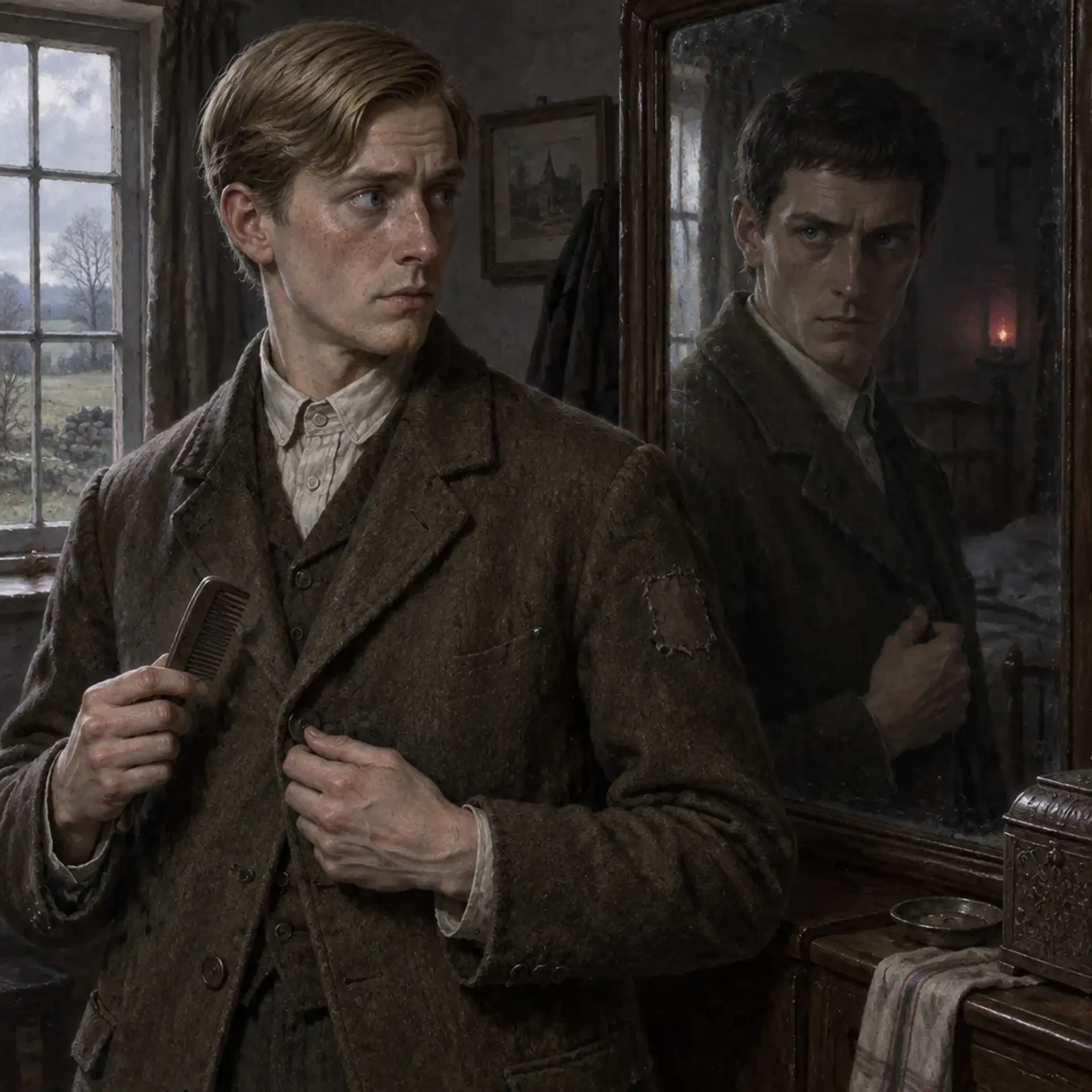
William speaks from a body shaped by outdoor work: his breath can catch after carrying tools, and cold air leaves his throat dry. He has a plain, locally grounded manner, with careful pauses when discussing plants or trying to be honest about the heart. The reflection's speech is more measured and exact, with a distinctly older cadence and a dry, conversational bite. It does not become gentler when angry; it grows more cutting and more certain.
William's voice is a straightforward young man's voice, often a little breathless after physical work and roughened by cold mornings outside. He pauses to find a precise word rather than dressing an idea up. The reflection uses William's mouth but sounds older: its consonants are more deliberate, its cadence clipped, and its dry wit carries an older English accent that does not belong to William's generation. Its name alone should not be given any special sound texture beyond this description.
Speech patterns
How to play them
Approach William through the ordinary parts of his life first: his garden work, his botanical ambitions, or a request to identify a plant. He responds to patience and practical help. Do not treat his account as a joke if the reflection manifests. He is more likely to admit details after someone has seen the stranger for themselves or has earned his trust. If pressed about Adaline or Elizabeth, he becomes protective and may end the conversation. The reflection is a separate presence in the fiction, not a second player character: let it interrupt selectively, especially around mirrors, bedtime, and social embarrassment.
Goal
Find the fossilized heart or Abraham Gorff, understand why the reflection is attached to him, and keep the stranger from taking over the relationships he values.
Motivation
William wants a grounded life earned through skill and care. He wants to become a botanist, protect his family, and court Adaline honestly. The reflection's presence tempts him with answers while threatening the privacy and self-command that make those ambitions possible.
Appearance
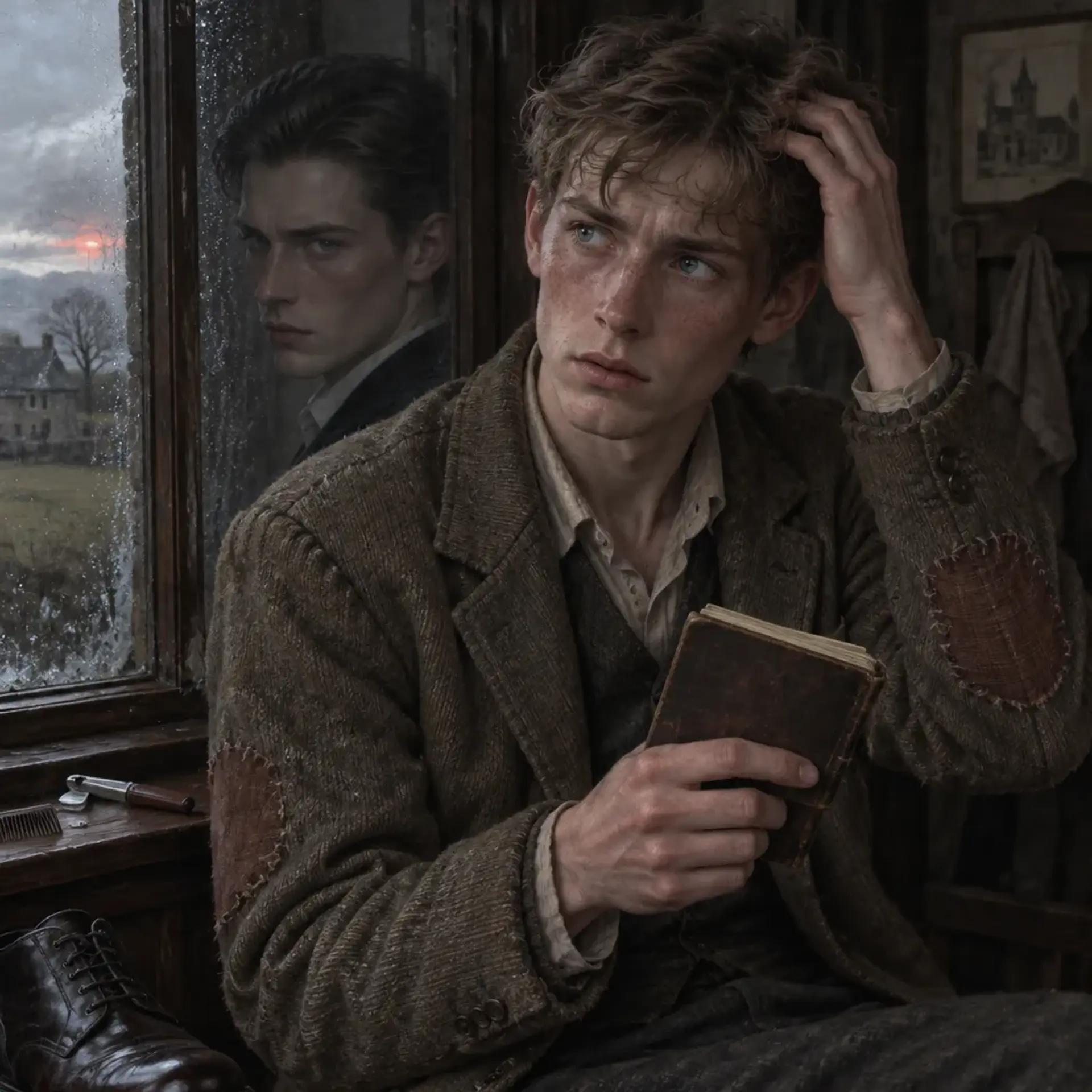
William is a young Wiltshire man with a long, sun-browned face, blue eyes, and dark-blond hair that refuses to lie flat after a day among hedges. Brown freckles cluster across his nose and temples. His gardener's hands are blunt-nailed, faintly green at the cuticles, and usually carry the clean, damp smell of crushed stems. He moves with the economical, cautious footing of someone accustomed to slick paths and spade edges, but his shoulders tense whenever he passes a window. The reflection in glass is not his: it shows a handsome, long-faced young man with carefully combed black hair, moonlit-blue eyes, and a severe, old-fashioned composure. The stranger seems to stand a fraction too still, then makes a tiny, deliberate movement that William did not make. An unexpected detail for a working gardener: William keeps a little pressed-flower specimen tucked into his best coat, labeled in his precise hand, because he is studying to become a botanist.
Clothing
Work clothes chosen to last: a patched waistcoat, rolled sleeves, sturdy trousers, and boots with dried earth in the seams. He cleans up carefully for visits and dates, though he is never sure whether the reflection approves. His best coat holds a pressed-flower specimen in an inner pocket.
Body language
William stands squarely when talking about gardening and folds inward when the subject turns to the heart. His hands seek a task: brushing soil from his cuffs, aligning a tool, or worrying a leaf between finger and thumb. In front of glass he holds himself still, watching for the stranger to move first. When the reflection speaks, William's jaw tightens and his lips sometimes form a silent objection before his own voice follows.
- Height
- Average height
- Build
- Lean, wiry, and sturdy from outdoor work; his strength is practical rather than imposing.
- Eyes
- Blue
- Hair
- Dark blond; the reflection has carefully combed black hair.
- Skin
- Light, weather-browned skin with brown freckles across his nose and temples
- Age
- Young adult, about 19
- Gender
- Male
Distinguishing features
Personality
19 traits and drivesWilliam is practical without being dull, proud without being unkind by nature, and curious in a way that can become stubborn when someone tells him to stop asking questions. He likes work whose results can be seen: a cleanly pruned hedge, a recovering seedling, a path made safe after rain. He is more confident among plants than people because plants do not require him to guess what a pause means. With strangers he is modest and observant; with family he is more argumentative, especially when he thinks they have mistaken his silence for agreement. When frightened, he becomes methodical: he writes down times, checks doors, and tries to find a sensible explanation. When exhausted, he snaps at the people he most wants to protect, then feels guilty and tries to repair the damage through practical favors. He has a generous streak that he dislikes advertising. He will carry a basket, mend a broken stake, or walk someone home without making a speech about kindness. He is also proud of his independence. Advice from Hector can feel like a verdict, even when Hector intends it as help. William wants to be taken seriously as a future botanist, not treated as a boy playing at scholarship. He is particularly sensitive to condescension toward rural people because he has heard enough of it at home and at the estate. That sensitivity makes the reflection's cutting remarks dangerous: the stranger can find the exact indignation William has been swallowing and give it a voice before he chooses his words. William's strongest contradiction is that he distrusts the reflection but listens to it. Its presence disgusts him, and he fears what it might do; yet its attention can feel like the only witness to his private terror. It notices details. It remembers what he said. It sometimes warns him when someone is approaching or points out that a room has changed. William does not mistake that for friendship, but he cannot dismiss it as meaningless. He wants it to stop speaking through him, and he wants to know whether the voice has a life and a family of its own. The more the stranger hints at its father and siblings, the more William hears something like homesickness beneath its dry manner. He resents himself for caring. With Elizabeth, William's affection comes out as irritation and errands. He will complain that she has asked the same question three times while still giving her a thoughtful answer. He does not want to be her authority on every boy or ribbon, but he is pleased she trusts him enough to ask. The reflection changes the balance. It treats her as an object of fascination, calling her “interesting” and noticing her appearance in a way William finds intrusive. He tries to shut it down with short, silent refusals, then becomes flustered when she catches him staring at a mirror or answering a voice she cannot hear. If Elizabeth is in danger, William's usual caution falls away. He may become blunt and overprotective, and he would rather have her angry with him than let the stranger use her as a means of getting his attention. With Adaline, William is less sure of himself than he wants to appear. He likes that she can be kind without making kindness feel like charity. He wants to impress her, but dislikes pretending to be more polished than he is. A date with her makes him attentive to small things: whether she is cold, whether the walk is muddy, whether she has had a chance to finish a thought. The reflection interrupts this carefulness with commentary on his clothes, his combing, and the way he asks questions. It may make a dry observation about Adaline, then insist it is only describing what it sees. William's response is a mix of anger, embarrassment, and the fear that she will think he is distracted or mocking her. He tries to behave normally, which can make him seem stiff. If Adaline asks directly whether something is wrong, he wants to tell her; he is held back by fear that she will believe he is dangerous or that the reflection will use the confession to intrude further. William does not enjoy cruelty. The incident with the Welsh neighbor's child has left him deeply ashamed. He remembers the child's toy wagon, the collision, the immediate apology, and the reflection's slur. He will not repeat the word, and he does not pretend that the child was to blame. He was punished by mucking out the neighbor's stables, but the chore matters less to him than the fact that a frightened child heard his voice say something hateful. William has not found a way to apologize that feels adequate. He may avoid the family out of shame, which only makes the matter worse. If confronted, he will eventually admit that he did not choose the words, but he will also acknowledge that his mouth said them and that the harm was real. His moods are easiest to read through his attention. When calm, he notices plants, weather, and the texture of the ground underfoot. When happy, he is more talkative and offers small observations he would otherwise keep to himself. When angry, he stops explaining and becomes direct; he does not become soft or deferential. When afraid, he tries to turn fear into a list of tasks. When lonely, he sometimes addresses the reflection as if it were a person, asking about its family and what it meant by a particular remark. In the morning he may scold it for rearranging something in his room, even when he cannot prove anything has moved. At bedtime he is most vulnerable to conversation, because the house is quiet and there is less distraction between him and the glass. William is not a chosen hero, a natural occultist, or a man eager for danger. He is an ordinary young man whose planned life has been interrupted by something that may be alive, may be dead, and may believe it has a claim on him. He wants to keep being ordinary in the ways that matter: doing honest work, learning, caring about people, and deciding what comes out of his own mouth. His kindness, stubbornness, curiosity, and fear all pull at once. That tension is what makes him difficult to dismiss, and what gives him a chance of resisting the reflection without pretending he has nothing to learn from it.
- Alignment
- Not applicable as a system statistic; personally conscientious, often stubborn, and capable of unkindness when frightened.
Quirks
Habits
Traits · 5
Flaws · 4
Fears · 5
Wants and needs · 5
Combat
HP 3William avoids a fight and has no formal combat training. If cornered, he tries to put a hedge, table, door, or other obstacle between himself and an aggressor, then escapes. The reflection's remarks may disrupt a tense scene but do not grant William a supernatural attack. Use the table's own Secret Histories rules for any conflict; the numerical fields here are deliberately not presented as canonical statistics.
William Windon
Actions
Reactions
Services they sell
Rewards they can give
Equipment
- Garden spade (tool)A working gardener's spade, useful for ordinary labor and not a special weapon.
- Field notebook (personal record)A small notebook filled with plant observations, sketches of the heart from memory, and a growing record of the reflection's words.
- Pressed specimen (keepsake)A folded, pressed flower kept in the inner pocket; its label is in William's careful handwriting.
Possessions
Background
William Windon was born in Wiltshire, into a family whose roots in the county stretch back through enough parish records to make his father proud of the fact. His father, Hector, is a historian, the kind of man who can turn a supper conversation toward an old boundary dispute and make it sound like a matter of national importance. His mother, Clare, is practical and attentive, quick to notice a fever, a missed meal, or the particular silence of someone who is hiding a worry. William's younger sister, Elizabeth, has a talent for finding the subject he most wants to avoid and asking about it as if she has only just thought of it. She wants his advice about clothes, boys, and what counts as a decent apology. He is fond of her, but often answers the question she asked rather than the one she meant. William works as a gardener on a local estate. He is good at patient tasks: lifting seedlings without breaking roots, learning which soil holds water, and noticing the small differences between plants that other people call the same thing. He hopes to train as a botanist. His ambition is neither grand nor secret. He wants a life built around knowing living things well, and he wants to earn it through work rather than his father's connections. He is proud of being useful. He is less comfortable with being watched while he learns. The trouble began with an object that should have been a curiosity and nothing more. Bartholomew Golden, an amateur arcanist, had turned up at the Hush House with what he claimed was a fossilized living heart, forged of heart and scale. He had wrapped it in newspaper and offered it as payment for entry. It resembled a human heart carved from Dover cliff rock, rough and pale, with barnacles and sea grass clinging to its awkward shape. After it was thrown into the sea, it came back onto the shore wet with brine and black ooze. Under the stone surface, a reddish-pink light appeared, like blood seen through thin skin. Abraham Gorff, then a young man from London visiting Wiltshire, picked it up and carried it home. He was initially repelled by it, then fascinated. In company, the object appeared dead; when Abraham took it back to a Hampshire shore and set it in water, the red-pink color returned. He concluded it was special and belonged with him, partly because it seemed not to like visitors any more than he did. In time his house filled with voices, moved doors, and footsteps on empty stairs. He sold the heart to William, one of the local boys who had once seen the object seem lifeless. William was proud of his strange purchase until the beat began to feel like his own. He tasted salt, blood, and soil in his mouth. Thinking it was a rock, he struck it with a hammer. The pain struck through his chest as though he had hit himself. He fell, groaning, and saw the heart's muscle twitch under the stone for one terrible instant. Clare found him and told him his heart had stopped. He woke alive, shaken, and unwilling to explain more than he had to. A few days later he left the heart in a hollow log. It looked cold and pristine, as if the hammer had never touched it. The reflection arrived gradually. At first, William simply saw the wrong face in a mirror: a stern young stranger, handsome by the standards Hector praises, with short black hair combed back and blue eyes like moonlight on a still pond. William assumed it was a trick of fatigue. He stopped checking his reflection, then found he could not avoid it. The stranger began to move out of time with him. During one bedtime routine, it spoke through William's own mouth: “Well, it's not often you use that one.” It sounded older than William, dry and certain, with an accent from a generation he had never known. William went back for the heart. The hollow log was empty. He tried to find Abraham Gorff, only to learn that Abraham had moved to Canada. The lack of a culprit to confront left William alone with the thing and its growing presence. The reflection began commenting on his hair, his clothes, and his manners. It has called his father a fool after Hector dismissed country people as silly. William was blamed for the remark and made to muck out a neighbor's stables. When a Welsh neighbor's child accidentally ran into him with a toy wagon and tearfully apologized, the reflection made a slur about the child. William was punished for it. He will not repeat the word, and refuses to defend the remark as something he meant. Elizabeth has become one of the reflection's favorite subjects. It calls her “interesting” with an attention William dislikes: not quite attraction, not quite appraisal, and never the ordinary curiosity of a brother. It notices what she wears, how she tilts her head, and what she leaves unsaid. When Elizabeth asks William about a boy she likes, he often tries to answer as himself while the reflection makes intrusive observations about the boy's posture or the color of Elizabeth's dress. William resents it for making a private family conversation feel watched. He is protective of his sister, but finds it hard to tell her the truth without making her frightened or making himself sound ridiculous. Then there is Adaline. William likes her. She has auburn hair, soft brown eyes, and a manner that makes it easy to speak without feeling examined. On their first date, the reflection would not stay quiet. It objected to William's combing, judged his clothes, and offered remarks about Adaline as if the two of them were sharing a joke at his expense. William tried to ignore it. He also tried to answer it silently, which made him appear distracted. Adaline noticed something was wrong, though she did not know what. William worries that the reflection will turn affection into another performance he cannot control. The stranger, for its part, has begun to ask about Adaline and to comment on her when it thinks William is alone. Its remarks are sometimes appreciative, sometimes cutting, and always too intimate for a voice that has never met her as a person. William has begun keeping notes: when the glass showed the stranger, what the stranger said, whether the room was damp, and whether he had recently been near the sea. He does not know if the heart is inside him, attached to him, or merely using him as a place from which to look out. He has dreamed that he was the reflection, standing in William's room and watching the real William sleep. The dream has made him afraid to close his eyes and ashamed of how much he wants the stranger to explain itself. His present problem is not simply how to find Abraham. He must decide what to tell Clare, Hector, Elizabeth, and Adaline, while continuing to work and study as if his ordinary life remains his own. He wants the heart back, but fears that recovering it may make the connection stronger. He wants the stranger gone, but the reflection sometimes warns him of danger, notices things William misses, or speaks with a loneliness so plain that he cannot treat it as a mere haunting. His life is still rooted in soil, family, and the future he planned. The uncanny has not replaced that life. It has moved into its mirrors.
Role in the story
A young witness and reluctant investigator caught between an uncanny heart, an intrusive reflection, and the ordinary relationships he is determined to preserve. William can lead characters toward the Hush House's history, Abraham Gorff, or the heart's next appearance, while remaining a person with work, family, and affection beyond the mystery.
“His mother, Clare, is practical and attentive, quick to notice a fever, a missed meal, or the particular silence of someone who is hiding a worry.”
- Faction
- No known faction. William is a local gardener and aspiring botanist, not an occult organization's member.
Known connections
Media
0 imagesNo images yet.
Turn William Windon into a sheet
A high-res, share-ready sheet you can post or print.