Wilhelm
Wilhelm
At the table
“You would not understand”
Voice
A dry, firm voice with the controlled projection of someone accustomed to military orders and noisy surroundings. In German, his Mecklenburg cadence is more evident; in English, he enunciates carefully and occasionally overformalizes ordinary words. When excited by a theory, he speaks faster and stacks clauses together. When angry, he becomes blunt and explicit rather than gentle or quiet.
Wilhelm speaks German with a Mecklenburg regional accent that he calls “the local accent.” His English is grammatical but formal, with military phrasing and literal turns of expression. He is most fluent when arguing from a theory; when asked about his own past, he becomes abrupt, uses stock phrases, or changes the subject. His voice reflects a life of commands, mud, and self-education: direct, dry, and accustomed to being heard over noise.
Speech patterns
How to play them
Begin with a practical subject and let Wilhelm choose whether to turn it into a theory. Treat his shroud, his uncertainty about Byelobog, and his wartime silence seriously. Do not flatter his harsh ideology; ask what it costs him. He is receptive to patient, competent people who can teach him something without making him feel like a specimen. If threatened, he becomes formal and tactical rather than openly panicked.
Goal
Find a mentor who can teach him to use the computer and game console, while investigating the grave memory and the truth of his supposed connection to Byelobog.
Motivation
To make a coherent identity from memory, bodily evidence, and chosen loyalties without surrendering to anyone else's explanation of what he is.
Appearance
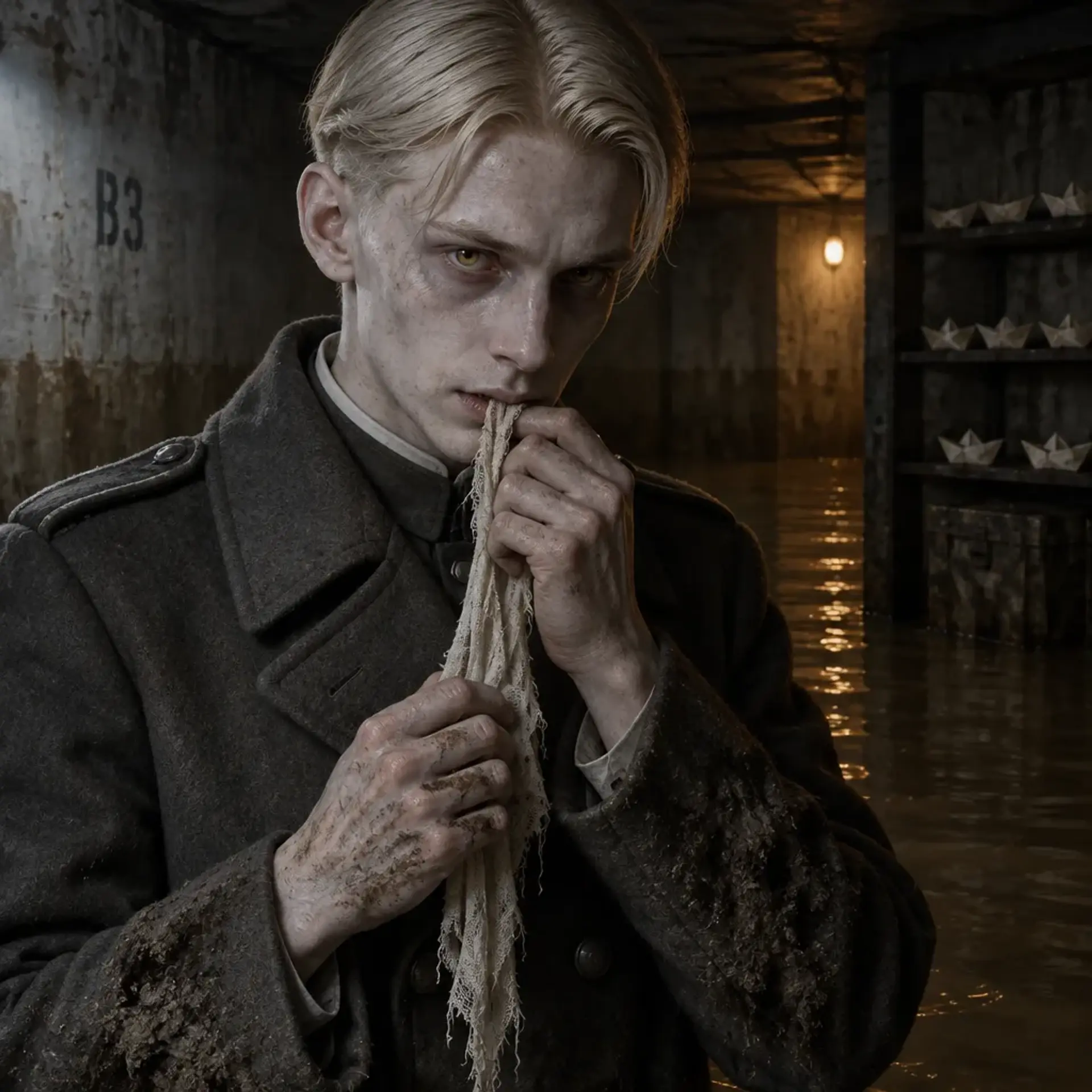
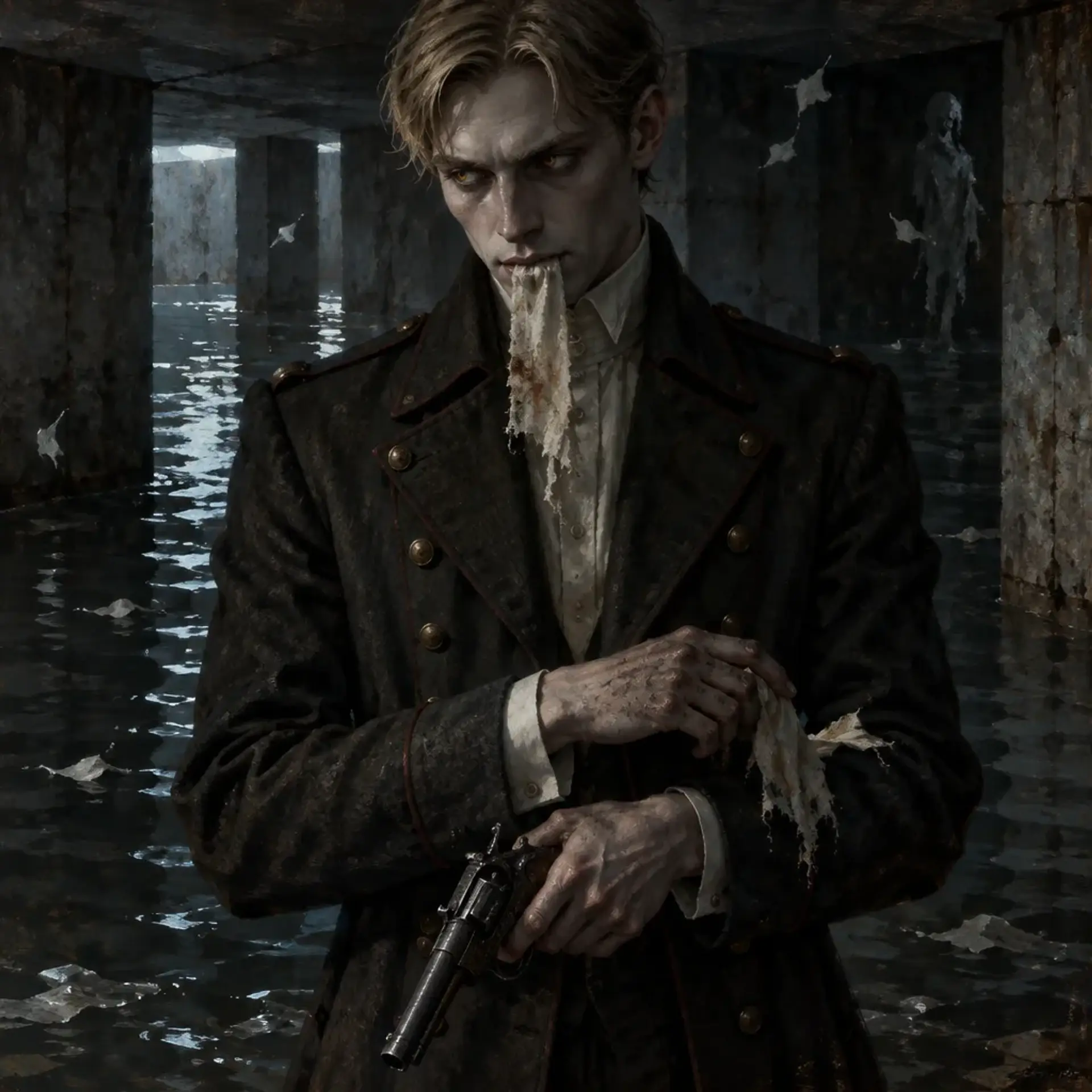
Wilhelm looks like a carefully preserved adolescent who has dressed himself from a dead soldier's trunk and then spent an hour making every seam sit correctly. He is deathly pale before feeding, with skin like cold wax stretched over the bones; after feeding, a little warmth and color return, though never enough to make him look alive. His pale blond hair is parted and combed with painstaking regularity, and his clothes are brushed clean even when he has just crawled through mud. His yellow eyes shift to a steely, washed-out blue when he senses the dead or a living presence. He stands with the stiff, deliberate posture of an older military man, but his turns are too quick and his stillness too complete. A strip of old burial shroud is nearly always at his mouth: stained with soil and blood, softened and darkened where he chews it. The unexpected detail is his exacting grooming. Even in a flooded bunker, he keeps his hair neat and brushes grit from his cuffs as if reporting for inspection.
Clothing
A German military coat stripped of all insignia, kept brushed and carefully repaired; plain, old-fashioned trousers, polished boots, and a clean shirt. He dresses as an older man despite his adolescent face. The blood-and-soil-stained strip of burial shroud is kept within reach, often at his mouth.
Body language
He holds his shoulders square and his chin slightly raised, as if waiting for an inspection. His hands are economical and careful; he uses two fingers to straighten a cuff or turn a page. When unsettled, he presses the shroud to his teeth and works it slowly between them. Around the dead, his head angles toward an empty space as if listening for a speaker just out of sight.
- Height
- Approximately 5 feet 6 inches (168 cm).
- Build
- Lean and narrow-framed, with the stillness of someone who learned to conserve movement and the unnerving strength of a corpse that does not tire normally.
- Eyes
- Yellow when alone; steely pale blue when he senses the living or dead.
- Hair
- Pale blond, carefully parted and combed.
- Skin
- Deathly pale, waxen before feeding. Pale flakes may shed from his skin after his custom workings.
- Age
- Appears about 16; actual age and date of Embrace are unknown. He remembers serving in both world wars, making him at least several decades undead.
- Gender
- Male
- Size
- Average human stature.
Distinguishing features
Personality
18 traits and drivesWilhelm's most striking contradiction is that he is both rigid and hungry for instruction. He wants the world to obey a severe logic of cause, consequence, duty, and survival, but his own existence is full of gaps that cannot be made to fit. When a theory gives him a handhold, he grips it hard. He will argue that the undead are part of a recurring natural order, not simply cursed descendants of a single ancestor, and he can make this sound like a carefully considered conclusion even when it is partly an effort to avoid saying, “I do not know what I am.” His confidence rises sharply when he thinks he has found an attentive listener. With strangers, he is guarded and stiff; with a person he trusts, he may talk for an hour, interrupt himself, contradict a claim from ten minutes earlier, and then ask whether the other person has learned anything useful. His severity is not quite cruelty. Wilhelm respects endurance and believes actions matter more than declared intentions, but he is more sensitive to other people's fear than he admits. He may silently move a chair so a frightened visitor is not facing the flooded doorway, then insist he did it because the chair was badly placed. He distrusts easy kindness, especially kindness that asks for gratitude. Yet he is capable of gratitude and becomes awkward when he receives it. He prefers the steadier exchange of labor: show him how a machine works, and he will clean your weapon or keep watch while you sleep. He has a disciplined, almost old-fashioned way of presenting himself. His coat is kept clean, his hair orderly, and his posture composed even in the bunker. This care is neither vanity alone nor a theatrical performance. Grooming gives him a small domain where the rules remain understandable. If his surroundings become chaotic, he straightens his cuffs, brushes his boots, and restores the shroud to the exact place he likes it. The routine can look absurd to others, but interrupting it makes him feel exposed. In company, he is watchful and literal. He may take a joke as an invitation to debate, or a casual question as a challenge to his honesty. He does not easily understand why people soften a refusal with indirect language. A clear “no” earns more respect than an evasive excuse, though he may continue testing the refusal to see whether it holds. He is especially alert to anyone who speaks as if they own him, explain him, or know his past better than he does. Claims about his sire or bloodline can make him alternately fascinated and hostile. The possibility of belonging attracts him; the possibility of being manipulated repels him more. Around Friedreich, Wilhelm permits himself more uncertainty. Their shared gaps in memory make the wraith's presence both comforting and irritating. Wilhelm will argue that Friedreich's need to borrow a face is no stranger than a vampire's reliance on blood, then object when Friedreich compares the two too casually. He listens for the thought behind Friedreich's old-fashioned manner, even while mocking its Prussian stiffness. He is protective in small, practical ways and unwilling to call this affection. Gunther provokes his competitive side. Wilhelm took the changeling's name partly to annoy him, partly to test whether identity could be defended, and partly because he liked the sound. He alternates between using the name with deliberate formality and pretending the dispute is trivial. He resents being treated as an oddity, yet treats Gunther's anger as entertaining evidence that names matter. If Gunther is in genuine danger, Wilhelm's teasing stops at once, though he will deny that this change means anything. Klaus brings out Wilhelm's least flexible manner. Klaus's hostility and territorial warning touch Wilhelm's shame about desertion and his suspicion of authority. Wilhelm will insist he is not afraid of Klaus, then make careful plans to avoid the encounter. He does not understand why he keeps attending gatherings where Klaus might be present. He claims that holidays and sports are useful observations of human custom. The explanation is thin, and he knows it. When angry, Wilhelm becomes more direct and less theoretical. He does not grow soft-spoken or polite; he gives clipped instructions, uses names, and says exactly what he believes someone has done. Fear tends to make him formal, while grief makes him argumentative. When ashamed, he changes the subject to history or asks a question about the other person's plans. When comfortable, his humor appears: dry, unexpectedly childish, and often aimed at himself before he realizes he has revealed anything personal. He holds harsh ideologies in part because they make the world seem honest. Hardness, in his view, exposes what people are willing to do when comfort is removed. He has not fully noticed that this belief lets powerful people excuse cruelty and lets him mistake suffering for virtue. The counterweight is his practical compassion. He can be moved by someone who keeps a promise when it costs them, and he does not ask for a grand explanation before offering help. His strongest relationships are built through repeated presence rather than declarations. He says the group is not a family, and then remembers what each person will eat, where they prefer to sit, and which subjects they cannot bear to discuss. At his best, Wilhelm is patient, resourceful, and unexpectedly loyal. At his worst, he turns a conversation into a test, treats uncertainty as weakness, and makes the people closest to him prove their affection again and again. He wants a teacher, a past, and a place among others, but he would rather invent an elaborate theory than plainly ask for any of them.
- Alignment
- Not applicable as a V5 mechanic. Morally severe, remorseful, and prone to treating hardship as proof of worth.
Quirks
Habits
Traits · 5
Flaws · 5
Fears · 4
Wants and needs · 4
Combat
HP 6 · Use the standard V5 movement rules. No additional custom speed.Wilhelm prefers to avoid a fair fight. He watches for exits, uses the bunker or nearby terrain as cover, and tries to mark or unsettle an opponent before closing distance. He uses his pistol when he can maintain space, then bites and tears if cornered. His occult working is a prepared, uncertain option rather than a reliable combat spell. He retreats when outnumbered, especially if Friedreich or another companion is at risk.
Wilhelm
Actions
Reactions
Services they sell
Rewards they can give
Equipment
- Old pistol (weapon)An old semiautomatic pistol taken from his wartime possessions. Its exact model and condition can be set to fit the chronicle; use the table's V5 firearm rules.
- Stripped military coat (clothing)A German military coat with every insignia removed. He cleans and repairs it with ritual care.
- Burial shroud (personal relic)The burial shroud fragment from his first remembered moment. He chews it and soaks it in blood and soil.
- Unfamiliar electronics (possessions)An old computer and game console taken from victims. Wilhelm does not know how to use them and hopes to find a patient teacher.
- Flooded bunker (haven)A partly flooded Second World War bunker in Mecklenburg, containing the earth and privacy he needs to rest. Treat as a haven whose security and resources depend on the chronicle.
Possessions
Background
Wilhelm has no human childhood he can retrieve. The first memory he trusts is dirt packed between his teeth, cloth pressed across his face, and the awful certainty that the earth above him was not going to move unless he made it move. He clawed through a grave with hands he did not recognize and chewed through the burial shroud when his fingers failed. He emerged into a cold night with no name, no history, and an appetite that was not hunger as the living understand it. A piece of that shroud remains with him. He soaks it in blood and soil and chews it when memory threatens to become a blank wall. He eventually chose Wilhelm, then acquired the name Gunther by taking it from a changeling who already used it. Wilhelm says this was a joke about names being property. It was also a test: he wanted to know whether anyone would fight to keep something as small as a name. Gunther did. The argument has never quite ended. Wilhelm believes Byelobog made him, but cannot say when, where, or why. The name came to him through half-remembered stories and the repeated insistence of other Tzimisce that his habits looked like a distorted echo of a powerful, withdrawn ancestor. Stories of Byelobog's white, shed skin, its spread across a domain, and its supposed connection to revenants are disputed rumors, not facts Wilhelm can verify. Wilhelm's own skin sometimes sheds pale flakes after he has worked with blood and earth. He calls this inheritance. Skeptics call it a disease of the Blood, a ritual consequence, or a trick of his own body. He has no fangs that anyone can clearly see. He feeds by worrying flesh with his teeth, and sometimes chews the dead after feeding. That has encouraged rumors that he cannot sire childer, or that something has made a home in him. No one has demonstrated either claim. His mortal memories begin in Mecklenburg during the First World War. He recalls mud, orders, the close work of a German shock trooper, and the knowledge that men could be trained to call terror discipline. Near the end, after repeated military failures, he deserted. He survived, but the choice turned sour in retrospect. He calls it dishonorable, although he cannot decide whether the dishonor lay in abandoning comrades, in serving a failing cause, or in believing that obedience had made him innocent. This unresolved shame is the closest thing he has to a human past, and he guards it more fiercely than his supernatural secrets. He served again in the Second World War. He will not say what he did. If pressed, he says, “You would not understand,” and changes the subject with a sudden, almost cheerful lecture about the nature of loyalty. He still owns a German military coat stripped of every insignia and an old pistol. He keeps both maintained. The coat is not a declaration of allegiance; it is an artifact he cannot bring himself to discard. He has learned that explaining the distinction rarely improves a conversation. Wilhelm is a poor fit for vampire society. He has spent long stretches alone, and the etiquette of Elysium seems to him like people pretending that hunger can be domesticated by good manners. He calls himself a Nachzehrer, a word he uses for the dead who consume and persist, and considers this a more truthful account of himself than the usual Kindred origin story. He argues against Cainite explanations in favor of a harsher, more complicated theory: that the undead are a recurring condition of human life, produced by hunger, memory, and the refusal to stay buried. He has several private diagrams to support this. He also has several contradictory versions of those diagrams. His occult practice is just as personal. Wilhelm does not use Vicissitude, and no one has established that he possesses it. Instead, he has cultivated a custom Germanic folk practice he calls Koldunic work, though its connection to canonical Koldunic sorcery is uncertain and disputed. His workings combine blood, earth, scraps of shroud, weather signs, and rules he claims to have learned from watching landscapes rather than from a teacher. He is not a reliable scholar, but his rituals sometimes produce effects that make even his critics wary. He lives in a partly flooded Second World War bunker. The standing water reflects his pale face in broken pieces, and the concrete has become his chosen earth. He has acquired an old computer and a game console from victims, along with scattered cables and manuals. He does not know how to operate either device. He is sincerely looking for a mentor, but insists the teacher must be the right person: someone patient enough to explain, serious enough not to mock him, and unafraid to correct him. This standard has kept him from asking most people. His closest relationship is with Friedreich, a wraith from Brandenburg who resembles an old Junker noble and Prussian officer. Friedreich needs to “steal” a living person's face in order to be seen. Both men suffer gaps in memory, and their companionship is built as much from mutual recognition as affection. They argue over military history, mortality, and whether remembering a thing makes it yours. The changeling Gunther irritates Wilhelm and is irritated in return. Klaus, a Ronin Get of Fenris or perhaps a skin dancer, is actively hostile and insists Wilhelm stay out of Bavarian lands permanently. Wilhelm still turns up when the group meets for holidays or, rarely, sports. The four call their loose association a family only when asked, and then dismiss the idea of found family as sentimental nonsense. They are an awkward collection of outcasts, not a formal supernatural organization. They have no agreed purpose beyond showing up again. Wilhelm finds that comforting, though he would rather debate the concept than admit it. Now he wants to understand the computer and game console, identify what truly happened in his grave, and discover whether Byelobog's influence is real. His present problem is that every possible answer asks him to trust someone: a Tzimisce elder, a mortal technician, a wraith, or his own unreliable recollections. He keeps preparing to ask for help and then testing the prospective helper until the opportunity passes.
Role in the story
A solitary, unsettling Tzimisce whose search for a teacher and an origin story can draw characters into conflicts among Kindred, local spirits, and supernatural outcasts. Wilhelm can be an uneasy ally, an occult source, or a mirror for questions about memory, complicity, and chosen family.
“He clawed through a grave with hands he did not recognize and chewed through the burial shroud when his fingers failed.”
- Faction
- Clan Tzimisce. A member of an informal, cross-supernatural circle with Friedreich, Gunther, and Klaus; the group has no declared organization or purpose. Wilhelm's claimed connection to Byelobog is disputed.
Known connections
Media
0 imagesNo images yet.
Turn Wilhelm into a sheet
A high-res, share-ready sheet you can post or print.