Gunther
Gunther
At the table
“dishonorable”
Voice
His voice has a dry, slightly rasping edge, as though the damp air of the bunker has roughened it. The careful grooming does not extend to a polished public manner: his speech sounds trained by shouted instructions, long silences, and the habit of speaking to himself while working. He pronounces German names with practiced precision, and his accent thickens when he is tired, hungry, or irritated.
His German carries the regional Mecklenburg character he calls "the local." He speaks English, if used in the chronicle, with deliberate phrasing and occasional German sentence structure. He tends to state a conclusion first, then assemble the argument behind it. His vocabulary draws on military routine, burial practice, and folk belief. When comfortable, his speech becomes a long, digressive lecture; when he is ashamed, he becomes terse and literal. He does not become soft-spoken when angry: anger makes his consonants more clipped and his sentences more direct.
Speech patterns
How to play them
Approach him without mocking the shroud or demanding his wartime history. Offer practical help, especially with the computer, but be honest about what you want in return. He responds better to directness and shared tasks than to flattery. Respect for his companions earns more trust than agreement with his theories. In a chronicle, use his hunger, isolation, and uncertainty about his origins as leverage, not as an excuse to remove his agency.
Goal
Find a trustworthy mentor who can teach him to use the computer and game console, while learning whether Byelobog truly made him and what the grave-memory means.
Motivation
To make a coherent identity from the grave, war, and blood; to be judged by his own conduct rather than by clan rumors; and to preserve the few relationships that have endured his strangeness.
Appearance
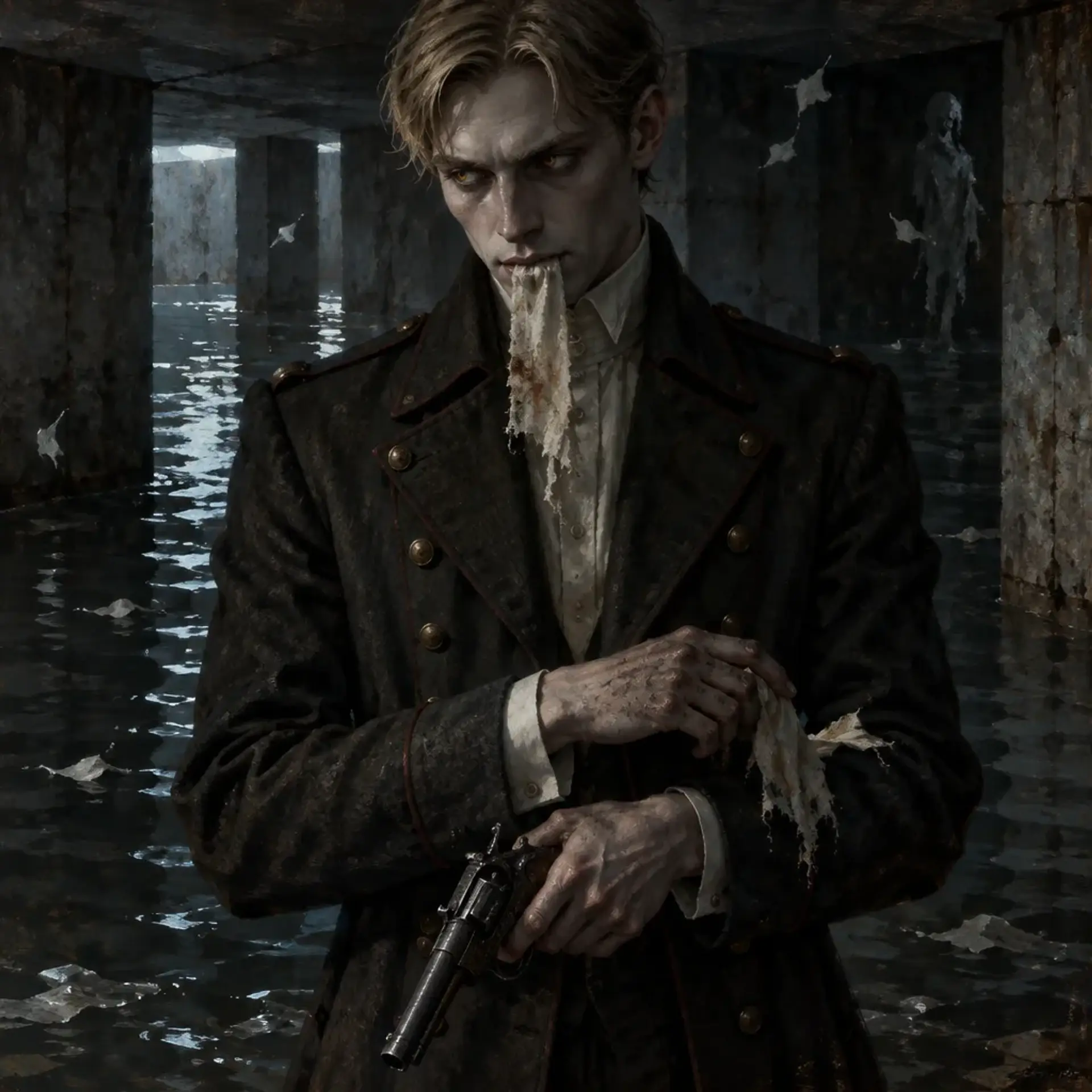
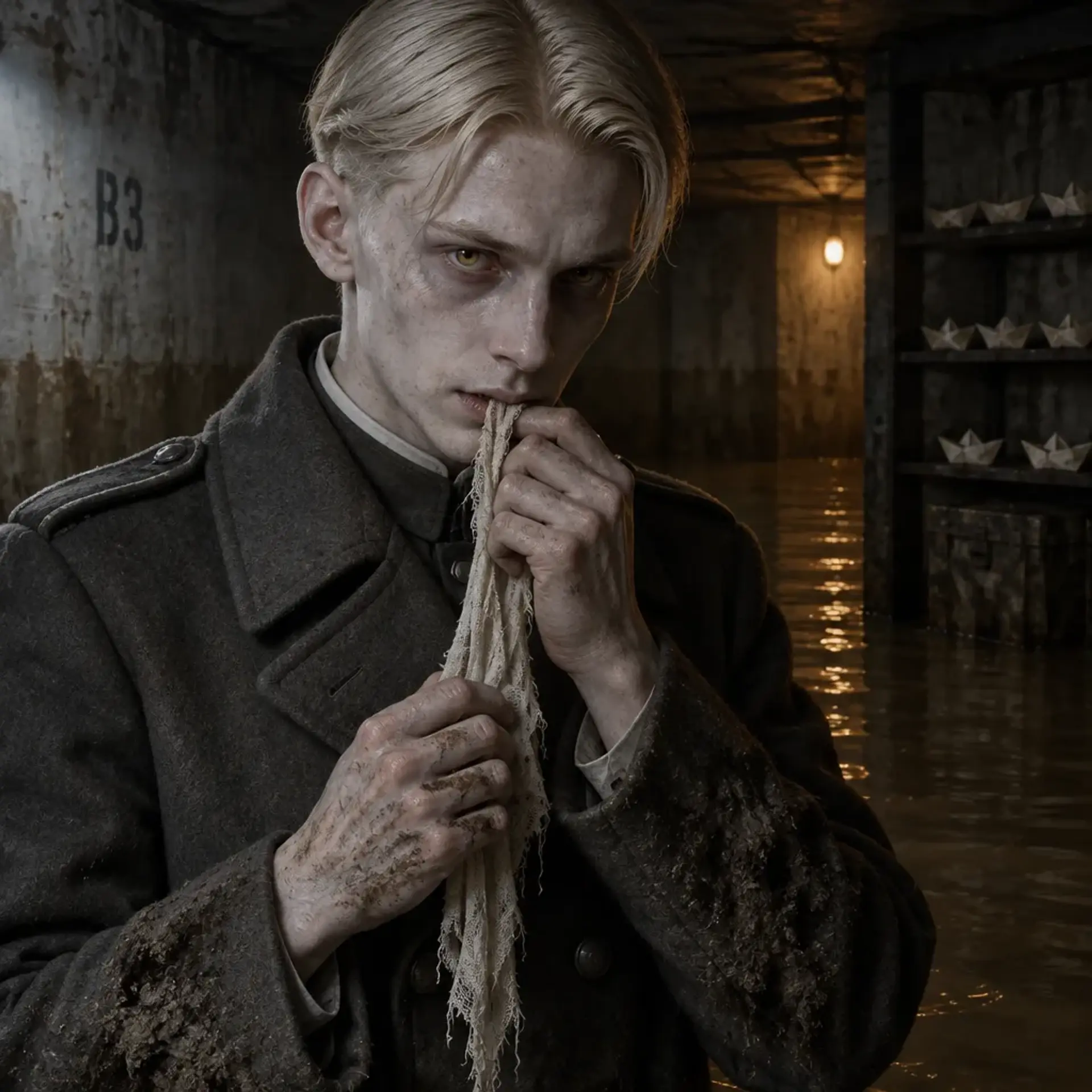
Wilhelm looks like a carefully groomed teenage boy who has copied the posture of an older soldier from photographs: chin level, shoulders squared, weight balanced on the balls of his feet as if waiting for an order. His skin is corpse-pale and faintly waxy before feeding, with a dry, powdery texture at the temples; after feeding, a trace of color returns without making him look alive. His pale blond hair is combed into a precise part, and his yellow eyes turn steely pale blue when he notices a living or dead body. He smells unmistakably of wet soil, old wool, and the sour iron tang of blood. He seems unaware of the smell. His voice and hands are clean, his boots maintained, and the incongruity of his immaculate grooming beside the mud-stained burial cloth is hard to forget. Unexpectedly, he has a small, meticulous collection of hand-folded paper footballs arranged on a bunker shelf.
Clothing
A well-kept German military coat stripped of all insignias, plain shirt, sturdy trousers, and carefully cleaned boots. He carries no visible medals or symbols. The coat's hem is often damp from the bunker floor.
Body language
He stands with his weight forward, heels barely settled, as if a whistle might send him running. When waiting, he folds his hands behind his back and rubs the shroud between thumb and forefinger inside his coat. He turns his head toward movement before his eyes follow. In an argument he becomes very still, except for his jaw working against the cloth.
- Height
- Approximately 5 feet 6 inches (168 cm)
- Build
- Lean, narrow-shouldered, and wiry, with an unnerving stillness that can give way to abrupt, efficient movement.
- Eyes
- Yellow before finding a body; steely pale blue afterward
- Hair
- Pale blond
- Skin
- Deathly pale, faintly waxy and dry-looking before feeding; slightly less corpse-like afterward
- Age
- Appears about 16; actual age uncertain, likely over a century. He remembers no mortal life before waking in a grave.
- Gender
- Male
- Size
- Medium human-sized
Distinguishing features
Personality
17 traits and drivesWilhelm is formal without being reliably courteous. He wants the comfort of rules, uniforms, and clear duties, but his most formative decision was to abandon an army whose failures he judged intolerable. He calls that desertion dishonorable, yet would make the same choice again if he believed the cause had become wasteful. He can sound cold when discussing mass suffering and unexpectedly tender when handling the shroud or listening to Friedreich describe a memory he cannot recover. He is not naturally sociable, but loneliness makes him talkative around anyone who seems willing to listen. With strangers he measures every word and watches the door; with the circle he can become a relentless, argumentative theorist. He insists that harsh ideologies reveal truths about humanity, while flinching from the personal consequences of his own wartime obedience. He takes pride in grooming and order, though his home is damp and half-submerged. He is curious about machines but embarrassed by his ignorance, so he disguises questions as tests. He wants to be accepted as a person, but resists any language that makes acceptance sound like pity. His humor is dry, usually aimed at himself or Gunther, and he sometimes uses provocation to find out whether a relationship will survive anger. When hungry, those habits narrow into watchfulness and fixation on the nearest body. After feeding, he becomes more composed, not more humane; his calm can make his strangest ideas sound persuasive.
- Alignment
- Not applicable to Vampire: The Masquerade. He has a severe, self-made code of honor, though his idea of honor is often warped by guilt and ideology.
Quirks
Habits
Traits · 4
Flaws · 5
Fears · 4
Wants and needs · 4
Combat
HP 7 · Use the movement rules of the chronicle's chosen edition; no separate speed value is assigned.Wilhelm avoids a fair fight. He uses darkness, flooded passages, and cover, tries to isolate one opponent, and will retreat if outnumbered. He prefers a pistol at range, then grapples and feeds if forced close. His soil rite is preparation-dependent and should not function as an instant combat spell. He does not fight to protect abstract vampire politics; he fights when cornered, hungry, or defending the bunker or a companion.
Gunther
Actions
Reactions
Services they sell
Rewards they can give
Equipment
- Service pistol (weapon)An old German military pistol. It is a real, maintained weapon; ammunition and damage follow the chronicle's chosen edition and setting.
- Insignia-less coat (clothing)A stripped military coat, maintained with disproportionate care and bearing no insignia.
- Burial shroud fragment (personal keepsake)A fragment of burial cloth, sometimes soaked in blood and soil. He chews it as a grounding ritual.
- Computer and game console (unfamiliar technology)An old computer and game console stolen from victims. Wilhelm is curious about them but cannot operate them.
Possessions
Background
Wilhelm has no reliable account of his mortal childhood, family, or name. The first memory he trusts is not a memory of life at all: he came to awareness beneath cold earth, wrapped in a burial shroud, clawing at the fabric and chewing through it because his mouth had found no other way out. He cannot say who buried him, when it happened, or whether the name Wilhelm belonged to him before the grave. The ragged piece of shroud he saved is his only fixed possession from that beginning. He chews it when thinking and sometimes soaks it in blood and soil, a private rite that disgusts even some of the vampires who know him. He believes Byelobog made him. The belief rests on scraps: rumors of the ancient Tzimisce's white, shedding skin; the way Wilhelm's own pallor seems to drink in damp earth; and the fact that several elders who heard his account stopped asking questions. He has never received confirmation. Some Tzimisce regard him as an impossible or failed childe, whisper that Byelobog's skin has made a host of him, and speculate that his strange feeding means he cannot sire childer. Wilhelm calls himself a Nachzehrer, insisting that this is what he is rather than what other vampires have decided he must be. He has no visible fangs, does not use Vicissitude, and does not appear to possess it. His otherworldly earth rites are his own Germanic folk practice, not a claim to a known Slavic or Baltic tradition. The first formative life he can describe begins in the First World War. He served as a German shock trooper, learning to obey in trenches where mud filled boots and the dead stayed close. Near the war's end, repeated failures and the collapse of the army convinced him that continuing to fight was not courage but waste. He deserted. He has never forgiven himself for surviving by leaving, and he calls the act dishonorable even when he argues that the army had already abandoned its men. This contradiction is the hinge of his life: he reveres hard discipline but has experienced obedience as a machine that spends human lives. He served again during the Second World War, but evades questions about his exact work. If pressed, he says, "You wouldn't understand," and ends the conversation. He wears a German military coat with every insignia removed and keeps an old pistol. The coat is not a political declaration, he says; it is clothing that fits the dead boy he remembers becoming. Whether that explanation is honest, even to himself, is unclear. Wilhelm has spent most of his unlife alone, poorly integrated into vampire society and distrustful of its inherited stories. He argues against the Cainite origin account when he thinks he has an audience, proposing instead a shifting history of predation, contagion, and inheritance. His alternatives can be absurd, but he treats them as serious work. Norse paganism interests him less as comfort than as an example of humans making harsh meanings from hardship. He believes brutality and the undead are closer to ordinary humanity than polite vampires admit. His bunker is partly flooded, a World War II structure whose waterline leaves a brown tide mark on the walls. He keeps an old computer and a game console taken from victims. He does not know how to operate either and wants a teacher, but insists that the right mentor must first prove they are not merely trying to control him. He has folded paper footballs from scraps of manuals while waiting for someone to explain the machine. His closest friend is Friedreich, a wraith from Brandenburg who resembles a Prussian Junker and can be seen only by borrowing a living person's face. Friedreich, like Wilhelm, has lost pieces of his past. The two share a wary recognition rather than easy intimacy. Wilhelm's other recurring companions are a changeling named Gunther, whose name Wilhelm deliberately stole to irritate him, and Klaus, a hostile Ronin Get of Fenris or perhaps a skin-dancer, who insists Wilhelm stay out of Bavarian lands permanently. They and Friedreich sometimes meet for holidays and football, though the gatherings are rare and argumentative. They call themselves a family, then reject the phrase "found family" as if naming the bond might make it sentimental or false. The group is a loose, uneasy circle of supernatural outcasts, including werewolves, mages, changelings, and wraiths. Its purpose is unclear even to its members. They tolerate Wilhelm's ideological speeches because he is one of theirs, not because they agree. His present problems are practical as well as existential: he needs blood, his bunker is vulnerable to discovery and flooding, Klaus wants him gone, and every potential mentor for his electronics seems to demand trust before offering help. Beneath all of it lies the question he cannot answer: whether he was ever a person before he woke hungry, or whether the grave was the beginning.
Role in the story
An unsettling ally, potential antagonist, or source of occult investigation. His uncertain origin connects the characters to Tzimisce history, while his bunker and cross-supernatural friendships create an entry point into a fragile community of outcasts. His hunger and unresolved wartime past can become immediate dangers.
“He cannot say who buried him, when it happened, or whether the name Wilhelm belonged to him before the grave.”
- Faction
- Tzimisce by blood, though an oddity to his lineage. He claims Byelobog as his sire without proof. He keeps company with a loose supernatural circle of outcasts and is not well integrated into vampire society.
Known connections
Media
0 imagesNo images yet.
Turn Gunther into a sheet
A high-res, share-ready sheet you can post or print.