Jor Heimskrsson
Jor Heimskrsson
At the table
Voice
His voice has the grain of someone accustomed to shouting over wind and water: clear at first, with a little rasp at the edges. The wreck and his time among the trolls have added a damp, throat-deep resonance. Certain phrases slip into a low growl, especially when he is startled, hungry, or speaking Troll. He does not sing his words; he places them carefully, like someone learning to trust each sound.
Jor speaks fluent Norse and Troll with the confidence of someone who assumes the listener understands him. He sometimes lets a Troll word slip into a Norse sentence, then covers it by repeating the thought in Norse. His phrasing is controlled and formal around nobles, but more practical among guards. When tired, startled, or hungry, his consonants roughen and a low growl catches the ends of words.
Speech patterns
How to play them
Treat Jor as a returned survivor who is trying very hard to seem ordinary. He responds best to practical questions and patient company, not immediate demands for a full confession. Mentioning guard service gives him a stable subject; sudden touch, especially near his neck, or pressing an iron weapon into his hands can break his composure. If the party earns his trust, he may reveal troll words, his fear of the cross, and the fact that his account of the wreck leaves out the years of captivity.
Goal
Earn a place in the guard while deciding whether he can return to his family without becoming a spy against them.
Motivation
To reclaim a chosen life, protect the family and home he lost, and prove that being changed does not mean being owned.
Appearance
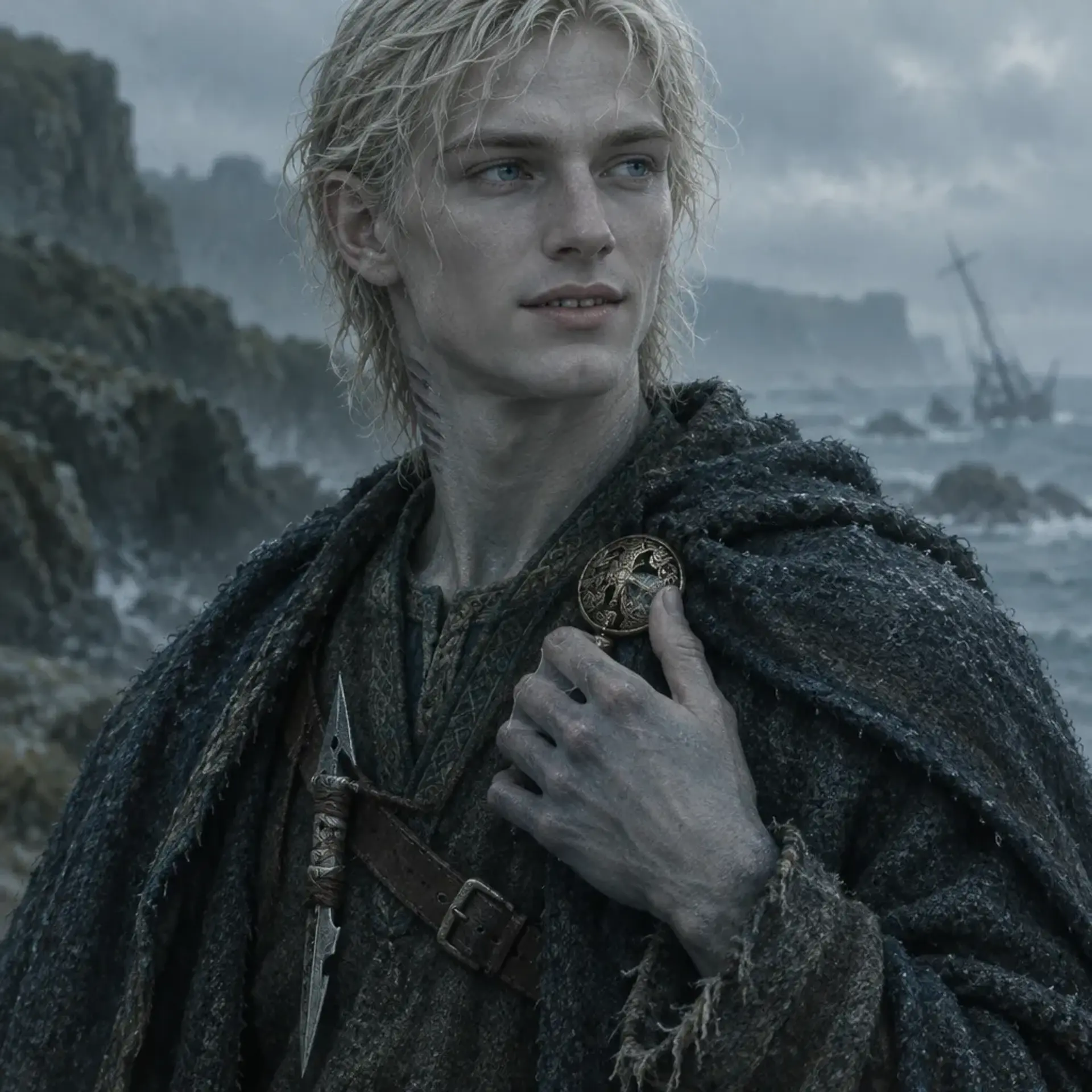
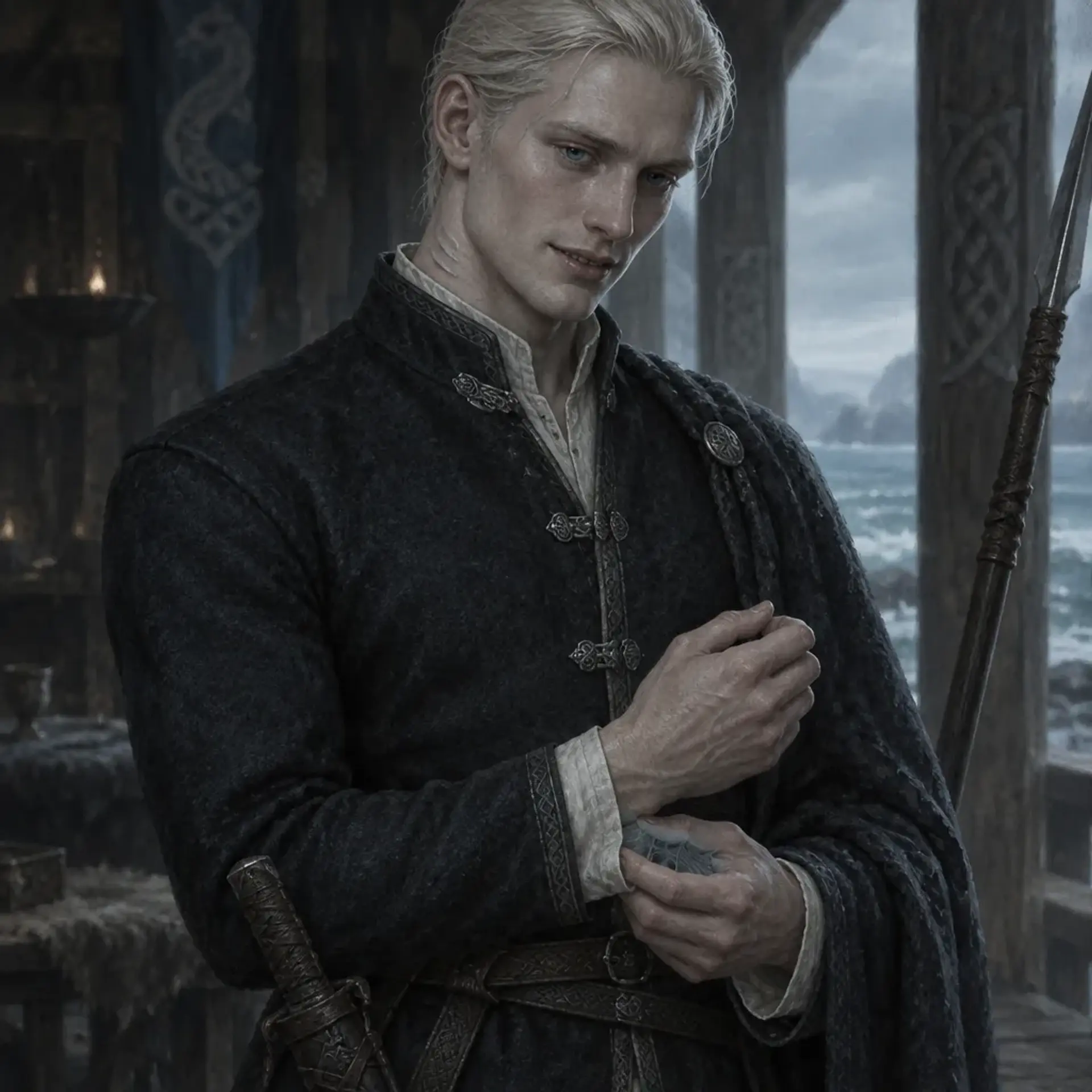
Jor looks like a handsome young Norse nobleman who has been carefully put back together after a terrible voyage. His clothes are clean and well-cut, his posture schooled, and his pale blond hair combed into place; still, he carries a faint, unmistakable smell of cold tide pools and brine. He has grown taller since he was last seen, now a little over six feet, and explains it as growing pains. His blue eyes are steady in a way they never were before. He moves with an unnerving economy: no fidgeting, no sudden gestures, and a slight, smooth sway as if unconsciously balancing on a deck. His gaze checks exits, hands, and weapons before it settles on a face. Trollcraft makes him appear human, but the disguise has seams. His hair is paling toward white; his smile sometimes shows too many teeth; his fingers and toes are webbed if examined closely; and faint gill slits crease the sides of his neck, which he guards from touch. He winces at bright sun, and his voice can dip into a low, wet growl mid-sentence. The unexpected detail is that, despite his noble clothes and grim new stillness, he has an almost fussy habit of smoothing wrinkles from his cuffs before entering a room.
Clothing
Clean, respectable Norse nobleman's clothes in dark wool and pale linen, carefully mended and fastened with non-iron fittings where possible. At first contact after his return, he may instead be in the ragged, salt-water-logged clothes he wore when lost at sea.
Body language
He stands almost too still, then shifts his weight with a smooth, rolling adjustment like a sailor keeping balance on a moving deck. His hands stay close to his body, fingers gathered to hide their webbing. If someone reaches for his neck, his shoulders lock and his chin tucks down. His eyes often track a person’s hands rather than their expression. Before speaking to someone important, he smooths a cuff or straightens a seam.
- Height
- A little over 6 feet, still growing
- Build
- Long-limbed and broadening through the shoulders, with the sturdy frame of someone who was once eager to wrestle and is still growing into his height.
- Eyes
- Blue
- Hair
- Pale blond, turning almost white
- Skin
- Pale, cool-toned skin with a faint salt-washed cast
- Age
- Young adult
- Gender
- Male
- Size
- Medium
Distinguishing features
Personality
21 traits and drivesJor is composed now in a way that unsettles people who remember the boy he was. Before the wreck he was excitable, quick to grin, quick to brawl, and eager to make a name for himself with the guard. That energy has not disappeared so much as been pressed flat. He now studies a room before joining it, weighs a promise before answering, and keeps his face arranged in a calm expression that can look almost cold. Yet the old Jor appears in flashes: he can become fiercely animated when someone is mocked unfairly, and a friendly challenge still tempts him to step forward before he has thought through the consequences. He is not naturally meek. He is trying to be controlled because uncontrolled reactions feel like the first step toward becoming something his captors intended. He is both proud of his survival and ashamed of the means by which he survived. He wants to be seen as Heimskr’s son, not as a monster or a victim, and resents anyone who treats him as fragile. At the same time, he is acutely conscious of every part of himself that no longer fits the human shape he presents. He is proud that his trollcraft works and that he can conceal the webbing, the gills, and the oddness of his voice better than Mikkel can conceal his changes. That pride makes him stubborn. If someone notices a flaw in the glamour, he may insist it is a trick of the light even while moving to hide it. If a companion offers help too gently, he can hear pity where none was intended. His manners are formal when he has an audience and practical when he does not. In public he uses the clean language and posture expected of a noble son, thanks people for ordinary courtesies, and tries to make his return easy to accept. In private he speaks more directly and asks questions that reveal how much he has been observing. A guard’s equipment, the household’s seating order, who carries keys, and who speaks for whom all draw his notice. This attentiveness makes him useful, but it can also make him seem calculating. He is not always gathering secrets for his captors; often he is simply trying to understand where danger might come from. He has not yet learned how to stop doing it. Jor’s instincts pull in opposite directions. He wants a place in the guard because it was once his own ambition and because service gives structure to a life that has been stolen and returned in pieces. Yet iron hurts him, and each lesson with a spear forces him to choose between discomfort and exposure. He wants to be near people, especially the family he thought he might never see again, but closeness creates opportunities for them to notice the changes. He wants to trust Peer Ludvik because his altered nature recognizes Peer as kin, but that bond frightens him: it feels too certain to be entirely his own. When he is alone, he can be tender with small things, straightening a blanket or putting a fallen object back where it belongs. When watched, he often performs competence instead of asking for comfort. His anger is still there, though it has changed its shape. He used to show it openly, with sharp words and a readiness to fight. Now it collects behind stillness. He can stare too long, answer with a flat politeness, or go silent while his hands close into fists inside his sleeves. If someone threatens a child, a sibling, or a person he has decided belongs under his protection, the old quick temper may break through. He is then more likely to act before speaking, and afterward he may be horrified by how easily violence came. The calm he presents is not proof that he has become harmless; it is an effort to keep several hungers and fears from choosing for him. Jor’s hunger is a constant source of private humiliation. A normal meal may leave him unsatisfied, and long stretches without food make it difficult to think clearly. He can be courteous at table, but his attention sometimes follows the smell of meat with uncomfortable intensity. He hates being watched while eating and dislikes anyone making a joke of appetite. He has not knowingly eaten a person, and the possibility frightens him more than he can say. When he is hungry, he may become curt or distracted, then apologize later with painstaking formality. His instinct is to hide the problem rather than ask for more food, because needing something feels too much like being controlled. Bright sunlight and the Christian cross provoke reactions he does not fully understand. He winces at the sun and tries to pass it off as strain from the wreck, but prolonged glare makes his control harder. A cross can make his attention snag and his body tense, as if something in him recognizes a threat before his thoughts catch up. He may look away, change the subject, or find an excuse to leave. He does not necessarily believe the cross has power over him; he is afraid that it might. This fear makes him defensive about religion, not necessarily hostile to believers. He has seen kindness from people of faith and is unsettled by the contradiction between that kindness and his own reflexive dread. He has a careful, watchful kind of loyalty. Jor does not offer trust quickly, but once he has decided someone is his responsibility, he will take risks for them without announcing what he is doing. He can be generous with information that seems practical and evasive about information that feels intimate. Praise disarms him more than threats do, especially praise for something he has chosen himself rather than for his family name. Direct accusations make him close ranks; patient honesty gives him room to answer. He responds to humor if it is not at his expense, and old physical games can briefly make him seem like the boy who left on the voyage. In a crisis, Jor becomes decisive. The training he received taught him to notice exits, watch hands, and act on small changes before anyone else has named them. He can be an excellent lookout or courier, and his ability to assume a human appearance makes him dangerous as an infiltrator if he chooses to use it that way. But he has not yet settled whether that skill belongs to him or to the trolls who taught it. He may volunteer to scout and then feel sick about how naturally he lies. He may refuse a task that resembles his old orders even if it would help his new companions. His moral center is not absent; it is under argument. Jor is neither a secret villain nor an uncomplicated innocent. He wants to do good, but he has been shaped by captivity into someone who conceals, observes, and calculates. He wants his old life back, but the sea changed him beyond any simple return. He wants to be accepted as human while recognizing Peer Ludvik as kin through a trollish nature he refuses to call his own. In a good mood, he can be dryly funny, attentive, and surprisingly eager to hear about ordinary guard work. In a bad one, he becomes still, suspicious, and difficult to reach. When afraid, he may hide the fear behind correct manners. When truly safe, the restraint loosens, and the young man who once wanted to brawl his way into a name resurfaces, now trying to learn what courage means when fists and steel are not the only ways to fight.
- Alignment
- Neutral; raised to value family duty, now uncertain which people deserve his loyalty.
Quirks
Habits
Traits · 4
Flaws · 5
Fears · 6
Wants and needs · 6
Combat
AC 12 · HP 16 · 30 ft., swim 30 ft. (custom sea-troll adaptation)Jor avoids a fair fight if he can help it. He uses a spear at reach, chooses stable ground, and tries to put allies or obstacles between himself and iron-armed opponents. He prefers to disarm, shove, or escape rather than kill. In water or close to a shoreline, he uses his swimming speed and breath-holding to break line of sight. He maintains his glamour under pressure but knows pain, bright sun, and surprise can make it falter.
Jor Heimskrsson
Actions
Reactions
Services they sell
Rewards they can give
Equipment
- Guard-training spear (weapon)A sturdy spear with iron fittings. Jor carries it because it is useful for guard training, but touching the metal too long hurts him.
- Wrapped dagger (weapon)A small knife with an iron blade, wrapped so his hand need not rest directly on the metal.
- Noble clothes (clothing)Clean Norse noble clothing, altered to conceal the shape of his hands and neck.
- Wreck clothing (personal keepsake)A salt-stiff remnant of the garment he wore on the wrecked ship, kept folded out of sight as proof that the voyage was real.
Possessions
Background
Jor Heimskrsson is the fifth son of Heimskr’s household, born into a family that measured its future in alliances as carefully as other families measured grain. He grew up among older siblings whose names and prospects filled every conversation about inheritance, and learned early that being loved did not mean being central. For a while, that suited him. Jor was quick to laugh, quicker to take offense on behalf of a friend, and happiest when some small quarrel gave him an excuse to spar. He wanted to join the guard. He imagined a plain life of watch rotations, earned trust, and a place where courage mattered more than birth order. Then the succession crisis reached the family table. Arguments about loyalties and claims made every pledge sound like a trap. Jor watched grown people who had once shared bread speak as if a cousin’s future were a weapon. He did not become a political thinker overnight, but he understood that a guard sworn to the wrong person might be made to hurt people he loved. He changed his mind about service and began looking for a future beyond the quarrel. The voyage toward Iceland was supposed to give him a name, land, and wealth of his own: a way to stop being a spare son whose choices were decided by other people. It was an ambitious plan, but a practical one, and he left with more excitement than wisdom. The ship wrecked in the North Sea. The survivors were scattered, the vessel broken, and Jor vanished beneath the waves. His family presumed him dead. The trolls who found him did not treat him as a rescued nobleman. They kept him captive in a hidden place along the northern sea and made a project of him. Their aim was to turn a human-looking survivor into a spy who could move through human settlements without warning anyone. They taught him to speak Troll fluently, drilled him in observation and concealment, and used trollcraft to reshape and disguise his nature. He learned to perform a human expression while watching the room as a predator watches a shoreline. The transformation did not erase his memory. It altered how he inhabited it. His body grew, his hair lost color, webbing spread between fingers and toes, and faint gills opened along his neck. The sun began to feel too sharp. His voice acquired a low, involuntary growl. His temper, once lively and volatile, settled into an unnerving calm; it is the one conspicuous missing piece of the three troubles his captors cultivate in their missing human subjects. Jor instead bears signs of all three kinds of troll corruption in lesser, more controlled forms: the old temper can still flare under pressure, hunger arrives with a frightening urgency, and fatigue or stress can make thought slow and blunt. Unlike Mikkel, who struggles to conceal what has happened to him, Jor has been trained to cover these changes with considerable success. His captors’ lessons were not only magical. Jor was taught to recognize a guard’s routines, remember who speaks to whom, and conceal what he knows behind an ordinary answer. He learned to use small, practical bits of troll magic as casually as another person might mend a hem: drying a damp cuff, disguising a webbed palm, or making a human face settle over his own. He does not think of this as a grand power. It is a tool, and tools are for use. Yet the habits of captivity persist. He measures doorways, counts weapons, and notices who has the authority to ask him to stay. When he returned, he presented himself as a miracle survivor of the wreck. The account he gives is true in outline and carefully incomplete in detail. He has come back in respectable clothes, cleaned up enough to pass as a son of a noble house, though at first discovery he may still be soaked through and dressed in the salt-ruined garments he wore when lost. The two versions of his appearance reflect how recently he has managed to reach safety, not a change in his story. He says he has no reason not to join the guard now. The succession crisis has not vanished, and he understands that a uniform may give him purpose and a place to stand. Privately, however, he watches every iron weapon presented to him and is teaching himself how to hold one without pain or revelation. His relationships are all newly dangerous. Heimskr’s family has mourned him and may not know how to welcome the quiet, taller young man who has come back. Jor wants to be recognized as their son, but fears that closeness will expose him. He recognizes the exiled Thane and Folk Hero Peer Ludvik as kin through the change, a bond he cannot explain in ordinary family terms. He is drawn to Peer, but the feeling is tangled with the thought that this new kinship may have been planted or shaped by his captors. Mikkel is a living comparison and a warning: another missing son whose troll traits are harder to hide. Jor’s captors remain somewhere beyond the coast, and he does not know whether they consider him a successful agent, a runaway, or property they intend to retrieve. His current problem is not simply whether to tell the truth. Jor has multiple truths, each with a cost. He wants to serve the guard and protect the people he once left behind, but he has been trained to gather information and could be asked to spy on the very household that mourned him. He wants to eat enough to quiet the hunger without letting it decide what counts as food. He wants to touch iron without flinching, yet the effort can make his disguise falter. He wants to trust Peer Ludvik as kin, but cannot tell whether that recognition is a gift of his changed nature or another hook in the trolls’ design. Most of all, he wants the choice of what he becomes to be his own. His return is therefore not a clean homecoming. It is a rescue, a lie, an infiltration risk, and a second chance that has arrived wearing the face of the boy everyone thought the sea had taken.
Role in the story
A presumed-dead noble son returns as a convincing human-looking survivor, a potential guard recruit, and a quietly compromised spy. The party can help him reclaim agency, uncover the trolls’ plans, and determine whether his new kinship with Peer Ludvik is a bond to trust or a trail to follow.
“Jor was quick to laugh, quicker to take offense on behalf of a friend, and happiest when some small quarrel gave him an excuse to spar.”
- Faction
- Heimskr’s family by birth; formerly captive and trained by the North Sea trolls; seeking a place in the local guard.
Known connections
Media
0 imagesNo images yet.
Turn Jor Heimskrsson into a sheet
A high-res, share-ready sheet you can post or print.