Friedreich
Friedreich
At the table
Voice
A dry, breath-catching start gives way to a clear, carefully articulated German voice. It carries the clipped precision of a young man trained to answer elders correctly and the restless pace of someone afraid a listener will turn away. His anger does not make him softer or more polite: it makes him faster, more exact, and increasingly willing to name the thing he has been avoiding.
His voice begins with a dry intake and a slight catch, as if an old cadet is about to give a report. Years of listening to people who could not see him have made him attentive to pauses and interruptions. He sounds precise when discussing duty or prices, then rushes his words when ignored. Borrowing a face lets him reproduce a voice with eerie ease, but a tiny breath-catching hitch remains his own.
Speech patterns
How to play them
Treat Friedreich as a person even when he is not visible. Ask before he borrows a face, and do not mistake a borrowed appearance for consent to speak for its owner. He opens up through ordinary shared activities, especially football, market trips, cards, and unhurried time with the coven. Direct accusations about Wilhelm's wartime past make him defensive, but patient questions about what Friedreich himself remembers can lead to genuine trust.
Goal
Learn what opened his Caul and recover enough of his own past to be recognized without borrowing a face.
Motivation
To belong to his coven as himself, while finding out whether his brother's missing memories conceal a truth that binds them together.
Appearance
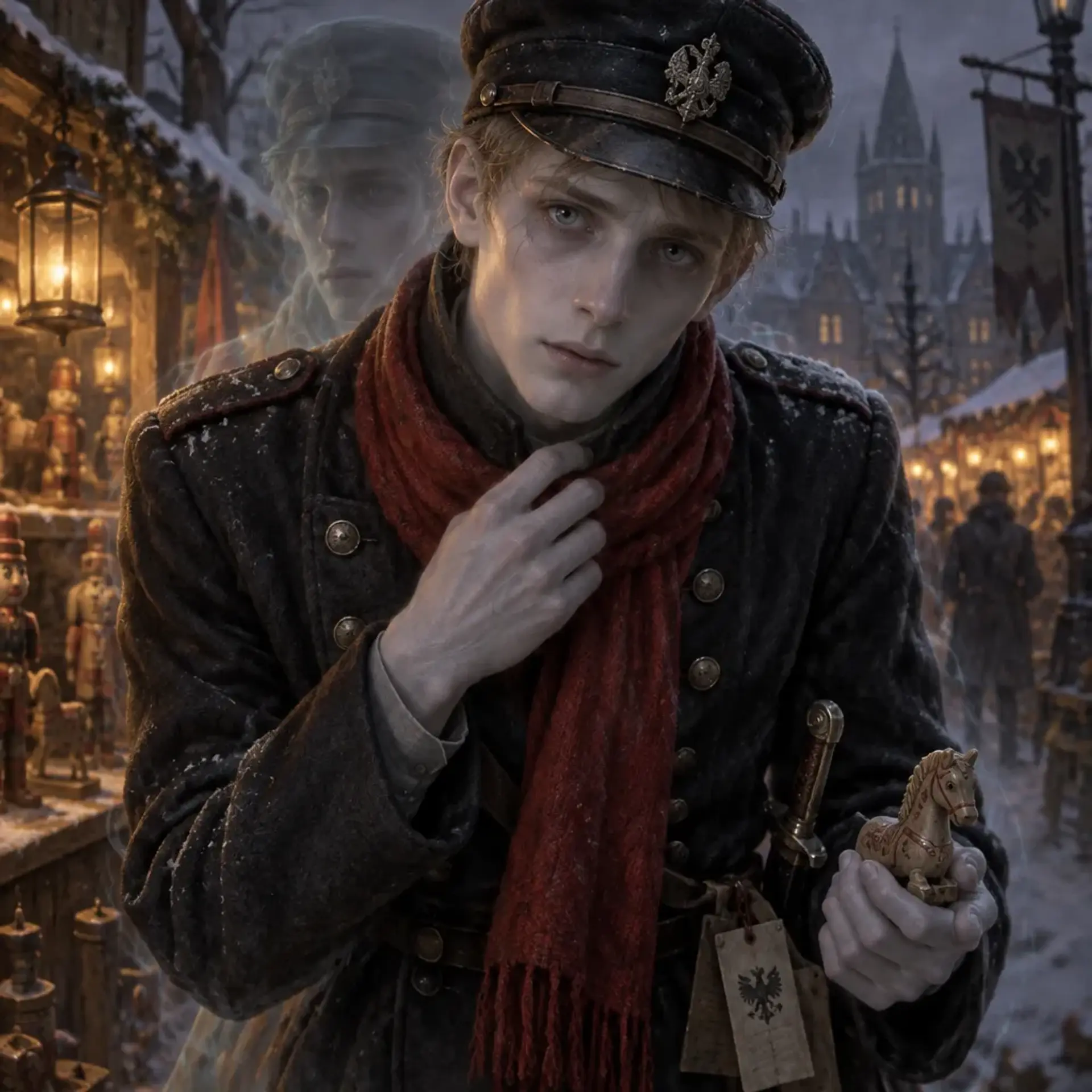
Friedreich looks like a young Prussian cadet drawn in smoke and remembered lamplight. His borrowed face usually resolves into a narrow, watchful young man with a straight nose, a faintly hollowed mouth, and pale skin that seems to have the texture of cold wax beneath its living expression. The edges of his borrowed features sometimes lag a fraction behind his movements, like a reflection on rippling water. He stands too close when he wants to be included, then catches himself and retreats with formal stiffness. Before he speaks, he takes a small, unmistakable intake of breath, though he has no lungs. An unexpected softness: when handling a Christmas-market purchase for a friend, he cradles it with the care of someone carrying a sleeping bird.
Clothing
A worn dark cadet-style coat, carefully brushed despite its spectral, smoke-soft edges, with an old-fashioned high collar and mismatched buttons. He sometimes borrows a modern scarf from Gunther's stock, which he wears with solemn pride.
Body language
He takes up more space than his slight frame suggests, leaning close to catch reactions and then correcting himself with abrupt military formality. His posture is straight until he is excited, when he forgets the pose and crowds the table. He often draws breath before speaking and touches his collar when someone fails to notice him.
- Height
- About 173 cm when clearly manifested; his apparent height can waver with the Shroud.
- Build
- Slender, narrow-shouldered, and held in a posture learned from a military household; his spectral outline seems denser around the jaw and hands.
- Eyes
- Pale gray-blue when his own features resolve; a borrowed face keeps its owner's eyes imperfectly.
- Hair
- Dark blond, close-trimmed beneath his cadet's cap when he remembers to wear it.
- Skin
- Pale, with a cool, waxlike cast when his own face is visible; borrowed faces retain their owner's complexion imperfectly.
- Age
- Appears 17 or 18; died at 18 in 1916. His remembered age and face can blur when the Shroud thins.
- Gender
- Male
- Size
- Medium
Distinguishing features
Personality
16 traits and drivesFriedreich is loyal and sociable, but his welcome can turn into a demand to be included. He values duty and ritual, yet resents the people who use duty to excuse cruelty. In company he is lively, competitive, and eager to make himself useful; alone, he rehearses conversations with faces he no longer wears. He can be generous about another person's needs and surprisingly possessive about small pleasures he cannot have. With Wilhelm he swings between brotherly warmth and prosecutorial anger. With Klaus he is patient partly because Klaus's hesitation makes Friedreich feel unusually safe. When frightened, he becomes formal; when hurt, he talks faster and tries to bargain his way back into someone's attention.
- Alignment
- Protective, with a stubborn sense of old-fashioned duty; not reliably obedient to any cause.
Quirks
Habits
Traits · 4
Flaws · 4
Fears · 4
Wants and needs · 4
Combat
HP 7 · Not assigned a D&D-style speed. Use the chronicle's Wraith movement and Shadowlands rules.Friedreich avoids a fair fight. He uses borrowed faces to confuse pursuers, chooses narrow approaches, and attacks only to break contact or protect a companion. He is more useful at misdirection and escape than sustained violence. His Shadow can tempt him to remain in a stolen identity when retreat would be wiser.
Friedreich
Actions
Reactions
Services they sell
Rewards they can give
Equipment
- Dress knife (shadowlands possession)A spectral keepsake that he treats as a cadet's dress knife. It is a focus for his memories, not a mundane weapon available to living hands.
- Christmas-market tags (keepsake)A small collection of market tokens and paper tags he uses to remember who wanted which gift.
- Marching scrap (memory aid)A folded, smoke-gray scrap with a marching rhythm marked in uneven strokes. He cannot tell whether it predates his death or was made afterward.
Possessions
Background
Friedreich was born in Brandenburg into a minor Junker household that measured affection in corrected posture and polished brass. He remembers fragments rather than a life: a stiff collar, a stable yard after rain, his mother's gloved hand, and a young blond man with clear blue eyes whose face he can never hold in focus. He died at eighteen in 1916, amid the dislocation of war. His last clear memory is a breath he could not finish and the sound of marching that continued after the soldiers had gone. His Caul was not opened by a wraith, mage, or human occultist. A spirit of place and land, apparently entangled with the Wyld, the Weaver, the Wyrm, and Luna, acted on him deliberately. This account is uncertain and partly comes from Klaus, who has never explained how he knows it. Friedreich remembers an indistinct image of a blond young man with clear blue eyes. When the Caul broke, a will-o'-the-wisp remained where the marching rhythm had been. He woke in the Shadowlands with no reliable memory of his death and a face that the living could not properly see. He met Wilhelm during the upheavals surrounding the First World War. Wilhelm, a Tzimisce vampire from Mecklenburg with his own missing past, became the closest thing Friedreich has to a brother. Friedreich remembers being near him through both world wars whenever he could cross or exploit a thinning of the Shroud. He is furious that Wilhelm deserted during the First World War and ashamed of what Wilhelm did in the Second, though Wilhelm will not speak plainly about either. Friedreich suspects the silence is a protection, a punishment, or both. He cannot decide which possibility hurts more. Borrowing faces became his way of being present. He has worn the face of a railway clerk to help the coven pass unnoticed, an old market seller to argue over the price of carved toys, and a dead soldier's face during a Harrowing that tried to make him march forever. The soldier's face helped him recognize the Harrowing's rhythm as a trap, but afterward Friedreich could not remember whether the soldier had liked coffee or whether that had been his own preference. On another occasion he used a drowned woman's face to distract a pursuing spectre long enough for a companion to escape. He still remembers the wet hair across that face and feels guilty that the memory is more vivid than his own death. The coven gathers for cards, fishing, hunting, drink, and football. Gunther, a changeling who spent long stretches in Arcadia before returning to the world, sells clothes made from moss and is endlessly curious about how the dead perceive sensation. Klaus is a ronin Get of Fenris, or perhaps a skin-dancer; Friedreich has never established which account is true. Klaus can be passive-aggressively cruel to nearly everyone, but his sharpness falters around Friedreich. Friedreich looks forward to holidays because more of the coven makes the effort to attend. At Christmas markets he advises everyone on bargains, sometimes urging them to buy the beautiful object he secretly wants but cannot keep. The possession experiments began with Wilhelm. Friedreich wanted to lend him feeling, and both wanted to know whether possession could stir Wilhelm's lost memories. Wilhelm consented. Friedreich entered by force of will and found a body that was alive only in the vampire's unnatural sense: no ordinary heartbeat, no easy warmth, and a hunger that seemed to have its own attention. Wilhelm experienced Friedreich's presence as pressure behind the eyes and an unwanted second intention laid over every movement. Friedreich tried to offer the sensation of cold air and a remembered breath. Instead, his own old panic flooded the shared awareness. Wilhelm's hands clenched; his jaw worked as if to speak around a mouthful of ash. Friedreich felt a flicker of Wilhelm's predatory hunger, while Wilhelm caught the ragged remnants of Friedreich's marching memory. Neither recovered a useful memory. They forced the possession longer than either should have, each trying to prove he could endure it. Klaus became alarmed and stood ready to pull them apart. Gunther asked whether their overlapping memories had distinct tastes, then stopped asking when Wilhelm nearly lunged at him. When Friedreich withdrew, Wilhelm was furious, nauseated by an emotion he could not name, and embarrassed that Friedreich had felt his shame. Friedreich was left with a borrowed impression of hunger that did not belong to him. Gunther later invited Friedreich to try again, hoping to compare their experiences and share memories. The attempt was gentler in intent and worse in sensation. Gunther's awareness did not feel like a single room to enter. It seemed to open sideways into shifting paths, bright fears, and the echo of Arcadia. Friedreich tried to hold to Gunther's familiar face, but the face kept becoming an invitation to follow. Gunther felt a cold guest pressing into his sense of self, while Friedreich was overwhelmed by emotional color and impressions that might have been memories or might have been the changeling's way of making meaning. They separated quickly. Gunther was shaken, but fascinated enough to ask what Friedreich had felt. Friedreich refused to answer more than once: never again. He still worries that the refusal wounded Gunther, though Gunther has respected it. He agreed to one final attempt with Wilhelm, with an explicit promise that they would stop if either asked. This time they prepared, and Friedreich focused on one concrete image: the smell of wet wool after rain. Wilhelm allowed the intrusion, but the old shared pressure returned. The image brought no hidden past. It brought a sharp, involuntary sense of being watched by someone who expected Wilhelm to confess. Wilhelm's own shame surged through the connection and tangled with Friedreich's anger. They stopped on the agreed signal. Afterwards Wilhelm told Friedreich that some doors were not locked because he had forgotten the key. Friedreich has never decided whether that was an answer. His current difficulty is the cost of staying visible. On days when the world unbinds itself from the dead, his borrowed faces become clearer and his friends can hear him without effort. At other times their attention slides away, and he gets angry at being treated as absent when he is standing right there. Long use of a face brings envy, confusion, and Shadow whispers that he should keep it permanently. He wants an honest account of Wilhelm's past, an explanation from Klaus about the spirit that opened his Caul, and a way to be recognized without stealing someone else's face. He is afraid that wanting all three is itself another borrowed desire.
Role in the story
A companion and mystery-bearing witness whose face-changing gift solves social and Shadowlands problems while threatening his sense of self. His bond with Wilhelm can draw the characters into unresolved wartime guilt, while Klaus's incomplete account of the Caul-opening spirit points toward a larger supernatural history.
“He died at eighteen in 1916, amid the dislocation of war.”
- Faction
- A loose supernatural coven of friends, not a formal Wraith faction. Friedreich has no confirmed affiliation with a Hierarchy Legion or Renegade organization.
Known connections
Media
0 imagesNo images yet.
Turn Friedreich into a sheet
A high-res, share-ready sheet you can post or print.