József Castor
József Castor
At the table
Voice
A resonant, chest-driven voice with a dry catch at the start of a sentence, like breath passing over a chapel bell's rim. It carries easily without shouting. The slight rasp comes from long years of preaching in smoky halls and campaigning outdoors; the clipped cadence comes from a lifetime of issuing commands that others were expected to obey.
His words arrive with the measured projection of a practiced preacher, shaped by years of addressing stone chapels and open squares. He begins with a short intake through the nose, then speaks in crisp, carefully separated phrases. The consonants of his birth family's Hungarian-influenced court diction remain audible beneath formal clerical language. When angry, he does not grow gentle or soft; his pace tightens, and each word lands like a verdict.
Speech patterns
How to play them
Begin with formal courtesy and offer a concrete way for the characters to demonstrate good faith. He is an exceptional public speaker and will make a sincere-sounding case that submission prevents greater suffering. He does not negotiate over the Concordance's right to rule, but may bargain over timing, prisoners, or local customs if it serves his larger campaign. Challenges to his authority make him coldly inquisitorial; a direct threat to Nakarnia can make him lose his measured composure.
Goal
Unify every mortal realm under the Divine Concordance and eliminate what he defines as heretical faiths and alien ideologies.
Motivation
He believes spiritual pluralism leaves ordinary people exposed to eternal ruin, and that only his singular, uncompromising rule can save them. Beneath that conviction is a terror that if he is not chosen, then his purges and wars have no sacred justification.
Appearance
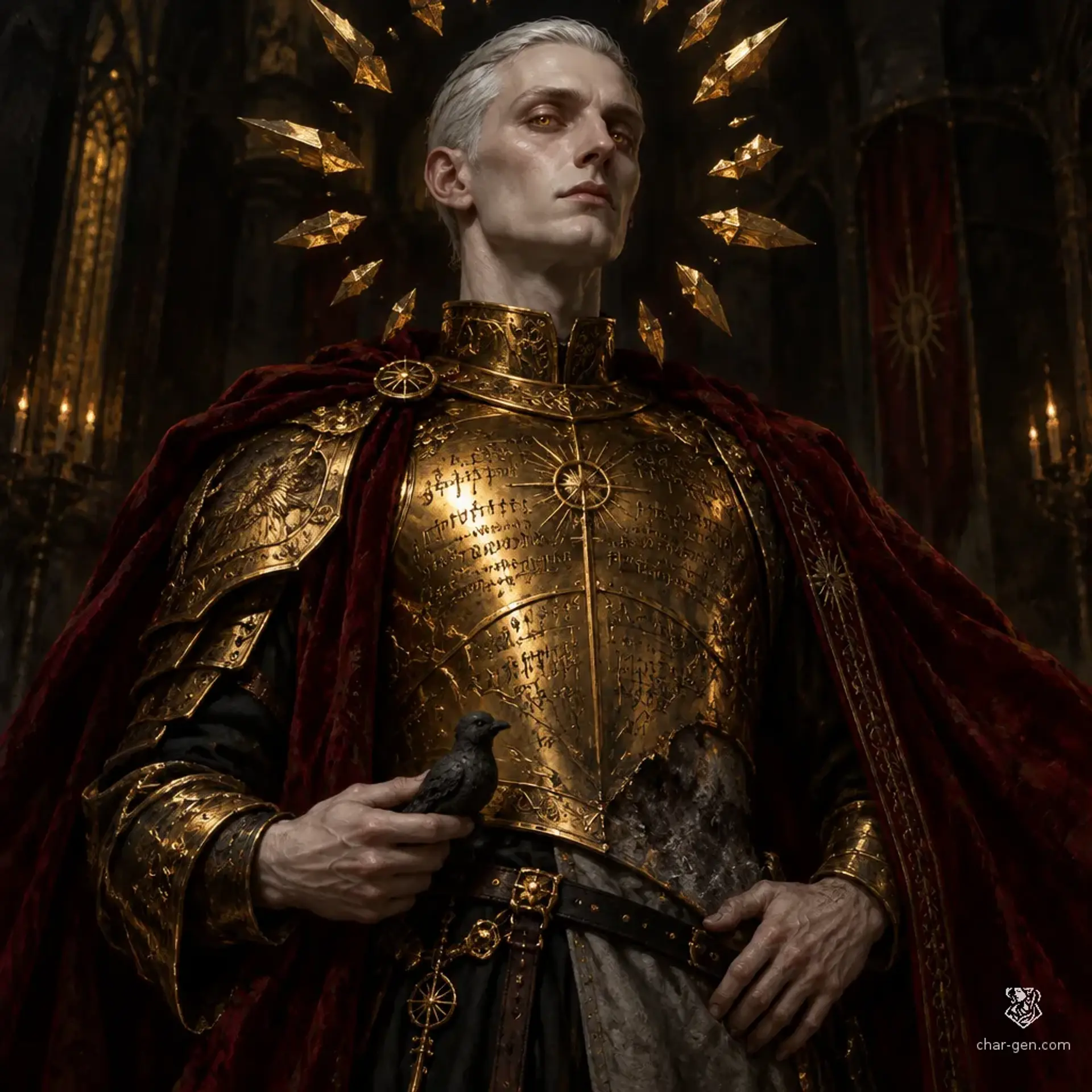
A tall, rigidly upright man whose porcelain-pale face seems almost carved, with an aquiline nose and gold eyes that catch the light like heated glass. His close-cropped silver-white hair is combed into exact, unbroken lines. The gold plating of his ceremonial armor is bright at the chest but rubbed dull along the left hip, where a thumb-sized patch has been polished by years of resting his hand there. A heavy crimson velvet cloak follows him with a delayed, weighty sweep. Jagged gold shards orbit his head in a slow, uneven halo, making a faint glassy hum. He walks as if each step has been rehearsed for a public procession, yet turns his head abruptly when he believes he hears a revelation. Unexpectedly, he keeps a small, soot-blackened clay bird tucked into his belt, an ugly child's trinket that clashes with the splendor around it.
Clothing
Ornate gold-plated ceremonial armor engraved with holy passages, a heavy crimson velvet cloak, polished boots, and a circlet of floating jagged gold shards. Under the armor he wears a plain, ash-colored tunic.
Body language
Keeps his chin lifted and his shoulders squared toward whoever holds the room. His hands remain controlled in public, often folded over the mace pommel; when he believes he is receiving a sign, one finger taps twice against his breastplate. He turns sharply toward empty space, then waits with the stillness of a man expecting an answer.
- Height
- Tall, about 6 feet 4 inches
- Build
- Tall, lean, and hard-conditioned rather than bulky; carries himself with parade-ground precision.
- Eyes
- Metallic gold, with an uncanny inner gleam
- Hair
- Silver-white
- Skin
- Pale, porcelain-like
- Age
- Adult; exact age not publicly recorded
- Gender
- Male
- Size
- Medium
Distinguishing features
Personality
14 traits and drivesCharismatic and controlled, yet incapable of tolerating a rival moral authority. He can be patient with frightened petitioners and unexpectedly attentive to small acts of kindness, but interprets disagreement as a danger to be contained. His confidence looks like humility to him: he claims to be merely the instrument of a greater will, while ensuring that every decision flows through his hands.
- Alignment
- Lawful and zealously authoritarian
Quirks
Habits
Traits · 4
Flaws · 4
Fears · 3
Wants and needs · 3
Combat
HP 180 · 30 feet per round in this custom rules profileOpens with a command or display of solar power to disrupt enemy confidence, then targets leaders and anyone threatening his line of command. Uses the mace when enemies close and the solar beam against exposed or retreating foes. He protects his position and nearby loyalists, but may pursue a perceived blasphemer beyond sound tactical sense. If Nakarnia is endangered, his usual caution can collapse into reckless violence.
József Castor
Actions
Reactions
Rewards they can give
Equipment
- Engraved regent's plate (armor)Gold-plated ceremonial plate. Custom rule: reduces physical damage by 5, to a minimum of 0.
- Noon edict (weapon)A heavy mace with a sunburst head, used for close combat.
- Shard circlet (custom magical focus)The orbiting shards are a visible focus for his solar manifestations; their exact origin is disputed.
- Child's clay bird (personal keepsake)A soot-blackened clay bird small enough to close inside his fist, carried despite its poor condition.
Possessions
Background
Born into a high-ranking clerical household, Hadrian Castor was trained to debate doctrine before he was old enough to understand its consequences. At twelve, he said a voice had spoken to him from the empty chapel. His family treated the claim as proof of favor; Hadrian came to treat doubt as proof of disloyalty. He rose through the Divine Concordance with real theological brilliance and a gift for reading a crowd, while rivals who challenged his visions were stripped of office, exiled, or quietly condemned. He seized the Regency and remade the Concordance from a religious institution into a militant empire. During an expedition to suppress a distant heresy, he found a young Hodne child, Nakarnia. He declared the discovery a sign and took the child into his household, raising them as his own while shaping their education around obedience and destiny. Nakarnia is now old enough to question the story of their rescue. Hadrian's current problems include unrest among annexed realms, officers who fear his purges more than they trust his commands, and increasingly frequent private conversations with the silent voice he believes guides him. A formative turning point came during a failed campaign: a town surrendered after Hadrian promised mercy, but his own commanders carried out a massacre anyway. Rather than admit that his authority had failed, he proclaimed the slaughter a divine purification. Since then, he has confused the ability to command with the right to be obeyed.
Role in the story
A powerful antagonist, patron, or unstable ally whose public promise of order conceals a crusade against pluralism. He can command armies and sway crowds, but personal ties, disputed revelations, and the consequences of his rule give the characters leverage beyond simply defeating him in combat.
“At twelve, he said a voice had spoken to him from the empty chapel.”
- Faction
- Regent of the Divine Concordance, a militant theocracy he has transformed into an expanding empire.
Known connections
Media
0 imagesNo images yet.
Turn József Castor into a sheet
A high-res, share-ready sheet you can post or print.