Sigurd
Sigurd
At the table
Voice
A young man's voice with a light rasp and occasional breathy catch, especially after exertion. It carries the blunt projection of someone learning to call warnings across a guard post, but his phrasing remains precise and observant, reflecting years of laboratory work and historical curiosity. When his temper rises, the voice sharpens rather than softens, and little sparks may slip from his lips.
Sigurd speaks an early medieval form of German, shaped by a modern Minnesotan past he keeps hidden. His delivery is careful and plainly articulated, with a slight rasp from training, cold air, and the unfamiliar weight of his new voice. He often chooses concrete words and asks precise follow-up questions. When he is trying to appear composed, he sounds more formal than the situation requires. When he loses his temper, his sentences become blunt and clipped, and the faint crackle of escaping embers can punctuate his words. He does not sing his speech or deliberately lower his voice; its strangeness comes from a familiar mind speaking through a body that still feels partly unfamiliar.
Speech patterns
How to play them
Treat Sigurd as a competent but unsettled person, not as a puzzle to solve. He responds best to direct, private conversation and practical kindness. Avoid teasing him about Līga in front of her or the merchant's company; public jokes make him retreat into stiff formality. If asked about his former life, he may discuss history and family but will evade the truth of his transformation. Trust grows when someone respects his guarded keepsakes, acknowledges his work, and lets him decide how much of his body or past to explain.
Goal
Protect his friends, earn the merchant's trust without being treated as a threat to his valuables, and learn whether he can accept his changing body without abandoning the life and people he remembers.
Motivation
To keep the group safe and remain useful while finding a way to live honestly with a body and instincts he never chose.
Appearance
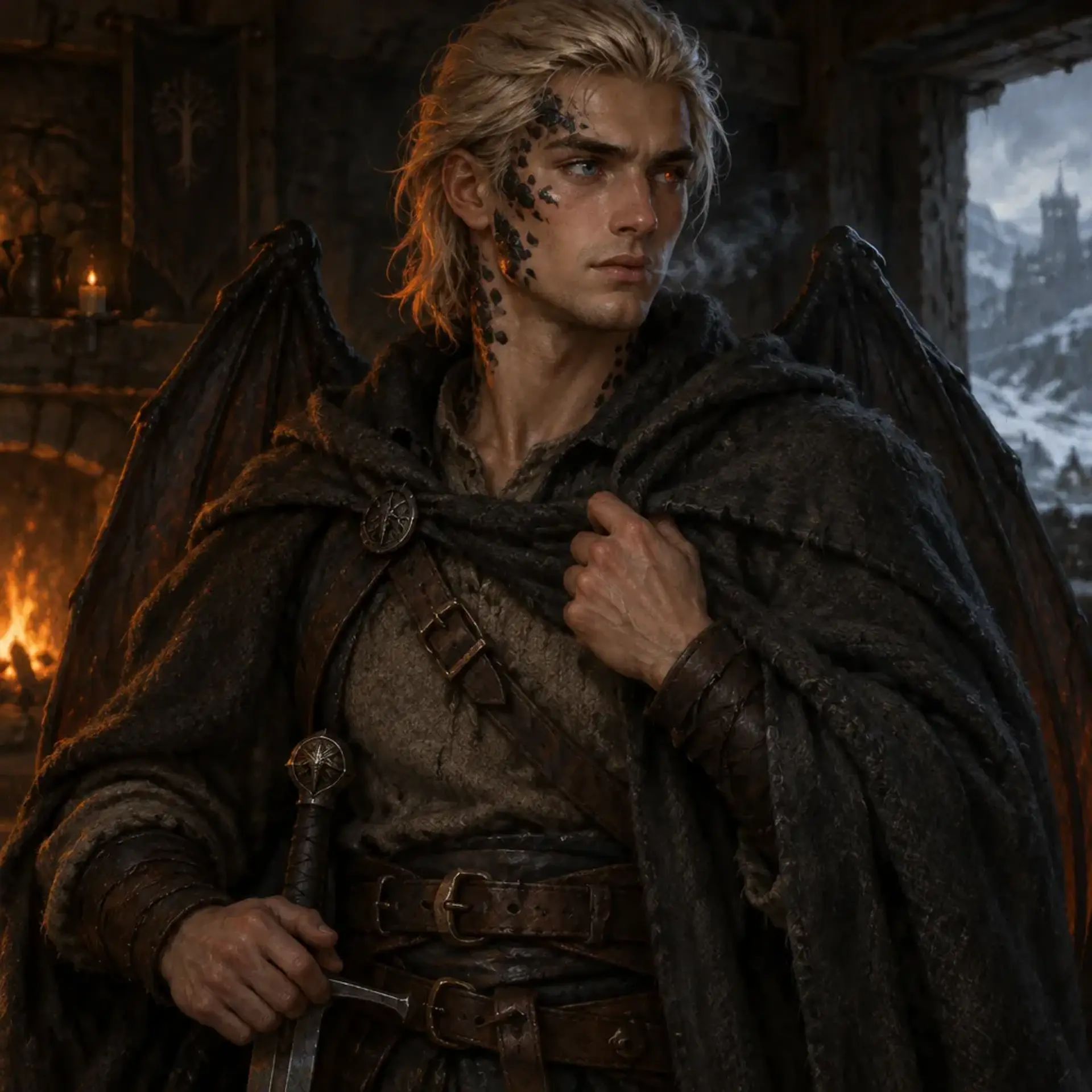
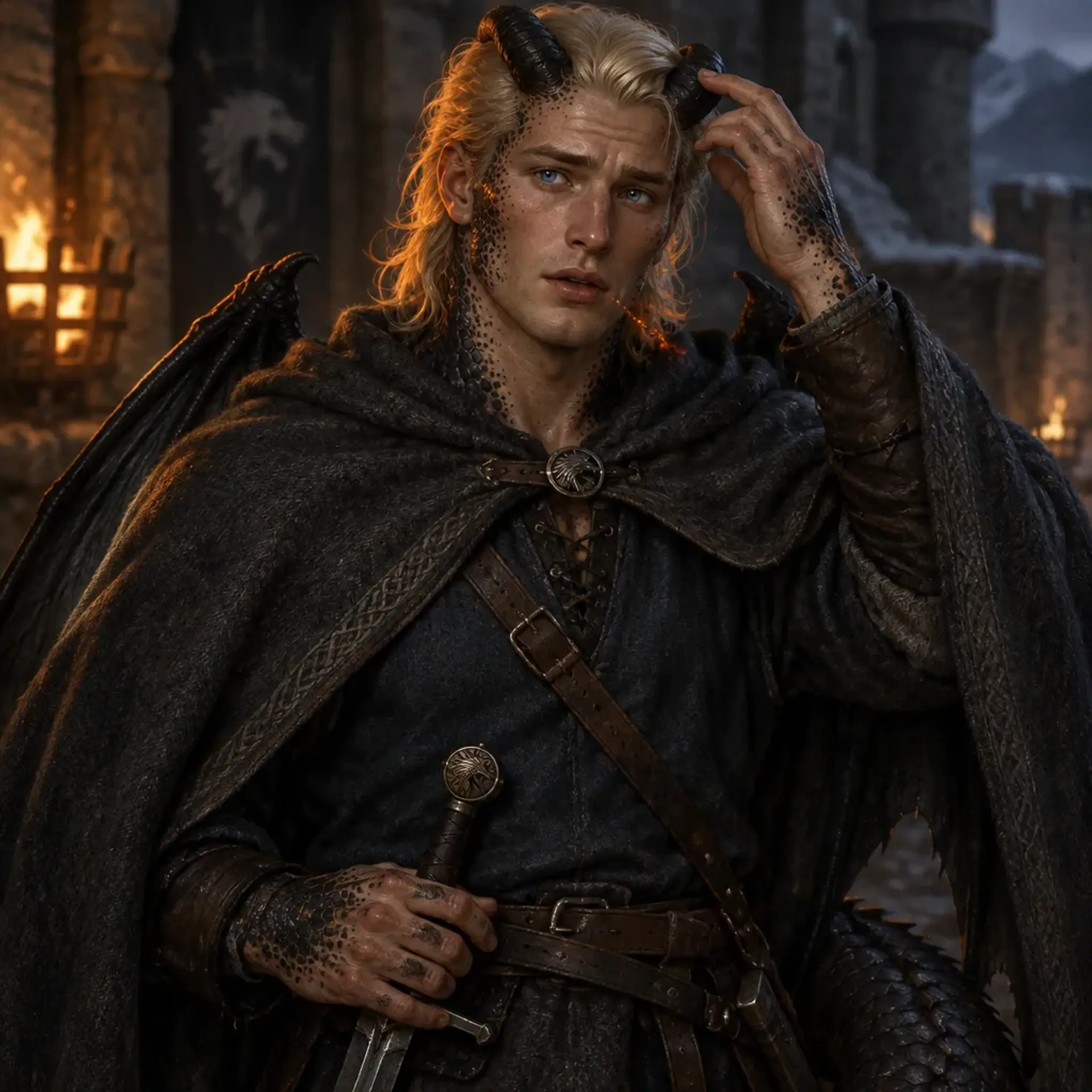
Sigurd looks like a young Saxon hero lifted from a Nibelungenlied carving and then made unsettlingly real: handsome, broadening through the shoulders, and still faintly startled by the scale of his own body. His pale-blond hair is brushed back from his brow, its ends tinted an ember-warm copper that is easiest to see in firelight. Fine black scales, subtle as soot caught in bark, stipple his temples, collarbones, ribs, and the backs of his hands. His skin is unusually warm to the touch. Two short, dark horns are emerging through his hairline, and a heavy tail shifts beneath his cloak, pulling painfully when he turns too quickly. His folded wings are leathery and dark, with a faint sheen like polished obsidian. He moves with a guard's trained effort at stillness, but his shoulders keep making tiny adjustments to accommodate the wings. When cornered, furious, or caught in the grip of dragon-sickness, his blue eyes flare to a wild, furnace-like orange. He is careful to keep his wings hidden from casual view, though in solitude he tests their stretch and lets the wind run across them. Unexpectedly for a hired guard, he is fascinated by tiny, ordinary customs: he will pause to study the exact way a stranger knots a shoe or greets a child, as if each gesture were evidence in a historical inquiry.
Clothing
A practical wool tunic, dark trousers, leather boots, and a weathered guard's cloak cut wide enough to conceal folded wings. His belt carries a plain sword and a small utility knife. He favors layers that can be loosened when his skin runs hot, though he pretends this is only for comfort after training.
Body language
His posture is carefully controlled, with a guard's squared shoulders and a scholar's habit of leaning toward whatever he wants to examine. His tail gives away irritation before his face does, tapping once against his leg or tightening beneath his cloak. When Līga is near, he becomes conspicuously occupied with straps, buckles, and the ground. He touches the base of one horn as if checking whether it has grown again, then acts as though he was merely adjusting his hair.
- Height
- 6 feet 2 inches
- Build
- Tall and increasingly broad through the shoulders, with a strong young guard's frame still awkwardly adapting to its wings and tail.
- Eyes
- Blue, flaring furnace-orange when cornered, furious, or caught by dragon-sickness
- Hair
- Pale blond, brushed back, with ember-copper tint at the ends
- Skin
- Fair, warm-toned skin with subtle soot-black scales like charred bark and polished obsidian
- Age
- 19
- Gender
- Male, formerly female before the crossing and transformation
- Size
- Medium
Distinguishing features
Personality
20 traits and drivesSigurd is both observant and self-conscious. As a historian, he naturally watches how people greet one another, divide food, bargain, mourn, and show respect. He can be quietly delighted by a custom that reveals something human and ordinary beneath the strangeness of this world. Yet when attention turns toward him, he becomes stiff and self-monitoring, measuring every word against the person he remembers being and the man other people expect him to become. He is loyal without being blindly obedient: he will follow a sensible plan, but if someone is in danger he can step out of formation before he has finished thinking. His courage is practical rather than grand. He stands watch, learns the sword, and takes the dangerous position because those are useful things to do. He does not see himself as a hero, though he has begun to resemble one. He can be gentle with frightened people and patient with children, then surprisingly sharp with an adult who treats his transformation as entertainment. His politeness is sincere, but it can also serve as a wall. When he is embarrassed, he becomes excessively formal or launches into an explanation of local etiquette, history, or safety. When he is angry, he does not grow quiet or sweet; he speaks more bluntly, his jaw sets, his tail tightens beneath his cloak, and sparks may betray the temper he is trying to control. Sigurd wants to keep faith with the person he was, but sometimes mistakes fidelity for refusing to change. He remembers being a woman, remembers his old relationship with a boyfriend, and remembers the expectations that once shaped his life. His present attraction to women unsettles him, not because he believes it makes him bad, but because it does not fit the simple story he hoped to tell himself about what the transformation means. His feelings for Līga are particularly difficult. He loves her as a friend and fears that desire could make her feel watched, pressured, or unsafe. He therefore tries not to act on the crush, sometimes so forcefully that he becomes awkward around her. He can be jealous of Aldwin's marriage to her, and then ashamed of his jealousy. He knows Līga is not a prize and Aldwin is not an enemy, but knowing does not immediately stop the feeling. He is also proud. The merchant's decision to keep him away from valuables feels like a judgment on his character, even though Sigurd understands the fear behind it. He would rather be given a difficult assignment than be treated as a danger to the cargo. The merchant's daughters' flirtation leaves him unsure whether to answer with humor, reserve, or retreat. Their attention is flattering and unnerving at once. Sigurd can manage a blade drill more easily than a teasing compliment. His moods alter his manner. When curious, he leans in, asks careful questions, and may forget that other people do not want to be interviewed about how they fold a napkin or bless a meal. When tired, he goes quiet in the ordinary sense of having little energy, not as a performance of politeness; he becomes literal and appreciates clear instructions. When relaxed with trusted friends, a dry humor emerges, often directed at his own clumsiness with horns, wings, and tail. In private, he is more playful with the wind than he is willing to admit. He enjoys the sensation of air moving over his wings and tests their span with cautious flaps, then immediately tells himself he was only checking their mobility. Fear makes him controlling. He checks the same straps repeatedly, hides the modern objects he has brought from Minnesota, and tries to anticipate every possible way his fire might harm someone. He sometimes confuses preparation with safety. His keepsakes matter because they contain the texture of a life beyond this strange world: notes in his own handwriting, tools familiar to his hands, and traces of family he cannot reach. Yet he is beginning to hide and alter them as if the past were contraband. The contradiction is painful. He wants the others to promise that he will become who he was again, but he is quietly preparing for the possibility that he will not. Under all of this, Sigurd is devoted to his companions. He is not sure what kind of man he is becoming, but he knows the people he cares about deserve protection, honesty, and room to choose their own lives. He is trying to learn that the same kindness should include himself.
- Alignment
- Neutral good
Quirks
Habits
Traits · 5
Flaws · 5
Fears · 5
Wants and needs · 5
Combat
AC 15 · HP 20 · 30 ft.Sigurd holds a defensive position near whoever seems most vulnerable, using his longsword and shield rather than charging into danger. He saves Second Wind for a moment when he can keep protecting others, and uses Action Surge to finish a threat or reposition quickly. He avoids using Ember Breath in public unless someone is in immediate danger; when forced to reveal it, he targets clustered enemies while taking care not to catch allies or nearby buildings in the cone. His wings are not yet dependable for flight.
Sigurd
Actions
Reactions
Services they sell
Rewards they can give
Equipment
- Longsword (martial weapon)A serviceable straight blade used for guard work and training.
- Guard shield (armor)A sturdy shield carried on duty, painted with the merchant's plain trade mark.
- Wing-concealing cloak (clothing)A weathered cloak with concealed room for folded wings, altered by Sigurd himself.
- Hidden thermos (personal keepsake)A modern thermos from Minnesota, stripped of conspicuous decorations and carefully hidden from the group.
- Minnesota keepsakes (personal effects)A phone, science journal, pencils, and modern pens from his former life. He has removed or concealed identifying decorations.
Possessions
Background
Before the crossing, Sigurd was Sigrid, a young woman from Minnesota who worked as a laboratory assistant and loved history with the hungry attentiveness of someone who wanted the past to be more than dates in a book. She liked the small, revealing things: what people ate when food was scarce, how a household divided labor, which greeting was formal and which meant affection. She kept a science journal beside her research notes, filling the margins with questions and corrections. She had an older brother and an older sister, parents she loved despite their ordinary disagreements, and five nieces and nephews whose small triumphs she remembered with painful precision. She also had a boyfriend. Her old life was not a vague dream or a costume she had worn; she remembers its relationships, habits, and body distinctly. The crossing stranded the group in a cold, unfamiliar world. Sigurd remembers the first night with painful clarity: bitter air, wind worrying at the walls, moonlight on a room whose furnishings made no sense to him, and the false comfort of alcohol. He shared a bed with Līga, believing he had not changed. At dawn he woke close enough to feel her warmth and smell her hair, and then became aware of the unfamiliar body he inhabited. Terror came first. The room was strange, his height and weight were wrong, and his voice seemed to belong to someone else. Then his attention betrayed him, turning toward Līga with an attraction he had not expected and did not know how to reconcile with his memories. He got out of bed before he disturbed her, shut himself away, and recoiled from what he found in the mirror. The experience remains a private fault line in his memory: fear, grief, bodily curiosity, shame, and a tenderness toward Līga that he cannot simply will away. The transformation did not stop at changing his sex. Over the following year, he grew taller and stronger, his voice roughened, and a shadow of facial hair demanded unfamiliar care. Horn buds pressed through his scalp. His tail arrived as pain before it became a practical nuisance, and his wings made every attempt to dress, sleep, and pass unnoticed more complicated. Dark scales spread in subtle patches beneath his clothes. He learned that his blood carried a Firedrake inheritance, a custom draconic lineage whose private notes describe an echo of a greedy, ever-burning pitch-black dragon. The phrase frightens him because it makes a possible future sound like a verdict. He has begun to breathe fire, but works hard to keep that ability secret. Embers sometimes escape his lips when he is annoyed, making concealment harder than he would like. Sigurd has tried to remain useful rather than become a burden. A wealthy merchant hired him as a guard, partly because the merchant saw promise in his strength and partly because he wanted a capable protector close at hand. The employer knows about the draconic heritage and keeps Sigurd away from the merchant's valuables. Sigurd notices the distrust, even when it is disguised as a work assignment, and it needles him. The merchant's daughters flirt with him and ask personal questions; he has noticed they do the same with other handsome men in the company, but their attention still leaves him awkward and uncertain. The merchant laughs about his obvious crush on Līga. The teasing makes Sigurd embarrassed and defensive, especially because he is actively trying not to make his feelings Līga's problem. His sword instructor is a broad-backed, sharp-eyed Saxon from the borderlands between Christian Germans and pagan Danes. The instructor believes discipline will make Sigurd a man according to old German custom, and drills him harder as he learns to read Sigurd's guarded posture and unfamiliar speech. One evening, speaking privately in their native tongue, the instructor bluntly told him there was no reason he should not sleep with Līga, or at least another woman. Sigurd did not find the suggestion comforting. He remembers being a woman, remembers a boyfriend, and feels his current attraction as an inconvenient fact rather than an easy new identity. An old male friend has patiently taught him shaving and other practical knowledge he never needed before. That friendship helps, but it does not erase the disorientation. The group has tried to reassure him that, if they return to their own world, he may become as he was before. Sigurd listens and wants to believe them. Yet he has started altering the objects he carried from Minnesota. His phone, science journal, pencils, modern pens, and thermos have had their identifying decorations removed or hidden. He says it is to prevent confusion if someone sees them. The thermos is especially guarded; he hides it even from his friends. In private, he has begun treating these acts as a quiet renunciation. He fears that if he clings to the old life too fiercely, he will be unable to survive the new one. He dreams of returning home in this changed body, of flying freely, of claws digging into gold, and of being with Līga. The dreams do not tell him which future he wants. They only reveal how much he is still trying to understand.
Role in the story
A loyal guard and displaced historian whose transformation tests the boundaries between memory, identity, and the person he is becoming. Sigurd can offer cultural insight, practical protection, and a personal story that develops alongside the party. His crush on Līga, jealousy of Aldwin, concealed fire breath, and fear of dragon-sickness create tensions for roleplay without requiring him to betray his friends.
“She kept a science journal beside her research notes, filling the margins with questions and corrections.”
- Faction
- Hired guard in a wealthy merchant's traveling company. No formal military or religious allegiance.
Known connections
Media
0 imagesNo images yet.
Turn Sigurd into a sheet
A high-res, share-ready sheet you can post or print.