Mary
Mary
At the table
Voice
A dry, breathy voice with a faint rasp at the start of a sentence. It carries the practical projection of someone used to speaking over machinery and across a yard. Fear disrupts her breathing before it changes her words; anger makes her quicker and more direct, not softer.
Her voice has a dry, breathy edge shaped by years of speaking over mill noise and cold wind. She starts sentences after a small held breath, as though she must first decide whether the words are safe. When rattled, the breath catches and becomes a soft rasp; when angry, her words come quickly and plainly, with no attempt to soften them.
Speech patterns
How to play them
Mary is cautious with strangers but responsive to patience and practical kindness. She shares ordinary details readily, then tests a visitor with small questions before speaking about the wedding night. If someone threatens her son, she stops negotiating and acts at once. Show her conflict through the contrast between affectionate memories of her husband and the physical fear his unexplained silences provoke.
Goal
Discover what happened on her wedding night and keep the Barguest, or whatever marked her son, from taking him.
Motivation
Love for her family pulls her toward forgiveness; fear for her son pushes her toward the truth, however ugly it may be.
Appearance
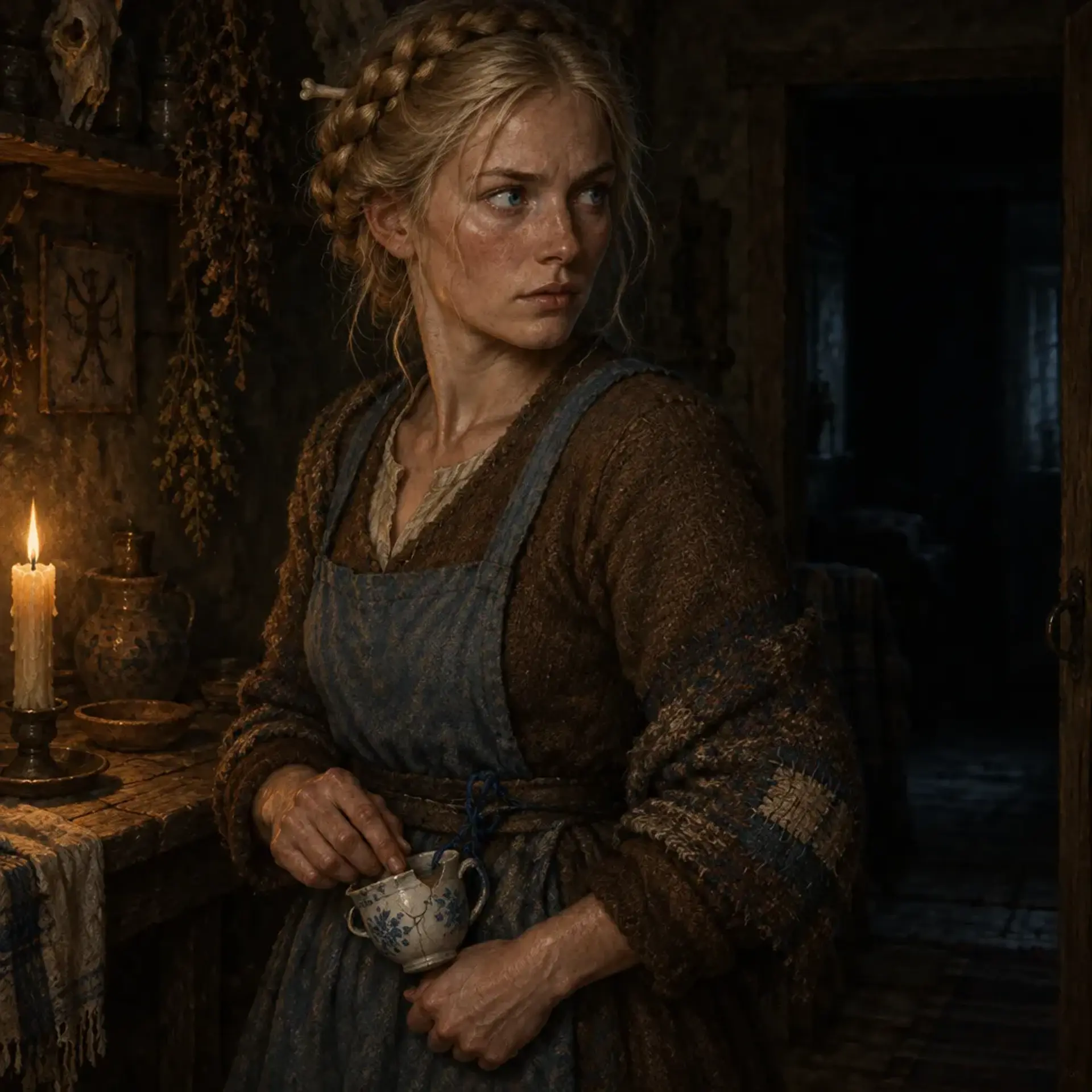
Mary has pale, weather-warmed skin and bright blue eyes that seem to keep measuring the distance to the nearest door. Her blond hair is thick and usually braided in a practical coil, though fine strands escape around her temples. She moves with a careful, heel-first tread, as if every floorboard might be listening. Before she speaks, she takes a small breath through her nose and holds it for a beat; when frightened, that held breath becomes a faint, involuntary rasp. Her unexpectedly playful detail is a row of tiny stitched birds hidden along the inside hem of her severe work apron, each one made from scraps of a different old dress.
Clothing
A dark brown wool dress, patched at the elbows, beneath a plain apron with tiny bird stitches hidden inside its hem. She wears a faded blue shawl pinned close at the throat and stout boots still marked with marsh silt.
Body language
She keeps her shoulders square and her hands occupied, folding cloth, peeling roots, or smoothing a tabletop. When unsettled, she holds her breath for a moment, then releases it through her nose in a thin rasp. She instinctively places herself between her son and any open doorway.
- Height
- 5 feet 5 inches
- Build
- Sturdy and capable, with strong forearms from household work and a habitual forward lean from carrying baskets.
- Eyes
- Clear blue
- Hair
- Blond
- Skin
- Fair, lightly weathered by outdoor work
- Age
- 29
- Gender
- Woman
- Size
- Medium
Distinguishing features
Personality
13 traits and drivesMary is tender without being meek: she remembers small kindnesses and will defend her husband from insults, yet watches his hands when he comes home after dark. In a safe mood she is dryly funny and generous with food; under pressure she becomes brisk, suspicious, and fiercely decisive. She wants to believe the man she married, but refuses to let that hope outrank her child's safety.
- Alignment
- Neutral Good
Quirks
Habits
Traits · 4
Flaws · 3
Fears · 3
Wants and needs · 3
Combat
AC 10 · HP 9 · 30 ft.Mary avoids a fight and tries to get her son and other bystanders to safety. If cornered, she swings her mallet to make space, then retreats toward a door, a crowd, or a place where someone can hear her. She does not pursue enemies.
Mary
Actions
Reactions
Services they sell
Rewards they can give
Equipment
- Firewood mallet (improvised weapon)A plain wooden mallet used for household work, awkward but solid in a desperate fight.
- House key (tool)A small iron key for the family door; she keeps it on a cord beneath her clothes.
- Travel bundle (supplies)A wrapped heel of bread and a piece of clean cloth, kept ready in case her son must be taken from home quickly.
Possessions
Background
Mary married the man she loved after a courtship built from shared errands, dry jokes, and long walks home from the mill. On their wedding night, he disappeared into the dark for hours. He returned at dawn with mud on his clothes, an unfamiliar animal stink, and no clear account of where he had been. He later told her a tender, carefully rehearsed story about their first night together. She wanted to believe him, and for years she did. Then their young son began waking from dreams of a great black hound at the window and called the creature his father. Mary confronted her husband, who confessed that something had happened that night but still will not tell her what. She loves the warm, familiar man she remembers and fears the thing she glimpsed outside their shutter: a huge dog-shaped shadow with a human way of watching. Now she believes the Barguest may be her son's true father, or at least the presence that marked him. Oswin Hirst, an old connection of her husband's, has begun asking questions about the child and the wedding night. Mary is trying to keep her family together while deciding whether the truth will protect her son or draw the creature closer.
Role in the story
A frightened but resourceful witness whose love for her husband complicates the party's search for the truth. Mary can anchor the mystery in ordinary domestic life and reveal that the Barguest's connection to her son may be more personal than a haunting.
“On their wedding night, he disappeared into the dark for hours.”
- Faction
- No formal faction. Her closest ties are to her household and the neighbors who share work and warnings.
Known connections
Media
0 imagesNo images yet.
Turn Mary into a sheet
A high-res, share-ready sheet you can post or print.