Mary
Mary
At the table
Voice
Her voice has a dry, slightly breath-worn texture from years of speaking over a mill wheel and calling across a yard. It carries clearly without sounding forceful. When distressed, she clips the ends of practical sentences and lets a pause stand where a confession might go.
Mary speaks in plain, practical sentences shaped by years of household work and village bargaining. She often describes a feeling through an object or sound rather than naming the feeling directly. Her speech is steady when discussing chores and catches on details when she recalls the wedding night.
Speech patterns
How to play them
Treat Mary with patience and give her room to speak indirectly. She will discuss household worries readily, but questions about the wedding night make her guarded. Demonstrating concern for her son earns more trust than pressing her for a confession.
Goal
Discover what happened on her wedding night and protect her son without condemning Oswin before she knows the truth.
Motivation
Love for her family pulls against an instinctive fear that the family she loves may be bound to something monstrous.
Appearance
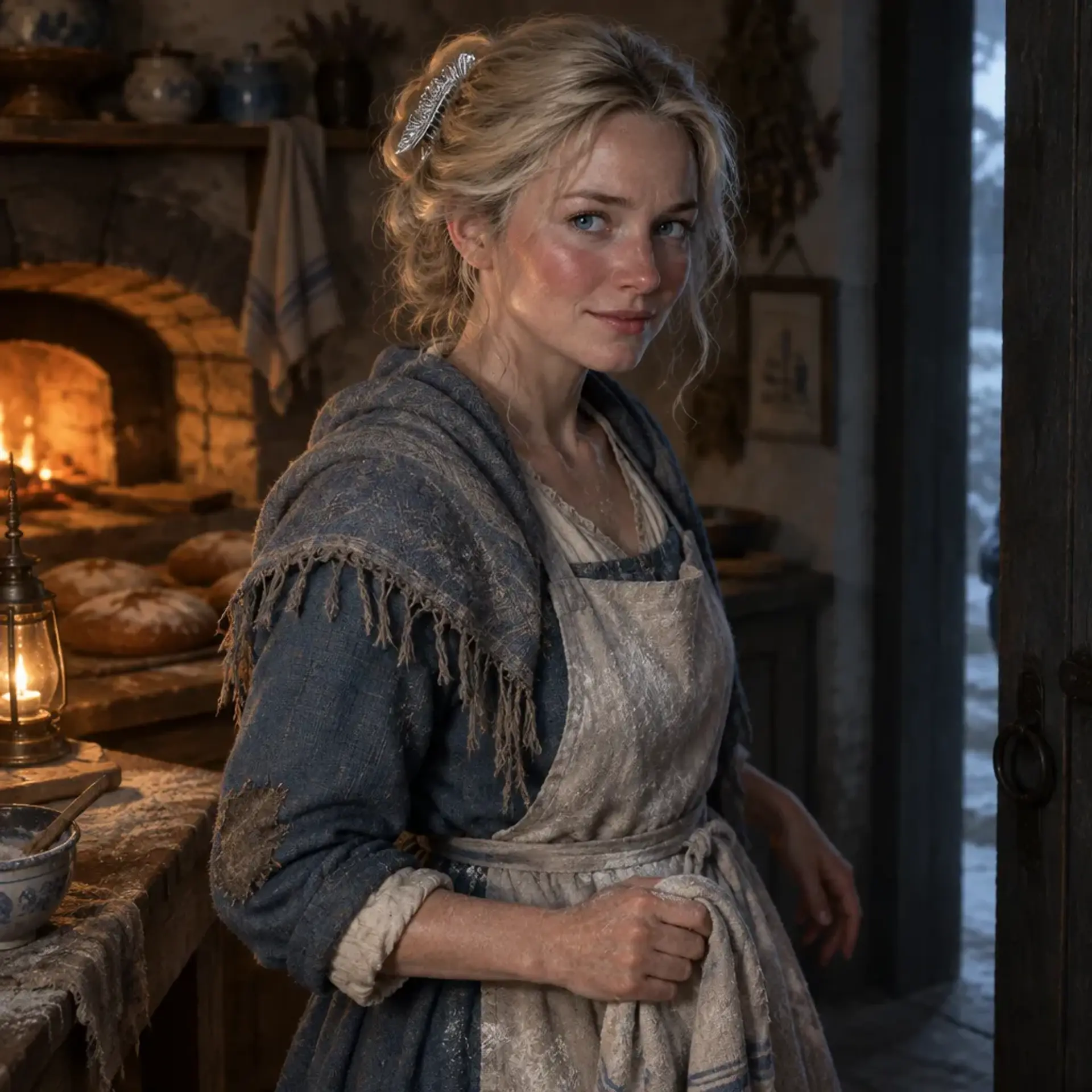
Mary is a fair-haired young woman with clear blue eyes, a narrow chin, and a weather-browned nose. Her wheat-blond hair is usually braided and pinned with a bone needle, though loose strands escape around her temples. She moves with careful, economical steps, as if always avoiding a sleeping child or a creaking floorboard. Within a minute of meeting her, people notice where her eyes go: not to faces, but to doorways, shadows beneath furniture, and the space behind whoever is speaking. She keeps a cracked porcelain cup tied to her belt with blue thread; its chipped rim has been rubbed smooth by her thumb.
Clothing
A practical brown wool dress, a faded blue apron with a deep pocket, a shawl darned at both elbows, and sturdy boots dusted with flour. A small bone hairpin secures her braid.
Body language
Her shoulders stay composed, but her gaze repeatedly measures doorways and dark corners. She angles her body between her son and unfamiliar people, and rubs the smooth chip in her porcelain cup when a conversation turns to the wedding night.
- Height
- 5 feet 4 inches
- Build
- Lean and wiry from carrying water, flour, and a growing child.
- Eyes
- Clear blue
- Hair
- Wheat blond
- Skin
- Fair, lightly weather-browned across the nose
- Age
- Twenty-six
- Gender
- Woman
- Size
- Medium
Distinguishing features
Personality
13 traits and drivesMary is tender with children and brisk with adults, but her practical warmth is threaded with suspicion. In daylight she can laugh easily and argue over the price of flour; after sunset she becomes watchful and avoids being alone with Oswin. When frightened she grows methodical rather than panicked, finding tasks to occupy her hands. She wants to trust her husband, yet resents how readily she still longs to believe him.
- Alignment
- Neutral good
Quirks
Habits
Traits · 4
Flaws · 3
Fears · 3
Wants and needs · 3
Combat
AC 10 · HP 4 · 30 ft.Mary is not a combatant. She tries to get her son behind a locked door, raise an alarm, and escape. If cornered, she uses whatever household object is in hand to make space rather than pursue an attacker.
Mary
Actions
Reactions
Services they sell
Rewards they can give
Equipment
- Iron ladle (improvised weapon)A sturdy iron kitchen ladle, more useful for stirring porridge than fighting.
- Porcelain cup (keepsake)A cracked cup tied to her belt; she will not explain why she carried it away from the wedding room.
- Household remedy pouch (supplies)A small pouch of clean linen strips and dried herbs for ordinary household cuts and fevers.
Possessions
Background
Mary grew up in a mill hamlet, learning to keep a house running through bad harvests and worse winters. She married Oswin Hirst after a courtship that was mostly shared work: mending a roof, carrying flour, and walking home together after market. On their wedding night, Oswin vanished from their room and something vast and animal-shaped stood in the moonlit doorway. Mary remembers its breath fogging the window and the floorboards groaning beneath its weight. Oswin returned before dawn, shaken and unable to explain the torn linen or the blood on his shirt. He told her he had stumbled outside. She accepted the explanation because she loved the man she had married, but never again felt safe beside him in the dark. Their young son was conceived around that night. Mary believes the beast, not Oswin, fathered the child, and watches the boy for signs of claws, strange hunger, or a shadow that moves wrongly. She has told no one this outright. She remains devoted to Oswin in daylight, even as fear makes her sleep with the door barred. Now the child has begun waking from dreams of a moonlit threshold, and Mary is quietly seeking someone who can learn what happened without forcing her to accuse her husband.
Role in the story
A frightened witness and emotional anchor in Oswin Hirst's story. Mary can reveal the human cost of the wedding-night deception, offer clues about the creature, and force the party to consider how truth can protect a family while also breaking it.
“She married Oswin Hirst after a courtship that was mostly shared work: mending a roof, carrying flour, and walking home together after market.”
- Faction
- No formal faction. Her strongest ties are to her family and the people of her childhood mill hamlet.
Known connections
Media
0 imagesNo images yet.
Turn Mary into a sheet
A high-res, share-ready sheet you can post or print.