Peer Ludvik
Peer Ludvik
At the table
Voice
A chest-driven, weather-trained voice with a blunt, wind-cut rhythm. His words can carry across a rocky shore without becoming a shout. When his troll nature presses forward, a low gravelly resonance thickens the ends of his sentences; anger makes his delivery more direct and physically forceful, not quieter or more polite.
Peer's speech carries the clipped practicality of someone used to conserving breath in cold weather. He learned to project over wind and surf, so he speaks from the chest and places important words firmly, with little flourish. When nervous he talks too quickly and tries to fill pauses with explanations. His old heroic manner can return in public, polished by years of being praised, but it slips when he is hungry or tired. In those moments his consonants roughen, his jaw works between phrases, and a low growl can vibrate beneath ordinary words. He can control the sound most of the time, but not when his temper is already rising.
Speech patterns
How to play them
Treat Peer as a frightened and proud person rather than a monster or a tragic spectacle. He responds well to practical help, direct questions, and people who do not flinch at his teeth. Do not demand that he tell his whole history at once. If the party offers news of his wife or family, he may become intensely focused and reckless. If they speak of the troll king, he listens closely but initially denies that he is afraid.
Goal
Find out whether the troll king survived, discover whether troll craft can loosen the bond that changed him, and return to his wife and unborn child without endangering them.
Motivation
Peer wants to believe that he can choose what kind of man he becomes, even if his body and instincts have changed. Beneath the wish for a cure is a deeper need to prove that his family can still claim him.
Appearance
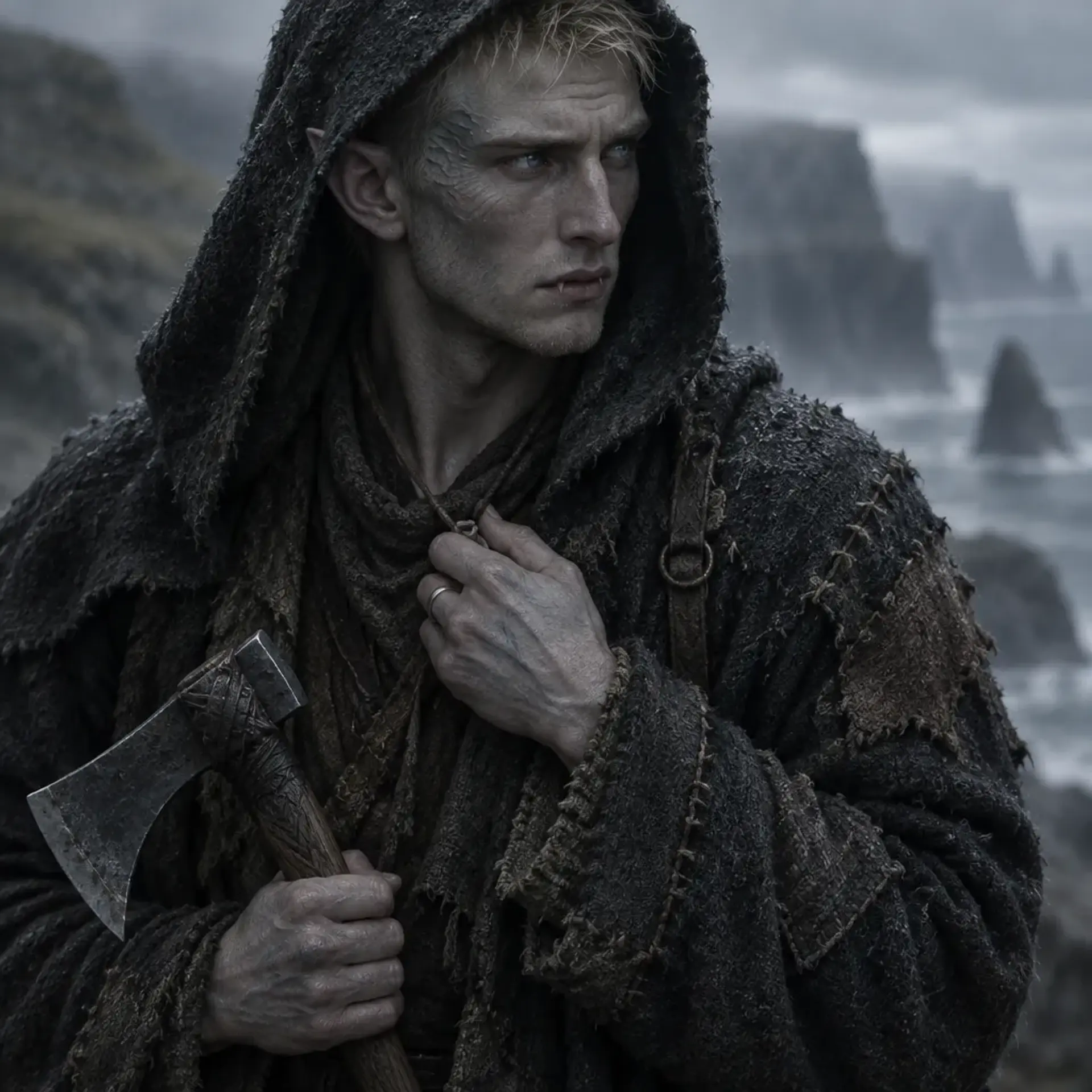
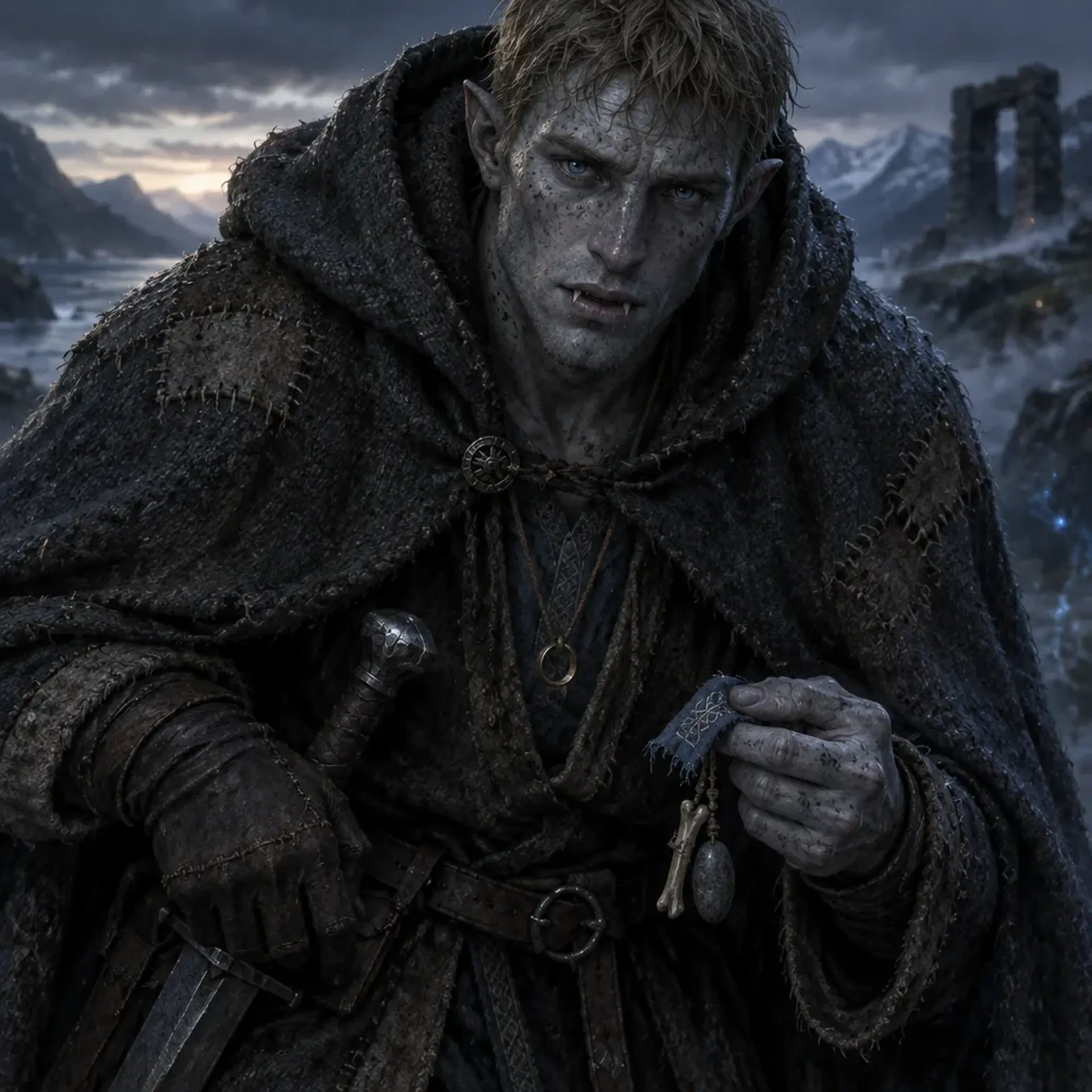
Peer Ludvik is a little over six and a half feet tall, with the long, heavy frame of a man who has outgrown his own clothes. His skin has the color and rough texture of granite washed pale by winter rain, with darker mineral flecks at his temples, knuckles, and the bridge of his nose. His face still has traces of the handsome young hero the villagers once praised, but its lines have lengthened: his nose is prominent, his ears taper to small points, and his jaw seems built to crack roots. When he eats, he tears food with his front teeth and works his jaw in a slow, grinding motion; when he laughs, his sharpened canines show before he can hide them. His deep silver-blue eyes catch light like a frozen lake and seem almost luminous in shadow. His blond hair has dulled to the color of old straw, is cut short, and grows back with irritating speed. He carries his weight forward on the balls of his feet, even when still, as though ready to lunge or flee. The surprising detail is that he keeps a small, carefully folded scrap of blue embroidered linen tucked into his belt, a delicate thing he handles with the caution of a man carrying a live ember.
Clothing
A thick, patched wool cloak with a deep hood, a plain tunic borrowed from Bjorn when Peer outgrows his own, leather belt, practical trousers, and heavy boots. He trims his hair close to keep it manageable and wears gloves when strangers are near. His wedding band is kept on a cord beneath his shirt rather than on his changed hand.
Body language
Peer waits with his weight on the balls of his feet and his shoulders slightly hunched under his cloak, making him look ready either to spring forward or to slip away. He angles his face from direct sun and keeps his hands close to his belt. When embarrassed, he covers his mouth as if that could hide his teeth. When he feels safe, he leans against stone or a tree and lets his long arms hang heavily. Before a fight, his jaw begins a slow grinding motion.
- Height
- 6 feet 7 inches
- Build
- Tall, long-limbed, and broad through the shoulders, with dense strength that looks more like a boulder in motion than a trained athlete.
- Eyes
- Eerie silver-blue
- Hair
- Dull straw blond
- Skin
- Pale grey with a rough, rain-worn stone texture and darker mineral flecks
- Age
- Young adult, about 21
- Gender
- Male
- Size
- Medium
Distinguishing features
Personality
18 traits and drivesPeer is a man who wants to be generous and is often generous, but he keeps a mental tally of every kindness because a childhood of hunger taught him that resources vanish. He will split the last loaf with a stranger, then lie awake wondering whether he has endangered his companions by doing it. He wants to be admired, yet praise makes him suspicious: he remembers how easily the settlement turned a frightened young fighter into a legend and how quickly the same crowd called him a monster. When someone tells the story of his victory over the troll king, Peer can smile and play the hero for a few moments. If the listener describes the king as a beast, the smile becomes stiff. Peer remembers a thinking enemy, and he cannot decide whether that makes his own victory more impressive or more shameful. He is clever in practical, sideways ways. Peer notices which stair creaks, which person has not eaten, and where a room's heavy furniture could become a barricade. He can turn a broken tool into a useful one and make a plan from bad supplies. But cleverness is also his favorite excuse. As a boy, he avoided difficult work by finding bargains with trolls; as a young man, he avoided hard conversations by making jokes or bringing gifts. He tells himself that he is solving problems efficiently. Often he is simply putting the frightening part off until it grows teeth. Peer is protective without being naturally gentle. He may place himself between danger and a companion, then bark at that companion for making him do it. He dislikes cruelty and tries not to kill people or animals he likes, but his restraint is an active effort rather than an effortless virtue. Hunger, humiliation, and the sensation of cold iron can make his temper flare. In that state, his thoughts narrow: the person who hurt him becomes a threat to be stopped, and the rest of the world fades. He is horrified by how satisfying that clarity can feel. When he catches himself, he often overcorrects into silence and shame, avoiding the person he frightened until someone forces the conversation. With Rutgur, Peer is simultaneously younger brother, rival, and dependent. He trusts Rutgur's courage and resents his certainty. Rutgur's jokes about adventure sometimes make Peer laugh, but jokes about becoming a real man strike the sore place where Peer suspects that his old heroism was mostly luck and good storytelling. Peer can overpower Rutgur now, and he hates that the old wrestling matches have changed meaning. He will still let Rutgur win a harmless contest if doing so seems to restore the old order, then feel foolish for caring. With Bjorn, he is less guarded: he grumbles about borrowed clothes, complains that the sleeves are too short, and quietly repairs them afterward. He thinks of both cousins as brothers, even when he cannot bring himself to say so plainly. Emil is the relationship Peer most avoids thinking about. Peer imagines that Emil is angry, then imagines he is frightened, then imagines he is waiting for Peer to explain himself. Each version gives Peer a reason not to write. He tells himself he will contact Emil when he has found a cure or uncovered the truth about the troll king. In reality, he fears that Emil will say the thing Peer has already said to himself: that Peer chose the easy bargain again and left the rest of them to bear the cost. His wife brings out a different kind of honesty, though she is not there to witness it. Peer speaks to her in his thoughts as if she were beside him, explaining small events from the road: what Rutgur said, where they found shelter, how badly the fish tasted. He remembers her as capable and sharp, not as a prize he won by being handsome. He also knows that his memory may be protecting him from the possibility that their marriage had troubles he never took seriously. He wishes he could ask her whether she wants him to return. He is afraid of the answer and more afraid of never asking. In a crowd, Peer performs confidence. He stands straight, lets the cloak hide the worst of his features, and speaks as if every decision has been considered. Around children, he becomes unexpectedly patient and lets them ask about his height or his teeth, provided no adult turns their curiosity into a threat. Around animals, he is quieter and less self-conscious. He tries to feed them before himself, though he sometimes catches himself watching their movement with the appetite of a predator. That awareness makes him withdraw rather than lash out. At night, when the camp is still, Peer is both calmer and less safe. Darkness eases the pain in his eyes and loosens his face into its true shape. He takes watch because he can stay useful instead of trying to sleep. Sometimes the troll tongue comes out of him in fragments: a phrase for hunger, an old bargain formula, a name he refuses to explain. If another person hears him, he claims he was muttering to keep awake. He cannot always tell whether the words are remembered, learned, or newly forming. Peer is not trying to become the golden-haired hero again. He knows that face was partly a disguise, even before the curse. What he wants is more difficult: to be trusted without being admired, to make a promise without turning it into a bargain, and to believe that his family could see him as he is now and still recognize him. When he is in a hopeful mood, he plans for a future where he returns with a cure and his child knows him as a father. When he is frightened, he imagines leaving the coast forever so no one he loves can be harmed by his presence. His contradictions are not a puzzle to solve. They are the daily work of a person trying to choose his actions while afraid of what he has become.
- Alignment
- Chaotic good, struggling against the self-serving instincts and explosive temper of his troll nature
Quirks
Habits
Traits · 5
Flaws · 4
Fears · 4
Wants and needs · 5
Combat
AC 15 · HP 58 · 30 feetPeer begins with a spell or a measured sword strike, trying to control space and end a fight without killing anyone. He uses terrain the way he did against the troll king: loose stone, narrow passages, heavy doors, and obstacles matter more to him than a fair duel. He prefers to draw enemies toward a bottleneck, use Eldritch Blast to disrupt a ranged attacker, and protect companions with Armor of Agathys or a shove. If reduced to half hit points, his custom troll fury can overwhelm his restraint, so allies who know him should speak his name and give him a clear, immediate task. He does not know whether the troll king survived and avoids boasting about the old battle.
Peer Ludvik
Spells
Actions
Reactions
Services they sell
Rewards they can give
Equipment
- Road longsword (weapon)A serviceable longsword with a plain grip and a nicked edge, kept sharp but never polished for display.
- Patched wool cloak (clothing)A thick wool cloak that hides his outline, protects him from cold, and conceals most of his changed features.
- Wedding band (personal token)A ring from his marriage, wrapped in cloth and carried on a cord close to his chest.
- Troll-crafted focus (spellcasting focus)A small charm of worked bone and river stone, used as a focus for his custom Trollkarl spellcasting.
- Road kit (adventuring gear)A whetstone, flint, fishing line, and a folding skinning knife, all kept in a weather-worn pouch.
Possessions
Background
Peer Ludvik was born in a timber settlement between an Atlantic inlet and a range of steep, snow-fed mountains. His parents died while he and his younger brother Emil were still children. Their uncle took the boys and his own two sons into the wooded uplands, then abandoned all four near an old cabin with an axe, a few blankets, and no dependable food. Peer remembers the first winter less as a season than as a series of small humiliations: wet socks, a roof that let snow sift into the sleeping space, and the moment Emil quietly gave him the last strip of dried fish. Peer resolved that he would never again be helpless, though he mistook cleverness for preparation and pride for courage. The cousins learned to snare rabbits, split wood, mend the cabin, and read weather from the clouds over the peaks. Peer was the quickest to spot an opportunity and the quickest to decide that the difficult work could be avoided. Rather than hunt every time the stores ran low, he began visiting the trolls who lived in caves and stone hollows above the valley. He traded labor, scraps, and promises for food, iron tools, and little charms that seemed to bend luck. He told himself every bargain was temporary and every strange custom harmless. Emil and the cousins warned him that the trolls did not give gifts; they made debts that could outlive the people who made them. Peer brought provisions home and treated their warnings as envy. One troll, whose true name Peer refuses to speak, taught him scraps of troll craft: how to hide a face in shadow, how to set a charm into a tool, and how to make a spoken promise carry weight. Peer thought he was learning tricks from a useful neighbor. In truth, the troll was drawing him into a kinship custom, marking him through repeated bargains and borrowed food. Peer noticed that he was eating more, sleeping at odd hours, and recovering from cuts with unsettling speed. He blamed the cold, the work, and the cheap stew. He had always been good at finding an explanation that let him carry on as before. As a young man, Peer became famous for killing the troll king. The villagers tell the story as a clean heroic deed: Peer drew the king beneath a narrow stone shelf, baited him into a charge, and used a wedge and a falling weight to trap him. Then he climbed the broken structure and severed the king's head with a sword. Peer remembers the deed differently. He remembers the king's intelligence, the wet breath in the cavern, the terrible patience in the troll's eyes, and the way the head fell. He remembers that he did not burn the body. The villagers needed a victory and Peer needed to believe he had earned the praise. They made him a hero, and he accepted the title because it came with warmth, meat, and a place at a rich man's table. He married the rich man's daughter, a woman who had first liked his quick wit and then learned to distrust how easily he made a joke of serious questions. Peer loved her, even if he did not always know how to show it without gifts or boasts. For the first time he had a steady roof, good food, and a bed that did not smell of wet wool. She became pregnant. He began imagining a future in which his child would never have to bargain for supper or sleep in a ruined cabin. He did not understand that the comforts he treasured had also made him careless. He continued to visit the trolls, trading labor and favors as though his old life had not followed him home. The change came during a raid. Peer was cut deeply by cold iron while defending the settlement. The wound hurt in a way his other injuries had not. As he weakened, a rage rose in him, sudden and almost impersonal. He felt his bones stretch, his jaw ache, and the skin of his face tighten as if a mask were being pulled from within. The shift was not a disguise he could control. His body took its true troll-changeling shape in front of people who had trusted him. He remembers trying to speak his wife's name and hearing a growl instead. The villagers saw the hero become the thing they believed he had slain. They chased him from town before he could explain, and his wife and unborn child remained behind. At 21, Peer is an exile with a wedding band he keeps close and a fear he cannot resolve: that his child will be born into a story where their father is a monster. He worries that his wife is endangered, ashamed, or simply relieved to be rid of him. He has no proof of which possibility is true. His cousin Rutgur found him by the lake path, eating raw fish and trying to keep out of the sunlight. Rutgur did not flinch. He treated Peer as a person in need of a plan, then announced that this was the perfect time to seek gold and glory on the road. Peer suspects Rutgur's plan is partly a clumsy attempt to keep him alive and partly an excuse to turn their lives into a saga. He accepts the company because he cannot bear the thought of being alone with his own thoughts. Peer's feelings about Rutgur are knotted with gratitude and resentment. As boys, Peer lost every wrestling match to his older cousin. Now Peer can overpower Rutgur and Bjorn, and the change frightens him more than it pleases him. Emil and Bjorn remain in his thoughts like the family he abandoned. He has not written to them. He imagines their disgust, then their pity, and finds both unbearable. He takes night watch, partly because daylight hurts his eyes and partly because he has trouble sleeping near others. In the dark, he sometimes speaks in the old troll tongue without noticing. His present trouble is not merely finding a cure. Peer has begun to suspect the troll king was not dead when he left the cavern, or that the troll king's body could have healed even after a wound that should have ended any other life. Troll law may consider Peer kin to the king through the bargains that changed him. If the king lives, he may claim Peer as family, servant, or successor. If the king is dead, Peer may still carry a debt that the old rules will not let him escape. Peer wants to learn what happened to the body, but every answer could lead him back to the caves where he first mistook convenience for safety. He travels now as an exiled thane without a hall, a former folk hero without a crowd, and a frightened husband trying to become worthy of a child he has not yet met.
Role in the story
A displaced folk hero and potential ally whose changing nature makes him a living link between the settlement and the trolls. His search for a cure can lead the party toward family conflicts, troll law, and the unresolved question of whether the troll king truly died.
“His parents died while he and his younger brother Emil were still children.”
- Faction
- Formerly celebrated as a folk hero and exiled thane of his home settlement; currently travels with Rutgur and has an uneasy, involuntary connection to troll kinship law.
Known connections
Media
0 imagesNo images yet.
Turn Peer Ludvik into a sheet
A high-res, share-ready sheet you can post or print.