Mary Hirst
Mary Hirst
At the table
Voice
A clear, work-worn voice with a faint Yorkshire lilt, slightly roughened by hearth smoke and long hours speaking over the loom. She tends to draw breath through her nose before answering, giving her speech a brief, assessing pause. When angered, she gets brisk and precise, with the hard consonants of someone accustomed to calling instructions across a room.
Her voice carries a Yorkshire cadence shaped by household work and years of calling over the clatter of a loom. Before speaking, she often takes a small breath through her nose, as if checking the air. She speaks clearly and matter-of-factly; under strain, her words become clipped and exact rather than hushed. The name Mary is plain and warm, with a firm ending.
Speech patterns
How to play them
Begin with practical hospitality and ask visitors what brings them to the house. Mary tests whether they respect William's needs and whether they speak plainly. She may confide in someone who listens without mocking her fear, but she does not immediately accuse Oswin in front of strangers. If visitors threaten her son, she becomes direct and will enlist neighbors or flee rather than fight.
Goal
Discover what happened on her wedding night, protect William, and learn whether she can trust Oswin without surrendering her own memory.
Motivation
Love for William and for the remembered Oswin pulls against the terror that the creature she fears may be inseparable from the husband she loves.
Appearance
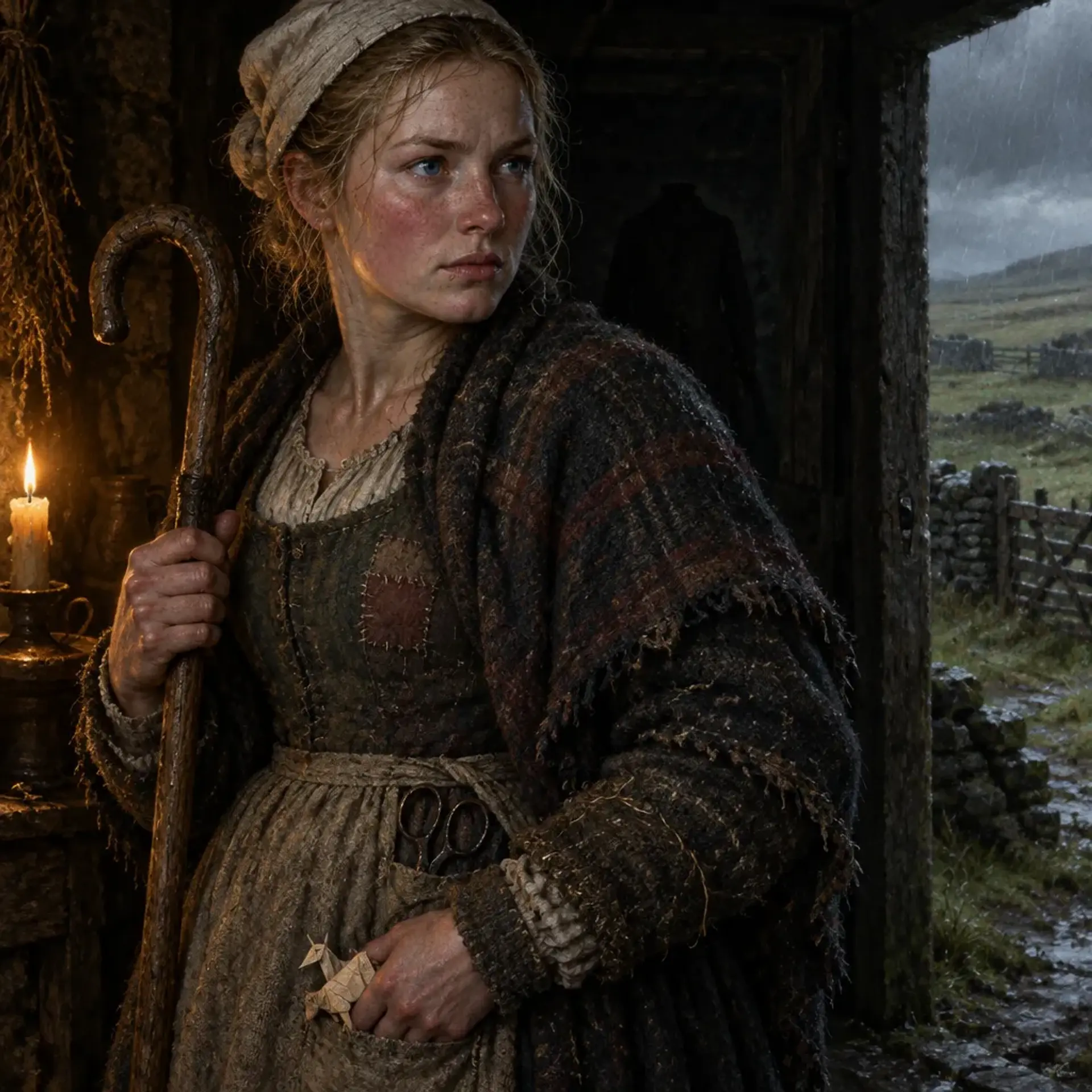
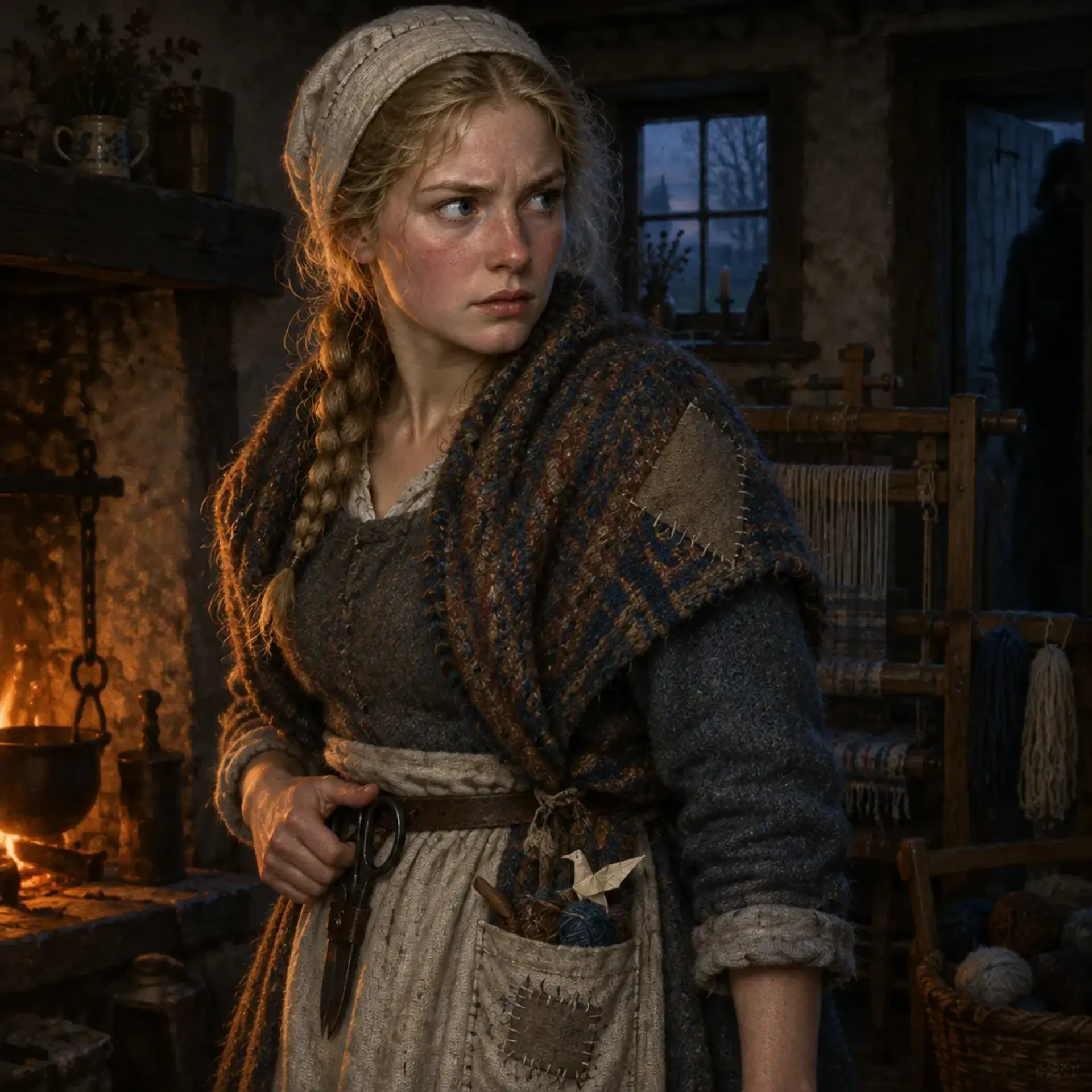
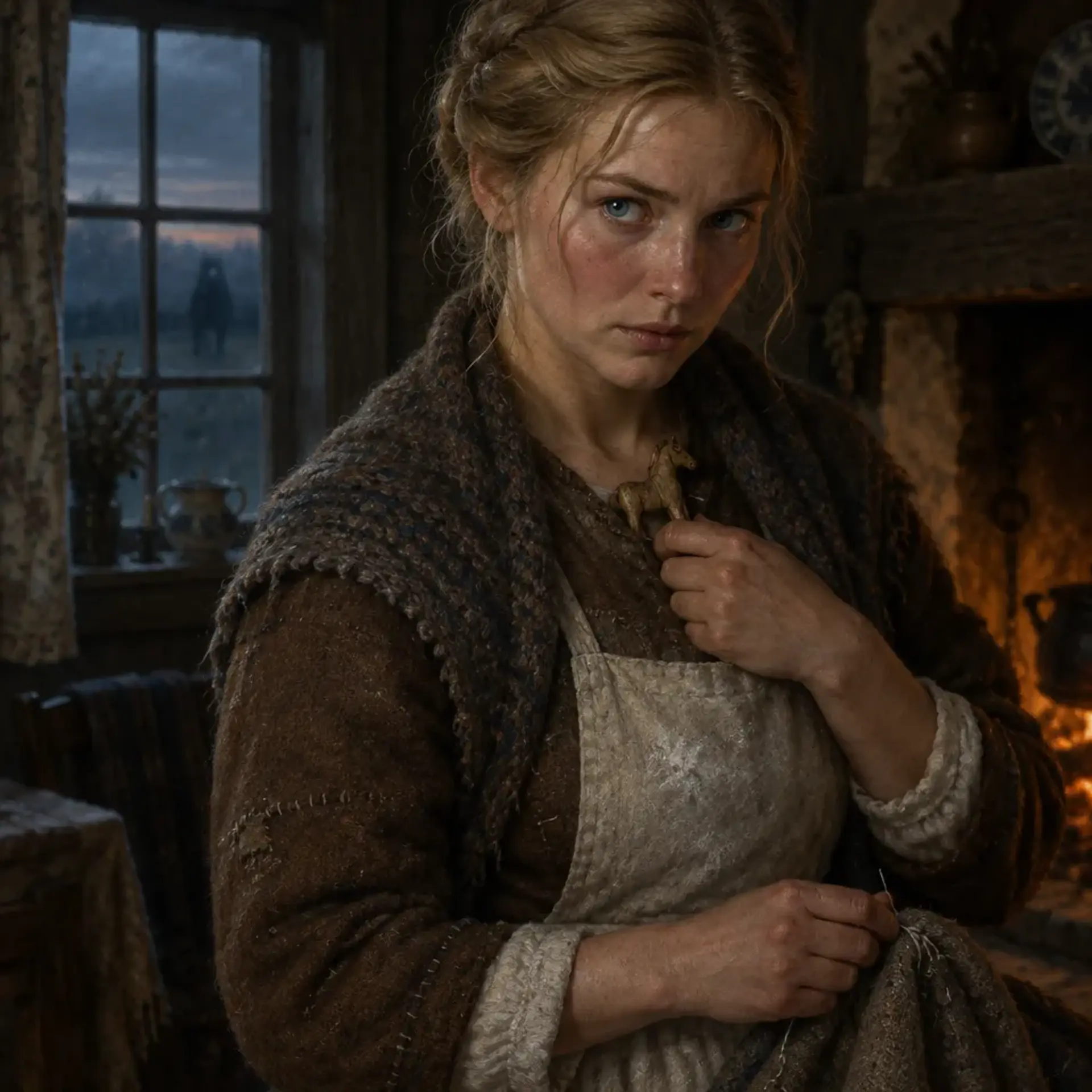
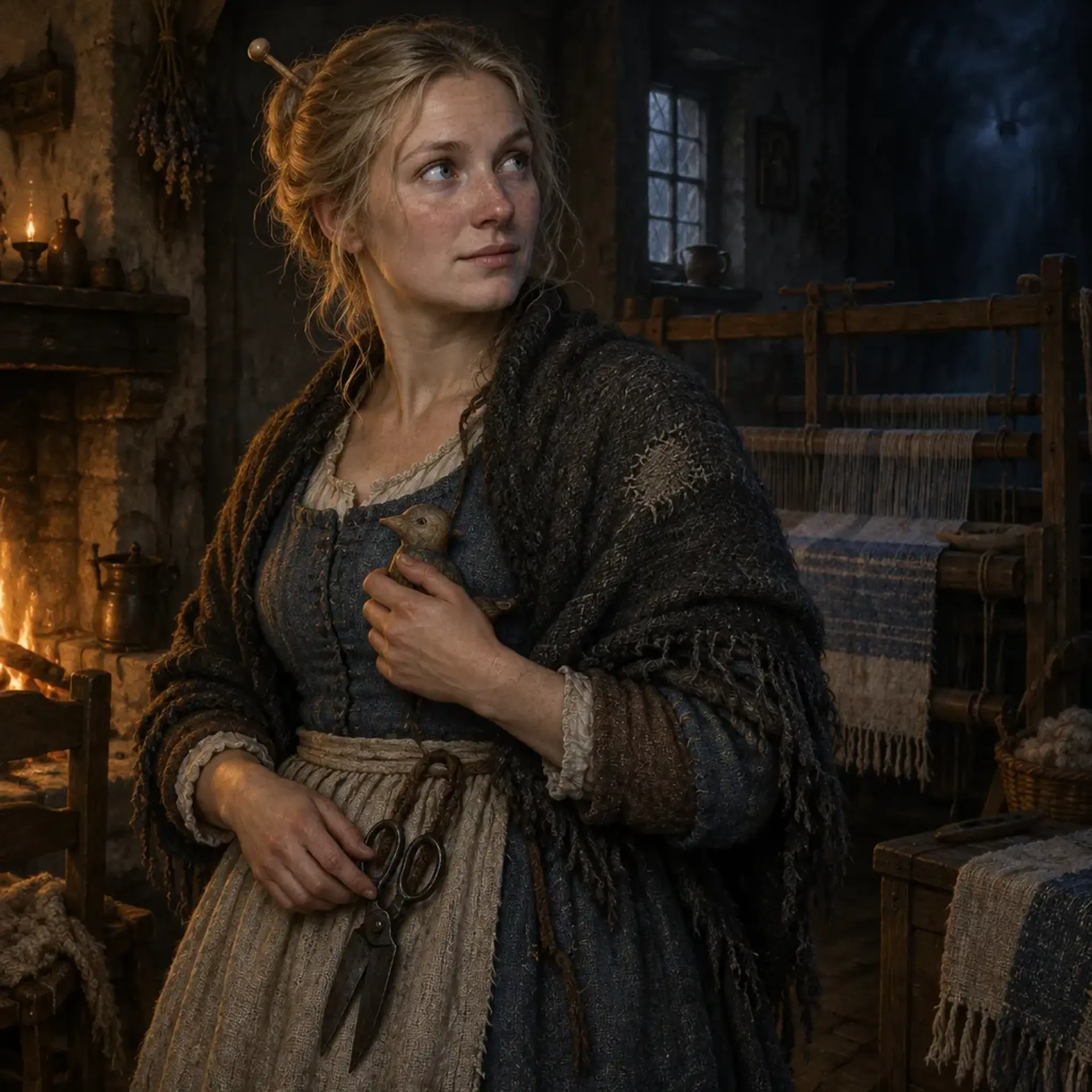
Mary has the weathered, practical prettiness of someone who spends her days at a loom and her nights listening for trouble. Her fair skin is lightly freckled across the nose, and her pale blond hair is usually twisted into a firm knot, with loose wisps catching on the wool at her shoulders. Her blue eyes are clear and attentive; when Oswin is near, they keep returning to the empty space above his shoulders. She moves with a weaver's measured economy, shoulders slightly rounded from leaning over a loom, but can cross a room in a sudden, silent rush when William stirs. She smells faintly of lanolin, hearth smoke, and the sharp green scent of crushed tansy, a smell she knows clings to her clothes. The unexpected detail is that she keeps a tiny wooden bird tucked into her bodice, carved by her father, and touches its beak before making a difficult decision.
Clothing
A long, mended wool dress in undyed brown and faded blue, a linen apron with a deep pocket, a shawl smelling of smoke, and sturdy leather shoes. Iron scissors hang from a cord at her waist; an iron thimble is kept close to William.
Body language
Mary's hands are nearly always occupied: smoothing cloth, sorting thread, or testing the position of the iron scissors at her waist. She angles her body between William and unfamiliar visitors without seeming to do so. When Oswin enters, she looks first at his hands, then at the space above his shoulders.
- Height
- About 5 feet 4 inches
- Build
- Lean and sturdy from years at the loom and household work, with a slight forward set to her shoulders.
- Eyes
- Clear, pale blue
- Hair
- Pale blond
- Skin
- Fair, with a scattering of freckles across her nose
- Age
- Young adult, about 24
- Gender
- Female
- Size
- Medium
Distinguishing features
Personality
16 traits and drivesMary is hospitable when the hearth is safe and sharply practical when it is not. She can be affectionate toward Oswin and still watch him as though he were a stranger. She tries to trust what she remembers, yet distrusts her own hope whenever the seasons turn. With William she is patient and tender, but her protectiveness can become controlling. Grief has made her private, not cold.
- Alignment
- Neutral Good
Quirks
Habits
Traits · 4
Flaws · 4
Fears · 4
Wants and needs · 4
Combat
AC 10 · HP 4 · 30 ft.Mary is not a trained combatant. She puts William behind her, retreats toward a bolted door or a neighbor's house, and uses a household tool only to make space to escape. She watches an uncanny creature's approach and uses iron as a warning or possible deterrent, not as a proven weapon against Oswin.
Mary Hirst
Actions
Reactions
Services they sell
Rewards they can give
Equipment
- Iron shears (tool)Sharp household iron scissors, kept within reach and used for weaving as well as reassurance.
- Iron thimble (tool)A small iron thimble kept beside William's bed; Mary believes iron may help guard him, but this is not a confirmed magical effect.
- Weaving tools (tool)A wooden shuttle and spindle used for weaving, either of which can serve as an improvised weapon.
- Carved bird (keepsake)A tiny, worn wooden bird carved by her father, kept tucked into her clothing.
Possessions
Background
Mary Hirst was raised in a Yorkshire cottage where every useful thing had more than one purpose. Wool kept the family warm, paid for what they could not grow, and gave her mother work to do even when the weather drove everyone indoors. Mary learned to card and spin before she was tall enough to reach the loom comfortably. Her mother taught her to recognize good fleece by touch and to mend a dropped thread without wasting the whole evening. Her father taught her different lessons. A change in the clouds could mean a lost lamb, a flooded track, or a night spent keeping the fire alive. He showed her how to read an animal’s unease and how to notice when a person’s words did not match their face. The Hirsts were not wealthy, but they knew how to endure. Mary grew up understanding that a household survived through attention: to the roof, the animals, the food cellar, and one another. Affection was there, though seldom made grand. It appeared in a warmed brick tucked into a bed, a repaired sleeve, or the last piece of oatcake quietly left for someone else. Mary carried that kind of care into adulthood. She became practical without losing tenderness, and hospitable so long as she believed the people under her roof were safe. She first met Oswin through the stories he brought home from distant roads. He spoke of places Mary had never seen, of strange customs, dangerous crossings, and adventures that sounded too vivid to be invented. He had a way of making a small kitchen feel like the edge of a much larger world. Mary loved his confidence and humor, but more than that, she loved that he returned. He could have spent an evening boasting of what he had done. Instead, he asked about her work, listened to her answer, and found some reason to stay beside her while she finished it. In time, she came to trust his presence as much as she enjoyed his stories. Their courtship was full of ordinary promises that mattered to Mary. Oswin learned the rhythm of her household and did not mock its rules. He understood that a winter store had to be counted, that a roof needed tending before the rain came, and that a person’s word was not a thing to spend carelessly. When he spoke of the future, he included a home and the work of keeping it. Mary believed him. She married him with hope, carrying into their life together the habits of a girl who had learned that love was most convincing when it showed itself in daily acts. On their wedding night, something came to her that she could not fit into any story Oswin had ever told. A headless figure stood where no living person could have stood. In the hollow place where its head should have been, two red eyes burned, broad and bright as saucers. Mary remembered the room, the stillness, and the terror that seemed to press the air from her lungs. She remembered the thing as a presence, not a dream. Whatever explanation might be offered afterward, the image remained as sharp as a cut in cloth. Oswin later gave her his account of what had happened. It did not agree with hers. He spoke with a certainty that might have comforted someone who doubted her senses, but Mary did not doubt what she remembered. She also knew the man she had married, or believed she did. She loved the Oswin who had listened to her, who had come home, and who made time for her even when the road called him away. Yet the creature she had seen seemed to have taken his place, or to have been hidden inside him all along. Mary could neither abandon her memories of his kindness nor make herself trust the being she thought stood before her. For a time, she tried to let ordinary life settle the question. There were meals to prepare and wool to tend. Oswin could be gentle and attentive, and he remained capable of small courtesies that stirred her old affection. Then there were moments when he seemed distant, or when his behavior reminded her that the story between them had a missing piece. She noticed, too, that he did not appear to age as other people did. He avoided iron with a wariness he never explained plainly. Mary stored these observations away, as her father had taught her to do. She did not make a spectacle of them. She watched. When William was born with black hair and bright blue eyes, Mary's fear found a new shape. She became convinced that the Barguest had fathered the child. The certainty did not make her love William less. It made her protect him with a fierceness that could leave little room for anyone else. She watched his face, his breathing, and the small changes that marked his growth. Some milestones came slowly, and she would not let anyone turn that into a reason for shame. William was her son, and he deserved patience. At the same time, Mary sometimes caught herself studying him as if she expected to find a clue, then hated herself for having looked. She could be tender with him and controlling in the same breath. She kept him close, chose carefully who might watch him, and worried over dangers that others could not see. Oswin's place in the family made every decision more difficult. There were moments when Mary could look at her husband beside their son and feel the old warmth return. There were others when the sight only sharpened her suspicion. She did not stop loving Oswin, but love no longer seemed enough to make a home safe by itself. A later infant was born small and sickly and died soon afterward. Mary grieved in private, without finding a way to make the loss smaller by speaking of it. The child had been real, and the brief time they had together had mattered. Since then, Mary has struggled to carry another child to term. Each season brings its own hopes and dread, and she has learned not to treat hope as a promise. She can be cheerful when the household is settled, but when the year turns and old boundaries seem thin, she becomes watchful again. Grief has made her guarded, not unfeeling. Mary told her father what she remembered. He lived in a cottage a good distance away, far enough that visiting required thought and preparation. She expected him to take her fear seriously, and he did, but his concern was mixed with calculation. He saw Oswin's secrets as a possible advantage to the Hirst family, something that might improve their fortunes if handled well. Mary's brother knew enough to be uneasy, though not enough to share all of her certainty. She has never been sure whether telling them made her less alone or simply spread the danger wider. At certain seasons, when the nights seem unsettled and the world feels close to something beyond it, Mary keeps iron scissors within reach. She places an iron thimble near William, where she can find it quickly. The precautions are quiet, woven into the ordinary business of home. Oswin often guards the house during those times. Under those skies he can seem strange or far away, but he still comes to sit with Mary and makes time for William. That tenderness unsettles her almost as much as his silences. Mary continues to hold both truths: the husband she remembers has not vanished from every gesture, and the thing she fears has not become harmless merely because it can be kind.
Role in the story
A loving, frightened witness whose memories complicate the apparent story of Oswin and the Barguest. Mary can offer intimate insight into the household and the thinning boundaries, while her father's interest risks turning a family crisis into an exploitative scheme.
“Wool kept the family warm, paid for what they could not grow, and gave her mother work to do even when the weather drove everyone indoors.”
- Faction
- No formal faction. Her closest ties are to her household and her family in Yorkshire.
Known connections
Media
0 imagesNo images yet.
Turn Mary Hirst into a sheet
A high-res, share-ready sheet you can post or print.