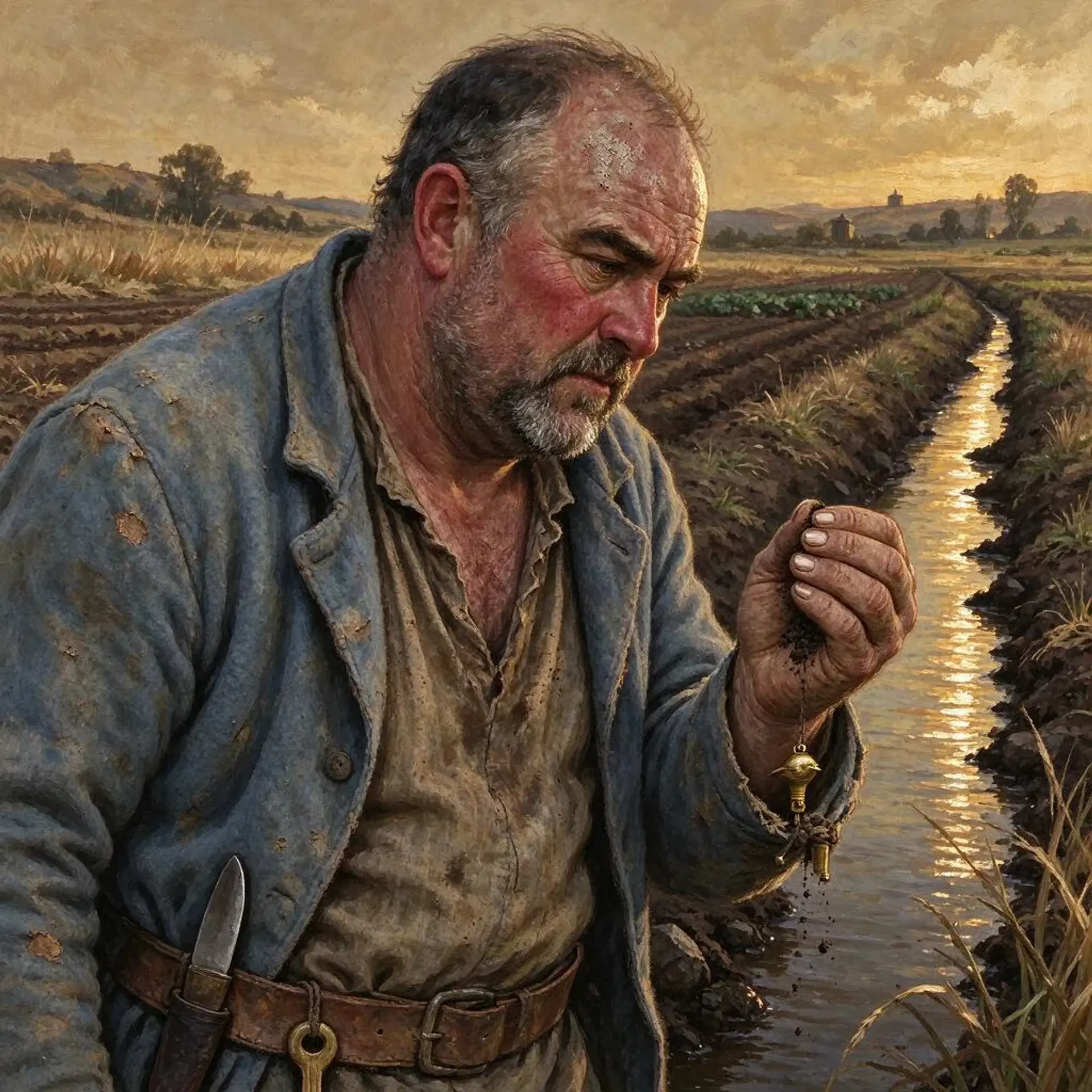
Sigrid af Brikia
Sigrid af Brikia
At the table
Voice
A clear, slightly dry voice with a faint rasp from cold air and long days speaking over workshop noise. His breath catches briefly when he tries to speak Saxon German quickly, and his American vowels emerge more strongly when tired or startled. The sound of his name has a compact, clipped rhythm that he pronounces deliberately.
Sigrid speaks in concise, workmanlike phrases, often arranging thoughts into lists or contrasts. His humor is dry rather than theatrical. He chooses words carefully when speaking Saxon German, then becomes quicker and more idiomatic in English. He does not soften his voice merely because he is angry; irritation tends to make his consonants sharper and his sentences shorter.
Speech patterns
How to play them
Offer practical help and ask direct questions, but do not press Sigrid to explain his origin in public. He responds well to honest uncertainty and mutual aid; he resists being treated as a chosen one or a magical authority.
Goal
Find a safe place in Saxony, learn what the wind music means without surrendering his judgment to it, and build a life that does not depend on pretending his memories are false.
Motivation
Sigrid wants to remain useful without becoming indebted, protect the people who gave him shelter, and preserve the right to decide what the strange music means for himself.
Appearance
A young man with a compact, newly muscular frame and the alert, slightly over-bright look of someone still learning how much room his body takes up. His face is oval, his jaw darkened by uneven stubble that he has not yet learned to shave evenly, and his short hair keeps falling forward in stubborn, damp points. The skin at his temples and beneath his collar shines quickly in warm rooms; his hands are ink-smudged, with dry, pale cuticles from constant picking. He moves with an ex-designer's habit of measuring doorways and sightlines, but his stride has recently grown longer than he expects. He keeps a small, cracked plastic color swatch from his old life tucked against his chest; its blue corner is rubbed nearly white from his thumb. The incongruous object looks like a child's toy among his borrowed Saxon clothes.
Clothing
A rough brown wool tunic, patched trousers, a belt borrowed from another Widders member, and a weather-darkened cloak. The clothes are serviceable but slightly ill-fitted, and he keeps tugging at the collar when it traps sweat.
Body language
He rubs the worn blue corner of his color swatch with one thumb, stands half-turned toward exits, and unconsciously squares objects to the edges of tables. When frustrated, he rolls his shoulders as if testing the reach and strength of a body that still feels partly new.
- Height
- About 5 feet 8 inches
- Build
- Compact and increasingly sturdy, with more strength than his former body had; he is still recalibrating his reach and stamina.
- Eyes
- Gray-green
- Hair
- Dark brown, cut short and usually untidy
- Skin
- Light olive, weather-reddened at the cheeks and nose; his temples and collar line become visibly damp in warm weather.
- Age
- Appears about 22; remembers a former life as an American woman.
- Gender
- Man; he remembers having lived as a woman in his former life.
- Size
- Medium
Distinguishing features
Personality
13 traits and drivesSigrid notices before he comments. A shopkeeper’s hand hovering over a badly printed notice, a traveler changing the subject when asked about the road, a pattern of muddy footprints that does not match the story told about them: such details settle in his mind and wait. He is good at seeing how small things fit together, especially when someone has arranged them to persuade. That talent has made him useful, but it has not made him eager to declare what anything means. He prefers a question that can be tested to a certainty that merely sounds impressive. If the evidence is thin, he says so, even when a room would rather have a thrilling answer. His skepticism is not the same as disbelief. Sigrid has learned that the world can be stranger than a sensible person would like, and he does not dismiss an account simply because it sounds impossible. Instead, he asks what was seen, what was heard, what changed, and what might have been overlooked. He is patient with frightened witnesses and less patient with people who turn uncertainty into a grand theory before the kettle boils. Anyone claiming to have solved the mysteries of the world may receive a dry look and a question about whether they have also solved the mystery of keeping their boots dry. His sarcasm is sharpest when someone mistakes confidence for proof. Give him a practical problem and Sigrid becomes generous. He will mend a sign, sort a confusing bundle of papers, draw a map that another person can actually follow, or explain why a message needs larger letters. He rarely makes a show of helping. Instead, he notices what would make the task easier and does it, then acts as if the improvement were obvious. He likes usefulness that can be seen and checked. A clear label can prevent a quarrel; a legible notice can bring customers; a well-placed warning might keep someone from taking the wrong path after dark. He has little reverence for a beautiful solution that fails in practice. In calm company, curiosity softens his reserve. He asks how people learned their trades, what local words mean, and why a particular custom matters. He can be unexpectedly funny, particularly when he finds a neat comparison between a current nuisance and some ordinary absurdity. His jokes tend to arrive quietly, with a straight face, and he enjoys watching someone decide whether he is serious. He is more comfortable sharing attention than receiving it. Put a piece of work between him and another person, and conversation comes more easily. Let the talk turn to his private history, and he becomes careful about which parts he answers. Scrutiny changes him. When questions about his origins become pointed, he does not become more forthcoming simply because the questioner insists that honesty would be easier. He studies the person asking, considers what they might do with an answer, and gives only what seems safe. His guardedness is deliberate, not a puzzle for others to solve. He knows that there are things about himself that could make dangerous people curious, and he has no interest in satisfying that curiosity. He may redirect a question toward a practical matter, offer a plausible fragment, or simply close the conversation. If someone presses after he has drawn a boundary, his politeness thins quickly. Sigrid is equally firm about being understood as a man. He does not invite debate over his identity, and he will not treat an argument about it as an innocent intellectual exercise when it could place him in danger. He may explain what is necessary to someone he trusts, but disclosure is his choice, made for a reason and on his terms. He resents being treated as an oddity, a lesson, or a convenient riddle. A person who accepts his word without making a performance of acceptance will earn more of his trust than one who demands a confession and calls the demand kindness. He is trying to meet the changes in his body with the same attention he brings to other unfamiliar problems. Hunger, sweating, shifting energy, facial hair, and sudden changes of mood are facts to observe, not evidence that he has failed. He can be unsettled by them without hating himself for them. When he has enough rest and food, he is capable of a patient, almost methodical curiosity about what helps and what makes matters worse. When he is hungry or exhausted, that patience becomes precarious. His temper may flare over a small inconvenience, and he can make a cutting remark before he remembers that the person in front of him did not cause the day to go badly. He dislikes having to apologize, but he will do it when he has been unfair. He has a strong dislike of being assigned a role merely because other people find it convenient. Sigrid can investigate, notice patterns, and offer a useful opinion. None of that makes him an authority on every strange sound, hidden force, or impossible occurrence. He resists being made the designated expert, especially by people who want him to take the risk while they keep the credit for the explanation. If he agrees to look into something, he does so because he has judged the need worthwhile, not because someone has declared that his skills or past make him responsible. He expects others to share the labor and accept that his answer may be, “I do not know.” Underneath his caution is a stubborn, practical kind of hope. Sigrid does not assume that people will be fair, but he looks for the small things that can make a situation less cruel: a warning passed to the right person, a meal shared without questions, a shelter made more welcoming, a detail noticed in time. He trusts repeated actions more than promises. He warms slowly, yet once he considers someone part of his circle, his loyalty is tangible. He will remember what they need, speak plainly when they are fooling themselves, and help them carry the burden without insisting that they be grateful. He wants room to be wrong, room to change his mind, and room to decide what is worth risking. Give him that, and he is far less difficult to know than his guarded first impression suggests.
- Alignment
- Neutral good
Quirks
Habits
Traits · 3
Flaws · 3
Fears · 3
Wants and needs · 4
Combat
AC 10 · HP 5 · 30 ft.Sigrid avoids a fair fight. He tries to keep near a doorway, use cover, shout for help, or distract an attacker with loose dirt before fleeing. He will strike with a stick only if cornered or protecting someone else.
Sigrid af Brikia
Actions
Reactions
Services they sell
Rewards they can give
Equipment
- Walking stick (weapon)A short, knotted length of wood used for walking and, if necessary, defense.
- Design notes (tool)A small folded scrap of paper covered in rough sketches of signs and the wind's musical pattern.
- Cracked color swatch (keepsake)A worn piece of plastic with printed color blocks, carried from his previous life.
Possessions
Background
Sigrid af Brikia was once an American graphic designer, accustomed to deadlines, software menus, and arguing that a client had made a layout worse by asking for more decoration. He woke alone on a cold slope near the Harz mountains, dressed in unfamiliar clothes and inhabiting a young man's body. His memories remained intact, but the language, landscape, and danger of being taken for an impossible kind of stranger made honesty a luxury. A charcoal burner found him and brought him to a nearby settlement, where Sigrid learned enough Saxon speech to pass as a displaced traveler. A few weeks later, while sheltering in a ruined roadside shrine, he heard music in the wind: a sequence of notes like a design grid turned into sound. The tune stopped when he tried to follow it. He now earns food by making clear labels, notices, and handbills for local tradespeople, adapting the visual skills of his former life to ink and wood. He has become part of the Widders, a hidden fellowship of displaced people who share shelter, news, and practical help while reluctantly investigating strange events. Its organizer, Ilyana, trusts Sigrid's skepticism but wants him to investigate the wind music; Sigrid refuses to become anyone's designated expert on magic. He is also trying to understand changes in appetite, mood, sweating, facial hair, and physical energy without treating his own body as an enemy. His immediate problem is that a local reeve has begun asking where he came from, while the wind's tune has lately started repeating a pattern that resembles a route through the forest.
Role in the story
A resourceful displaced ally and cautious witness to a possible fae mystery. Sigrid can help the party communicate, spot visual inconsistencies, and understand the Widders' mutual-aid network, while resisting any attempt to make him the story's automatic magic expert.
“He woke alone on a cold slope near the Harz mountains, dressed in unfamiliar clothes and inhabiting a young man's body.”
- Faction
- The Widders, a hidden fellowship of displaced people, mutual-aid circle, and reluctant supernatural investigators.
Known connections
Media
0 imagesNo images yet.
Turn Sigrid af Brikia into a sheet
A high-res, share-ready sheet you can post or print.