Jānis
Jānis
At the table
Voice
A dry, slightly rough voice with the faint rasp of cold air and long days outdoors. Before speaking, Jānis takes a small breath through his nose; when he is comfortable, his laugh catches briefly on his crowded teeth. Anger makes his words more clipped and exact, not softer.
His Latvian carries the crisp, practical cadence of someone used to giving directions over wind and road noise. He separates thoughts with small pauses, as if checking each sentence for accuracy before speaking it. His work has given him a habit of naming materials and actions plainly. When tired, his consonants soften and he leaves more of his thoughts unfinished.
Speech patterns
How to play them
Begin with practical kindness rather than questions. Jānis is patient and empathetic, but his trust develops through repeated, consistent behavior. If asked about the change, he will answer honestly when the question is respectful, though he may not have a clear explanation.
Goal
Find the scattered former members of the Seven Stitches and learn whether the changes and dreams have a common cause, without turning their survival circle into a public target.
Motivation
To make a life in the present without denying the girl he remembers, and to keep the people who once sheltered him from being isolated or endangered.
Appearance
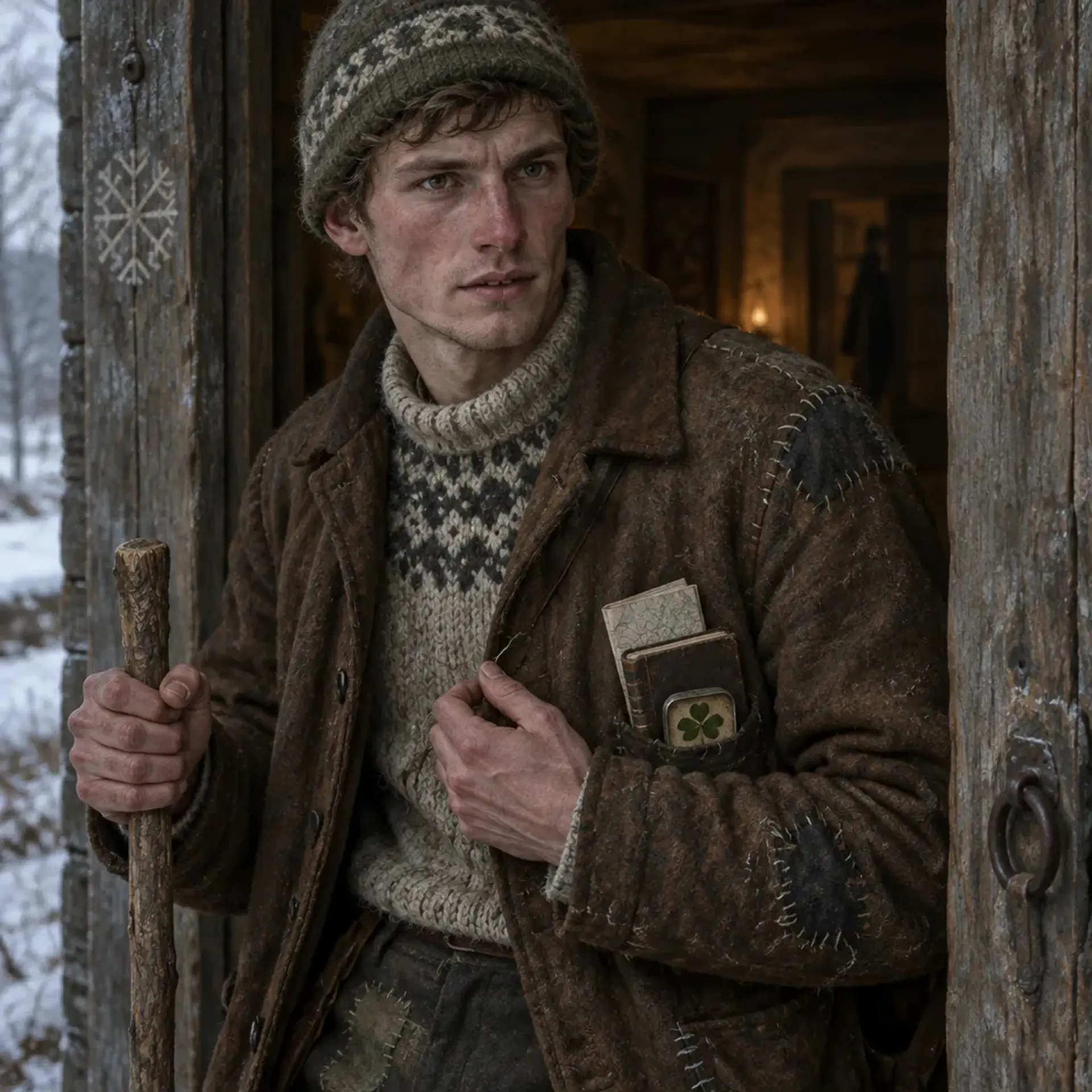
Jānis has a narrow, watchful face and a habit of pausing just before he enters a room, as if listening for the room to answer. His jaw is broad at the hinges, with slightly crowded front teeth that show when he laughs; he chews slowly and carefully, as though testing each bite. His movements are economical but not timid, and he turns his whole body toward whoever is speaking. People often remember the small breath he takes through his nose before answering.
Clothing
A weatherproof brown jacket over a thick wool sweater, patched trousers, sturdy boots, and a knitted cap he keeps pulling down over his ears. His clothes are clean but repeatedly repaired, with stitches in contrasting thread where he has mended them himself.
Body language
He pauses at thresholds, draws a measured breath through his nose, and lets his eyes travel over a room before stepping in. When listening, he angles his head slightly and keeps his hands occupied with a strap, cup, or loose thread. If frightened, his jaw tightens and his crowded teeth press together; if relieved, he laughs with his whole face.
- Height
- About 5 feet 8 inches (173 cm)
- Build
- Lean and sturdy from walking and carrying supplies, with a slight forward set to his shoulders from years of practical work.
- Eyes
- Grey-green
- Hair
- Ash-brown
- Skin
- Fair, weather-reddened across the nose and cheeks in cold weather
- Age
- Twenty-four
- Gender
- Man; he remembers having been a girl before the change
- Size
- Medium
Distinguishing features
Personality
13 traits and drivesJānis is patient and attentive, often noticing what others need before they ask, yet he distrusts sudden intimacy and keeps part of himself guarded. In calm company he can be quietly funny; under pressure he becomes precise and practical, sometimes to the point of seeming cold. He wants people to accept the young man they see, but resists being told that his past self no longer matters.
- Alignment
- Neutral good
Quirks
Habits
Traits · 3
Flaws · 3
Fears · 3
Wants and needs · 4
Combat
AC 12 · HP 7 · 30 ft.Jānis avoids fights and tries to put a barrier, a door, or another escape route between himself and an attacker. If cornered, he uses his walking stick to create space, then retreats toward cover. He will use the rifle only to stop an immediate threat, not to pursue someone.
Jānis
Actions
Reactions
Services they sell
Rewards they can give
Equipment
- Walking stick (weapon)A plain, well-used stick that serves as a walking aid and an improvised weapon.
- Hunting rifle (weapon)An old hunting rifle maintained carefully, with a small supply of ammunition.
- First-aid pouch (supplies)A compact first-aid pouch with gauze, tape, antiseptic, and painkillers.
Possessions
Background
Jānis learned early that most things announced their trouble before they broke. A kettle began to sing unevenly. A hinge sagged a fraction before it tore loose. The sky over his small Latvian town could turn the color of pewter hours before snow, if you knew which clouds to watch. His grandmother taught him to mend tools and his father taught him to keep a dry place for kindling. No one taught him how to speak about fear, so he learned to put it away and make himself useful instead. For a long time, the memories of being a girl were simply the memories he had. They belonged to the child he had been, vivid in places and blurred in others: the scratch of a wool collar, a particular path beside the river, the embarrassment of being praised for something he had not meant to do. He did not think of those recollections as a separate life. They were his, even when he could not quite reach the feelings attached to them. Later, when people began calling him a young man and his body changed around that name, the old memories did not vanish. They became more like rooms in a house he had once lived in, familiar to walk through but not always easy to inhabit. The dreams began before anything else. In them, Jānis crossed a house with seven doors. Each door was different: one painted blue and swollen with damp, one with a brass latch warm as skin, one so narrow he had to turn sideways to pass. The rooms beyond them shifted from dream to dream. Sometimes they held ordinary things, a cracked cup, a spool of thread, a chair with one short leg. Sometimes they were empty except for the feeling that someone had just left. He woke with the sense that he had been given a task, though he could never remember what it was. Then came the instincts. He would turn down a lane before hearing a cart approach, or refuse to step onto a bridge that looked sound to everyone else. Once, in the middle of a summer afternoon, he moved away from a doorway seconds before a stack of firewood spilled across the threshold. These moments unsettled him more than the dreams. They seemed to come from a part of him that had made its decision before the rest of him knew there was a choice. He tried to explain them as habit, good observation, or luck. The explanations were sometimes true, which made them harder to dismiss. The change itself was gradual. His voice roughened over months. His shoulders broadened. His clothes stopped fitting in familiar ways. People adjusted to him before he understood that there was anything to adjust to. Some called him Jānis as if they had always done so. Others hesitated, then followed their lead. He accepted the name because it fit the life taking shape around him, not because it erased the child whose memories remained. He wanted people to see the young man he was becoming. He also wanted them to understand that this did not make his past a mistake or a story that could be neatly closed. The Seven Stitches found him when he had become too tired to keep pretending that nothing unusual was happening. They were seven displaced people who had learned to recognize need without demanding a confession. They were not an order, and they had no public name or political purpose. They passed news quietly, shared whatever shelter they could find, and taught one another the small skills that made survival less lonely. One knew how to stretch a meal. Another could set a broken finger. Someone else had a gift for finding a dry roof in a town where every inn was full. Their rule was plain: no one had to explain their past before receiving help. Jānis found that the rule left him with nowhere to hide and, for once, did not make him want to run. The others did not ask him to choose which memories counted. They let him speak of them when he wished and sit silent when he did not. In return, he repaired buckles, sharpened knives, checked the weather, and noticed when someone was trying to carry too much alone. He was the last among them to undergo the change they had all come to understand in their own ways. By then, they had learned not to treat a person’s new life as proof that the old one had ceased to matter. Salla was the one who most often sat beside him without trying to fill the silence. During a winter evacuation, Jānis dreamed again of the house with seven doors. In the dream, snow pressed against the windows, and he heard a deep crack from somewhere overhead. He woke certain that a roof he knew would collapse. The certainty frightened him, but so did the possibility of being wrong. He had no clear way to explain what he had seen, and the group was already hurrying through bitter weather. He kept the warning to himself. The roof came down. Salla was injured in the collapse, badly enough to need weeks of care and to carry pain long afterward. Jānis helped tend her, found what supplies he could, and stayed close through the slow work of recovery. She never demanded that he punish himself on her behalf. That did not stop him. He has never forgiven himself for choosing silence, though he knows that guilt is not the same as making amends. He checks on Salla whenever he can, paying attention to the ordinary needs she might not mention: a repaired strap, a warm meal, a path cleared of ice. He is careful not to mistake care for permission to decide what she needs. When the Seven Stitches dissolved, it was not because they had stopped caring for one another. They scattered as circumstances changed, carrying their skills and their private griefs into different corners of the world. Jānis has tried to find them, following scraps of rumor and asking questions without making their old circle sound larger or more formal than it was. He does not know whether all of them want to be found. He keeps looking anyway, partly from loyalty and partly because he has never been good at leaving a task unfinished. Recently, the dreams have returned with a detail that was never there before. The house still has seven doorways, but one stands open. He cannot see what lies beyond it. Since then, his instincts have grown sharper and less easy to dismiss. They turn him away from certain roads, make him pause before entering unfamiliar rooms, and sometimes pull him toward people he has no reason to seek out. Jānis is trying to be practical about it. He writes down what he remembers, checks the weather, and does not confuse a warning with an explanation. Still, each night he wonders who opened the door, and whether the dream is asking him to go through it or simply telling him that someone already has.
Role in the story
A grounded, compassionate witness to a strange transformation and a possible guide to the scattered survivors of the Seven Stitches. His instincts may provide warnings, but never a complete solution.
“The sky over his small Latvian town could turn the color of pewter hours before snow, if you knew which clouds to watch.”
- Faction
- Formerly part of the Seven Stitches, a clandestine survival circle of seven displaced people. The circle is no longer active as a group and was never a public order or recognized political body.
Known connections
Media
0 imagesNo images yet.
Turn Jānis into a sheet
A high-res, share-ready sheet you can post or print.