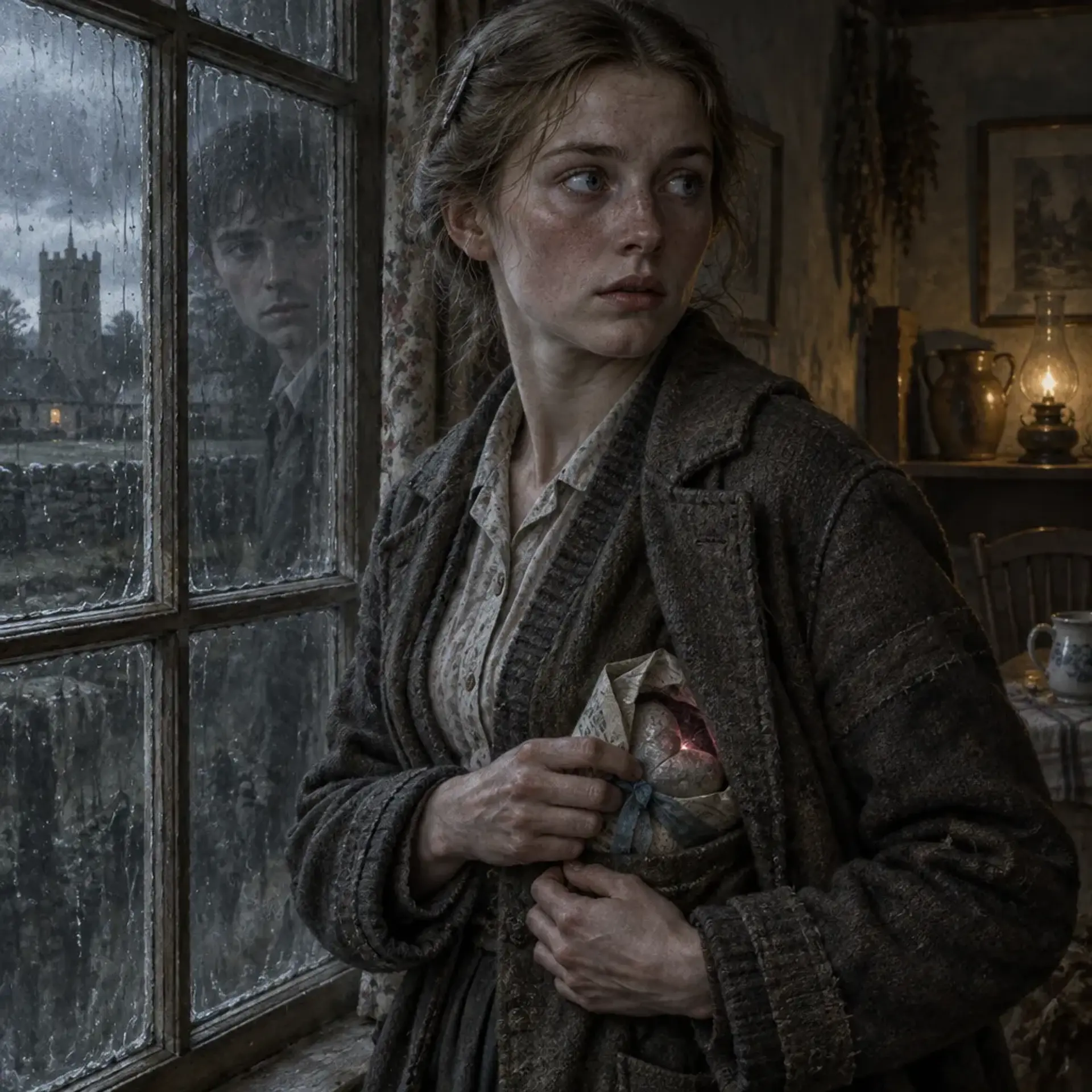
Mary Bell
Mary Bell
At the table
Voice
Her voice has a dry, slightly rasped edge from cold mornings, house dust, and calling children in from other rooms. She speaks with a Wiltshire rural cadence softened by proximity to London family and work, without performing a strong dialect. In the rare moments she is at ease, her words come quicker and she lets a small laugh escape before she can stop it. The borrowed young man's voice has a clearer, more effortless resonance that Mary does not recognize as her own.
Mary speaks in the practical rhythms of someone used to being interrupted by work. She favors concrete nouns and direct questions, often answers an emotional question with a useful detail, and has a dry, unsentimental wit when she is comfortable. Her vocabulary is ordinary and local; she avoids occult language because she has no framework for what is happening. When frightened, she becomes more specific rather than more dramatic, listing exactly what moved, when it happened, and who was in the house.
Speech patterns
How to play them
Approach Mary through practical help rather than demands for confession. Offer to mind a child, carry a load, or take a shift, then be honest about what you have noticed. She tests whether a visitor is safe by watching how they treat her siblings. Pressing her for the heart before establishing trust makes her hide it; threatening the children makes her desperate and potentially receptive to its power.
Goal
Protect her siblings from the heart's influence, discover what the reflection does at night, and find a way to give Matilda a life beyond unpaid family labor.
Motivation
Love expressed as labor: Mary wants the children to be safe, fed, and spared the duties that swallowed her youth, even when she cannot imagine what her own life would look like without those duties.
Appearance
Mary is a young woman with dark-blond hair usually pinned back with a practical, crooked grip, and blue-grey eyes that look more watchful than her tired face suggests. Her skin is pale and freckled across the bridge of her nose. She has a compact, work-strengthened build, with a slight forward stoop from carrying baskets and bending over chores. She walks quickly, favoring the left side when burdened, and stops with abrupt stillness when she hears a sound in the house. A small stone heart wrapped in a square of newspaper is nearly always tucked into her coat pocket; the paper has worn away at one corner where her thumb worries it smooth. She dresses for errands and work, not effect, but keeps a blue ribbon from her eighteenth birthday threaded through the wrapping as if it were a charm. The unexpected detail is that she collects pressed leaves and keeps them carefully arranged inside a battered household manual, despite rarely having time to read it. People remember the contrast between her brisk, competent hands and the way she will pause to watch rain run down a window as if it has said something.
Clothing
Practical skirts, blouses, a worn cardigan, sensible shoes, and an old coat with a deep inner pocket. Her clothes are mended rather than fashionable. A faded blue birthday ribbon is tucked around the newspaper-wrapped heart.
Body language
She is brisk and purposeful while working, often turning her shoulder to protect whatever she carries. When anxious, she rubs the frayed corner of the heart's newspaper wrapping through her pocket. When someone offers genuine kindness, her first response is to look for what they need in return.
- Height
- Approximately 5 feet 4 inches
- Build
- Compact, wiry, and made stronger by years of carrying water, laundry, and groceries.
- Eyes
- Blue-grey
- Hair
- Dark blond
- Skin
- Pale, with a scatter of light freckles
- Age
- 18
- Gender
- Female
- Size
- Medium
Distinguishing features
Personality
17 traits and drivesMary is practical enough to distrust miracles and compassionate enough to keep a miracle if she thinks it might help her family. She can be patient with a frightened child and abruptly impatient with an adult who makes promises without doing a task. Her kindness is not softness: when someone tries to use Matilda as unpaid labor, Mary becomes blunt, watchful, and difficult to move. Yet she is naive about the scale of the danger around the heart and has a stubborn habit of calling frightening things manageable until they become impossible to ignore. At home she is brisk and quietly protective; at work she is reliable and sparing with personal details; alone, she lets herself stare at the heart and wonder what it wants. When exhausted, she can sound almost cold, then make amends through food or a mended sleeve rather than an apology. She longs for someone else to take responsibility but mistrusts help that arrives without a cost. Her deepest contradiction is that she wants her siblings to escape the life she has accepted, while believing that she herself has no right to leave them.
- Alignment
- Not applicable as a canonical Secret Histories statistic; morally compassionate, but increasingly willing to conceal the truth to protect her siblings.
Quirks
Habits
Traits · 5
Flaws · 4
Fears · 4
Wants and needs · 4
Combat
HP 3 · Ordinary walking and running pace; no canonical movement statistic supplied.Mary is not a trained fighter. She tries to get between danger and a child, use a doorway or heavy object as a barrier, and flee with whoever cannot run. If cornered, she uses whatever tool is at hand. The borrowed face and chalk laborers can complicate a confrontation, but neither is a dependable weapon. Statistics and actions here are custom, not canonical Secret Histories combat rules.
Mary Bell
Actions
Reactions
Services they sell
Rewards they can give
Equipment
- The Heart of England (custom supernatural object)A Dover-chalk-like stone carved into a human heart shape, barnacled and sea-grass threaded, now showing a red-pink glow beneath its rock surface when active. Its alleged history is disputed.
- Work coat (clothing)A practical coat with a deep inner pocket, repeatedly mended at the seam.
- Kitchen knife (tool)A small household knife used for food and string, not carried as a weapon by choice.
- Household manual (personal)A battered household manual holding pressed leaves and scraps of paper.
Possessions
Background
Mary Bell was born into a family that treated need as weather: unpleasant, constant, and nobody's responsibility to change. She grew up in an isolated Wiltshire house with parents who could be cruel to one another and careless toward their children. Her father, Simon, took work far from home whenever he could. Her mother, Malinda, drank, drifted between affection and absence, and once gave Mary a small eighteenth-birthday party that Mary remembers less for the cake than for the fact that her mother had stayed awake long enough to be there. Mary is the oldest of eight. Henry, fourteen, has begun to test how much trouble he can cause without being caught; Mary sees the hurt beneath his cunning and resents him for making her watch him become difficult. Matilda, twelve, is her sweetheart and closest ally among the children, always trying to take chores from her. Mary refuses to let their parents turn Matilda into her replacement. Olympia, ten, is Chrissy's closest friend. Chrissy, nine, is Malinda's daughter by an unknown Jamaican father, with tan skin, freckles, and dark wavy hair. Belladonna, five, has black hair and green eyes; the household assumes her father was Simon's coworker Todd, though no one says so plainly. Jonas, five, is Simon's son by another woman, brought home with bright blond hair and vivid blue eyes, a living reminder of Simon's betrayals. Abigail, four, has red hair and green eyes and resembles Simon's grandmother, a resemblance that earns her a warmth Mary rarely sees him give the others. Owen, two, follows Mary with his blanket and finds comfort in her presence. Mary tries to make time for every one of them and never quite succeeds. On her eighteenth birthday Malinda found a strange object in a log and gave it to her. It looked like a piece of Dover cliff carved into the shape of a human heart: barnacled, rough, and threaded with dried sea grass. Mary accepted it because rejecting a gift would have hurt her mother, and because she has always liked stones. The rock had already passed through several hands. An amateur alchemist, Bartholomew Golden, had left it at the Hush House as payment for entry, claiming it was the Heart of England, a living fossil capable of making servants from the shadow of mankind. The Hush House refused him further access to Brancrug. The object was thrown into the sea, washed ashore, and later found by Abraham Groff, who carried it inland to Wiltshire. It beat beneath his coat on the train. Around other people it seemed to die; when returned to seawater it flushed red-pink and woke. Groff eventually sold it to William Windon, a local boy who had once struck it with a hammer and stopped its beating. Mary did not know any of that. At first the heart was simply an odd possession on her bedside table. Then it began to beat in time with her own. Her reflection changed: instead of Mary, she saw a handsome young man with short blond hair, clear blue eyes, and an expression that shifted when she was not looking directly at it. She assumed it was a trick of exhaustion. She had work to find and children to feed; she could not afford to be frightened by a rock. The first change came after a night of fragmented dreams. Mary dreamt of a vast, grey country with doors that opened onto impossible landscapes and people who seemed to remember her before she was born. She woke with salt on her lips and the heart glowing faintly. After that, the dreams returned, bringing images of chalk hollows, submerged rooms, and hands that worked in darkness. She told no one. The house already had enough trouble. One night she woke and found that the reflection was no longer confined to glass. The young man stood in the dim room, wearing her face's borrowed life with unnerving ease. Mary was terrified, then discovered that he could open doors, walk out into the night, and return before dawn. She believed this was a convenient dream or a form of sleepwalking. In truth, the reflection has begun to build a life outside her awareness, using a voice and face drawn from the heart's history. It may be William Windon, an echo of him, or something the stone fashioned from his memory. Mary does not know. The heart's presence is now worsening the house's ordinary strains. Doors move when no one is near them. Footsteps climb stairs after everyone is asleep. There are soft voices from empty rooms, and the youngest children sometimes wake convinced someone has tucked their blankets around them. The chalk-born servants have not yet appeared plainly, but the heart seems to be preparing them. Mary fears that whatever is coming will treat her siblings as household labor to be claimed, as the heart's old story promised. Her present life is divided between shifts, chores, and the effort to keep the family from collapsing. She wants Matilda to have a future that is not merely Mary's life repeated; she wants Owen and Abigail safe; she wants Henry to stop mistaking cruelty for independence. She also wants, secretly and guiltily, one night in which nobody needs her. Her growing bond with the heart may give her power to change the house, but it may also make her the one who supplies the house with its servants. She has started hiding the heart in a flour tin and checking the mirrors before she goes to sleep. Each morning she finds the newspaper wrapping damp with salt.
Role in the story
A grounded, vulnerable point of entry into a domestic supernatural mystery. Mary is neither an occult expert nor a chosen hero; she is a young woman trying to keep a crowded household running while an ancient, poorly understood object begins to answer her heartbeat. Her independent reflection can become a witness, a suspect, or a second protagonist whose motives differ from hers.
“She grew up in an isolated Wiltshire house with parents who could be cruel to one another and careless toward their children.”
- Faction
- None known. The heart's history touches the Hush House and Brancrug, but Mary has no formal connection to either.
Known connections
Media
0 imagesNo images yet.
Turn Mary Bell into a sheet
A high-res, share-ready sheet you can post or print.