Eber
Eber
At the table
Voice
His voice has a dry, slightly rasped edge from years of workshop dust and the strain of adjusting to a changed jaw. It is clear and steady, with consonants placed carefully; certain sounds catch briefly when his jaw is sore. He sounds most at ease while explaining a repair, when the rhythm of his words follows the steps of a task. When speaking with family, a warmer, quicker cadence comes through, especially around children or Ignatz.
Eber speaks in measured sentences, as if he is setting each word into a mechanism and checking that it turns. He often uses practical comparisons and specific details when emotions make direct speech difficult. He does not ramble, but a subject that interests him can draw him into an exact explanation of springs, teeth, tolerances, or bodily changes. His anger is plain and cutting rather than hushed. He uses familiar family expressions and halfling sayings, though his taller, more solitary life has left him with a habit of pausing before joining in communal banter.
Speech patterns
How to play them
Begin with a practical topic: a damaged tool, a needed repair, or a question about what the visitor is building. Give him time to observe before pressing him for intimate details. He responds to straightforward kindness, especially when it is offered without pity. Show respect for his family and he becomes helpful; mock his eating or treat his brothers as beasts and his reserve turns to sharp, unmistakable anger.
Goal
Build practical tools, beds, clothing fittings, and reliable knowledge that let high-blood family members live safely in the village without abandoning the shared life that raised them.
Motivation
To make a place for himself and his brothers without pretending that their bodies, needs, or instincts are ordinary. He hopes practical knowledge can protect them from both fear and exploitation.
Appearance
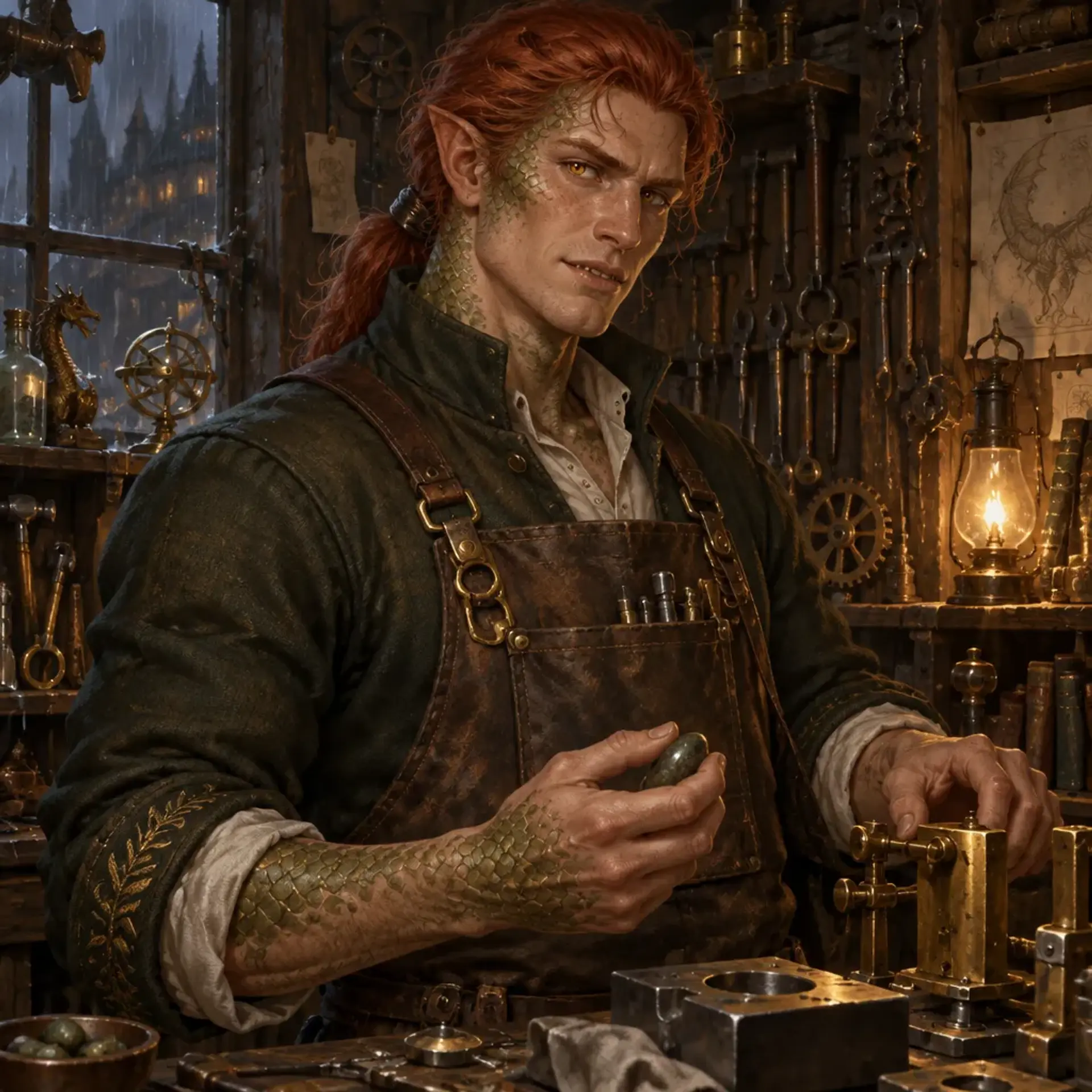
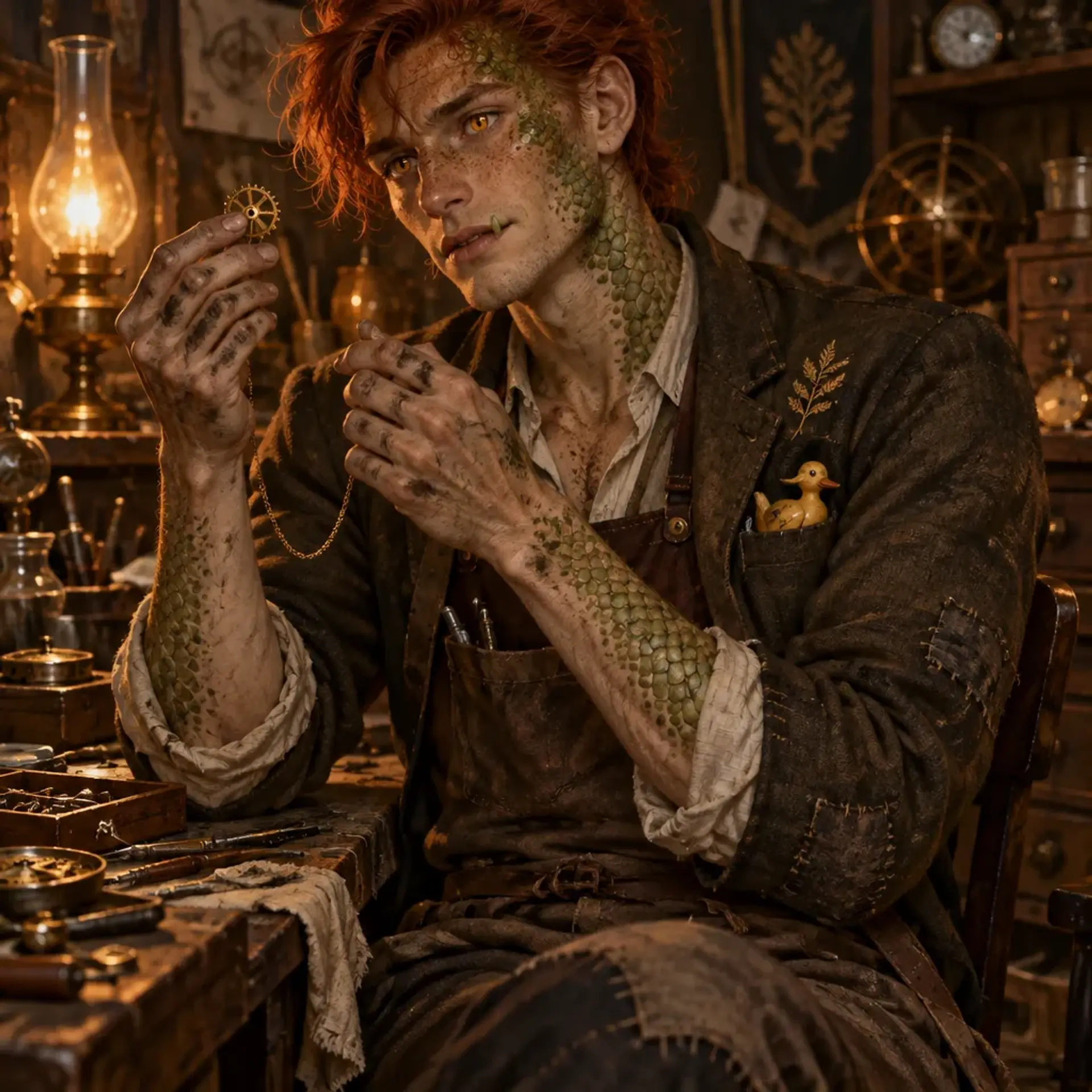
Eber stands five feet ten inches tall, a startling height in a family of stout halflings. Olive-green scales overlap his fair, freckled skin in fine, flexible plates, darker along his shoulders and spine and paler at his throat. His auburn hair changed to an unusually vivid red during adolescence; he keeps it unevenly trimmed so it will not fall into the fine gears he handles. Amber eyes, vertically slit like a predator's, track small movements before his face turns to follow. His jaw has changed painfully: it opens with a controlled sideways hitch, and his long green-dragon teeth can grip and tear but cannot grind food. He has no tail or wings, a lack his relatives mention less often than he suspects. Eber has a lean, work-hardened build, with long fingers marked by grease and tiny nicks from tools. He moves carefully through crowded rooms, shoulders turned to avoid knocking things over, but takes up more space than he understands. His German-influenced halfling work clothes are repeatedly let out and patched: a fitted wool jacket strains across the back, the sleeves end short, and the hem of his trousers is sewn with mismatched cloth. He fusses over one little brass watch chain, polishing it until it catches the light. The unexpected detail is that he keeps a child's painted wooden duck, chipped and bright yellow, in his breast pocket. It was made by his mother and is far too small for his hands.
Clothing
Practical German-influenced craftsman's clothing: a fitted wool jacket, linen shirt, apron, sturdy boots, and family-embroidered details. The jacket has been let out several times, the sleeves remain too short, and the trousers have mismatched patches. He carefully maintains a small brass watch chain.
Body language
Eber turns his shoulders sideways in tight spaces and often underestimates how much room his height and strength require. When concentrating, he holds a gear close to his face and goes very still, his eyes moving independently over its teeth. Embarrassment makes him rub the edge of his jaw, careful not to draw attention to it. He keeps one hand near a pocket containing a few smooth stones.
- Height
- 5 feet 10 inches
- Build
- Tall, lean, and sinewy, with more strength than his halfling family expects and the long reach of a young adult still adjusting to his body
- Eyes
- Deep amber with narrow draconic pupils
- Hair
- Unusually vivid red-auburn
- Skin
- Fair skin with freckles beneath flexible olive-green scales
- Age
- 19, a young adult by village custom
- Gender
- Male
- Size
- Medium
Distinguishing features
Personality
21 traits and drivesEber is clever and cautious, but not timid in the simple sense. He can spend a whole afternoon alone with a watch mechanism, content in the precise company of springs and teeth, then become unexpectedly fierce if a cousin is treated as a monster. He wants the warmth of a crowded halfling household and resents how his size, appetite, and draconic blood make him feel like a guest in it. He is curious about the world beyond the village, yet suspicious of anyone who offers him a grand explanation for his body's changes. Among family he is more playful than strangers expect, especially with children; in public he is watchful and economical with words. He can be generous with labor and ungenerous with vulnerability. He dislikes pity, but secretly treasures small signs that people have remembered what helps him. His cleverness is a tool and a shield: when emotions become hard to name, he translates them into measurements, repairs, and plans. He is not sure whether solitude is his nature or a habit acquired because his body became difficult for others to understand.
- Alignment
- Neutral Good, though fear and pride can make him calculating and withholding
Quirks
Habits
Traits · 6
Flaws · 5
Fears · 5
Wants and needs · 5
Combat
AC 14 · HP 17 · 30 ft.Eber avoids a fair fight. He uses cover, keeps distance with a light crossbow, and uses faerie fire to help allies target hard-to-see opponents. He spends a spell slot on cure wounds when an ally is in serious danger and uses grease to disrupt a pursuer or defend a narrow exit. He is reluctant to hurt people and will retreat or bargain if the family is not directly threatened.
Eber
Spells
Actions
Reactions
Services they sell
Rewards they can give
Equipment
- Watchmaker's tools (artisan's tools)A compact set of fine drivers, tweezers, pliers, and a brass loupe, wrapped in oilcloth.
- Light crossbow (weapon)A short crossbow kept in a canvas sling for protection on solitary walks.
- Repair kit (artificer equipment)A small flask of clear oil, chalk, and a few alchemical reagents for workshop experiments.
- Gizzard stones (personal item)A cloth pouch of smooth pebbles chosen for size and texture; he swallows them to aid digestion.
- Pocket duck (keepsake)A chipped yellow wooden duck made by Wilma, carried as a private reminder of being small and cared for.
Possessions
Background
Eber is the youngest of eight children in the family of Trogi and Wilma, stout-halfling descendants who have spent three generations making a home on an island their ancestors reached as refugees. The Greenwake Kin village is a compact sprawl of timber houses, stone footings, steep roofs, gardens, chicken yards, and covered workspaces built to survive rain and volcanic ash. Its people still share labor, food, and news across lanes, though old habits are under pressure. High-blood descendants, those in whom the old dragon-blood bargain shows most strongly, are now numerous. Their growth, appetites, and unfamiliar instincts make everyday life harder to plan, and their rising status has encouraged some to value hierarchy and display over mutual care. Trogi is a low-blood craftsman with black hair turning gray and green eyes. Calm, patient, and often found among tools, he says he wants to retire but continues to settle disputes in the workshop like a patriarch. In secret he has long wanted a beard, a small ordinary vanity Eber finds both funny and touching. Wilma, fair-haired and hazel-eyed, is the family's practical heart. She tends the garden and chickens, remembers who is short on food, and can read a person's mood before they admit to having one. She is smart and warm, though violence makes her faint. She will butcher fish and chickens if needed, but prefers Trogi to do it. They fish together at a nearby stream when the work allows. Their family gratitude is sincere, but so is their worry: their high-blood children need larger clothes, more food, sturdier beds, and more room than the old house was built to provide. Eber's first memories of being the baby of the family are all hands and warmth: Yonda drawing him into a crowded bench, Kasper slipping him a broken watch to take apart, and Ignatz daring him to race to the river. The siblings carried their own lives around him, but he believed they would always be close enough to touch. He watched Windle, the oldest, take on the quiet burden of being dependable. Windle is balding, hazel-eyed, and already has a family of his own: his son Otto, brown-haired and brown-eyed, and cheerful baby Anika. He works in the family shop and is expected to manage it. His stoicism conceals fear that his children might undergo the same painful transformation as Eber. Karl, the second son, enjoys gears and tools but has a rocky marriage to Leanora, a sailor whose absences and fierce independence leave their household unsettled. She descends from the dragon hunters Wilks and Nailia, famous halfling figures said to have rejected a green dragon's blood in the time of the Castaways. Karl and Leanora have a son, Hansel, and Ragni, a child with pale purplish skin, white hair, and milky blue eyes, whose parentage is an unspoken complication. Eber has learned that a family can love a child and still circle around a truth it cannot bear to name. Yonda is Eber's only sister, a low-blood woman with blond hair, hazel eyes, and a gift for gathering friends. Married and mother to five, she is beautiful in the old village style associated with Yondalla, but Eber knows her better as the sister who gently insists that he go outside and speak to people. Her daughters are Willow, Trude, and Liesel; her sons are Hans and Birke. Hans's vivid green eyes and Birke's hazel eyes that turn yellowish in bright light have caused quiet speculation that they may be high-blooded. Yonda treats the question as something to meet when it comes, not a reason to fear her boys in advance. Alder, another low-blood brother, serves part time as a town guard but is more often occupied with merriment. His son, Black Alder, is a twenty-two-year-old high-blood cousin with black hair, amber serpent eyes, and green scales over pale skin. He visits often and tells stories of adventures. Eber likes him, though the stories make home feel small. Kasper, brown-haired and brown-eyed, works as clerk and watch repairer in the shop; he also tends the chickens and garden. He and his wife are content with two daughters, Wonda and Ilse. Wonda loves the garden and birds, while Ilse follows her everywhere. The older children were still learning to raise Eber when his body changed. At first his auburn hair darkened and brightened oddly, his eyes turned from deep brown to draconic amber, and small scales appeared along his neck and ribs. Then adolescence brought the jaw: a deep, relentless pain, days when even broth hurt, and teeth that began to tear meat without letting him chew. His body did not change into a dragon's. He gained no wings or tail. He became, instead, a tall young man whose body was partly familiar to his mother and father and partly something they had no instructions for. The first night after the worst of the pain, he could not bear to sleep alone. Ignatz, himself newly high-blooded, dragged a blanket into the kitchen and lay beside him. Rodrick joined later, pretending he was there because the kitchen was warmer. They slept together among the flour bins and benches, listening to their parents move quietly in the next room. Eber still remembers Ignatz's hand resting near his, not quite touching, and Rodrick waking at every creak. For months the kitchen became the brothers' refuge, a cramped room where nobody had to explain why beds were too short, why a meal had become a problem, or why they were frightened by their own appetites. Rodrick is twenty-one, taller and broader than Eber, with auburn hair, yellow eyes, fair skin, and green scales tipped reddish at the edges. He works in the shop and carries heavy loads, but wants a life beyond it. He is blunt and arrogant, and insists he means no harm when his teasing lands badly. He needles Eber about eating until Eber's anger becomes unmistakable. Then Rodrick stops, sometimes awkwardly, as if only anger can make a boundary visible. Eber remembers the gentler boy Rodrick was before the change and cannot decide whether that memory is evidence of who Rodrick is or only who he used to be. Ignatz, twenty, has ashy blond hair, draconic green eyes, gray-green scales that grow more vivid with time, a flexible tail, claws, and a predator's build. Eber's closest brother has always supported him, even when neither knew what to do. As children they played in the woods and by the river. After Ignatz killed a chicken with his bare hands during a sudden hunting urge, he was horrified and sheepish. He confined himself to workshop duties, afraid that one impulse had revealed his true nature. Eber does not think it did, but he has never found the right words to make Ignatz believe him. Eber took refuge in the workshop. At first the tools were simply a way to help his father and keep busy while his jaw healed. Then he found that watch gears, catches, and tiny spring tensions made sense to him in a way that people's expectations did not. He learned to repair clocks and mechanisms, to make practical fittings for oversized clothing and beds, and to use small alchemical tricks to strengthen a joint or brighten a lamp. He is an apprentice artificer, not yet a master, and his ingenuity is still more reliable than his courage. His keen mind notices what other people overlook: a wheel wearing unevenly, a brother avoiding a question, a visitor who looks at the village as if it were a possession. Food remains a daily negotiation. Eber cannot chew as his family does. He tears food into manageable pieces and swallows small smooth stones to aid digestion, as green dragons do. His family watches over his health, keeps a dish of polished pebbles near his place, and checks that he has enough food. They try not to make a spectacle of it. Eber knows that their care is love, but sometimes it feels like a reminder that he cannot share the simplest family ritual. He misses the old meals: the taste, the time at the table, and the easy pleasure of eating alongside his parents. He dislikes that his size and strength separate him from the warmth of a halfling household, and he hates needing more than the family can comfortably spare. His fascination with shiny things is part instinct and part craft. He notices a bright pin or brass fitting before he has decided whether he wants it. He keeps small pieces of colored glass, polished washers, and an odd button in careful rows, telling himself that he is studying reflective surfaces. Some are useful; others are simply beautiful. This private collecting habit is one of the few draconic impulses he lets himself enjoy without shame. Outside the family, the village is changing. Some high-blood youths embrace dragon heritage as proof they should rule; others want nothing to do with it. Strict gender roles and conspicuous status have begun to enter a place once governed by shared work. Elders blame the green dragon whose blood altered the first settlers. Others suspect her daughter or an unfinished rite. A secret circle has been quietly encouraging dragon worship and exploiting people's fear. The green dragon who once loved a halfling tried to save the refugees, but her absent father, a revenge-seeking patriarch, treats the village as a useful piece in a larger design. The Greenwake Kin are wary of the other island peoples, including golden serpentine beings whom they cannot confidently call allies or enemies. Eber has not found a simple position in these arguments. He is grateful the bargain may have saved his ancestors, furious that its consequences have reached his body, and afraid of anyone who claims that suffering proves he should be grateful. He does not want the village to return to a past that never existed. He also will not let anyone call his brothers monsters or use them as evidence for a doctrine. He has started keeping notes on the changing bodies and needs of high-blood relatives, hoping that careful observation might separate biology from rumor. His parents worry this will attract dangerous attention. He worries that refusing to look would leave his family helpless. Now Eber divides his time between the workshop, the family's garden, and solitary walks along the stream. He is designing an adjustable bed frame for the high-blood children and a tool that makes watch repair easier for hands with claws. He says these are practical projects. The deeper purpose is to make a household that can still fit everyone. His current problem is immediate: the family's workshop cannot keep supplying bigger clothes, beds, food, and repairs without outside work, and the village's new factions are beginning to notice who has talent, who has secrets, and who might be persuaded to choose a side. Eber wants a life with room for family, craft, and privacy. He is slowly learning that making room may require him to step out of the workshop and speak before other people decide what his body means.
Role in the story
A young craftsperson caught between the communal life of his halfling-descended family and the social changes driven by high-blood identity. Eber can become a useful ally, a source of grounded information about the village, or a personal stake in conflicts over dragon worship, family safety, and the meaning of the old blood bargain.
“Its people still share labor, food, and news across lanes, though old habits are under pressure.”
- Faction
- The Greenwake Kin by birth and the Trogi family workshop by labor. Eber is not a member of the secret dragon-worshiping circle and distrusts anyone trying to make high-blood heritage a claim to authority.
Known connections
Media
0 imagesNo images yet.
Turn Eber into a sheet
A high-res, share-ready sheet you can post or print.