Eber
Eber
At the table
“an inconvenience.”
Voice
A dry, work-worn voice with a slight rasp from workshop dust and the altered shape of his jaw. His words are measured and clearly articulated, with a faintly tooth-edged scrape on certain consonants. He does not boom or whisper for effect; his mood shows instead in how quickly he answers and how exact his phrasing becomes.
His voice has a lightly rough edge from years of workshop dust and a dry catch at the back of the throat when he has swallowed stones. He speaks at an even pace, clipping technical explanations into precise steps. Around family, his words loosen into familiar teasing; around strangers, he leaves pauses after questions and listens hard to the answer. His changed jaw gives certain consonants a faintly rasping, tooth-edged quality, especially when he is tired.
Speech patterns
How to play them
Treat Eber as an adult, be direct about what you need, and do not stare at his jaw or assume he is dangerous because of his blood. He responds to practical help, shared work, and honest curiosity more readily than pity. Mentioning family too quickly makes him guarded, but a concrete offer to help the workshop or protect a younger relative earns trust. If players respect his limits around food, he may share far more than he intended.
Goal
Develop practical devices that let him and other high-blood youths live safely, while learning whether the old dragon-blood changes can be understood without surrendering the village to dragon worship or fear.
Motivation
To make his body and skills useful on his own terms, protect his family without being smothered by them, and find a truthful account of the inherited dragon blood.
Appearance
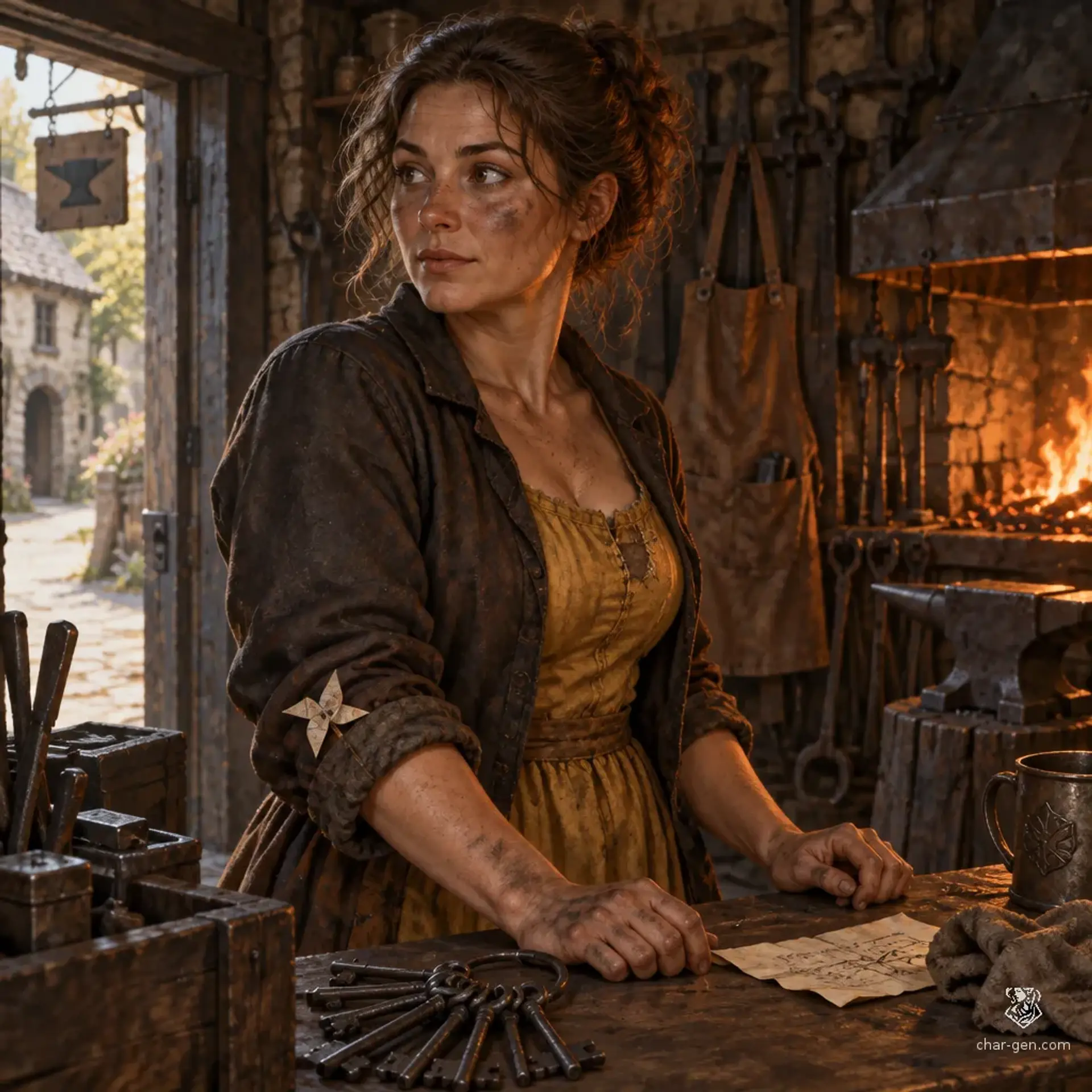
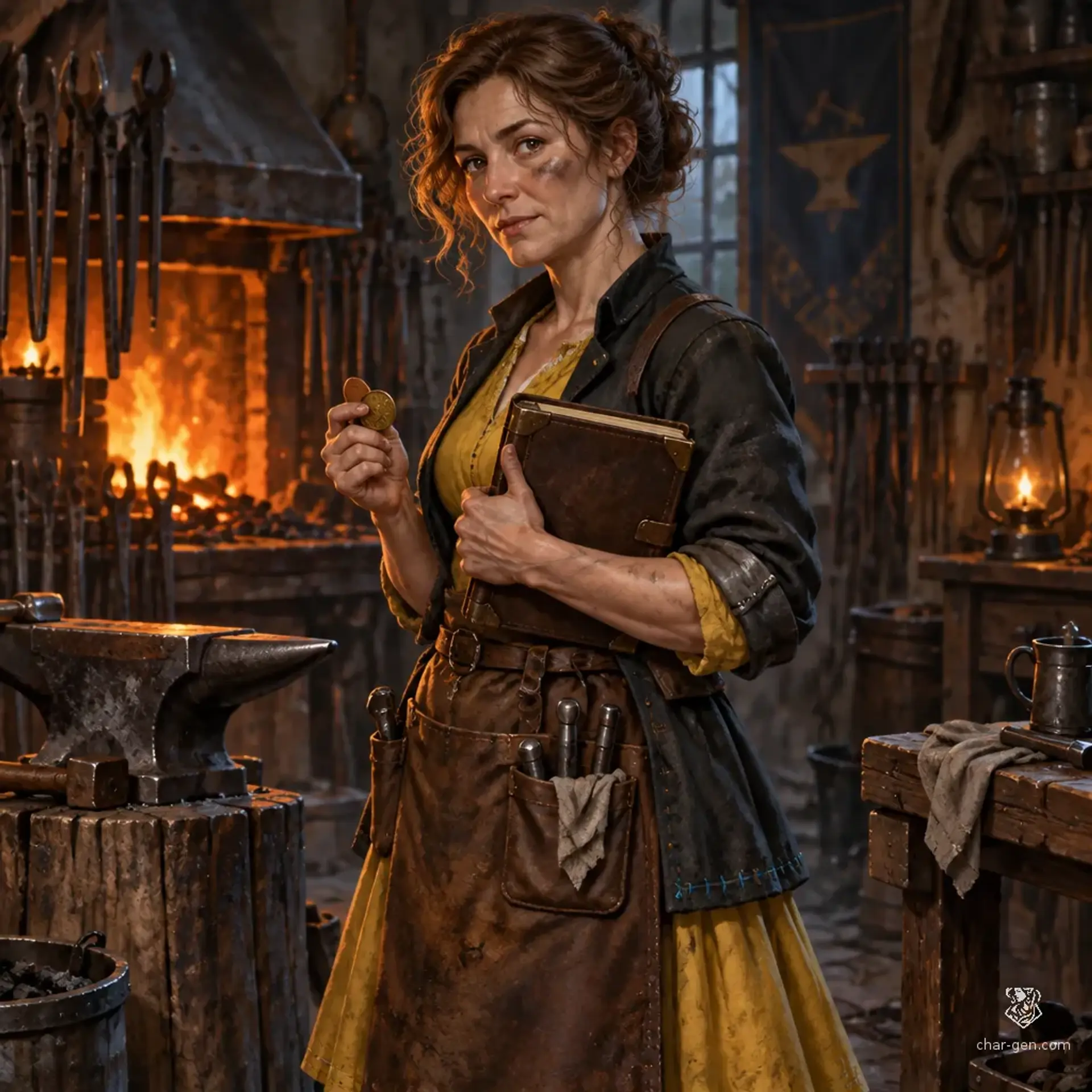
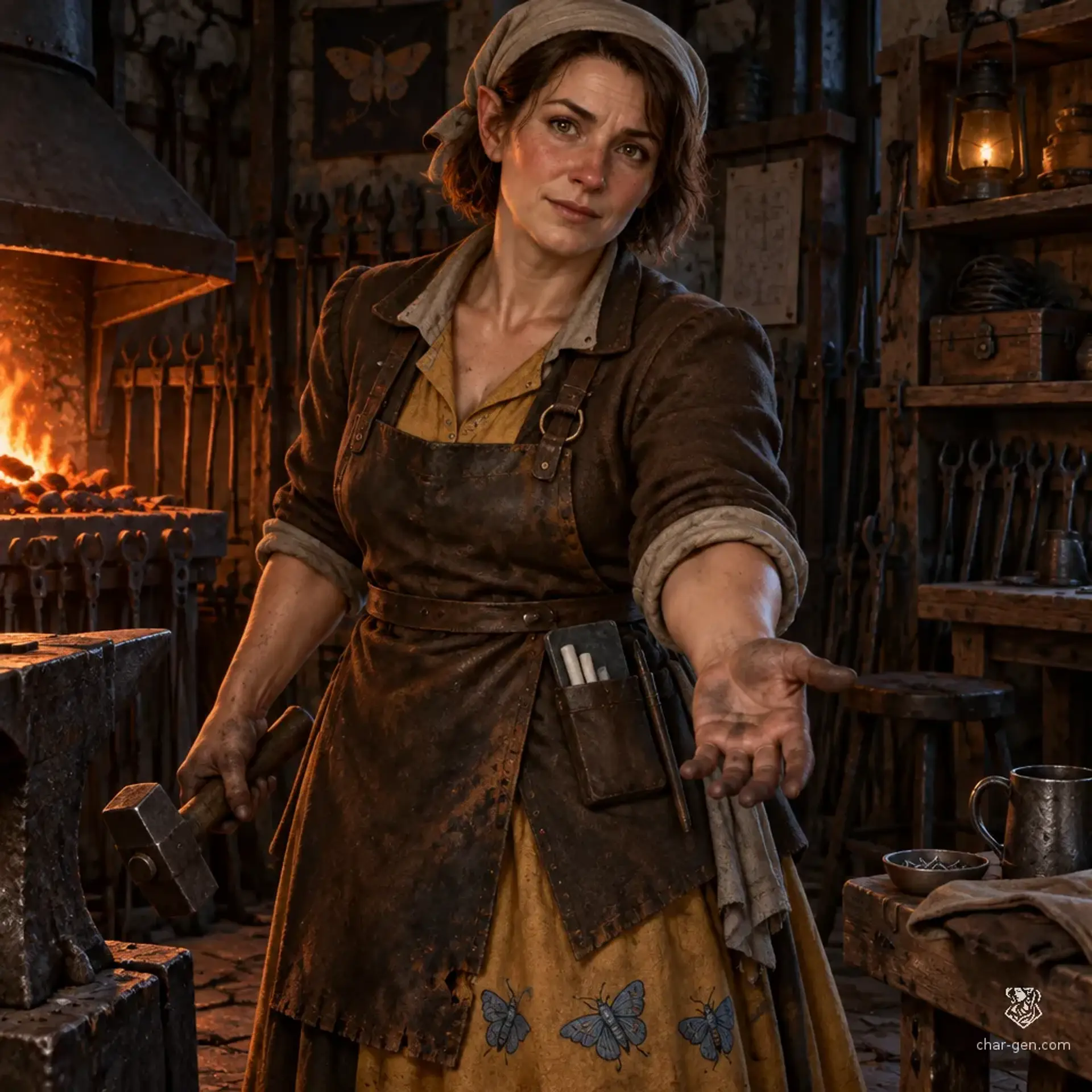
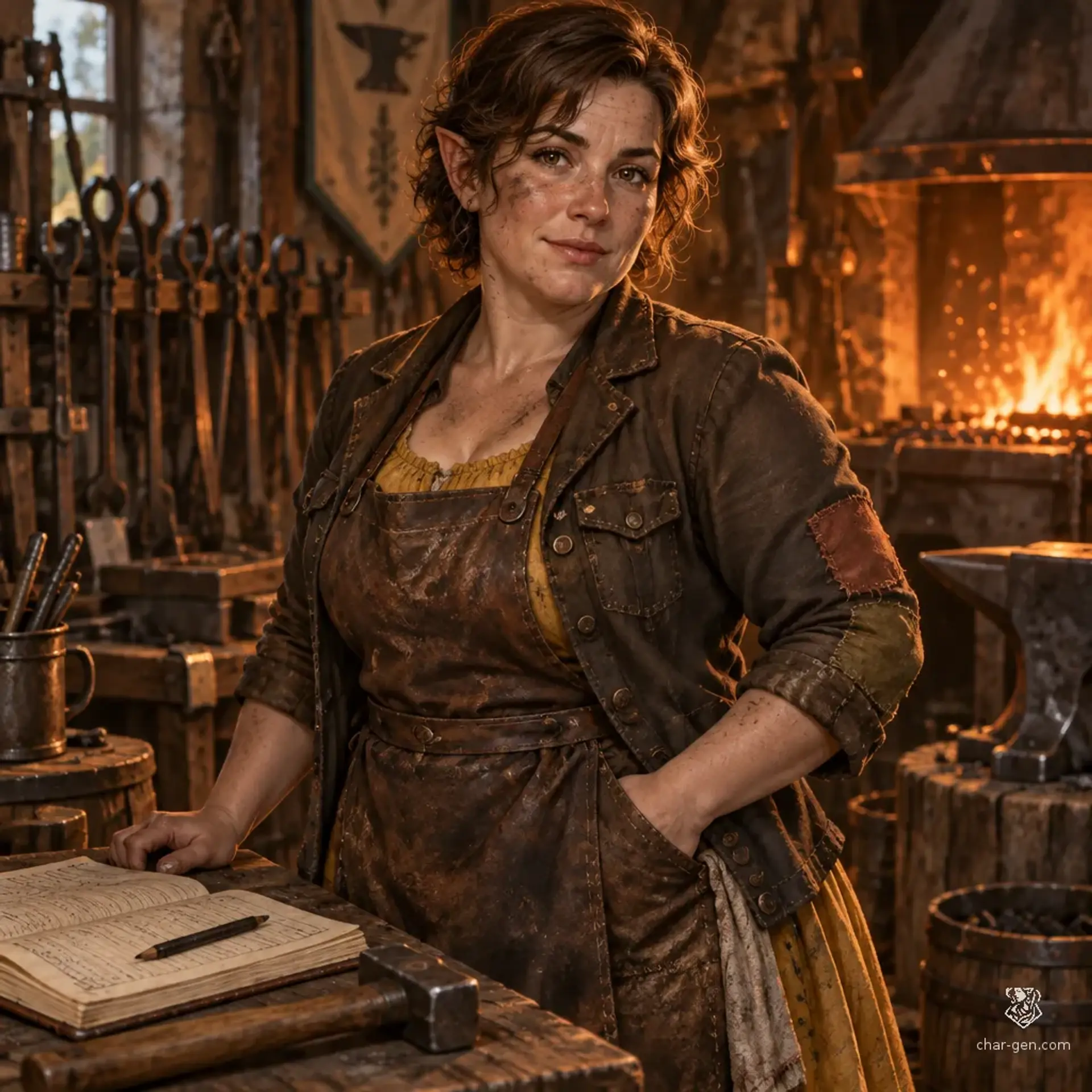
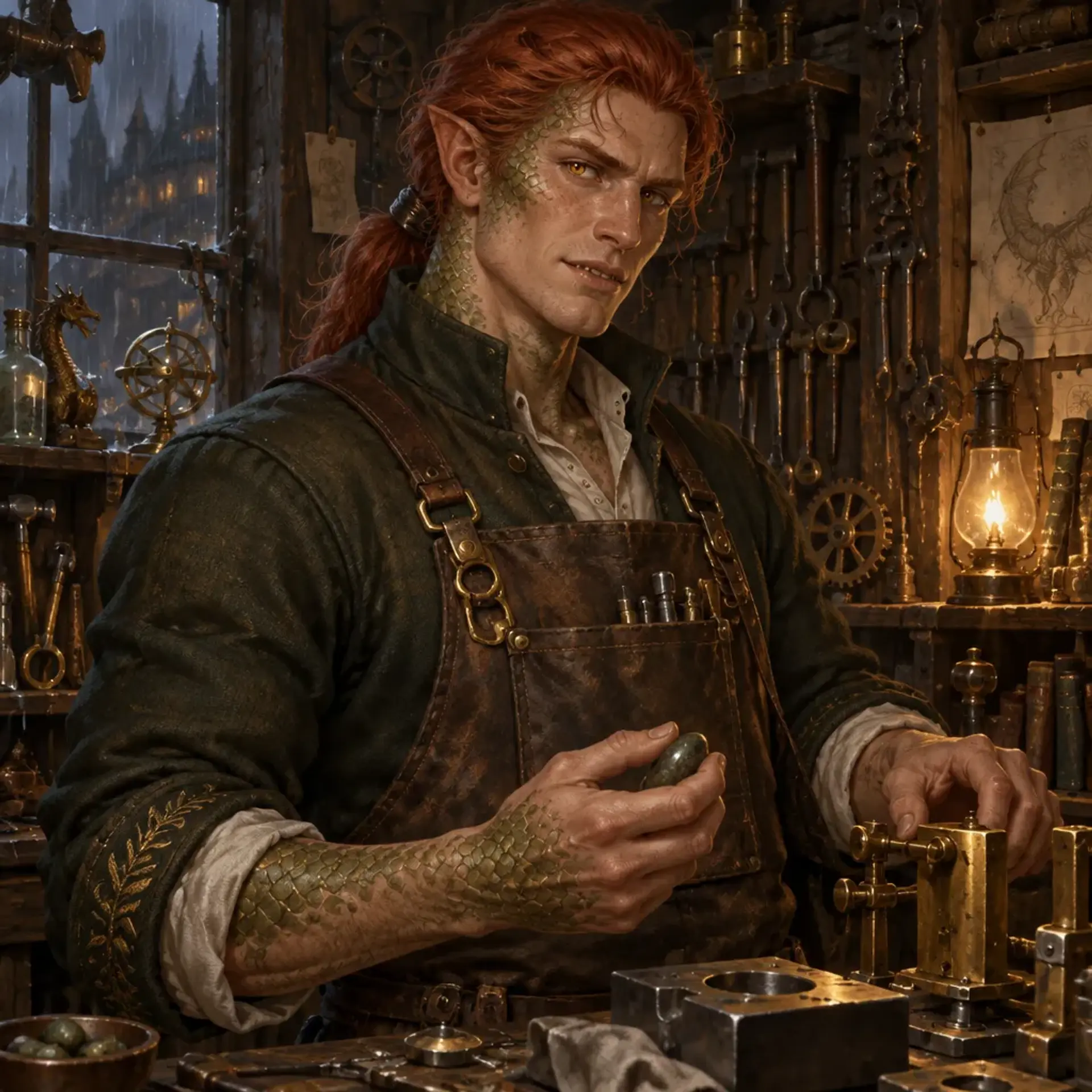
Eber is five feet ten inches tall, a startling height in a family of stout halflings. Olive-green scales lie close across his fair, freckled skin, fine and flexible like overlapping leaves with a faint satin sheen. They are most visible along his temples, throat, shoulders, forearms, and knuckles; a few scattered patches break up the freckles on his cheeks. His auburn hair turned a vivid, unmistakable red during adolescence, and he ties it back with a narrow strip of leather when working. Pointed ears angle slightly backward, framing amber eyes with narrow, draconic pupils that catch the light like polished resin. His altered jaw is longer and more predatory than a halfling’s, built to seize and tear rather than chew. He has no tail, wings, or crest, a difference that makes his silhouette look almost ordinary until he turns his head. Eber moves carefully around his shorter relatives, but in the workshop he has a measured, sure-footed stride and handles heavy tools with unnerving ease. He smells faintly of machine oil, damp stone, and the bitter-green scent of crushed leaves; he knows about the oil but has never noticed the leafy smell. People often remember how still he can become while watching them, as if he were taking their measure.
Clothing
He wears practical village craftsman’s clothes with strong German influences: a fitted wool jacket, linen shirt, leather apron, sturdy boots, and a family-embroidered band at one cuff. His garments are altered to fit his height, with reinforced seams and a high collar that keeps workshop dust off his scales. Brass fasteners and a few polished buttons are conspicuously brighter than the rest.
Body language
Eber turns one shoulder slightly toward people when uneasy, unconsciously protecting his jaw. His thumb rubs a smooth stone in his pocket or checks the small brass clasp at his belt. He watches hands and exits, but with family he leans close enough to hear every small remark. When amused, he gives a brief, surprised grin that shows the tearing teeth he usually keeps hidden.
- Height
- 5 feet 10 inches
- Build
- Tall and sturdy, with a lean, work-hardened frame, broad shoulders, and more strength than his careful movements suggest.
- Eyes
- Amber with narrow, draconic pupils
- Hair
- Vivid red auburn
- Skin
- Fair, freckled skin with flexible olive-green scales
- Age
- 19, a young adult
- Gender
- Male
- Size
- Medium
Distinguishing features
Personality
20 traits and drivesEber is not simply shy or clever. He is attentive to other people’s discomfort and surprisingly tender with children, yet he can turn that same attention into a cold inventory of someone’s leverage. He wants to be included in the family’s warmth, but hates being fussed over as though he were still small. He will accept a tool placed beside him more easily than a hand on his shoulder. In the workshop, where problems have causes and parts can be tested, he is patient, methodical, and willing to explain a repair until even a child understands it. In crowded rooms, especially around meals, he grows watchful and self-conscious; he may leave before anyone can offer help. With Ignatz he can recover the impulsive humor of their childhood, while Rodrick’s teasing makes him unexpectedly sharp and defensive. He is fascinated by bright things and by the hidden motives behind village politics, but he dislikes the attention that comes with being a high-blood descendant. He would rather be valued for a clever repair than for his scales. His moods change his manner: when calm, he speaks carefully and makes room for other people; when embarrassed, he hides behind technical detail; when frightened for a younger relative, he becomes decisive and almost startlingly bold. He envies the easy, shared life his Low-blood parents and siblings still enjoy, then feels guilty because they have never stopped loving him. Eber can forgive awkwardness but not deliberate humiliation. He tries to be fair, though his suspicion sometimes makes him test a new acquaintance instead of trusting them. He is proud of his strength and ashamed of needing it. He believes family matters, but he is beginning to understand that loyalty does not mean agreeing with every family custom, every elder, or every dragon-blooded claim.
- Alignment
- Neutral Good, though his self-protective habits and fascination with leverage can make him seem more calculating than he is.
Quirks
Habits
Traits · 5
Flaws · 5
Fears · 5
Wants and needs · 5
Combat
AC 15 · HP 17 · 30 ft.Eber avoids a fair fight. He opens from cover with Fire Bolt, uses a shield spell or his reaction to blunt a dangerous hit, and shifts behind sturdier allies. He prioritizes a threat to his family or an opponent disrupting his allies, and will use grease to control a narrow approach. If a foe is willing to talk, he tries to learn what they want before committing to violence. He has no breath weapon, claws, or draconic damage resistance.
Eber
Spells
Actions
Reactions
Services they sell
Rewards they can give
Equipment
- Workshop light hammer (weapon)A compact light hammer with a carefully balanced head, used for delicate fitting as well as defense.
- Craftsman's apron and tools (tools)A leather apron with reinforced pockets, measuring cord, wire, files, spare screws, and small brass components.
- Stone case (personal)A tin case holding smooth, carefully chosen stones for his digestion.
- Pocket collection (personal)A small number of bright but inexpensive objects, including polished glass, brass scraps, and an old watch spring.
- Alchemist's supplies (tools)Wax-wrapped ingredients and a stoppered vial for preparing his experimental healing elixir.
Possessions
Background
Eber was born the eighth and youngest child of Trogi and Wilma, the baby of a family whose kitchen was rarely quiet. He arrived into a household where tools, garden baskets, grandchildren, and bowls of shared food passed through the same narrow rooms. His parents were Low-blood descendants of the refugees who founded the Greenwake Kin village after shipwreck, hunger, dangerous forests, and a volcanic eruption. Trogi, now sixty-eight, is a calm, black-haired craftsman going grey, a patriarch who insists he wants to retire while continuing to repair whatever breaks. Wilma, with whitening blond hair and hazel eyes, is the household’s warm and watchful center. She tends the garden and chickens, fishes with Trogi at the local stream, and can read worry in a child’s face before the child can name it. She dislikes violence and may faint at its sight, but she can dispatch a chicken for supper without hesitation. The family carries the history of the old dragon-blood bargain in different ways. Low-blood relatives retain more of the village’s stout-halfling customs: shared labor, practical hospitality, and a belief that a meal is something to be offered, not earned. High-blood descendants bear stronger, less predictable signs of draconic inheritance. Some elders see those changes as the cost of survival; some young people see them as proof that the old bargain made them superior. Three generations have passed since the refugees reached the island, and the village’s roughly 447 people still live close together in timber houses with stone footings, steep roofs, and covered workyards built to shed rain and ash. Yet old habits are under pressure. High-blood youths increasingly want private space, conspicuous possessions, and status measured by strength or bloodline. Eber grew up hearing that the family’s survival depended on helping one another. He also grew up watching the meaning of help change as his body did. His eldest brother, Windle, forty-two, is a balding Low-blood with brown hair and hazel eyes. He works in the workshop and is expected to inherit its management. Windle married later in life and treasures his two small children: Otto, brown-haired and hazel-eyed, and baby Anika, whose cheerful smile lights her brown eyes. Windle is steady with Eber, but he privately fears that his own children might undergo the same painful change. Karl, forty, is another Low-blood son, balding, black-haired, and warm-eyed, who genuinely enjoys tools and gears. His marriage to Leanora is rocky. She is often away as a sailor and descends from Wilks, a celebrated dragon hunter, and Nailia Strongheart, the halfling heroine who refused the green dragon’s blood in the time of the castaways. Karl and Leanora have a son, Hansel, with black hair and black eyes, and Ragni, a pale, white-haired child with milky blue eyes and purplish skin, was born from one of Leanora’s other relationships. Eber has learned that family love and family hurt can sit at the same table. Yonda, the only sister, is thirty-eight, blond and hazel-eyed, Low-blood, socially gifted, and often compared to the old halfling goddess Yondalla for her beauty. She has five children and treats Eber with a kindness that sometimes comes wrapped in a gentle push to be more social. Her sons Hans, blond with vivid green eyes, and Birke, whose hazel eyes seem yellow in certain light, show possible signs of high blood. Her daughters are Willow, with dark brown hair and startling blue eyes; Trude, auburn-haired and doe-eyed; and Liesel, dark blond and hazel-eyed. Alder, another Low-blood brother with cropped black hair and green eyes, works part-time as a town guard, though merriment often claims the hours he means to give to duty. His son Black Alder, twenty-two, is a High-blood cousin with black hair, amber serpent eyes, and green scales over pale skin. He visits and tells Eber stories of adventures beyond the village. Kasper, thirty-five, is a brown-haired, brown-eyed Low-blood who keeps accounts, repairs the rare watches that reach the island, and is as likely to be found tending the family garden or chickens as at his bench. He and his wife are content with two daughters: Wonda, light auburn-haired and devoted to the garden and chickens, and Ilse, dark auburn-haired and always following her older sister. Eber’s adolescence did not arrive as a single dramatic event. It came as months of aching joints, sleeplessness, and a jaw that changed faster than his parents could understand. His auburn hair blazed red; his brown eyes became amber and slit-pupiled; olive-green scales surfaced over his skin; his ears sharpened; and his teeth grew long, strong, and suited for tearing. He became too tall to fit comfortably into the beds his parents owned and too strong to join the small, easy routines of his childhood without constant care. The worst discovery was that he could no longer chew. He could tear meat and swallow it, but ordinary family meals became a painful embarrassment. A village healer could offer comfort, not a cure. During the first week after the jaw change, Wilma and Trogi moved blankets into the kitchen so Eber would not be alone at night. Ignatz, then just beginning his own changes, insisted on sleeping there too. The brothers lay among baskets and flour sacks, listening to the house settle and to the older family members whispering over what food Eber could manage. Ignatz did not know how to fix his brother, but he stayed close enough that Eber could hear his breathing. That became one of Eber’s strongest memories of being loved without being asked to explain himself. It also fixed the kitchen in his mind as a place of safety, embarrassment, and the smell of warm bread he could no longer eat. Rodrick, twenty-one, is another High-blood brother, taller and broader than Eber, with auburn hair, yellow eyes, fair skin, reddish-tipped green scales, and a predator’s build. He works in the shop, carries heavy loads, and helps with the chickens while seeking work beyond the family business. Rodrick teases Eber about his eating and can be blunt to the point of cruelty. He insists he means no harm, and sometimes he truly believes that. Eber remembers him as a careful, kinder boy before adolescence, which makes each sharp joke feel like a small loss. Rodrick’s green-dragon sorcery gives him a confidence Eber distrusts. Ignatz, twenty, has ashy blond hair, green draconic eyes, grey-green scales slowly becoming more vivid, claws, sharp teeth, a flexible tail, and a lean, predatory build. As children, he and Eber played in the woods and by the river. When Ignatz killed a chicken with his bare hands during a sudden hunting urge, he was horrified by himself and retreated to the workshop. He has supported Eber ever since, even when both brothers were frightened by what their bodies might demand of them. Eber found a different way to be useful. The family workshop is busy with repairs and practical craft, and he has a gift for understanding why a mechanism sticks. His intellect is sharp, patient, and suspicious of easy answers. He began repairing tools, then making small devices to solve the problems his body presented: a hinged spoon-like feeder for broths, a narrow cup that limits spills, and a brass case for smooth stones. He swallows small stones to help grind food in a second stomach, a green-dragon inheritance he dislikes discussing. The stones are not a cure and he still needs suitable food, but choosing and carrying them has given him a small measure of control. He is an artificer in the making, not a grand inventor yet. His magic is practical and provisional: a spark from a bolt-shaped casting rod, a shield of force shaped like a hinged plate, and a healing mixture he keeps wrapped in waxed cloth. His love of shiny things is not merely greed. Polished brass, glass beads, bright screws, and the glint on a watch face offer certainty: they reflect light in predictable ways and can be examined, sorted, and placed where he wants them. He collects them in small hidden caches around the house and workshop, sometimes forgetting that other people regard the pieces as rubbish. He is clever enough to know that a hoard can become a habit, and lonely enough to keep collecting anyway. The village’s wider fears make his private adaptation more difficult. Elders still remember the green dragon whose blood altered the survivors and the massacre that drove their ancestors from home. The benefactor was said to have loved a halfling and tried to save the settlers, but her absent father, a green dragon patriarch bent on revenge, now treats them as useful pawns. Some villagers suspect the old ritual was never completed; others suspect one of the dragon’s daughters. A secret circle is using those uncertainties to encourage dragon worship and factional influence. A fivefold dragon goddess is gaining quiet adherents, while other families reject any dragon devotion as betrayal. Eber has heard fragments of these arguments through the workshop walls. His family wants him safe, but the village’s changing politics make even his body a public argument: is he a warning, an inheritance, or a promise? Now Eber is nineteen and trying to build a life that does not require him to become either a frightened child or a symbol. He wants to improve the workshop, make useful devices for other people with unusual needs, and find out what the family’s inherited changes actually mean. He is especially attentive to the younger high-blood children, including Hans and Birke, and to Black Alder’s adventurous accounts. He wants to believe he can be different from the most self-serving high-blood youths without denying the parts of himself that are solitary, watchful, or fascinated by possession. His family still worries about whether there is enough food, cloth, bedding, and space for the changing children. Eber worries that their care will become a cage, then feels ashamed for resenting it. He still misses the easy physical warmth of being a small child tucked beside his parents. He is learning that growing beyond their reach does not have to mean growing out of their family.
Role in the story
A family-centered, mechanically gifted young NPC whose physical adaptation embodies the village’s uneasy transition from halfling mutual aid to high-blood self-definition. Eber can become a guide to the Greenwake Kin, a source of practical inventions, and a witness to evidence about the unfinished ritual and the dragon’s influence.
“He arrived into a household where tools, garden baskets, grandchildren, and bowls of shared food passed through the same narrow rooms.”
- Faction
- The Greenwake Kin by birth and family; a member of the family workshop, but not an adherent of the growing dragon-worship circle.
Known connections
Media
0 imagesNo images yet.
Turn Eber into a sheet
A high-res, share-ready sheet you can post or print.