Marta Eichenwald
Marta Eichenwald
At the table
Voice
Her voice has a dry, slightly rough edge from years of calling over market noise and working outdoors. It carries a practical, clipped rhythm, with consonants made firm by habit rather than anger. When she is tired, a faint rasp catches at the ends of sentences. For children, she can make her voice spring into quick theatrical changes for the paper puppet; in a tense room, she uses a steady, carrying voice that does not need to be loud to hold attention.
Marta speaks in compact, practical sentences shaped by years of bargaining at a market stall and coordinating household work. She gives measurements, times, and tangible details when she is uneasy. Her German-influenced village phrasing is plain rather than formal, and she rarely uses grand titles. When talking to children, she becomes animated and gives ordinary objects little dramatic voices; when pressed about the sire, her sentences stop short and turn toward the next necessary task.
Speech patterns
How to play them
Begin with practical, respectful offers rather than questions about the sire or the eggs' meaning. Ask permission before approaching the nest. Marta responds best to people who treat her as a person with choices, keep promises, and offer help that supports the whole household. She may share more if the characters help with a concrete problem, such as crop sickness, safe shelter, or Hosh's distress.
Goal
Protect the three eggs and her family while finding out whether their origin is natural, magical, or the result of deliberate interference.
Motivation
To remain Marta, not become a public omen or a vessel for other people's claims, while keeping her children and family safe.
Appearance
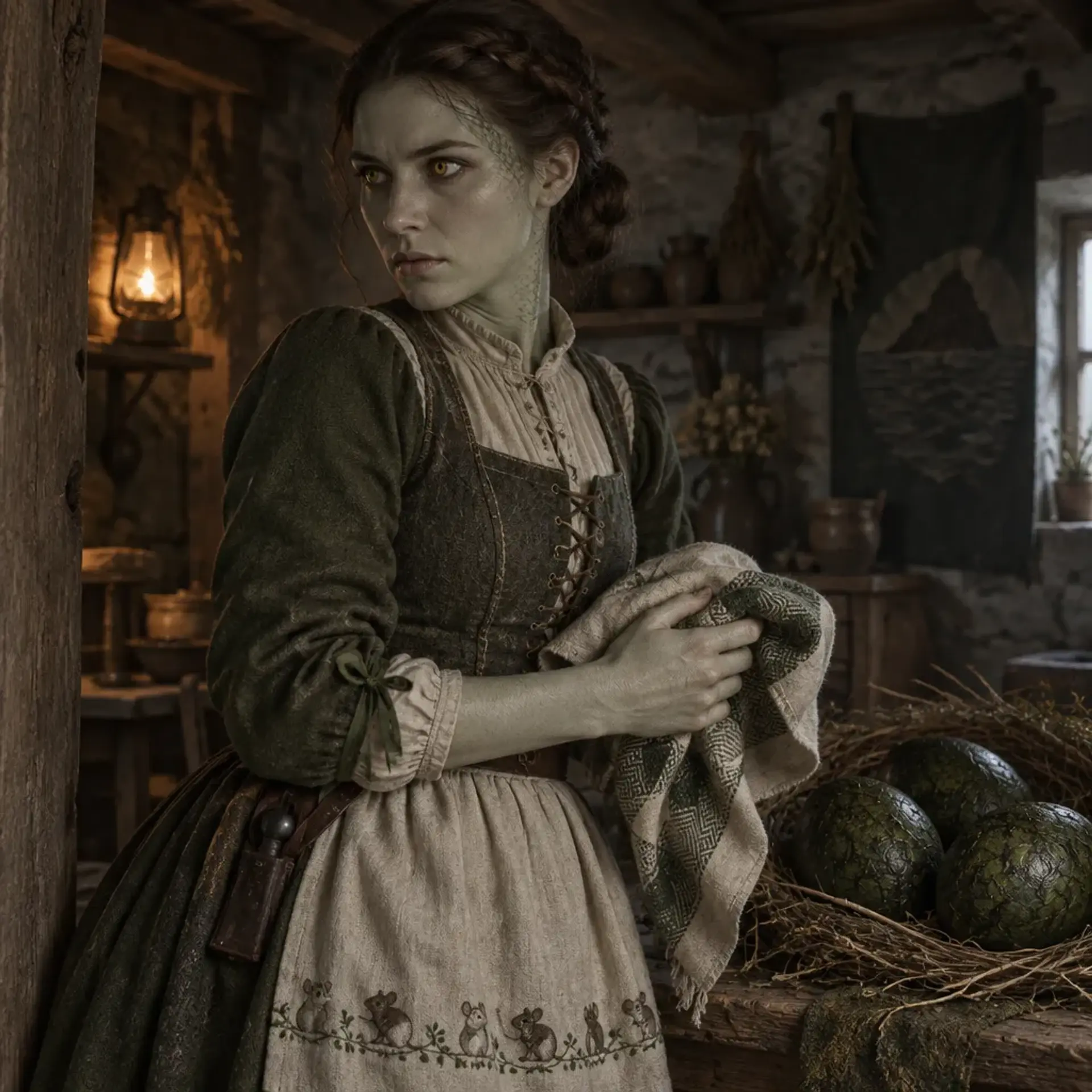
Marta looks as if she ought to disappear into a market crowd, until she turns her head and the yellow, slit-pupiled eyes catch the light. She is tall for a woman in her village, with a predator's narrow, spring-loaded frame and a habit of keeping her weight over the balls of her feet. Her pale green-white skin has a faint, cool sheen, like river stones dried in shade; tiny, close-set scales stipple her temples, the ridge of her shoulders, and the backs of her hands. Her black hair is thick and blunt-cut at the jaw, usually pinned with a plain wooden comb. She moves in economical starts and stops, watching a room before crossing it. While waiting, she puts her left heel against a wall or chair leg and angles her body toward the nearest exit. An unexpected detail is that she carries a tiny, carefully repaired paper theater puppet in her bodice pocket and makes it perform for children when she thinks no one important is watching. Her three eggs have made this once-unremarkable woman impossible to overlook.
Clothing
Practical German-style dresses of sturdy linen and wool, fitted close enough not to snag on work and layered with a laced bodice, apron, and weatherproof shawl. She favors muted cream, brown, and lichen green. Small flourishes include hand-stitched leaf-shaped cuffs, a narrow embroidered hem, and a brass clasp shaped like a seed pod. Her clothes are kept clean but visibly mended at the elbows and apron pockets.
Body language
She keeps her shoulders angled toward the nest and her stance balanced for a quick step. When challenged, she does not puff herself up; she becomes still, lowers her chin, and watches the other person's hands. Her fingers often touch the wooden comb in her hair as if checking that it is still there. Around Hosh, her posture softens but she leaves him room to retreat.
- Height
- About 5 feet 9 inches
- Build
- Tall, lean, and springy, with a predator's economical balance rather than conspicuous muscle.
- Eyes
- Draconic yellow with black, narrow pupils
- Hair
- Black
- Skin
- Pale white-green, with a cool stone-like sheen and fine scales in scattered patches
- Age
- Young adult, about 23
- Gender
- Female
- Size
- Medium
Distinguishing features
Personality
18 traits and drivesMarta wants to be ordinary and useful, yet the eggs have made her the center of every room she enters. She dislikes being watched, but watches everyone else closely because she has learned that attention can turn dangerous without warning. In calm moments she is matter-of-fact, wry, and unexpectedly playful with children; she will stage a whole puppet show with her paper toy, then refuse praise as if it were an accusation. When anxious, she becomes intensely organized, measuring warmth and counting supplies. When frightened, she can become sharp and territorial, especially if someone approaches the nest without permission. She is not naturally cruel, but the instinctive pull around the eggs has made her capable of frightening people she loves. She has an almost stubborn faith in ordinary work. A clean bandage, a mended seam, a meal shared with her family: these things feel more trustworthy than visions, rumors, and promises of destiny. Yet she is drawn to the mysteries she fears. She keeps records, observes her changing body, and listens for patterns in what High-blood strangers do, even while insisting that she wants no part in anyone's theories. Marta will protect the eggs, but resents the assumption that protection means surrendering judgment or identity. With her sisters, she can be affectionate and argumentative in the same breath. She trusts Sada's caution but hates feeling managed; she values Theska's openness but fears it will invite danger. She wants Hosh close, but does not force him to approach when his instincts make him afraid. Her kindness is practical rather than soft: she notices a hungry visitor and puts food within reach, but may never ask why they came. She has a dry sense of humor that appears when she feels safe, and a habit of making a pointed observation sound like a household reminder. Marta is ashamed of how much she wants someone else to take responsibility for a little while. She longs to sleep through a night without checking the eggs, yet feels guilty at the thought. She fears that her changing instincts might be genuine and meaningful, but she also fears that denying them would endanger the brood. She is pulled between the person she was, who preferred to pass unnoticed, and the person everyone insists she has become. Trust comes slowly, but once earned, it is durable. Betrayal, especially by someone who has treated her vulnerability as public property, is difficult for her to forgive.
- Alignment
- Neutral Good
Quirks
Habits
Traits · 4
Flaws · 4
Fears · 5
Wants and needs · 5
Combat
AC 10 · HP 9 · 30 ft.Marta avoids a fair fight. She puts furniture or a doorway between attackers and the eggs, calls for help, and uses a shove or a household object only to make space to flee. If the nest is directly threatened, she becomes more reckless, but she has no combat training and will retreat if she can carry the eggs to safety.
Marta Eichenwald
Actions
Reactions
Services they sell
Rewards they can give
Equipment
- Wooden spoon (improvised weapon)A plain wooden spoon with a worn handle, useful for cooking and, in desperation, a crude club.
- Household observation book (personal item)A small notebook recording the eggs' appearance, warmth, and Marta's symptoms.
- Paper puppet (keepsake)A patched, thumb-sized paper theater puppet kept in her bodice pocket.
- Notched comb (personal item)A wooden comb polished smooth at one notch from constant nervous handling.
- Work apron (clothing and supplies)A stout apron with a sewing kit, clean cloth, and a little wrapped food.
Possessions
Background
Marta Eichenwald grew up in a household that prized usefulness over distinction. Her father repaired harness and cart fittings; her mother kept a kitchen garden and knew which neighbors needed food before they knew it themselves. Marta became good at the quiet jobs: carrying water, keeping accounts for a stall, calming a frightened child, and noticing when a familiar animal was behaving strangely. She has two older sisters, Sada and Theska, both Low-blood and married into families of their own. Her younger brother, Hosh, is High-blood and has recently entered the difficult, unpredictable stretch of adolescence that Ashenbough families call the green years. Marta used to find his sudden rages and odd appetites embarrassing. Now she watches him with a tenderness she does not know how to show. The family descended from halfling shipwreck survivors who crossed a dragon-haunted wilderness and reached an island that seemed blessed. Their first harvest was abundant; later years brought ashfall, crop blight, and fevers that left whole fields gray. The family stayed, adapting with stubborn thrift. Marta remembers being taught to wash soot from vegetables, to store seed in clay, and never to mistake a good season for a promise. Those lessons shaped her into someone who trusts repeated acts more than declarations. Four months before she laid the eggs, Marta began acting unlike herself. She woke before dawn and walked the edge of the settlement without knowing why. Certain smells made her nauseated; others, particularly damp earth, crushed leaves, and raw meat, became compelling. She started arranging blankets in a shallow oval beside the hearth, then denied doing it when asked. Sometimes she stared toward the dragon-haunted interior as if listening for a sound no one else could hear. She did not become cruel or grandiose, but she grew impatient with anyone who stood between her and the door. The changes frightened her most when they felt comfortable. Then, without a known sire, Marta laid three eggs. The birth was painful and terrifying, and the family summoned the village healer. The eggs are about the size of a large melon, with tough, faintly pebbled shells that look nearly black in dim light. In daylight, the shells show dark green under their surface, like deep water beneath leaves. Each has a different pattern of thin, moss-colored branching lines. They feel warm, but not hot, and a faint earthy odor clings to their nesting straw. They have not hatched. Marta insists that nobody tap them, carry them without her permission, or conduct an experiment on them. She does not know how long incubation will take, and no one can honestly promise the eggs are viable. The birth transformed a private family crisis into public spectacle. Some neighbors call the eggs a blessing for a settlement losing its crops. Others call them a warning that a green dragon has marked the island, or proof that Marta is carrying a threat into the village. A few people have tried to claim guardianship on religious or customary grounds. Marta hates the attention. She would rather be remembered as the woman who can mend a torn sleeve than the woman with the impossible brood. High-blood Ashenbough react to the eggs in ways that make the uncertainty worse. Their responses are not identical and do not prove that they are related to the eggs. Some become watchful and protective; others feel compelled to approach, inspect, or challenge the person guarding them. Even High-blood strangers may stop mid-conversation, stare at the nest, and position themselves between it and a perceived danger. A few have been openly hostile to Marta, as if she were a rival whose claim must be tested. Low-blood people generally feel no such pull, though they may be frightened by what they witness. Hosh's reaction is the strongest in the family. His adolescent instincts imitate a male green dragon's courtship and brood-guarding behavior: he circles the nesting room, bristles when unfamiliar High-bloods approach, and has twice tried to leave food near the eggs. At the same time, he is instinctively terrified of Marta. He flinches when she turns too quickly and will not stay alone with her, even though he knows she has never harmed him. Marta is horrified by this and tries not to force closeness. Her own maternal instincts are present but strangely muted compared with the stories told by other High-blood women. She feels compelled to shelter the eggs, yet resents being treated as if instinct has made her a different person. Her body continues to change, with new scales roughening along her shoulders and a subtle tension through her hips and abdomen. She fears the changes are not finished. Marta has not named a sire, and nobody has produced convincing evidence of one. She has theories, but fear closes her mouth whenever she tries to make them words. She remembers a night during the strange four months when she woke outdoors with wet leaves clinging to her skirt and a taste like bitter herbs on her tongue. She cannot tell whether she went there in a half-sleep, was lured by a presence, or has invented the memory to explain what cannot be explained. A traveler who visited during that period was seen near the family well; another local claims to have heard wings above the roof. Neither account has been verified. Her present conflict is practical as well as uncanny. The eggs need a safe, stable place, the family needs food, and Marta needs people to stop treating her body and children as communal property. Her sisters want her to accept help but disagree about how much danger the household should tolerate. Sada urges caution and secrecy; Theska believes open cooperation will prevent panic. Hosh keeps watch and frightens himself with his own instincts. Marta's parents try to hold the household together while quietly asking whether they should send the eggs away. Marta refuses to decide on anyone else's timetable. She has begun keeping a record of the eggs' warmth, shell patterns, and any changes in her own health. She does not call it a prophecy or a scientific account. It is a way to make uncertainty measurable. She also keeps an eye on the settlement's ash-sick crops, because she cannot accept that the eggs are the only problem worth discussing. If the island is failing, her children will need more than a guarded nest. Marta wants to learn what happened to her, protect her family, and discover whether the eggs are natural, magical, or the result of deliberate interference. She wants the truth, but she is frightened that naming a possible sire will make that person, or whatever they are, real.
Role in the story
A vulnerable but determined community member at the center of a mystery. Marta's unexplained eggs provoke competing claims, High-blood instincts, and fear of a dragon's influence, while her personal need for agency keeps the story grounded in human choices.
“Her father repaired harness and cart fittings; her mother kept a kitchen garden and knew which neighbors needed food before they knew it themselves.”
- Faction
- No formal faction. She is part of the Eichenwald family and a member of a small island settlement founded by shipwrecked halfling families.
Known connections
Media
0 imagesNo images yet.
Turn Marta Eichenwald into a sheet
A high-res, share-ready sheet you can post or print.