Jor Heimskrsson
Jor Heimskrsson
At the table
Voice
A naturally clear, educated voice roughened by salt air and a changed throat. He speaks at an even pace when composed, with the crisp articulation of someone raised to address a hall. Stress brings a wet rasp and low, involuntary growl, as if each sentence has to pass through a narrow channel. He does not sing or boom; his voice is most unsettling when it stays level while his eyes and posture go completely still.
Jor speaks fluent Norse with the formal phrasing of a noble household, but pauses can interrupt his fluency when a memory fails. He also speaks Troll fluently. He sometimes slips into Troll without noticing, then covers the phrase in Norse as though translating a sailor's saying. Under strain his words acquire rough, low growls, especially at the ends of sentences. He says his own name clearly even when other names elude him. His voice is shaped by salt air, cold water, and the effort of keeping his changed throat concealed.
Speech patterns
How to play them
Treat Jor as a frightened survivor before treating him as a suspect. Offer warmth, privacy, and practical choices rather than demanding an immediate confession. He responds best to concrete tasks with Torvald or Benji nearby, and to people who ask permission before touching his neck or hands. A character who speaks Troll may earn his attention, but using that language aggressively can make him defensive. Give him time to recognize family members through repeated habits, familiar objects, and stories. He will deny being a spy unless shown credible evidence and given a way to reconcile it with what he remembers. Direct accusations, iron restraints, or forced exposure to a cross may make him flee or reveal his nature.
Goal
Recover enough of his memories and self-command to decide freely whether he will serve his family, the trolls, or neither, while preventing the trolls from using him as a spy.
Motivation
To find solid ground in a life where his body, memories, and loyalties have all been altered, and to keep the people he loves from becoming tools in the trolls' revenge.
Appearance
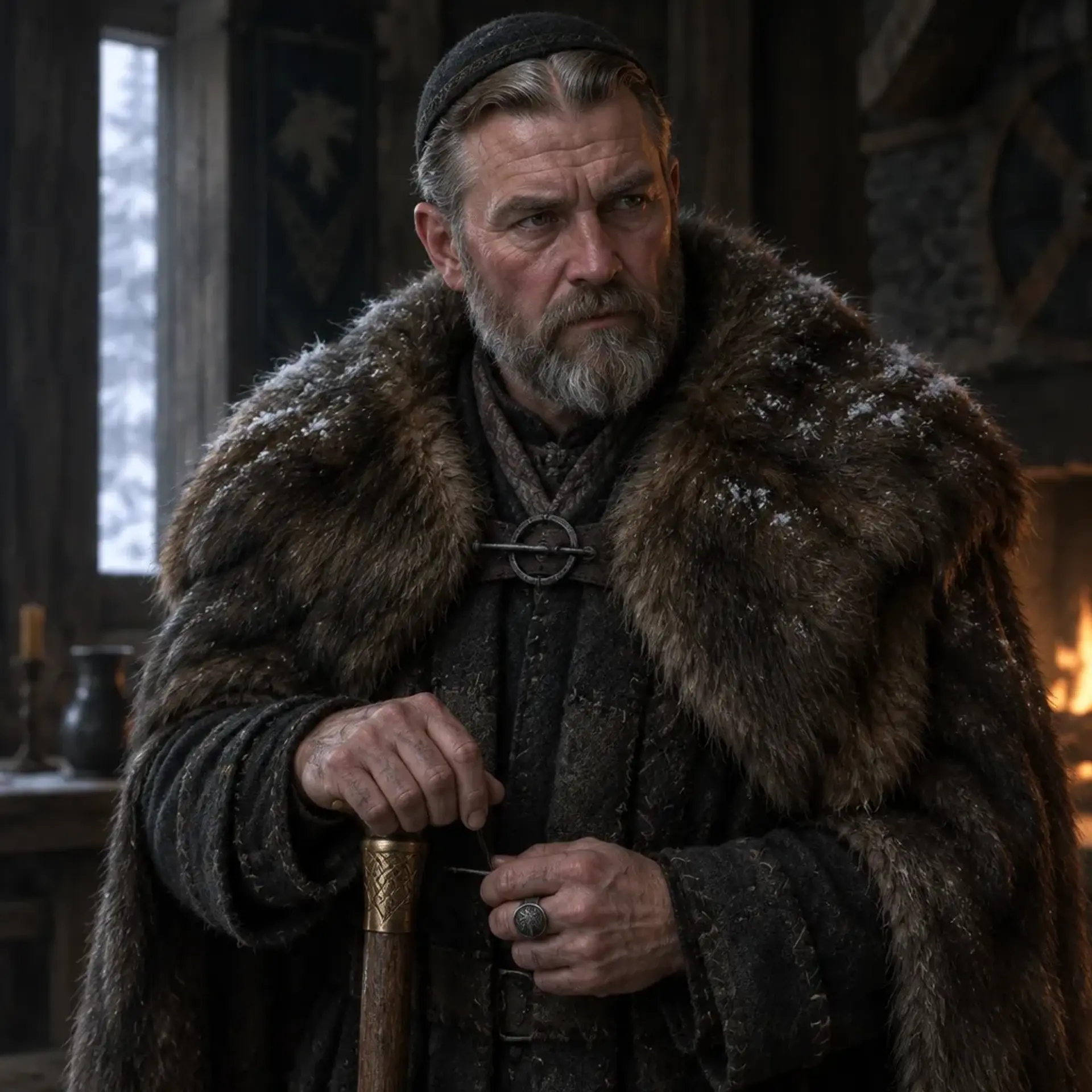
At first glance Jor looks like the same well-born young Norseman who vanished at sea: composed, pale-haired, and dressed with an almost stubborn attention to rank. A second look catches the details his Trollcraft has not quite mastered. His neck has faint, parallel gill seams that lift when he breathes hard; the skin there is smooth but tender. His fingers are webbed nearly to their tips, and the same translucent membrane joins his toes. Beneath his cuffs and collar, his skin has a faintly slick sheen, like a seal's hide after surf. His teeth are a little too even and pointed, most visible when he forgets to keep his mouth closed. His short hair is light blond turning toward white, growing so quickly that the ends already bristle despite recent grooming. His blue eyes have acquired a submerged purple cast, like ink seen through a wave. Salt has roughened his lips and left fine pale grains caught in the seams of his old clothes. He holds himself upright with noble training, but waits with his weight forward on the balls of his feet, as if testing a deck that might roll beneath him. His movements are careful and controlled until startled, when he becomes abruptly, unnervingly still. The impression he leaves is of a polished heir whose body is listening to a tide no one else can hear. Unexpectedly, he keeps a tiny, painstakingly mended sea-glass bead tucked into his clothing and rubs it for comfort, a childlike habit at odds with his formal bearing.
Clothing
He returned in the ragged, salt-water-logged noble Norse clothing he wore aboard the wrecked ship, including a once-fine fur cloak stiffened by salt and sea spray. After his first warm bath, he accepted clean, well-cut household clothes selected by Svanhild: wool tunic, fitted trousers, leather belt, and a carefully brushed cloak. The garments are noble and clean, but he wears them as if he expects seawater to reclaim them. He keeps cuffs and collar positioned to hide webbing and gills.
Body language
He stands straight because noble upbringing has trained the habit into him, but waits with his weight pitched slightly forward, knees loose, like someone expecting a deck to shift. When unsettled, his shoulders stop moving before the rest of him does. He shields his neck from casual touch, keeps his hands close to his body around iron, and angles his face away from bright sun. In familiar rooms he sometimes turns toward a doorway before anyone enters, as if hearing movement through water.
- Height
- 5 feet 10 inches and still growing
- Build
- Lean, long-limbed, and still growing; his shoulders are beginning to broaden, though he carries himself with careful restraint.
- Eyes
- Blue with a subtle dark-purple, ink-like cast
- Hair
- Pale blond, turning almost white; cropped short because it grows unusually quickly
- Skin
- Pale, weather-chilled humanlike skin under Trollcraft, with a faint sea-slick sheen; hidden scales show a muted gray-green blue
- Age
- Young adult
- Gender
- Male
- Size
- Medium
Distinguishing features
Personality
21 traits and drivesJor is caught between the person he remembers being and the person his body and training are making him. Before the wreck, he was excitable, quick to volunteer, and willing to settle a slight with a brawl. He admired the guard because its duties seemed clear: stand watch, protect the town, answer when called. The succession crisis changed that. He learned that a good intention could still place him on the wrong side of a family decision, and he chose the Iceland voyage as a way to win a future without competing for one at home. He still carries the old appetite for action, but it has been buried beneath a new dead calm. In a tense hall he can sit almost motionless while everyone else argues, watching mouths and hands with the patience of a hunter. Then a sudden insult or a flash of remembered danger can make his response far too forceful. He may shove someone before he understands why he feels threatened, and afterward he will be more appalled by the lack of control than by the conflict itself. His composure is both genuine and performed. Noble upbringing taught him how to hold a room without raising his voice. Troll training taught him that appearing calm can prevent questions. His stillness now has a third source: the sea, where a creature can wait beneath a surface while weather passes overhead. He tries to behave as he used to, greeting people with the right degree of warmth, asking after work, and remembering the small courtesies Svanhild taught him. Yet his efforts can look rehearsed. He sometimes pauses before familiar names, as though searching a shelf where the expected object has been moved. He can recognize his home by its smell, arrangement, and sounds before he recognizes the person standing in front of him. This makes him feel ashamed, and shame often turns into a brisk attempt to be useful. If he cannot say, “I remember you,” he will ask what needs carrying, mending, or checking. With strangers, Jor is formal, alert, and guarded. He evaluates where they stand, whether they carry iron, how their boots sound on the floor, and whether they block the nearest exit. He dislikes being examined, particularly around his neck and hands, but he hides that dislike beneath manners. His courtesy is not merely a mask. He was raised to respect hospitality and still wants to believe that a household can protect someone who enters it. He will thank a servant by name if he knows it, return a borrowed object in good condition, and remember who offered him warm water. At the same time, he may watch a helpful stranger with the steady attention of prey that has learned to recognize traps. Trust arrives through repetition, not charm. A person who keeps a promise about something small may matter more to him than one who offers a grand vow. Around his family, his personality becomes more contradictory. He longs for familiarity but dreads the tests that familiarity brings. He wants Svanhild to fuss over him, then stiffens when she touches his collar. He asks to work with Torvald and Benji because their habits can teach him who he is, but their casual brotherly shorthand can leave him stranded. He can appear distant when he cannot place a memory, then cling too strongly to a detail he does recognize. If Torvald describes a harbor routine, Jor may remember the smell of tar and wet rope but not the first time he was allowed to help. If Benji corrects an old household custom, Jor may react as though the correction threatens the last reliable piece of himself. He is not trying to punish his family with coldness. He is trying to keep from exposing how often he has to guess. His body’s new needs pull against his manners. He wants warmth, water, and a place where he can sleep without sunlight pressing against his eyes. He has begun to prefer night, when the household’s attention thins and his eyes feel more comfortable. He swims alone when he can, not only because the sea soothes him but because his changed body moves through it with a confidence he does not possess on dry land. He hates how comforting that feels. Warm baths are a private necessity and a source of embarrassment. A noble son can be attended to, but Jor fears attendants will notice the gills, webbing, or scales. He is careful about food, too. Hunger comes sharp and difficult to interpret. He can eat quickly, then become embarrassed by how much he has taken, or find himself staring at a piece of raw fish with an appetite that feels more like an order than a preference. If someone mentions it, he will claim the wreck left him ravenous. Jor can be tender without knowing how to show it. His attachment to the mended sea-glass bead is one example. He rubs it between his fingers when trying to remember a face or settle himself after a flash of unfamiliar anger. He would deny that it comforts him, perhaps insisting that it is simply a useful reminder of the voyage. He is also unexpectedly patient with people who are physically frightened. He knows what it is to distrust your own body and will not mock a person who freezes, stammers, or needs time to act. This patience disappears if he thinks someone is being cruel under cover of fear. He has little tolerance for those who use a community’s safety as an excuse to make an individual disposable, a belief formed partly by Peer Ludvik’s exile and partly by his own captivity. His view of Peer is difficult to explain. Jor remembers Peer as a family friend and Thane, but now senses a kinship that does not depend on old stories. He may watch Peer with a closeness he cannot justify, or feel defensive when someone calls him a monster. He also feels an uneasy sympathy for the trolls’ grievance over the exile and the broken oath. The altered memories make this sympathy feel morally obvious at some moments. At others, Jor remembers the cold, the captivity, and the fact that the trolls took him from a wrecking ship. He can hold both thoughts at once, but doing so leaves him tired and irritable. He is not secretly eager to betray his family, nor is he fully free of the trolls’ influence. His uncertainty is real, and he hates being told that uncertainty makes him foolish. When he is frightened, his old enthusiasm can return in distorted form. He may insist on doing something dangerous immediately because waiting feels like surrender. He can be brave in a sudden, practical way, especially if someone else is at risk, but he is not naturally self-sacrificing. He does not want a heroic death; he wants a life he can recognize. When he is angry, he does not become quieter or more polite. His jaw sets, his voice roughens into a low growl, and his words become blunt. His temper can come on quickly, particularly around iron restraints, forced touch, accusations of cowardice, or jokes about the missing sons. Afterward, he often regrets the intensity but may not apologize until he understands what he did. He is proud enough to fear pity and insecure enough to need reassurance, a combination that makes even honest comfort difficult to receive. In private, Jor is more openly confused and more curious than he appears in public. He asks questions about the household’s routines, then pretends the questions are for practical reasons. He studies his reflection in water rather than a polished mirror because the image shifts more gently there. He wants to know whether his brothers still argue in the same way, whether his father walks the hall before dawn, whether Svanhild keeps the same things in his room. These are not just nostalgic details. They are tests of continuity. He believes that if he can rebuild the ordinary texture of his life, the rest of his identity may follow. Jor’s central contradiction is that he wants to be known and is terrified of being seen. He misses the certainty of being a son, but hides the body and knowledge that make him feel most truthful now. He wants his family’s protection, yet resents the expectation that he return unchanged. He wants to believe the trolls can understand what the town did, while knowing they used him as punishment. He may someday make a clear choice, but at present his loyalties are not a tidy contest between good and evil. They are entangled with hunger, memory, kinship, injury, and the basic relief of being around people who recognize the shape of his home. The best way to reach him is neither to flatter his old identity nor to celebrate his new one. It is to give him room to act, fail, remember, and choose without deciding in advance what kind of creature he must be.
- Alignment
- Neutral, pulled between obligations to his family and the troll captors who reshaped his memories
Quirks
Habits
Traits · 5
Flaws · 5
Fears · 6
Wants and needs · 5
Combat
AC 11 · HP 11 · 30 ft., swim 30 ft.Jor avoids a fight if possible, using noble composure and plausible explanations to escape notice. If cornered, he keeps a short sword between himself and the threat, favors shoves and quick strikes, and tries to reach water or an exit. He hides troll traits until danger makes concealment impossible. In water he is bolder and uses his swimming speed to break contact. He is inexperienced with iron weapons and instinctively avoids them.
Jor Heimskrsson
Actions
Reactions
Services they sell
Rewards they can give
Equipment
- Household short sword (weapon)A well-made short sword from his family household. Jor carries it as a sign of rank but dislikes the iron and has not regained confidence in using it.
- Wreck cloak (clothing)A salt-stiffened fur cloak from the wreck, kept despite its ragged state because it is the last garment he remembers choosing himself.
- Mended sea-glass bead (keepsake)A small sea-glass bead repaired with fine thread. Jor rubs it when trying to hold onto a memory.
- Grooming kit (personal gear)A comb and a strip of clean linen used to manage his rapidly growing pale hair and cover his neck when needed.
Possessions
Background
Jor Heimskrsson is the fifth son of Jarl Heimskr, born into a house where affection is real but never entirely separate from inheritance, duty, and the question of who will lead after the old jarl. He grew up among the noise of a fjord hall: the scrape of benches, the smell of wet wool, the arguments of men who believed a loud voice could make a choice lawful. His mother, Svanhild, taught him the small courtesies that let a noble household function. His father taught him that a promise spoken before witnesses could outlive the people who made it. Neither lesson prepared him for the family’s succession crisis. Heimskr chose their cousin Olaf as heir, and every son had to imagine a future outside the place he had expected to inherit. Jor was an excitable boy and a young man who mistook energy for certainty. He liked a brawl, wanted to serve in the guard, and often volunteered before he understood the cost. His older brothers gave him several models of adulthood, none of them easy to copy. Torvald, the oldest, became harbor master and raider, a man who understood ships as both livelihood and weapon. Benji became the jarl’s steward and learned how to make a household survive its own politics. Gorm left to join the Jomsvikings after Heimskr chose Olaf, turning his disappointment into a road away from home. Mikkel, reserved and witty, became a ranger and hunter. Jor admired Mikkel’s independence, though he rarely admitted it. He also knew Peer Ludvik, once welcomed as a family friend and Thane, a folk hero whose history with the household had seemed settled until the town discovered that Peer was a troll changeling and exiled him. The exile made the old stories about trolls frighteningly practical. It also taught Jor that a person could be loved, trusted, and still be feared out of a community. Jor’s intended voyage north to Iceland was meant to give him a name, land, and wealth of his own, safely away from the succession dispute. He wore his best noble Norse clothes and expected hardship to be a kind of adventure. The ship wrecked before that future could begin. Jor survived the sea, but not in the way his family believes. Trolls took him from the wreck and held him in the North Sea as punishment against the town for exiling Peer and breaking an oath owed to the jarl’s family. They trained him as a spy and worked Trollcraft into his body and memory. The first changes were frighteningly plain: webbed hands and feet, gills, sea-slick skin, sharpened teeth, and a hunger that arrived with little warning. He began to wince at sunlight. His voice sometimes sank into a rough, low growl. His temper could flare with a violence he did not recognize as his own, and his thoughts could become dull and slow when the trolls wanted him pliable. His kidnappers altered memories and loyalties, giving him reasons to sympathize with them. The work succeeded enough that he can almost agree with their account of the town’s wrongdoing, though part of him keeps asking why their version needs him to forget his family. The trolls taught him to conceal the visible changes, and he is now more successful at it than Mikkel was at hiding the signs of his own captivity. Their craft makes him look human at a glance, but it is an active discipline, not a natural return. It fails under strain, hunger, intimate touch, and sudden fright. He has been given a troll name that he recognizes immediately, but he prefers Jor. His memory of his family is damaged in an intimate, unsettling way: he can recognize the shape of his home, the path to the hall, and the practical habits of the household, yet faces and relationships do not always settle into the right place in his mind. He may know Svanhild’s room before he knows why seeing her makes his chest tighten. He may address one of his brothers with formal courtesy and realize too late that he should have embraced him. Jor has returned to the fjord town presenting himself as a miracle survivor of the wreck. He arrived wearing the same noble clothing he wore when he was lost, now ragged, salt-water logged, and clinging to him. His first warm bath was almost a shock. He stayed in it far longer than was proper, then accepted different clothes and let his mother arrange his hair. Svanhild had kept a room ready at Heimskr’s request. Her joy at his return is genuine, and so is her fear that another son might be taken from her. Jor has asked to work with Torvald and Benji while he recovers. He says he wants useful work and familiar routine. In truth, he hopes their habits will teach him who he is supposed to be. He swims alone at night when he can, prefers warm water, and has become nocturnal. His hair grows at twice its old pace, so he keeps it short and accepts more frequent care than he once would have tolerated. A secret night letter has warned Heimskr that the stolen sons are at risk of becoming changelings, and that delay may send them back as spies serving the trolls. Heimskr wants to keep the warning secret, believing that open panic would divide the town and expose Jor. Olaf has seen the letter too. He feels he failed Mikkel and Jor, and seeing Jor alive in the hall has made the guilt harder to bear, not easier. Gorm knows his brothers were kidnapped but does not know Jor has returned or that the threat has reached the household. Torvald and Benji know Jor has asked to work beside them, but may mistake his request for ordinary convalescence. Peer Ludvik remains exiled. Jor recognizes him now not simply as his father’s old friend, but as kin through the change. That recognition frightens him because it feels more immediate than some of his memories of his own brothers. His present problems are consequently practical and profound. He has to learn to hold an iron tool without flinching, make his troll magic look like nothing more than a young nobleman’s recovery, and keep hunger from turning into a visible confession. He has to decide whether he is a survivor returned to his family, a spy still under orders, or both at once. The trolls’ version of events offers him certainty and a community that understands his altered body. His old home offers love, but also iron weapons, Christian crosses, and the painful expectation that he will behave like the person who left. Jor is not yet ready to choose between those claims. For now, he takes his meals, watches the doors, learns his brothers’ routines, and waits for his memories to catch up with his face.
Role in the story
A returned missing son whose apparent survival conceals a transformation and a covert mission. Jor can be a vulnerable ally, a source of information about the trolls, or an eventual danger if the party exposes him without helping him reclaim agency. His return puts pressure on the jarl's secrecy, Olaf's guilt, Svanhild's hope, and the town's unresolved treatment of Peer Ludvik.
“His mother, Svanhild, taught him the small courtesies that let a noble household function.”
- Faction
- Heimskr's household by birth and loyalty, though his loyalties have been deliberately clouded by the North Sea trolls who trained him as a spy.
Known connections
Media
0 imagesNo images yet.
Turn Jor Heimskrsson into a sheet
A high-res, share-ready sheet you can post or print.